Washington, D.C
Seized, subverted, shuttered: a year in Trump’s assault on the Kennedy Center


The Brentano String Quartet had finished their performance when a special guest dropped in backstage: the US supreme court justice Ruth Bader Ginsburg. “We thanked her for everything she had done for our country,” recalls violinist Mark Steinberg. “It was a nice moment.”
The year was 2016 and the place was the John F Kennedy Center for the Performing Arts in Washington. Fast forward a decade and old certainties have been shaken: Ginsburg is dead, Donald Trump is president and the Kennedy Center has become a case study in how a seemingly solid American institution can quickly unravel.
The Brentano String Quartet were due to perform there last week but cancelled their show, citing Trump’s hostile takeover of the complex. Steinberg explained: “I would have felt ashamed to walk out on stage there. I can’t quite bring myself to go into the building at this point.
“It would be such a luxury to make art in a vacuum and that’s what I yearn for but that’s not possible right now. Had we appeared there, in my eyes, that would be a way of condoning everything that’s happening and I couldn’t stomach that.”
As the US national capital Washington is first and foremost a politics town, forever in New York’s shadow as a hub of arts and culture. In a 1961 speech Kennedy observed: “Somebody once said that Washington was a city of northern charm and southern efficiency.”
But his predecessor, the Republican president Dwight Eisenhower, backed a bill from the Democratic-led Congress calling for a “national culture center”. It was later designated as a living memorial to Kennedy, a Democrat, after his assassination in 1963.
Construction began in 1965 and the centre formally opened in 1971 on the banks of the Potomac River with a premiere of Leonard Bernstein’s Mass. Over the decades it hosted a festival of Stephen Sondheim musicals, presented staged readings of all 10 plays in August Wilson’s American Century Cycle and staged Wagner’s Ring Cycle of operas. There was ballet, children’s theatre, comedy, contemporary dance, hip-hop, jazz, international festivals and educational programmes.
During Trump’s first term, he ignored the proudly non-partisan complex and did not attend the annual Kennedy Center Honors. But, as in so many other ways, his second term is very different. His takeover of the centre began, perhaps inevitably, with a Truth Social post one year ago, on 7 February 2025.
Trump wrote that he was immediately terminating “multiple individuals” from the center’s board of trustees “who do not share our vision for a Golden Age in Arts and Culture”. He said he would soon announce a new board, “with an amazing Chairman, DONALD J. TRUMP!”
He also criticised the centre’s past programming. “Just last year, the Kennedy Center featured Drag Shows specifically targeting our youth – THIS WILL STOP. The Kennedy Center is an American Jewel, and must reflect the brightest STARS on its stage from all across our Nation. For the Kennedy Center, THE BEST IS YET TO COME!”
The post sent shock waves through the Kennedy Center’s staff. One, who did not wish to be named, recalled: “There was a little bit of confusion at first because there was a Truth Social post about it and we as staff members weren’t sure what that meant. Then it became very clear within days what was going to happen.”
Trump claimed the centre’s finances were in a parlous state, a notion strongly rejected by its management. He fired the centre’s president, Deborah Rutter, and installed Ric Grenell, a former US ambassador to Germany with no prior experience in arts administration.
The ex-employee added: “Deborah, to her credit, once she was let go, gathered the entire staff and reminded us of how special the work that we did was and President Kennedy’s values, his ideals, and why that was important to our work.
“That stood in deep contrast to me with what happened after the takeover as in my entire time there post-takeover Grenell never once met with the entire staff. You could sense a depression within the building.”
In March the centre dissolved its social impact initiative, which had been created in 2020 to promote anti-racism and community outreach, affecting 10 staff. Speaking to the Guardian last year, Marc Bamuthi Joseph, who had been vice-president of social impact, said: “It wasn’t shocking but it was still seismic.
“We had probably known that this was going to come eventually and I would describe the atmosphere within the building for social impact in particular as morally untenable, so we were prepared. But even outside of that preparation, we thought that we would have an opportunity to create a transition plan.”
Joseph expressed sympathy for those left behind, under frequent attack from Trump for being too “woke”. He said: “It’s difficult to make the business of art happen when such a viable community of arts producers have been publicly chastised and vilified by the highest office in the world and so what’s left are people that are trying to do their jobs, how ever skilled, within that environment and that’s a hard thing to do.
“If the president of the United States declared war on soil, the folks at the Department of Agriculture would have a difficult time talking to farmers. In this case the president of the United States has said the soil is bad but I want you to grow something out of concrete.”
The 100ft-high complex – which features a concert hall, opera house and theatre, along with a lecture hall, meeting spaces and new extension – soon came to resemble a marble mausoleum. Artists ranging from the actor Issa Rae to the composer Philip Glass cancelled performances. When shows did go ahead, social media filled with photos of rows of empty seats as audiences voted with their feet.
Mark Rosenman, 82, a retired social activist academic, cancelled his subscription after three decades along with his membership. He explained: “It was clear what he was trying to do, which was to impose his taste and his vision and his unconstrained faith in his ability to know what was right in every case, including the smallest architectural detail. That can be described as nothing other than megalomania.”
Trump ploughed on regardless, inserting himself as the host of a Kennedy Center Honors ceremony that included the Rocky and Rambo actor Sylvester Stallone and Phantom of the Opera singer Michael Crawford, leading to a sharp drop in TV ratings. The new board suddenly announced that the building would be renamed the “Trump Kennedy Center” and, before Congress could object, Trump’s name had been added to the exterior wall.
Last month the 70-year-old Washington National Opera (WNO) announced it was leaving the centre, which had been its home since 1971, drawing luminaries such as Ginsburg and fellow justice Antonin Scalia. Next year it will perform at four different venues and mount a world premiere.
Timothy O’Leary, general director of the WNO, said via Zoom: “We were always, in recent history, producing in multiple different venues that all happened to be in the same building. Now we’re transforming ourselves into a company that produces in multiple different venues and we have a chance to be present for the whole Washington DC greater metropolitan area. That kind of resilience and ‘go on with the show mentality’ has defined us.”
On 29 January the Kennedy Center hosted the world premiere of Melania, a documentary about the first lady, with the Trumps in attendance. But three days later, Trump again used Truth Social to announce he is closing the facility for two years for a thorough renovation. “I have determined that the fastest way to bring The Trump Kennedy Center to the highest level of Success, Beauty, and Grandeur, is to cease Entertainment Operations for an approximately two year period of time,” he wrote.
The president later sought to offer reassurance that he would not be ripping the building down and estimated the construction work would cost “probably around $200m” but did not say where the funding would come from. Critics, however, suspected this was a fig leaf to avoid the embarrassment of diminishing shows and dwindling audiences.
In just a year, they said, Trump had sent one of America’s great cultural institutions into a death spiral.
That is a bitter pill for Bob McDonald, a singer and actor who first went to the Kennedy Center as a boy and has performed on nearly every stage there. He said: “I know every nook and cranny of that place. I don’t mean to sound overly dramatic but I consider the Kennedy Center to be a part of the family and it feels like I’ve lost somebody in my family.
“Having grown up here, it’s the one place where you could escape the politics. Why does this suddenly change when it’s worked for over 50 years? It’s one of the gems of Washington and I’m heartbroken at recent developments.”
It is also personal for Michael Kaiser, who preceded Rutter as president from 2001 to 2014. Ginsburg officiated at the nuptials of him and his husband at the Kennedy Center in 2013. But since Trump’s takeover, he has stayed away.
Kaiser said: “The Kennedy Center had always been a non-partisan institution. We didn’t talk politics. We didn’t evaluate performers based on their backgrounds or political beliefs and we were there to serve the nation and the region.
“It was upsetting to see different kinds of standards being applied, to see the place apply a philosophy, if you will, to fire board members, remove staff, and the result has been fairly predictable. Many people who cared about the Kennedy Center stopped caring and that’s not affordable for a not-for-profit cultural organisation.”
Trump’s decision to close the centre for two years could destroy support networks that took decades to assemble. Kaiser, a cultural consultant, added: “It’s very scary. I approach it as an arts manager and I know that cultural organisations in this country and abroad rely upon a family of people who care about them.
“They buy tickets, they give money, they generally support the organisation and I know that, when you close a venture for two years, much of that family wanders off and starts doing other things. Even if one day this all turns around, you don’t recreate that family of supporters overnight, particularly those who don’t live in the region.”
Similarly, there are fears that institutional knowledge and expertise will be lost. Charlotte Canning, a drama professor at the University of Texas at Austin, said: “Across the country, people in the biz respected the folks who worked there because that was how it should be done. So the question is, will they be able to restore that?
“That took decades to build. That wasn’t just overnight, the excellence of those people like who work backstage, who work in the offices, who work in the different scene shops, costume shops, prop shops, lighting shops. All those people are some of the best in the business. How do you rebuild that?”
Indeed, the Kennedy Center is now a symbol of how, after just a year in office, Trump has laid waste to institutions that seemed impregnable.
Canning reflected: “It’s always easy to destroy something. That can be done in seconds. It is very difficult to build something good that works, that serves, and the Kennedy Center is going to be a great case in point. It’s destroyed to serve vanity, maybe, but the vision, the expertise, the history – it feels to me like it’s gone.”

Our site’s security protections triggered a block. If you
think this was in error, email us at
[email protected]. Please include how you got to this webpage and the
Cloudflare Ray ID located at the bottom of the page.
Cloudflare Ray ID: a125c701ea927623
Back to The Atlantic

(NEWS FROM THE STATES) – Visitors from across the United States traveled to the National Mall Thursday for the opening day of the Great American State Fair, a days-long event that is part of President Donald Trump’s Freedom 250 celebration of the nation’s semiquincentennial.
States and territories showed off cultural and agricultural exports at exhibits stretching nearly a mile. Attendees snapped photos on the small Grand Ole Opry stage in the Tennessee booth, kids tried putt-putt at Indiana’s miniature golf course and cowboys rode horses at Montana’s rodeo.
A 110-foot Ferris wheel slowly turned at the center of the freshly manicured lawn, framing the Washington Monument and the U.S. Capitol in the distance on either side. Nearby stood a model of Trump’s controversial “triumphal arch.”
People collected swag from each state — drawstring bags from Ohio, stickers from South Dakota, snacks from Tennessee — and could receive a stamp on state fair passports.

The fair is part of the larger Freedom 250 programming and kicked off Wednesday night with a rally on the mall featuring a speech from the president that closely resembled his remarks along the 2024 presidential campaign trail. The festivities will continue over Independence Day, when Trump will deliver a second speech followed by what is promised to be an impressive fireworks display.
The president will visit North and South Dakota as part of his Freedom 250 tour for the opening of the Teddy Roosevelt presidential library and Independence Day eve fireworks above Mount Rushmore.

Freedom 250 then extends into August with a high school athletic competition in Washington, D.C., dubbed the “Patriot Games” and a Freedom 250 INDYCAR race around the National Mall.
The administration’s celebration is separate from the America250 commission, created by Congress a decade ago, and which has its own nationwide programming this year.
From Lake Erie to the Ohio River
Ohio Gov. Mike DeWine and first lady Fran DeWine greeted guests in Ohio’s pavilion. The couple posed for photos in front of a map of the Buckeye State.
“We wanted to see on the wall all the different things, from Lake Erie to the Ohio River, all the different fun things you can do in Ohio,” the Republican governor said, adding the state has local celebrations and initiatives planned for the 250th anniversary, including “Movies in Ohio” for community showings of films that feature the state.

Ohio’s first lady showcased a children’s literacy exhibit on the opposite wall and touted the roughly 427,000 participants in the state’s partnership with the Dolly Parton Imagination Library, a program that mails free children’s books monthly to households with kids under age 5.
“We’ve mailed out 27 million books. We know that a child’s brain is 80% developed by age 3, so we want to get them those books early,” she said.
Reflecting on America’s milestone birthday, the governor said, “We’re always a work in progress, Ohio’s a work in progress, this country is a work in progress.”
“I think you know the thing we need to keep in mind, all of us, is there’s some essential core principles that we all believe in. … We may disagree about different policies, but the core principles are the same,” he said.
Cartwheels on the lawn
People from various states walked from exhibit to exhibit, while stopped in the nation’s capital during road trip vacations.
Tanya Geders, 43, of St. Louis, Missouri, did a cartwheel in the mall lawn, trying to persuade her son to join in. The family stopped at the state fair on their way to Virginia Beach.
“We’re like, well, if we go to the ocean, we can go to D.C. and what a better time to be here than the 250th anniversary,” Geders said.

Robyn Toman, 71, of Severn, Maryland, escorted her 12-year-old grandson Miles to meet DeWine and grab a photo with the governor.
Toman said she remembers the country’s bicentennial.
“I was a kid about his age, and I came in 1976. I said, ‘We’re gonna go, let’s go down to D.C. for a couple days and see this,’” she said.
“We’ve enjoyed it. We went over to the archives yesterday, and saw the Constitution, and the Declaration of Independence, and the Bill of Rights. And, oh, that was so nice, that was fantastic.”
Not all states are there. A spokesperson for Washington state’s lieutenant governor’s office told States Newsroom the administration declined to join because of “the costs to the state associated with participating.”According to news reports, Connecticut, Massachusetts, North Carolina, Oregon, Pennsylvania, Rhode Island and Vermont did not contribute exhibits, though many are still represented by flags outside the individual booths.The state officials did not immediately respond to States Newsroom for confirmation.
All states that reportedly did not participate, with the exception of Vermont, are Democratic-led.
See a spelling or grammatical error in our story? Please click here to report it.
Do you have a photo or video of a breaking news story? Send it to us here with a brief description.
Copyright 2026 KOTA. All rights reserved.
Washington, D.C
DC reaches settlement with man detained while protesting troops with Darth Vader song

The District of Columbia has reached a settlement agreement for an undisclosed amount of money with a resident who claims police illegally detained him for following an Ohio National Guard patrol while playing Darth Vader’s theme song from “Star Wars” on his phone — an act of protest against the Trump administration’s federal law-enforcement surge in the nation’s capital.
A court filing late Thursday says the plaintiff, Sam O’Hara, will drop his lawsuit’s claims against the District and four Metropolitan Police Department officers within three business days of receiving the settlement payment. The filing doesn’t specify a dollar amount for the deal between the district and O’Hara, who is represented by the American Civil Liberties Union of the District of Columbia.
In an email on Friday, an ACLU spokesperson referred to the settlement’s financial terms as “a significant amount” that O’Hara “is pleased with” but said they aren’t disclosing the dollar figure to protect his privacy. A spokesperson for D.C. Attorney General Brian Schwalb’s office declined to comment on the settlement.
O’Hara’s agreement with the district doesn’t resolve his related claims against an Ohio National Guard member. Attorneys for the Guard member, Sgt. Devon Beck, have asked a judge to dismiss O’Hara’s claims against him.
“He was there because that was his assigned duty,” Beck’s lawyers wrote. “This was not an accidental encounter or a one-time disagreement on a public sidewalk.”
An earlier court filing, in February, said O’Hara had reached a settlement agreement “in principle” with the district. In response, a judge agreed to suspend the case while they negotiated terms.
O’Hara sued the district last October, claiming police officers violated his First Amendment rights to free speech and his Fourth Amendment rights against unreasonable seizures and excessive force.
The ominous orchestral music of “The Imperial March” from Star Wars movies was the soundtrack for O’Hara’s peaceful protests against President Donald Trump’s ongoing deployment of Guard members in Washington. Millions of TikTok users have viewed O’Hara’s videos of his interactions with troops, according to his lawsuit.
A series of major events tied to the nation’s 250th anniversary celebrations promise to bring big crowds and heightened security. On the News4 Rundown: That security is likely to include more National Guard troops as a new report says there’s a limit to their impact on safety in D.C.
O’Hara, an artist who works in the hospitality industry, says he didn’t interfere with the Guard troops during their Sept. 11, 2025, encounter on a public street. One of the troops summoned Metropolitan Police Department officers, who stopped O’Hara and kept him handcuffed for 15 to 20 minutes before releasing him without charges, according to the lawsuit.
“The law might have tolerated government conduct of this sort a long time ago in a galaxy far, far away. But in the here and now, the First Amendment bars government officials from shutting down peaceful protests,” the suit says.
Trump, a Republican, issued an executive order declaring a crime emergency in Washington last August. Within weeks, hundreds of Guard troops and federal agents were helping police patrol the city. The surge inflamed tensions with residents of the heavily Democratic district. Hundreds of Guard members remain deployed in the district nearly a year later, with no clear end in sight.
-

 Movie Reviews2 minutes ago
‘House of Criticism’ Review: A Pensive and Touching Portrait of Married Art Critics Jerry Saltz and Roberta Smith (It Is Only, at Moments, a True-Life Christopher Guest Movie)
-

 World14 minutes ago
Annecy Colombian Short ‘Once in a Body’: Fiction Rooted in Real Experiences
-

 Health37 minutes ago
This Protein Smoothie Trick Helps Women Over 40 Lose Twice as Much Fat
-
 Lifestyle52 minutes ago
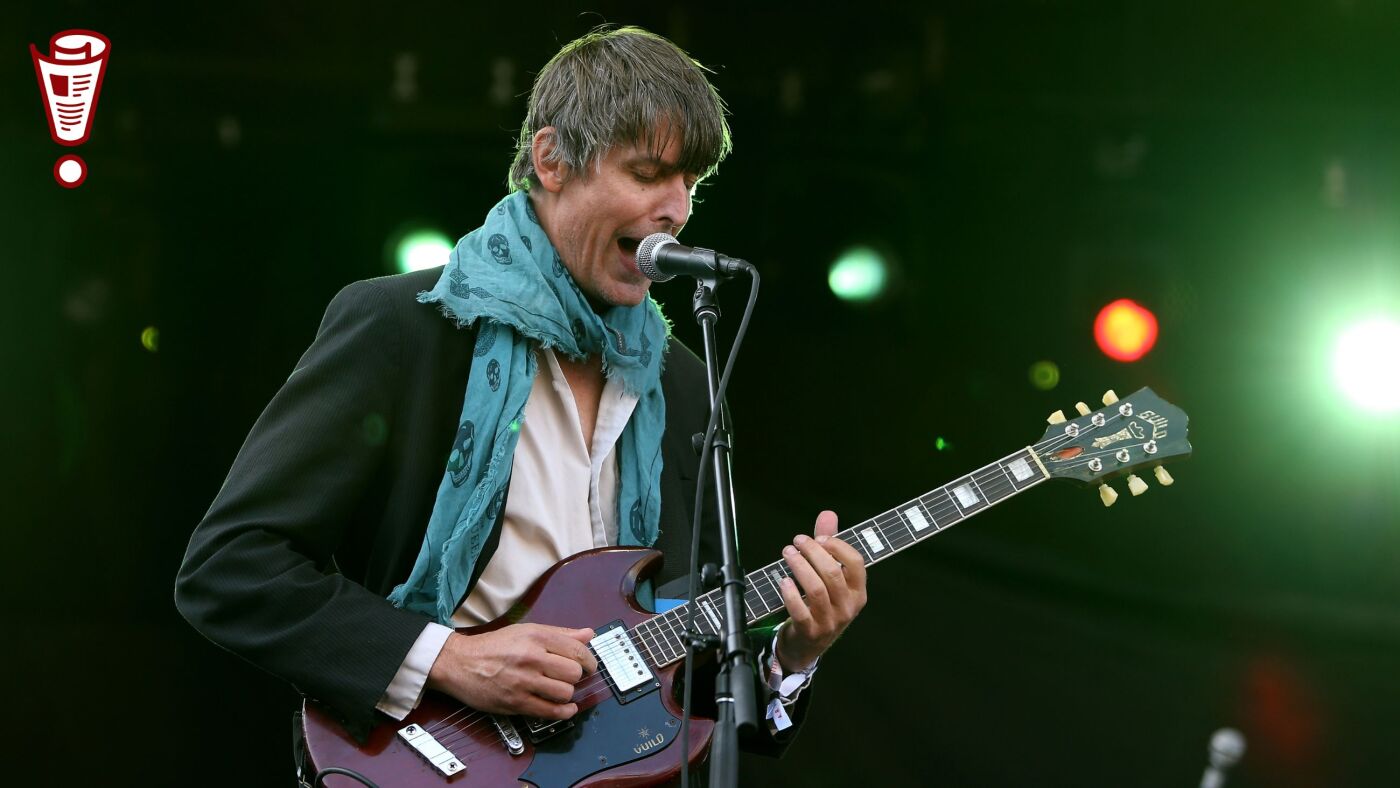
‘Wait Wait’ for June 27, 2026: With Not My Job guest Stephen Malkmus
-

 Technology1 hour ago
Margaret Atwood says the problem with AI is ‘garbage in, garbage out’
-

 World1 hour ago
Gulf countries strongly condemn Iran’s drone attack on Bahrain as rising tensions threaten MOU
-

 Politics1 hour ago
Jeffries welcomes Democratic Socialists into the fold as critics warn party is revealing ‘exactly who it is’
-

 Health1 hour ago
These leafy greens could help protect your lungs, study suggests

