Earlier in the week, we said the odds favored more rain than snow for a storm expected in the D.C. region this weekend. That remains the case, with most areas probably only seeing a little snow and sleet Saturday morning before changing to mostly rain in the afternoon. While some slick spots are possible, the snow should have limited impact on roads because temperatures will be at or above freezing, except far north and west of the District where heavier snow and icy travel is possible.
Washington, D.C
Saturday storm could briefly bring snow to D.C. area before flip to rain


There’s a decent chance that Washington’s streak of 717 days and Baltimore’s streak of 705 days since recording at least one inch of snow in a calendar day continues, based on statistics compiled by Capital Weather Gang’s Ian Livingston. Dulles International Airport has a chance to end its streak of 662 days since last seeing an inch of snow, but even that’s not a sure bet.
The rain could be heavy at times Saturday afternoon into the evening. Total liquid precipitation (combination of rain and melted snow) could reach near or over one inch, helping January get off to a wet start after one of the region’s wettest Decembers on record, and with another heavy rainstorm possible next week.
8 to 11 a.m.: Precipitation should arrive from southwest to northeast, starting as snow and sleet north and west of downtown Washington, and a mix of rain, sleet and snow downtown and to the south and east. In Southern Maryland, precipitation will be mainly rain. Temperatures: Low to mid-30s.
11 a.m. to 4 p.m.: Snow and sleet should change to mostly rain from southeast to northwest, except far northwest areas (western Loudoun and Frederick counties), where sleet and freezing rain could linger. Temperatures: Low to mid-30s.
4 to 9 p.m.: Rain expected, moderate to heavy at times. There’s a possible wintry mix for the far northwest areas. Temperatures: Mid-to upper 30s (low 30s far northwest).
9 p.m. to 1 a.m. Sunday: Rain should taper from southwest to northeast. Some wintry mix could linger in far northwest areas. Temperatures: Mid- to upper 30s (low 30s far northwest).
D.C., Alexandria and Arlington, Prince George’s, Anne Arundel, Charles, Stafford counties: A little snow and sleet is possible starting midmorning or so, then mostly rain after 1 p.m. Roads should mainly be just wet.
Montgomery, Fairfax, Prince William, Fauquier, Howard counties: Snow and sleet is expected to start around midmorning and may cause some slick spots, especially on untreated roads in northern and western sections. It should turn to mostly rain after 3 p.m.
Frederick, Loudoun, Carroll counties: Snow and sleet are expected to start mid- to late morning and could cause some slick spots. Some roads, especially untreated ones, could become slick. It should turn to mostly rain after 5 p.m., but a wintry mix and some icy spots could linger into early Sunday morning, especially in far northwest areas.
Calvert, King George, St. Mary’s counties: Mostly or all rain in the forecast.
This storm just won’t be strong enough and temperatures not cold enough to produce significant snowfall in the D.C. area. While temperatures should dip to Friday night lows in the mid-20s to near 30, they should quickly rebound to near or above freezing before precipitation arrives mid- to late Saturday morning.
If the storm were stronger, it could generate heavier precipitation that would help to cool temperatures back down to near or below freezing, increasing the potential for more significant snow accumulation. The storm is predicted to intensify as it heads to the north, potentially dumping several inches of snow just north and west of Interstate 95 from New York City to Boston.
“If you are a snow lover, this not the storm for you, as surface temperatures near to above freezing and a flow of warmer air from the south at about 5,000 feet in altitude will keep the precipitation mostly rain east of D.C., and likely cause the snow west of the city to change to rain,” said Wes Junker, Capital Weather Gang’s winter weather expert. “That should limit snowfall accumulations to at most an inch or two in the north and west suburbs.”
Jason Samenow contributed to this report.

Washington, D.C
Metro, DC leaders lay out more details on transit at new Commanders stadium – WTOP News

D.C. officials expressed an urgency Wednesday to begin preparing transit infrastructure for the opening in 2030 of the new Washington Commanders stadium on the old RFK Stadium campus.
D.C. officials expressed an urgency Wednesday to begin preparing transit infrastructure for the opening in 2030 of the new Washington Commanders stadium on the old RFK Stadium campus.
The work will impact far more than the single, cramped Metro station nearby.
During a roundtable discussion with District leaders, Metro General Manager and CEO Randy Clarke laid out the need for improvements to the existing Stadium-Armory Metro stop, and touted a new rapid bus transit line with dedicated lanes.
In tandem, those will be key to getting tens of thousands of people to events at the coming stadium, Clarke said.
“I absolutely believe the first couple of experiences that people have going to a Commanders game, going to some of the first big events, is going to dictate how people feel about taking transit,” D.C. Council member Charles Allen, who chairs the committee that oversees transportation projects, said. “So, we don’t have an option to get it wrong. We have to get it right.”
That’s why Clarke and other District leaders agreed that reaching a memorandum of understanding that lays out the roles, responsibilities and financials of these projects by July 23, the next Metro board meeting, is crucial.
“I think we’re all working towards that, and pretty optimistic,” Clarke said. “Then we’ve got to work really hard on design, we’ve got to work really hard on procurement, we’ve got to work really hard on construction.”
Clarke said the stadium’s ability to attract blockbuster events will depend on the transit agency and its ability to move people in and out of the complex.
“We’re not going to try to get, hosting the Super Bowl, we’re not going to try to host women’s World Cup, we’re not trying to get Taylor Swift and Beyoncé back here. I mean, at the end of the day, Metro is going to be the key to the success. We understand the pressure on us,” he said.
For the Stadium-Armory station, that means renovating the mezzanine and adding elevators to handle the increased demand. Clarke also talked about new street-level infrastructure to help manage the flow inside the station.
“So it’s very Disney-esque, where people feel like they’re constantly moving without actually going too far, if you know what I mean,” Clarke said. “Then we filter them where we need to go. That is a good example of what we need to do at the surface.”
But Metro won’t rely entirely on its trains. The roundtable also discussed what’s been dubbed the Gold Line, which would run buses from Union Station to the stadium.
Construction estimates for bus line are in the $75 million range, District Department of Transportation Director Sharon Kershbaum said
The Gold Line is to run through the heart of the H Street corridor, and transportation leaders said the impact will be everything the streetcar was supposed to be.
“This is now going to be the east-west corridor that we never were able to accomplish on the streetcar,” Kershbaum said.
“This is going to have frictionless service, because it will be center-running. So all of the issues — when a car double-parked and it stopped streetcar service — all of those things, we’ll be immune from. We are going to see the transportation service that was really never ever reached by streetcar achieved with this,” she said.
The vision for the Gold Line goes beyond the handful of weekends when NFL football is played at the stadium, and beyond initial Union Station-stadium route. Transportation officials see the buses eventually traveling between the Benning Road Metro Station and Rosslyn, Virginia.
“We want the Gold Line to solve the cross-town problem we’ve had in this community for a long, long time,” Clarke said.
That means providing access to the convention center and also solving the gridlock that fills up K Street NW every day. Clarke said coming up with dedicated lanes on K Street would actually be the most pivotal part of this new transit line.
“The downtown core of D.C. does not move, especially during p.m. rush hour,” Clarke said. “If you want people in Benning Road that may work, say on K Street, to have better transportation, solving K Street is equally as important, if not more important, because of time savings and reliability.”
Officials did not specify a timeline for the full expansion, but it would not be completed by 2030.
Where it does run, Gold Line buses would travel in the middle lanes, to avoid what caused problems for the Streetcar, which could grind to a halt when cars would double park. Building out the Gold Line would mean more changes to the way cars move along H Street in Northeast.
“You can’t do what you want to do and also keep all the parking,” At-Large Council member Christina Henderson said.
“There’s intersections where we’re going to have to take turns away at certain intersections, maybe parking in certain places,” Clarke said. “In other places parking could be kept, because we’re looking at putting platforms.”
Stadium-related transit construction will run far beyond H Street and the Stadium Armory stop.
“We do want to minimize outages, but there’s going to be significant outages to do this project,” Clarke said.
“It’s all about where we can turn trains around and how to manage that,” he added. “So if we do an outage to Stadium Armory, what that really means is we’re impacting customers from New Carrollton and Largo all the way through the system, and some people that are west of the system that want to go east of Stadium Armory won’t be able to.”
But with the project not even really in the design phase yet, it’s hard to plan out how and when those impacts will happen.
“We’ll be doing obviously overnight work,” Clarke said. “We’ll probably do some, what we call, early outs. Sometimes we’ll start at 10 o’clock at night. We might be able to do some single tracking on certain types of work. Other work is going to be complete shutdowns.”
“And the question is, is that going to be X amount of weekends or is it going to be like a two-, three-, four-week block at a time,” he added. “We’ve got to work through all of that.”
Get breaking news and daily headlines delivered to your email inbox by signing up here.
© 2026 WTOP. All Rights Reserved. This website is not intended for users located within the European Economic Area.

WASHINGTON, D.C. — Ohioans are among the visitors traveling to the nation’s capital this week for the Great American State Fair, part of the country’s 250th birthday celebration.
On Wednesday, visitors trickled into the Ohio state pavilion booth, which includes a map of Ohio’s most iconic places and an exhibit on several children’s initiatives championed by Gov. Mike DeWine, First Lady Fran DeWine and Lt. Gov. Jim Tressel.
“I wanted to come here, we wanted to see the sights here. We figured once in a lifetime,” said Carolyn Golamb of Fremont, who was visiting Washington, D.C. with her husband, Mark.
The fair has been a source of controversy after multiple musicians scheduled to perform at a kickoff concert withdrew, citing political concerns.
The event was organized by Freedom 250, a White House-backed group that has been accused of usurping the government’s official America250 commission, created by Congress 10 years ago for the same purpose. In addition, many elements of the fair have pushed a partisan message, such as President Donald Trump’s campaign-style rally on June 25 and events like “MAHA Mondays.”
Amid the controversy, attendance at the fair has been sparse.
Rep. Dave Taylor, R-Ohio, attributed the light turnout not to politics, but to forecasts of triple-digit heat this week.
“The weather is going to hold numbers down a little bit,” he said. “There’s a lot of walking to go from one place to another here, and people are here visiting with little kids. I think you’re going to see the numbers pick up as we get closer to Saturday for sure.”
Several visitors from Ohio said they did not notice any partisanship at the fair.
“That is the reason why I’m here, is because all of us have made a big positive contribution to what makes America great. And it’s not just one group or one party or anything. It’s all of us together,” said Toledo native Cassandra Newsome.
“It’s the 250th anniversary. No matter who was in power at the time, I still would be here,” said Mark Golamb.
The fair runs June 25 to July 10 on the National Mall.

The U.S. celebrates 250 years since signing the Declaration of Independence July 4. D.C. will be packed with America250 events and celebrations.
This summer many of D.C.’s top museums are showing new exhibits that explore American history. There’s an activity for everyone to enjoy this summer, from a new view of the Lincoln Memorial to new exhibits at the Smithsonian Air and Space Museum.
Most Smithsonian museums are open daily, including on July 4, from 10 a.m. to 5:30 p.m.
Photo by Smithsonian Institution
Air and Space Museum
The Air and Space Museum is nearing the end of the multi-year renovations that began in 2018 just in time for America 250. On July 1 the museum unveils five new exhibits:
If you’re interested in learning more about the history behind space technology and how the U.S. has used air and space tech in the past, you should check out RTX Living in the Space Age Hall and the Jay I. Kislak World War II In The Air exhibits.
If interactive exhibits are more your speed, the TEXTRON How Things Fly exhibit will feature nearly 50 interactive works. The Flight and the Arts Center is a great choice for art and space lovers alike, and the U.S National Science Foundation Discovering Our Universe explores the tools that move what we know on space forward.
Admission is free, but you must get a timed ticket.
Smithsonian Castle: American Aspirations Exhibition
Although “the pursuit of happiness” is among the most well-known cornerstones of the Declaration of Independence, this exhibit at the Smithsonian Castle challenges viewers to consider the other ideals America aspires to, including liberty, new horizons, fairness, democracy and hope. Through a collection of some of America’s most notable objects, from Harriet Tubman’s Hymnal to Thomas Edison’s lightbulb, the exhibit explores how America has sought to live up to its ideals through its history.
This exhibit will be open through Sept. 7 before the castle again closes for renovations. Admission is free.
Lincoln Memorial Undercroft

Images courtesy of the National Park Service
What better way to celebrate America 250 than to explore the hidden foundations of one of its most iconic monuments? The Lincoln Memorial’s undercroft opened June 25, featuring 15,000 sq feet of structural framework and exhibits that trace the history of President Lincoln and the memorial. Viewers can learn about the construction of the building, its place in American history and its impact in the civil rights movement as they walk through the caverns of concrete columns.
It’s free to visit, but every visitor age 2 and up needs a timed-entry ticket. You can reserve tickets in advance on recreation.gov or by calling 877‑444‑6777. Note, there’s a $1 service fee for every reservation. You can also pick up same-day tickets on the National Mall.
The Undercroft exhibit will be closed on July 4, but open the rest of the holiday weekend.
Arts and Industries Building: Voices and Votes
The Arts and Industries Building houses an exhibit based off an exhibition currently on display at the Smithsonian’s National Museum of American History. This new exhibit explores American democracy and asks visitors to engage in deeper questions about what democracy in America means. It includes photos, videos, items and interactive displays. Admission is free.
MLK Library: District Vibes/American Pride: How DC Changed American Culture
If you’re looking for a D.C. twist to America 250, look no further than D.C. Public Libraries! With art, artifacts and programming throughout the summer, the Martin Luther King Jr. Memorial Library will show how D.C. and American history are intertwined. Admission is free.
Other DCPL libraries will offer events on this theme and other America 250 events, too.
D.C. libraries will be closed on July 3 and 4.
Building Museum: THE PLAYGROUND

Daybreaker FUN HOUSE at the National Building Museum (Joy Asico/Asico Photo)
The National Building Museum’s historic Great Hall will see a fun-filled transformation this summer as they collaborate with New York-based design firm, Snarkitecture, for the third time. This collab will transform the Great Hall into an interactive playground. The playground aims to show America’s story through relationships and memories made by community.
“The Playground” brings outdoor activities indoors, giving museumgoers the rare opportunity to be a part of the art. The exhibit will open July 3 and run through Aug. 30. The events schedule includes evening hours for adults to enjoy, and special activities for kids.
To visit The Playground, book museum admission between 10:30 a.m. and 3:30 p.m. Tickets cost $15.95-$18.95 (infants under 2 can visit for free).
National Gallery of Art: Dear America
The National Gallery of Art’s latest exhibit is a love letter to America, exploring what it means to be an American through 100 different works. The multimedia exhibit features drawings, photographs and prints in which artists asked, “What does it mean to be American?” It includes works by Roy Lichtenstein, Carrie Mae Weems and Tonita Peña. Admission is free, and the museum is set to be open on July 4.
National Museum of Women in the Arts: Celebrate Women Artists Throughout America 250
The National Museum of Women in the Arts is celebrating women who shaped American history and art.
Exhibits include “Ms. Americana,” which features 10 paintings from American women artists. They also will feature an exhibit on Pueblo pottery from the North American Southwest called “Burnished: Pueblo Pottery at NMWA” and another on quilts in the Second Great Migration called “Routed West: Twentieth Century African American Quilts in California.”
Tickets are $16 for adults or $13 for D.C. residents and those 65+. People under 21, visitors with disabilities and SNAP/EBY holders can go for free. There are also free community days, including on Sunday, July 5. Make sure to book those tickets in advance.
From These Lands: Sharing Our Natural and Cultural Heritage
This summer, the National Museum of Natural History unveils its new exhibit focused on connections between people, places and the natural world. The exhibit will feature items from all 50 states, D.C. and the five inhabited U.S. territories. This exhibit opens on June 18, but patrons can visit until 2029. Admission is free.
American History Museum: In Pursuit
The National Museum of American History is displaying a new exhibit, highlighting 250 items spanning from the 1700s to the present day that reflect the ideals of the Declaration of Independence. The exhibit is on all three floors of the museum with pieces that aim to highlight how Americans have pursued the promise signed in 1776. The exhibit will last until the end of the year. Admission is free.
Subscribe to The Weekend Scene, our free newsletter about events, experiences and adventures for you and for your family around the DMV.
-
 Entertainment3 minutes ago
When, unlike our upcoming 250th anniversary, a bicentennial mattered to orchestras
-
 Lifestyle9 minutes ago
DLTA’s former Ace Hotel is reborn as a ‘creative hub’ — and yes, you can still sleep there
-
 Politics12 minutes ago
Trump wants to show off D.C. for the Fourth. His construction is in the way
-
 Science18 minutes ago
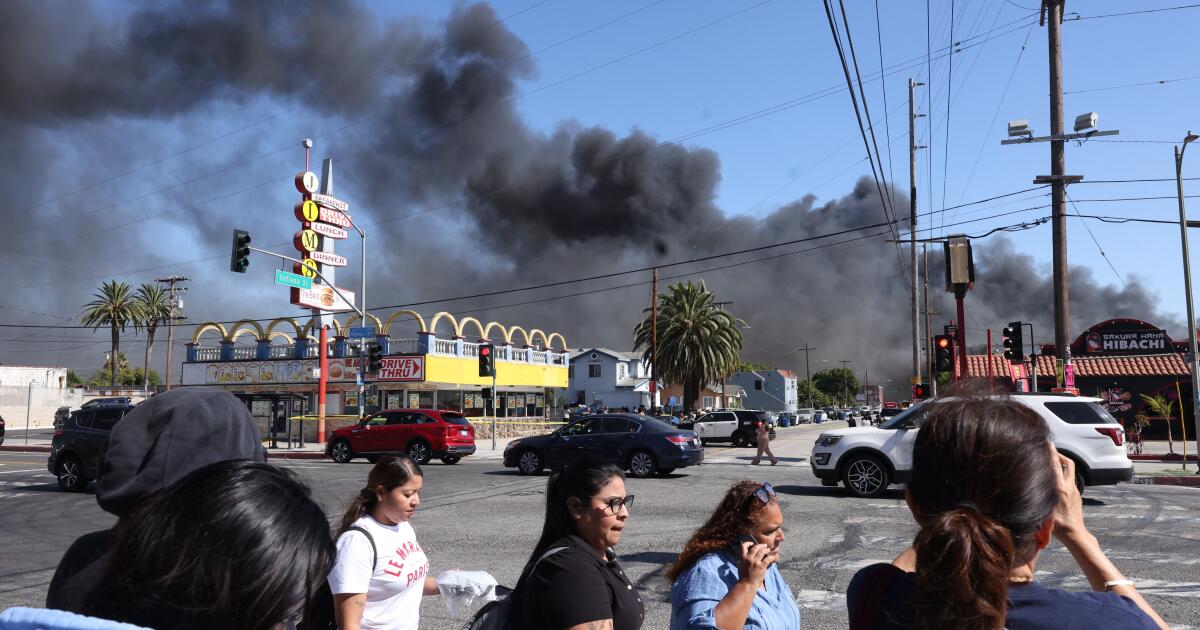
Boyle Heights blaze choked L.A. with astronomical soot pollution
-
 Sports25 minutes ago
Lakers announce summer league schedule, roster
-
World33 minutes ago
How the Entry-Exit System is becoming a nightmare for Europe's summer travellers
-

 News58 minutes ago
Newsom’s office responds to SCOTUS ruling on women’s sports as California faces ongoing trans athlete wave
-

 Los Angeles, Ca2 hours ago
Family of boy, 8, killed by falling tree branch at Calabasas park to get $14.6M

