When people ask me how I hear about restaurants, I tell them some of my informants are publicists, chefs and restaurateurs. Only a lazy critic would rely exclusively on a group with vested interests, though, so I take pride in walking or driving around neighborhoods where I find myself eating to poke around for additional review prospects.
Washington, D.C
Review | Tom Sietsema’s 5 favorite places to eat in February


A line leading out of a little storefront at high noon or a busy parking lot might find me joining the ranks. If I smell something enticing coming out of a mom and pop, my tendency is to investigate the source of the aromas. Whenever I’m out of town and I’ve had a good meal, I ask the staff where else I should eat before I leave — never “What’s best?,” which too often lands you someplace fancy, but often, “Where do you dine on your off hours during the week?,” which feels more personal.
Other times when people ask me where I get my tips, I respond by pointing at them: Readers and others are among my best sources. Thanks to my discerning friend Todd, I discovered a Japanese oasis above a Thai retreat in Washington. Another reader was worried that a rave of a vegetarian Vietnamese restaurant in Northern Virginia might bring in crowds, but he thought I needed to know about the newcomer anyway. And a proud mentor of a rising star in the exurbs let me know the young chef was ready for prime time at a restaurant of his own.
My point is, the majority of this month’s favorite places to eat are suggestions from readers, whom I’d like to thank for looking out for their fellow diners. It takes a village.
Bangkok native Jenistar Ruksirisopha says she’s been a Japan fan since she first visited the country as a 10-year-old. “To be honest, if I could only eat one food for the rest of my life,” it would be Japanese, says the owner of the second-story restaurant whose name combines the Japanese word for treasure with its location on 14th St.
As she prepared to open two and a half years ago, however, her mother’s warning nagged her: As a Thai native, “no one’s going to believe you,” the budding restaurateur recalls being told. The daughter’s response was to hire a chef from what she considers the No. 1 Japanese draw in D.C., the sublime Sushi Nakazawa behind the Waldorf Astoria hotel.
Visit Takara 14 — and you should — and you’ll spot Johnny Yi behind a slim sushi counter. Like his employer, he’s not Japanese. The Maryland native’s parents are from Korea. Does it matter? Like the owner, he’s ever present in a restaurant I’m always happy to find myself in, which is precisely how Ruksirisopha wants customers to feel after they climb the steep stairs to the 30-seat dining room.
“Forget about being serious,” she says. The design helps. Cheery pink blossoms frame the front picture window and canary-yellow banquettes run along the sides of the walls, hung with illuminated branches. The setting is a fetching backdrop to a surprisingly long a la carte menu whose small-plate highlights include juicy pork belly and kabocha squash gyoza and tuna tartare — red with gochujang and fruity with apple — scooped up with nubby tempura seaweed chips. Did I mention the $5 beers, $7 drinks and $21 bottles of house wine at happy hour? Or the fact a server insisted on running to a neighboring restaurant to fetch mezcal after a customer requested a mezcal negroni? No wonder so many customers treat the space as a date night.
The food romances us, too, especially the well-priced omakase, or “chef’s choice.” A recent parade of dishes delivered one hit after another. One moment, we’re spooning into tofu whipped with radish, dashi and sake, a creamy base for blow-torched salmon glistening with orange roe. The next, we are scarfing folds of dewy hamachi wrapped around thread-thin fried potatoes, the soft and the crunch tied together with a hint of truffle oil. There are housemade pickles to escort wispy, panko-crusted pork tucked in its bowl with curry-kissed carrots and potatoes, distinctive sushi, and steaming red snapper broth to revive yourself at the end of six or so courses for $75 a diner.
The owner says she argues with the chef about some dishes. Yi prefers simplicity. She likes a little extra flourish. I’m only privy to what comes to the table: some of the most enthralling food of several seasons, and this amid a boom in Japanese restaurants in Washington.
Within the next three months, Ruksirisopha plans to open an eight-seat room upstairs just for omakase. Otherwise, she says, “we want to keep it intimate.”
I like the way she thinks, and I love the way Yi cooks.
1326 14th St. NW. 202-507-8973. takara14st.com. A la carte entrees, $24 to $46 (for A5 Wagyu beef).
Quick, what do the “clam” dip, shaky “beef” and spicy noodle soup at this young restaurant in Northern Virginia have in common?
They’re all vegetarian versions of familiar Vietnamese dishes, and they’re all impressive. That dip, flanked with rice crackers for scooping, is bright with lime and pungent with vegetarian fish sauce. The convincing stand-in for meat turns out to be nuggets of soy protein flavored with sesame oil and pineapple soy sauce. And the steaming Hue-style soup — red with annatto and tingling with lemongrass — is a throwback to when chef Lan Tran ran a pho restaurant in her native Vietnam.
Tran’s partner in the restaurant and in life is Thi Le. He’s the guy you see hopping from table to table in the always-busy dining room, joking with customers and pointing out hits on the menu, like “Heavenly” rice, which the co-owner describes with a big smile and you greedily devour once you taste the fluffy, grease-free grains scattered with fresh cilantro and dry tofu floss that look like wood shavings.
The food comes out as if you’re eating in a chain (fast), but the setting is personal. A small burbling fountain welcomes you at the entrance, and outsize lotus flowers draw eyes to the painted walls. Style is a side dish at Chay.
6351 Columbia Pike, Falls Church. 571-378-1771. chayrestaurant.com. Entrees, $15 to $48 (for shareable hot pot).
Some of the region’s most beloved dining destinations are found in small towns in Virginia. Think the Inn at Little Washington, the Restaurant at Patowmack Farm in Lovettsville and, since fall, Alias in Warrenton, an hour outside the District. The 30-seat newcomer is modeled after the intimate Three Blacksmiths in tiny Sperryville, which is where chef Stephen Burke worked with his wife, Kelly, before the couple opened a place of their own. Like Three Blacksmiths, Alias serves a tasting menu.
Like the Sperryville attraction, the Warrenton restaurant also embraces a couple hours of sublime entertainment, starting with snacks whose plates are as fetching as what they carry. Hope for sparkling ceviche in a fluted pastry shell on a scalloped gold plate, my first taste of a recent winter evening. Thoughtfully, Alias offers a vegetarian option along with its regular five-course menu. The best strategy is to order both and pass plates. Because the truffle-showered sliced roast chicken has an equal in housemade ravioli stuffed with pureed carrots lit with aji amarillo. Bread — a cross between French brioche and Japanese milk bread — gets it’s own course here, and the hot rolls are divine sops for the chef’s fine sauces.
My memories might not be yours; the menu, which incorporates ingredients from local farms and gardens, changes every few weeks. What I had this winter makes me hopeful for a return engagement in spring.
No disrespect to the pastry chef, the talent behind the lovely bonbons and edible parting gifts, but the sweetest thing here is the Burkes’ toddler, Atticus, who plays or naps behind the kitchen door and whose dad might trot him out at the end of service. Alias is a family affair, and an engaging one at that.
7150 Farm Station Rd., Warrenton, Va. 540-422-0340. aliasvinthill.com. Tasting menu $145 to $165 (at chef’s counter).
What to order? A newbie could refer to the window, covered with photos of dishes, or the wall near the entrance, plastered with rave reviews. I’m inclined to check out what my Chinese neighbors are eating as I make my way to a table in this busy storefront in the shadow of the University of Maryland.
Noodles, definitely something with noodles, are in my future. Steaming knife-cut noodles, cooked to retain some bite, coil beneath a cover of crumbled pork, shot through with garlic and black vinegar, everything cooled with torn romaine lettuce. The kitchen, under the watch of chef-owner Hua Wang, makes its own liang pi, wheat-flour noodles. I wouldn’t think of leaving without a “burger,” or rou jia mo, either. The chewy bread is baked in-house, twice a day, and makes a great companion to a filling of crumbled lamb, warm with cumin, sweet with onion and hopping with jalapeños. Then there are dumplings to consider. Make mine pork dumplings draped with a creamy blanket of sesame seeds and lit with chile oil.
The owner is from Shenyang, the capital of Liaoning Province in China, where she ran a noodle restaurant before coming to the United States in 2007. Wang says she opened Northwest Chinese Food in 2015 as a way to introduce people to the food she ate and loved growing up in a part of China known for its bold flavors and Korean influences. Indeed, there’s housemade kimchi in the restaurant’s little market within the dining room, which also sells Chinese candy and snacks and three kinds of Wang’s chile oil.
I’m reminded this is a student hangout when the college kid waiting on a table of his cost-conscious peers asks whether they’re ready for their check: “Together or separate?” I’m also reminded not to go solo on my next visit. Wang’s food begs to be shared.
7313 Baltimore Ave., College Park. 240-714-4473. northwestchinesefood.com. Small plates, $7.50 to $12.50; noodle dishes, $10.50 to $19.50.
December saw chef Enrique Limardo’s splashy flagship restaurant move from 14th Street to CityCenter DC, and I’m happy to report the trip was a success. The relocated brand retains the taste and look of the South American original, meaning one-bite, cheese-filled arepas await your appetite and green is a dominant color throughout the space, almost twice the size of the first.
“We kept the feel of an urban jungle,” says Ezequiel Vázquez-Ger, CEO of the Seven Reasons Group, now six restaurants strong. Vines crawl over brick walls, and verdant tiles pave the front of the bar, the source of drinks designed to impress. One bold statement, Bourbon Street, envelopes recipients in a little cloud of smoke when it’s presented. Take a sip. Calvados, apricot, thyme and nutmeg add to the cocktail’s intrigue.
There’s more where that came from thanks to the kitchen, headed up by José Ignacio “Nacho” Useche, the group’s general chef director. Visitors are welcomed with a gratis snack, on one recent night a creamy pumpkin soup dappled with chipotle oil.
One of the more dramatic ceviches in town, filed under “Joy” on the menu, finds red snapper and crunchy quinoa ringed in purple sweet potato puree and capped with what looks like meringue but is in fact a whip of coconut, fish bits and lemon juice playing the role of leche de tigre. A server tells us to “eat the parts separately, then together” for the full effect. Plump medallions of lamb loin are paired with a black rectangle of forbidden rice laced with bacon and plantains on a plate finished with a dollop of pureed black beans, feta and sour cream — my kind of dip — and an amber hot sauce sprung from chimichurri. The entree is among dishes labeled “Memories.” Useche says the categories underscore some of the guiding principles, including “Experience” and “Knowledge,” at Seven Reasons.
Desserts are as complex — and easy to like — as anything else on the menu. Take the guava cheesecake, which gathers almond crumble, dark chocolate pearls, goat cheese ice cream and guava in the form of gummies, foam and sheer tiles on top. The bill is sweetened with gratis little chocolate and peanut butter sweets.
Next month or early April, Seven Reasons plans to offer twice-monthly, 22-course chef’s tasting menus in a private room, Useche says. The event promises to be unlike any other tasting experience in Washington. For one thing, the menu will be all-Venezuelan, reflecting Limardo’s mother country. Guests will also interact with fellow diners. The biggest distinction? An escape room sounds like an icebreaker to me.
931 H St. NW. 202-417-8563. sevenreasonsdc.com. Dinner entrees, $30 to $165 (for shareable 35-ounce dry-aged rib-eye).



An Air Force major was arrested in uniform on the steps of the Capitol after he called for the impeachment of President Donald Trump.
U.S. Capitol Police arrested Jason Watson, an active-duty service member, on Wednesday afternoon following remarks at a news conference where he said Trump and Vice President JD Vance should be removed from office.
The event was organized by the Removal Coalition, a group that lobbies members of Congress to impeach Trump, and attended by Rep. Al Green, D-Texas, who has repeatedly introduced articles of impeachment against Trump.
“I’m here with him because Rep. Green is the only member of Congress that has demonstrated the courage and conviction to … force a vote on articles of impeachment,” Watson said at the event. “If Congress followed his example, we could remove the entire Trump administration, but Congress remains unconvinced of the urgency and necessity for them to honor their oaths, so we must persuade them with our unrelenting, uncompromising civil resistance.”
Watson said he is not a Democrat and does not share policy positions with Green, who lost his re-election bid this year. Green’s office did not immediately respond to a request for comment on Watson’s arrest.
Capitol Police said in a statement that it “is generally against the law for the public to demonstrate on the House Steps unless they are with a Member of Congress.”
“Yesterday afternoon, a man was escorted to the House Steps by a Member of Congress,” the statement said. “When the Member of Congress left the area, our officers gave the man lawful orders to stop the illegal demonstration or he would be arrested. The man refused our lawful orders.”
Capitol Police identified the man as Watson, adding that he was arrested on charges of “Crowding, Obstructing, and Incommoding” and that it is legal to protest in other spots on the Capitol grounds.
Service members are subject to stricter laws than the average citizen when it comes to protesting. The Uniform Code of Military Justice prohibits officers from “using contemptuous language towards the President, Vice president, the Secretaries of War and of a military department, Congress, and certain other officials,” according to an Air Force memo last year.
An Air Force spokesperson said in a statement Thursday: “Service members must comply with all laws, regulations and policies governing conduct and the wear of the uniform. All Department of the Air Force personnel are expected to uphold the highest standards of discipline and professionalism, both on and off duty.”
All service members, not just members of the Air Force, are prohibited from participating in “political activities” in uniform.
Watson’s criticism of Trump and Vance focused on the administration’s actions in Venezuela and Iran, calling them “an unconstitutional usurpation of Congress’ authority and a violation of the War Powers Clause.”
“These violations resulted in the deaths of 13 service members and injuries of hundreds more,” he said, referring to the number of U.S. military deaths tied to the Iran war. “For this, the president and vice president must be impeached, convicted and removed.”
Watson also called the administration’s immigration policies and tactics unconstitutional.
The Removal Coalition did not immediately respond to a request for comment, and Watson could not be reached.
President Donald Trump responded to criticism of a financial disclosure that listed $1.4 billion in crypto earnings largely driven by meme coins.
Berk Kutay Gökmen
02 July 2026•Update: 02 July 2026
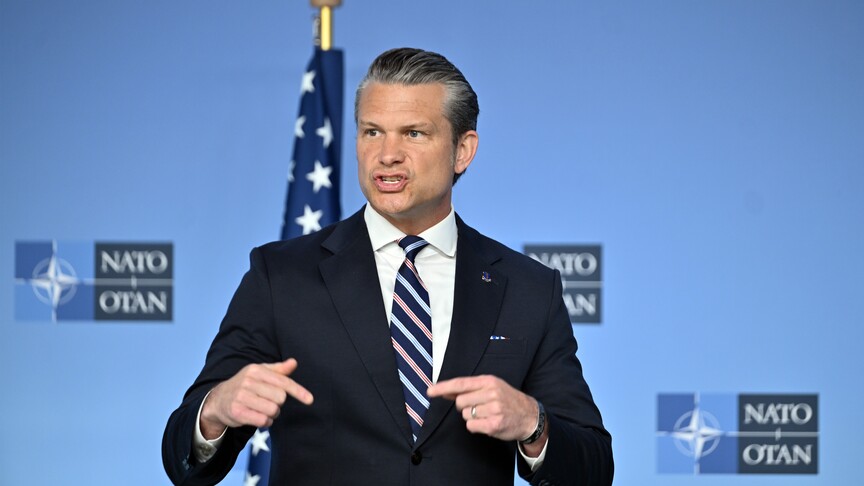
US Defense Secretary Hegseth on Thursday faced protesters while hosting the Trump administration’s DC Safe and Beautiful Task Force ceremony in Washington DC.
During the ceremony at Meridian Hill Park, which saw the gathering of National Guardsmen, dozens of demonstrators gathered near the park to protest Hegseth.
Footage shows the demonstrators chanting a short distance away from where Hegseth and roughly 200 members of the National Guard had gathered in the park
In social media posts, one protester was seen holding a Palestinian flag, while another person was holding a sign that reads “arrest Hegseth.” The protesters want a “Free DC,” according to social media posts.
In his address to the National Guard, Hegseth said that “this background noise is perfect,” referring to the protests.
“It’s the sound of ingrates, of ingratitude—of people who are so blinded by ideology they can’t see law and order and common sense in front of them,” he said.
Meridian Hill Park was repaired by the National Park Service and the Interior Department as part of a larger initiative to restore and enhance federal parks and public spaces throughout the nation’s capital in preparation for America’s 250th anniversary, which falls on this Saturday, July 4.
Though such beautification projects are typically popular with the public, the current initiative has been controversial both for its choice of projects and the use of no-bid contracts to hire firms to do the work, sometimes with disappointing results.
The work aligns with President Donald Trump’s DC Safe and Beautiful Task Force, established by a March 2025 executive order that directs federal agencies to coordinate public safety and beautification efforts across Washington.
Washington, D.C
Metro, DC leaders lay out more details on transit at new Commanders stadium – WTOP News

D.C. officials expressed an urgency Wednesday to begin preparing transit infrastructure for the opening in 2030 of the new Washington Commanders stadium on the old RFK Stadium campus.
D.C. officials expressed an urgency Wednesday to begin preparing transit infrastructure for the opening in 2030 of the new Washington Commanders stadium on the old RFK Stadium campus.
The work will impact far more than the single, cramped Metro station nearby.
During a roundtable discussion with District leaders, Metro General Manager and CEO Randy Clarke laid out the need for improvements to the existing Stadium-Armory Metro stop, and touted a new rapid bus transit line with dedicated lanes.
In tandem, those will be key to getting tens of thousands of people to events at the coming stadium, Clarke said.
“I absolutely believe the first couple of experiences that people have going to a Commanders game, going to some of the first big events, is going to dictate how people feel about taking transit,” D.C. Council member Charles Allen, who chairs the committee that oversees transportation projects, said. “So, we don’t have an option to get it wrong. We have to get it right.”
That’s why Clarke and other District leaders agreed that reaching a memorandum of understanding that lays out the roles, responsibilities and financials of these projects by July 23, the next Metro board meeting, is crucial.
“I think we’re all working towards that, and pretty optimistic,” Clarke said. “Then we’ve got to work really hard on design, we’ve got to work really hard on procurement, we’ve got to work really hard on construction.”
Clarke said the stadium’s ability to attract blockbuster events will depend on the transit agency and its ability to move people in and out of the complex.
“We’re not going to try to get, hosting the Super Bowl, we’re not going to try to host women’s World Cup, we’re not trying to get Taylor Swift and Beyoncé back here. I mean, at the end of the day, Metro is going to be the key to the success. We understand the pressure on us,” he said.
For the Stadium-Armory station, that means renovating the mezzanine and adding elevators to handle the increased demand. Clarke also talked about new street-level infrastructure to help manage the flow inside the station.
“So it’s very Disney-esque, where people feel like they’re constantly moving without actually going too far, if you know what I mean,” Clarke said. “Then we filter them where we need to go. That is a good example of what we need to do at the surface.”
But Metro won’t rely entirely on its trains. The roundtable also discussed what’s been dubbed the Gold Line, which would run buses from Union Station to the stadium.
Construction estimates for bus line are in the $75 million range, District Department of Transportation Director Sharon Kershbaum said
The Gold Line is to run through the heart of the H Street corridor, and transportation leaders said the impact will be everything the streetcar was supposed to be.
“This is now going to be the east-west corridor that we never were able to accomplish on the streetcar,” Kershbaum said.
“This is going to have frictionless service, because it will be center-running. So all of the issues — when a car double-parked and it stopped streetcar service — all of those things, we’ll be immune from. We are going to see the transportation service that was really never ever reached by streetcar achieved with this,” she said.
The vision for the Gold Line goes beyond the handful of weekends when NFL football is played at the stadium, and beyond initial Union Station-stadium route. Transportation officials see the buses eventually traveling between the Benning Road Metro Station and Rosslyn, Virginia.
“We want the Gold Line to solve the cross-town problem we’ve had in this community for a long, long time,” Clarke said.
That means providing access to the convention center and also solving the gridlock that fills up K Street NW every day. Clarke said coming up with dedicated lanes on K Street would actually be the most pivotal part of this new transit line.
“The downtown core of D.C. does not move, especially during p.m. rush hour,” Clarke said. “If you want people in Benning Road that may work, say on K Street, to have better transportation, solving K Street is equally as important, if not more important, because of time savings and reliability.”
Officials did not specify a timeline for the full expansion, but it would not be completed by 2030.
Where it does run, Gold Line buses would travel in the middle lanes, to avoid what caused problems for the Streetcar, which could grind to a halt when cars would double park. Building out the Gold Line would mean more changes to the way cars move along H Street in Northeast.
“You can’t do what you want to do and also keep all the parking,” At-Large Council member Christina Henderson said.
“There’s intersections where we’re going to have to take turns away at certain intersections, maybe parking in certain places,” Clarke said. “In other places parking could be kept, because we’re looking at putting platforms.”
Stadium-related transit construction will run far beyond H Street and the Stadium Armory stop.
“We do want to minimize outages, but there’s going to be significant outages to do this project,” Clarke said.
“It’s all about where we can turn trains around and how to manage that,” he added. “So if we do an outage to Stadium Armory, what that really means is we’re impacting customers from New Carrollton and Largo all the way through the system, and some people that are west of the system that want to go east of Stadium Armory won’t be able to.”
But with the project not even really in the design phase yet, it’s hard to plan out how and when those impacts will happen.
“We’ll be doing obviously overnight work,” Clarke said. “We’ll probably do some, what we call, early outs. Sometimes we’ll start at 10 o’clock at night. We might be able to do some single tracking on certain types of work. Other work is going to be complete shutdowns.”
“And the question is, is that going to be X amount of weekends or is it going to be like a two-, three-, four-week block at a time,” he added. “We’ve got to work through all of that.”
Get breaking news and daily headlines delivered to your email inbox by signing up here.
© 2026 WTOP. All Rights Reserved. This website is not intended for users located within the European Economic Area.
-

 Crypto2 minutes ago
Trump Made $1.4bn From Cryptocurrency Since Returning to Office
-

 Finance9 minutes ago
9 steps to avoid a financial retirement “cliff-edge”
-

 Fitness12 minutes ago
Fitness Experts Reveal Walking Exercises That May Help You Build Muscle
-
Movie Reviews24 minutes ago
‘Baby Do Die Do’ movie review: In the mood for Mumbai
-
World32 minutes ago
Iran prepares for dayslong funeral for late Supreme Leader Ayatollah Ali Khamenei, killed in war
-
 Lifestyle1 hour ago
To be or not to be a parent : It’s Been a Minute
-

 Technology1 hour ago
Sony’s PlayStation disc factory is already being repurposed
-

 World1 hour ago
Couple publicly caned after alleged TikTok kiss sparks outrage in Indonesia

