Practitioners of walking meditation often move at a glacial pace, engaging each step the way a sitting meditator registers every breath. The exercise is usually performed in a quiet room, not the bustling D.C. sites depicted in “Abiding Nowhere,” the 10th installment in Tsai Ming-liang’s “Walker” series and the first shot in the Western Hemisphere. The film was commissioned by the National Museum of Asian Art to mark the 2023 centennial of its Freer Gallery of Art, where the 79-minute movie will screen on March 1.
Washington, D.C
Review | In the galleries: A filmmaker’s latest edition of souls on separate journeys


The red-robed man moving with exquisite deliberation through Georgetown, the Mall and Union Station is not an actual monk. He’s played by Lee Kang-sheng, Tsai’s longtime collaborator and on-screen alter ego. The Malaysian-Taiwanese director largely abandoned narrative filmmaking a decade ago, but has continued to make “Walkers,” inspired by Xuanzang, the 7th-century monk who journeyed to India to acquire Buddhist texts and bring them back to China.
Although “Abiding Nowhere” tells no story, it shares much with Tsai’s earlier fiction films. The director has always employed long takes and leisurely action, thus calling attention to the passing of time. The latest “Walker” alternates the monk’s steps with moments that feature a secondary character (Anong Houngheuangsy, a recent addition to Tsai’s repertory company); in one scene, the latter wears a T-shirt that reads “time to kill.”
In interviews, the director often compares himself to a painter and says that his style has been shaped by exhibiting his films in museums such as the National Museum of Asian Art (long a reliable supporter of his work). The Freer itself appears in “Abiding Nowhere,” but so do scruffier, lesser-known D.C. locations, many of them associated with the local art scene. In a sense, all these places are equal: backdrops for the detached motion of bodies and minutes. Tsai’s latest film is set in Washington, but also in a realm outside place and time.
Tsai Ming-liang: Abiding Nowhere At 7 p.m., March 1 at the Freer Gallery of Art, National Museum of Asian Art, 1050 Independence Ave. SW. asia.si.edu. 202-633-1000.
Many color-field abstractionists have rejected the notion that their pictures look like landscapes, but sometimes the resemblance is hard to deny. Most of the vivid canvases in Hemphill Artworks’ “Willem de Looper: Paintings 1972-1975” were made soon after the Dutch-born D.C. artist’s 1973 trip to the American Southwest. The large pictures sweep horizontally and are usually in the colors of stone, sand and clay. (There are also three heavily blue ones, at least one of which predates the excursion.) The paintings are not literal landscapes, but the inspiration is palpable.
De Looper (1932-2009) was among the second group of Washington colorists to achieve prominence, and he adopted some of the methods of his predecessors. Like Morris Louis and Kenneth Noland, he stained unprimed canvases with acrylic pigments, which had been developed at that time. But the long-unexhibited paintings in this group were not made by brushing or pouring. Instead, de Looper used rollers to sweep bands of color horizontally across the composition.
This technique yielded pictures that suggest a spectator’s movement through vast expanses of tans and browns, or layers of rock built up and worn down by millennia. The arrays of close-colored streaks can also suggest other things, such as unglazed pottery. Whatever the softly striped hues evoke, de Looper used watery washes of diluted paint to conjure something profoundly earthy. These paintings are gauzy and solid at the same time.
Willem de Looper: Paintings 1972-1975 Through March 2 at Hemphill Artworks, 434 K St. NW. hemphillfinearts.com. 202-234-5601.
One piece in “A Corcoran Homecoming: The Art of Carroll Sockwell” seems to encapsulate the life and the work of this acclaimed but conflicted artist. Made when Sockwell was 15, “Hands Off Me/Am I Bad?” is an oil-pastel drawing of a face that combines geometric and expressionist aspects and includes the picture’s title, roughly written in white.
The juxtaposition of spontaneous and calculated lines recurs in the art Sockwell made between the late 1950s and his 1992 suicide, at age 49. A native Washingtonian who grew up in Foggy Bottom — the neighborhood was then predominantly Black — Sockwell showed great artistic promise as a teenager, encouraged by an art therapist who worked with him while he was committed at St. Elizabeths Hospital.
The show includes Sockwell’s collage portrait of one of his patrons, Walter Hopps, who was the Corcoran Gallery’s director from 1967 to 1972. More typical, however, are purely abstract works. All the pieces are on board and paper, sometimes shaped, and feature tones that are mostly dark or muted. “Mirror Composition” is an expanse of black graphite and oil pastel, separated into blocks by silvery lines and framed under glass to reflect the viewer’s face. Gazing into this void is a suitably ambiguous experience. Sockwell assuredly conjured his own uncertainty.
A Corcoran Homecoming: The Art of Carroll Sockwell Through March 9 at Luther W. Brady Art Gallery, Corcoran Flagg Building, 500 17th St. NW. bradygallery.gwu.edu. 202-994-1525.
Brentwood Arts Exchange’s “Chosen Family,” curated by Lauren Davidson, presents work by seven African American artists who constitute three sets of friends: Omari Jesse, Bria Edwards and Olivia Bruce; Wesley Clark and Rodney “Buck!” Herring; Austin “Auz” Miles and Angelique Scott. The standout, as he usually is in group shows that include him, is Clark.
The artist’s two entries are part painting, part sculpture. Screws and nails intrude on planes of thickly applied, partly cracked pigment, set off by wooden shingles or a band of weathered steel. The works evoke making and unmaking simultaneously.
Where Clark’s abstractions have an industrial vibe, most of the other work is at least partly representational, often portraying domestic scenes or private moments. What many of the artists share with Clark is an interest in metamorphosis. In Bruce’s drippy triptych, a nude woman takes on aspects of the water around her. In Miles’s portrait of a woman, the face appears solid but the rest is fluid. In Edwards’s scene of a couple in a kitchen, metal objects rendered in silver leaf add a sculptural quality. The figures and their environments are ordinary, but endowed with an intriguing mutability.
Chosen Family Through March 9 at Brentwood Arts Exchange, 3901 Rhode Island Ave., Brentwood. pgparks.com. 301-277-2863.



An Air Force major was arrested in uniform on the steps of the Capitol after he called for the impeachment of President Donald Trump.
U.S. Capitol Police arrested Jason Watson, an active-duty service member, on Wednesday afternoon following remarks at a news conference where he said Trump and Vice President JD Vance should be removed from office.
The event was organized by the Removal Coalition, a group that lobbies members of Congress to impeach Trump, and attended by Rep. Al Green, D-Texas, who has repeatedly introduced articles of impeachment against Trump.
“I’m here with him because Rep. Green is the only member of Congress that has demonstrated the courage and conviction to … force a vote on articles of impeachment,” Watson said at the event. “If Congress followed his example, we could remove the entire Trump administration, but Congress remains unconvinced of the urgency and necessity for them to honor their oaths, so we must persuade them with our unrelenting, uncompromising civil resistance.”
Watson said he is not a Democrat and does not share policy positions with Green, who lost his re-election bid this year. Green’s office did not immediately respond to a request for comment on Watson’s arrest.
Capitol Police said in a statement that it “is generally against the law for the public to demonstrate on the House Steps unless they are with a Member of Congress.”
“Yesterday afternoon, a man was escorted to the House Steps by a Member of Congress,” the statement said. “When the Member of Congress left the area, our officers gave the man lawful orders to stop the illegal demonstration or he would be arrested. The man refused our lawful orders.”
Capitol Police identified the man as Watson, adding that he was arrested on charges of “Crowding, Obstructing, and Incommoding” and that it is legal to protest in other spots on the Capitol grounds.
Service members are subject to stricter laws than the average citizen when it comes to protesting. The Uniform Code of Military Justice prohibits officers from “using contemptuous language towards the President, Vice president, the Secretaries of War and of a military department, Congress, and certain other officials,” according to an Air Force memo last year.
An Air Force spokesperson said in a statement Thursday: “Service members must comply with all laws, regulations and policies governing conduct and the wear of the uniform. All Department of the Air Force personnel are expected to uphold the highest standards of discipline and professionalism, both on and off duty.”
All service members, not just members of the Air Force, are prohibited from participating in “political activities” in uniform.
Watson’s criticism of Trump and Vance focused on the administration’s actions in Venezuela and Iran, calling them “an unconstitutional usurpation of Congress’ authority and a violation of the War Powers Clause.”
“These violations resulted in the deaths of 13 service members and injuries of hundreds more,” he said, referring to the number of U.S. military deaths tied to the Iran war. “For this, the president and vice president must be impeached, convicted and removed.”
Watson also called the administration’s immigration policies and tactics unconstitutional.
The Removal Coalition did not immediately respond to a request for comment, and Watson could not be reached.
President Donald Trump responded to criticism of a financial disclosure that listed $1.4 billion in crypto earnings largely driven by meme coins.
Berk Kutay Gökmen
02 July 2026•Update: 02 July 2026
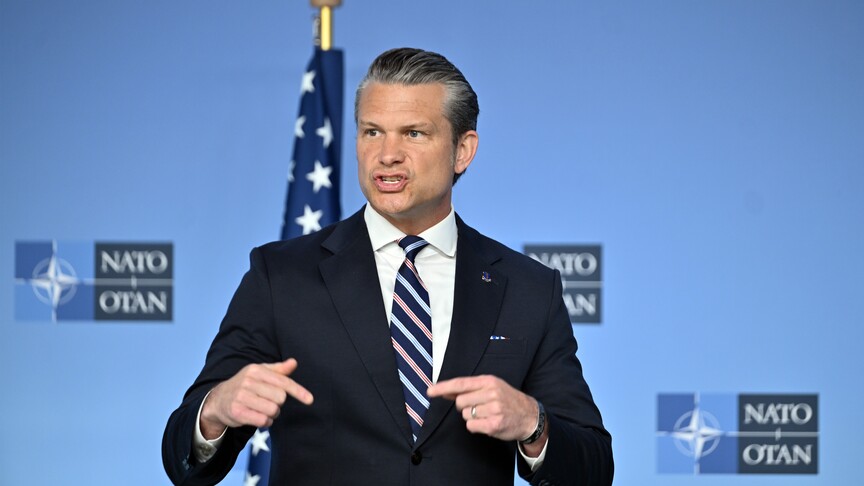
US Defense Secretary Hegseth on Thursday faced protesters while hosting the Trump administration’s DC Safe and Beautiful Task Force ceremony in Washington DC.
During the ceremony at Meridian Hill Park, which saw the gathering of National Guardsmen, dozens of demonstrators gathered near the park to protest Hegseth.
Footage shows the demonstrators chanting a short distance away from where Hegseth and roughly 200 members of the National Guard had gathered in the park
In social media posts, one protester was seen holding a Palestinian flag, while another person was holding a sign that reads “arrest Hegseth.” The protesters want a “Free DC,” according to social media posts.
In his address to the National Guard, Hegseth said that “this background noise is perfect,” referring to the protests.
“It’s the sound of ingrates, of ingratitude—of people who are so blinded by ideology they can’t see law and order and common sense in front of them,” he said.
Meridian Hill Park was repaired by the National Park Service and the Interior Department as part of a larger initiative to restore and enhance federal parks and public spaces throughout the nation’s capital in preparation for America’s 250th anniversary, which falls on this Saturday, July 4.
Though such beautification projects are typically popular with the public, the current initiative has been controversial both for its choice of projects and the use of no-bid contracts to hire firms to do the work, sometimes with disappointing results.
The work aligns with President Donald Trump’s DC Safe and Beautiful Task Force, established by a March 2025 executive order that directs federal agencies to coordinate public safety and beautification efforts across Washington.
Washington, D.C
Metro, DC leaders lay out more details on transit at new Commanders stadium – WTOP News

D.C. officials expressed an urgency Wednesday to begin preparing transit infrastructure for the opening in 2030 of the new Washington Commanders stadium on the old RFK Stadium campus.
D.C. officials expressed an urgency Wednesday to begin preparing transit infrastructure for the opening in 2030 of the new Washington Commanders stadium on the old RFK Stadium campus.
The work will impact far more than the single, cramped Metro station nearby.
During a roundtable discussion with District leaders, Metro General Manager and CEO Randy Clarke laid out the need for improvements to the existing Stadium-Armory Metro stop, and touted a new rapid bus transit line with dedicated lanes.
In tandem, those will be key to getting tens of thousands of people to events at the coming stadium, Clarke said.
“I absolutely believe the first couple of experiences that people have going to a Commanders game, going to some of the first big events, is going to dictate how people feel about taking transit,” D.C. Council member Charles Allen, who chairs the committee that oversees transportation projects, said. “So, we don’t have an option to get it wrong. We have to get it right.”
That’s why Clarke and other District leaders agreed that reaching a memorandum of understanding that lays out the roles, responsibilities and financials of these projects by July 23, the next Metro board meeting, is crucial.
“I think we’re all working towards that, and pretty optimistic,” Clarke said. “Then we’ve got to work really hard on design, we’ve got to work really hard on procurement, we’ve got to work really hard on construction.”
Clarke said the stadium’s ability to attract blockbuster events will depend on the transit agency and its ability to move people in and out of the complex.
“We’re not going to try to get, hosting the Super Bowl, we’re not going to try to host women’s World Cup, we’re not trying to get Taylor Swift and Beyoncé back here. I mean, at the end of the day, Metro is going to be the key to the success. We understand the pressure on us,” he said.
For the Stadium-Armory station, that means renovating the mezzanine and adding elevators to handle the increased demand. Clarke also talked about new street-level infrastructure to help manage the flow inside the station.
“So it’s very Disney-esque, where people feel like they’re constantly moving without actually going too far, if you know what I mean,” Clarke said. “Then we filter them where we need to go. That is a good example of what we need to do at the surface.”
But Metro won’t rely entirely on its trains. The roundtable also discussed what’s been dubbed the Gold Line, which would run buses from Union Station to the stadium.
Construction estimates for bus line are in the $75 million range, District Department of Transportation Director Sharon Kershbaum said
The Gold Line is to run through the heart of the H Street corridor, and transportation leaders said the impact will be everything the streetcar was supposed to be.
“This is now going to be the east-west corridor that we never were able to accomplish on the streetcar,” Kershbaum said.
“This is going to have frictionless service, because it will be center-running. So all of the issues — when a car double-parked and it stopped streetcar service — all of those things, we’ll be immune from. We are going to see the transportation service that was really never ever reached by streetcar achieved with this,” she said.
The vision for the Gold Line goes beyond the handful of weekends when NFL football is played at the stadium, and beyond initial Union Station-stadium route. Transportation officials see the buses eventually traveling between the Benning Road Metro Station and Rosslyn, Virginia.
“We want the Gold Line to solve the cross-town problem we’ve had in this community for a long, long time,” Clarke said.
That means providing access to the convention center and also solving the gridlock that fills up K Street NW every day. Clarke said coming up with dedicated lanes on K Street would actually be the most pivotal part of this new transit line.
“The downtown core of D.C. does not move, especially during p.m. rush hour,” Clarke said. “If you want people in Benning Road that may work, say on K Street, to have better transportation, solving K Street is equally as important, if not more important, because of time savings and reliability.”
Officials did not specify a timeline for the full expansion, but it would not be completed by 2030.
Where it does run, Gold Line buses would travel in the middle lanes, to avoid what caused problems for the Streetcar, which could grind to a halt when cars would double park. Building out the Gold Line would mean more changes to the way cars move along H Street in Northeast.
“You can’t do what you want to do and also keep all the parking,” At-Large Council member Christina Henderson said.
“There’s intersections where we’re going to have to take turns away at certain intersections, maybe parking in certain places,” Clarke said. “In other places parking could be kept, because we’re looking at putting platforms.”
Stadium-related transit construction will run far beyond H Street and the Stadium Armory stop.
“We do want to minimize outages, but there’s going to be significant outages to do this project,” Clarke said.
“It’s all about where we can turn trains around and how to manage that,” he added. “So if we do an outage to Stadium Armory, what that really means is we’re impacting customers from New Carrollton and Largo all the way through the system, and some people that are west of the system that want to go east of Stadium Armory won’t be able to.”
But with the project not even really in the design phase yet, it’s hard to plan out how and when those impacts will happen.
“We’ll be doing obviously overnight work,” Clarke said. “We’ll probably do some, what we call, early outs. Sometimes we’ll start at 10 o’clock at night. We might be able to do some single tracking on certain types of work. Other work is going to be complete shutdowns.”
“And the question is, is that going to be X amount of weekends or is it going to be like a two-, three-, four-week block at a time,” he added. “We’ve got to work through all of that.”
Get breaking news and daily headlines delivered to your email inbox by signing up here.
© 2026 WTOP. All Rights Reserved. This website is not intended for users located within the European Economic Area.
-

 Crypto3 minutes ago
Trump Made $1.4bn From Cryptocurrency Since Returning to Office
-

 Finance10 minutes ago
9 steps to avoid a financial retirement “cliff-edge”
-

 Fitness13 minutes ago
Fitness Experts Reveal Walking Exercises That May Help You Build Muscle
-
Movie Reviews25 minutes ago
‘Baby Do Die Do’ movie review: In the mood for Mumbai
-
World33 minutes ago
Iran prepares for dayslong funeral for late Supreme Leader Ayatollah Ali Khamenei, killed in war
-
 Lifestyle1 hour ago
To be or not to be a parent : It’s Been a Minute
-

 Technology1 hour ago
Sony’s PlayStation disc factory is already being repurposed
-

 World1 hour ago
Couple publicly caned after alleged TikTok kiss sparks outrage in Indonesia

