Washington, D.C
Military parade and No Kings protests: a split-screen of a divided America


Members of the U.S. Army drive a Stryker infantry carrier vehicle during Saturday’s 250th birthday parade in Washington, D.C.
Andrew Leyden/Getty Images
hide caption
toggle caption
Andrew Leyden/Getty Images
WASHINGTON, D.C., and ANNAPOLIS, Md. — There are events that become a Rorschach test that brings out America’s political and cultural divisions in bold relief. Saturday’s military parade — which celebrated the U.S. Army’s 250th anniversary and also fell on President Trump’s birthday — was that kind of moment.
As the Trump administration geared up for the parade filled with tanks and armored personnel carriers rolling through the nation’s capital, people in dozens of cities across the country protested the event as a politicization of the armed forces by a would-be autocrat.
The protests were called No Kings.
The 33-mile trip from one protest in Annapolis to the parade grandstand in front of the White House was like a journey between two different countries.
The crowds in Annapolis gathered in front of the colonial, red-brick Maryland State House around mid-morning. The people who came were largely white, and they held signs reading: “RESISTING THE CROWN SINCE 1776,” and “I’M A VETERAN, NOT A SUCKER OR A LOSER,” a reference to comments attributed to Trump disparaging American war-dead, which Trump has called “a total lie.”

John Wells, a retired economist statistician with the federal government, called the miltary parade outrageous. “We’re not in Russia or North Korea … or China,” he said. “That’s the thing they do. We don’t do that.”
Frank Langfitt/NPR
hide caption
toggle caption
Frank Langfitt/NPR
John Wells, a 76-year-old retired economist statistician with the federal government, said he supported the U.S. army, but couldn’t stand the parade.
“It’s outrageous. We’re not in Russia or North Korea … or China. That’s the thing they do. It’s also costing a lot of money and people’s resources,” Wells said of the price tag for the D.C. parade and surrounding events, estimated at $25 million to $45 million.
Speakers in Annapolis included labor union representatives, the leader of an immigrant advocacy group and a George Washington reenactor who wore a white wig and a blue waistcoat. Randy Goldberg, a 75-year-old retired nurse, played America’s first president and delivered the speech Washington gave when he relinquished his military command there in 1783.
“I retire from the great theater of action and bidding an affectionate farewell to this august body under whose orders I have so long acted, I hereby offer my commission and leave all the employments of public life,” Goldberg said, channeling Washington as the crowd broke into applause.

The centerpiece of the No Kings protest in Annapolis, Md., was a George Washington reenactor named Randy Goldberg, who delivered the speech Washington gave when he relinquished his command there in 1783. Protestors contrasted Washington’s voluntary decision to give up miltary power with what they saw as an autocratic-style military parade on the National Mall.
Frank Langfitt/NPR
hide caption
toggle caption
Frank Langfitt/NPR
The protesters’ point was that Washington voluntarily gave up military power, while they say Trump was trying to accrue more by holding the parade on the National Mall with countless tons of military hardware.
Trump dismissed such criticism Saturday.
“Every other country celebrates their victories,” Trump told the crowd in D.C. “It’s about time that America did, too.”

In fact, this was not a victory celebration, but a birthday party for the Army. The last time the U.S. held a similar parade was after the First Gulf War, in 1991.
Trump has attacked the patriotism of his critics and of journalists he doesn’t like, saying, “They hate our country.” Anticipating such an attack, speakers in Annapolis said protest is an act of patriotism, especially when the target is a president they say is trampling America’s system of checks and balances.
“We have to own the flag. No one can tell us that we’re not patriots,” said Donna Edwards, president of the Maryland & DC AFL-CIO, who addressed the Annapolis crowd wearing an American flag dress. “No one should say that because we’re here, we hate America. We’re fighting for America.“
About 45 minutes to the west, many who attended the Army celebration also wore flag T-shirts, hats and shorts. The crowd was diverse and included military families whose members had immigrated to the U.S. from around the world, including Ecuador, El Salvador and Vietnam.

Julianna Balogh (left) and Kim Nguyen are President Trump superfans who traveled from Arkansas and California, respectively, to attend the military parade. Nguyen says her father served with the U.S. Army in South Vietnam and that she came to the U.S. in 1991.
Frank Langfitt/NPR
hide caption
toggle caption
Frank Langfitt/NPR
The event in the nation’s capital seemed at times like a cross between a military festival and an Army recruiting video. People lounged on the grass in the shadow of the Washington Monument. Amid the strains of Van Halen over the loudspeakers, tank drivers pumped their fists and revved their engines as they drove past cheering crowds down Constitution Avenue. Along the way, the announcer thanked the various corporate sponsors, including Lockheed Martin and Palantir, the data-mining firm that has a $30 million contract to help Immigration and Customs and Enforcement track migrants in the U.S.

The staging seemed designed to enhance the muscular image Trump likes to project. A pair of tanks sat in front of the grandstand from which the president watched. After his speech, Trump was presented with a traditionally folded U.S. flag — a gift usually reserved for the family members of fallen soldiers.
Some who attended the event — including a few who said they did not vote for Trump — dismissed criticism that the parade had authoritarian overtones.
“I think they’ve got this whole cloud over their head that Trump’s this dictator when he’s acting completely [within] the law,” said Dennis Connelly, 19, who wore baggy American flag pants and had flown in from Knoxville, Tenn., for the event.

Dennis Connelly, 19, of Knoxville, Tenn., flew for the first time in his life to Washington, D.C., to see the parade. Connelly wants to join the Marines and said the combination of the parade and the president’s birthday was too good to miss.
Frank Langfitt/NPR
hide caption
toggle caption
Frank Langfitt/NPR
The president, too, took issue ahead of the parade with being described as a king. “I don’t feel like a king,” Trump said in advance of the parade. “I have to go through hell to get things approved.”
His administration’s actions have been mired in hundreds of lawsuits — and the courts have frequently blocked them from being implemented.
Connelly says he hopes to enlist in the Marines and serve in counterintelligence. While No Kings protesters criticized Trump for busting norms, Connelly sees that as a good thing.
“He’s powerful, and he’s kind of like those high school bullies. … And I just think that’s wonderful,” said Connelly. “We have to have a powerful president who’s willing to push some boundaries.”
Although Connelly is a fan of Trump’s, he has doubts about some of the president’s policies. He says allowing ICE agents to wear masks provides people the opportunity to impersonate them and commit crimes. He also says he doesn’t think Trump has a complete understanding of tariffs.
“I think he’s assuming that these companies are willing to pay them and not going to manipulate the public … and add that on to [the] consumer price,” said Connelly, who took his first airplane flight ever to come here.
The parade attracted many Trump voters, who gave the president a warm round of applause when he was introduced. A smattering sported MAGA gear. But most people with whom NPR spoke said they were there to celebrate the Army and see the tanks.
Well before the parade’s end, thousands began heading out. As they exited onto Constitution Avenue, they were met by No Kings protesters.
“Trump is a Tyrant,” read one sign. The parade-goers with whom an NPR reporter was walking made their way past the protesters and headed toward the Metro trains.
America’s split-screen day had finally merged into a collective image of a divided people half block from the White House, many unable or unwilling to talk to one another.



Washington, D.C
What’s that noise? What you need to know about D.C. flyovers Friday and Saturday – WTOP News

Reagan National Airport will close for America 250 flyover rehearsals Friday and celebrations Saturday featuring the Thunderbirds, Blue Angels and more.

Reagan National Airport will close from 10 a.m. to 1 p.m. Friday for rehearsals ahead of this weekend’s America 250 celebrations, meaning people around D.C., Arlington and Alexandria may hear and see low-flying military aircraft.
According to Freedom 250 event organizers, Friday’s “Wings of Freedom” demonstrations over the National Mall will feature parachute teams, helicopters and military aircraft, including the U.S. Marine Corps’ MV-22 Osprey and F-35B, the Navy’s F-18F and F-35C, the Air Force’s F-22 Raptor, the Thunderbirds and a tri-bomber formation.
On Saturday, the FAA will close the airport from noon to midnight for the full celebration. All arrivals and departures at Reagan National are scheduled to end before noon.
Flyovers and demonstrations are scheduled throughout the afternoon and evening along the National Mall and Washington Monument grounds, including appearances by Air Force One, the Thunderbirds, Blue Angels, military aircraft fleet reviews, parachute demonstrations and B-2 stealth bombers.
Highlights include an Air Force One flyover scheduled for 7:03 p.m., a Thunderbirds demonstration beginning at 6:25 p.m., a tri-bomber formation at 6:02 p.m. and a stealth aircraft flyover at 7:38 p.m.
Friday’s schedule of flyovers and demonstration rehearsals along the National Mall and Washington Monument
- 10 a.m.: Golden Knights, Leap Frogs
- 10:15 a.m.: Army Helo Flyover
- 10:20 a.m.: USMC V-22 Osprey Demo
- 10:35 a.m.: USMC F-35B STOVL Demo
- 10:50 a.m.: USN F-18F Demo
- 11:10 a.m.: USN F-35C Demo Team
- 11:30 a.m.: USAF F-22 Raptor Demo
- 11:50 a.m.: NASA F-5s
- 12 p.m.: HUGE (1) Formation
- 12:05 p.m.: USAF Thunderbirds
- 12:55 p.m.: USAF Tri-Bomber
Saturday’s schedule of flyovers and demonstration along the National Mall and Washington Monument
- 1:14 p.m.: – NASA F-5 Flyover
- 1:24 p.m.: -NASA Fleet Review
- 1:44 p.m.: USCG Helo Flyover
- 1:54 p.m.: USCG Fixed Wing Flyover
- 2:09 p.m.: Golden Knights, Leap Frogs
- 2:29 p.m.: Army Helo Flyover
- 2:44 p.m.: USAF Fleet Review – Wave 1 – Heavies
- 2:54 p.m.: USAF Fleet Review – Wave 2 – AFSOC
- 3:04 p.m.: USAF Fleet Review – Wave 3 – Fighters
- 3:29 p.m.: Executive Rotary Wing Airlift
- 3:39 p.m.: USMC Fleet Review – Wave 1 – Rotary
- 3:49 p.m.: USMC Fleet Review – Wave 2 – Fixed Wing
- 3:59 p.m.: USN Fleet Review – Wave 1 – Rotary
- 4:09 p.m.: USN Fleet Review – Wave 2 – Fixed Wing
- 4:19 p.m.: USN Fleet Review – Wave 3 – Fighters
- 4:21 p.m.: USN F-18F Demonstration
- 4:59 p.m.: USN Blue Angels
- 5:26 p.m.: USMC MV-22 Osprey Demonstration
- 5:44 p.m.: USAF Fleet Review – Fighters
- 6:02 p.m.: USAF Tri-Bomber Formation
- 6:05 p.m.: USN F-35C Demonstration
- 6:25 p.m.: USAF Thunderbirds Demonstration
- 7:03 p.m.: Air Force One Flyover
- 7:07 p.m.: USAF Thunderbirds Delta Break
- 7:17 p.m.: HUGE 1 Flyover Led by the Newly Renovated Air Force One
- 7:38 p.m.: U.S. Stealth Airpower Flyover
- 7:39 p.m.: F-22 Raptor Demo
- 7:53 p.m.: F-22 Raptor in Afterburner
- 7:59 p.m.: B-1 Flyover
- 8:07 p.m.: B-1’s in Afterburner
- 8:11 p.m.: HUGE ONE Fly Over Review
- 8:22 p.m.: Golden Knights Twilight Jump
- 10:36 p.m.: B-1 Afterburner Night Pass
Get breaking news and daily headlines delivered to your email inbox by signing up here.
© 2026 WTOP. All Rights Reserved. This website is not intended for users located within the European Economic Area.

An Air Force major was arrested in uniform on the steps of the Capitol after he called for the impeachment of President Donald Trump.
U.S. Capitol Police arrested Jason Watson, an active-duty service member, on Wednesday afternoon following remarks at a news conference where he said Trump and Vice President JD Vance should be removed from office.
The event was organized by the Removal Coalition, a group that lobbies members of Congress to impeach Trump, and attended by Rep. Al Green, D-Texas, who has repeatedly introduced articles of impeachment against Trump.
“I’m here with him because Rep. Green is the only member of Congress that has demonstrated the courage and conviction to … force a vote on articles of impeachment,” Watson said at the event. “If Congress followed his example, we could remove the entire Trump administration, but Congress remains unconvinced of the urgency and necessity for them to honor their oaths, so we must persuade them with our unrelenting, uncompromising civil resistance.”
Watson said he is not a Democrat and does not share policy positions with Green, who lost his re-election bid this year. Green’s office did not immediately respond to a request for comment on Watson’s arrest.
Capitol Police said in a statement that it “is generally against the law for the public to demonstrate on the House Steps unless they are with a Member of Congress.”
“Yesterday afternoon, a man was escorted to the House Steps by a Member of Congress,” the statement said. “When the Member of Congress left the area, our officers gave the man lawful orders to stop the illegal demonstration or he would be arrested. The man refused our lawful orders.”
Capitol Police identified the man as Watson, adding that he was arrested on charges of “Crowding, Obstructing, and Incommoding” and that it is legal to protest in other spots on the Capitol grounds.
Service members are subject to stricter laws than the average citizen when it comes to protesting. The Uniform Code of Military Justice prohibits officers from “using contemptuous language towards the President, Vice president, the Secretaries of War and of a military department, Congress, and certain other officials,” according to an Air Force memo last year.
An Air Force spokesperson said in a statement Thursday: “Service members must comply with all laws, regulations and policies governing conduct and the wear of the uniform. All Department of the Air Force personnel are expected to uphold the highest standards of discipline and professionalism, both on and off duty.”
All service members, not just members of the Air Force, are prohibited from participating in “political activities” in uniform.
Watson’s criticism of Trump and Vance focused on the administration’s actions in Venezuela and Iran, calling them “an unconstitutional usurpation of Congress’ authority and a violation of the War Powers Clause.”
“These violations resulted in the deaths of 13 service members and injuries of hundreds more,” he said, referring to the number of U.S. military deaths tied to the Iran war. “For this, the president and vice president must be impeached, convicted and removed.”
Watson also called the administration’s immigration policies and tactics unconstitutional.
The Removal Coalition did not immediately respond to a request for comment, and Watson could not be reached.
President Donald Trump responded to criticism of a financial disclosure that listed $1.4 billion in crypto earnings largely driven by meme coins.
Berk Kutay Gökmen
02 July 2026•Update: 02 July 2026
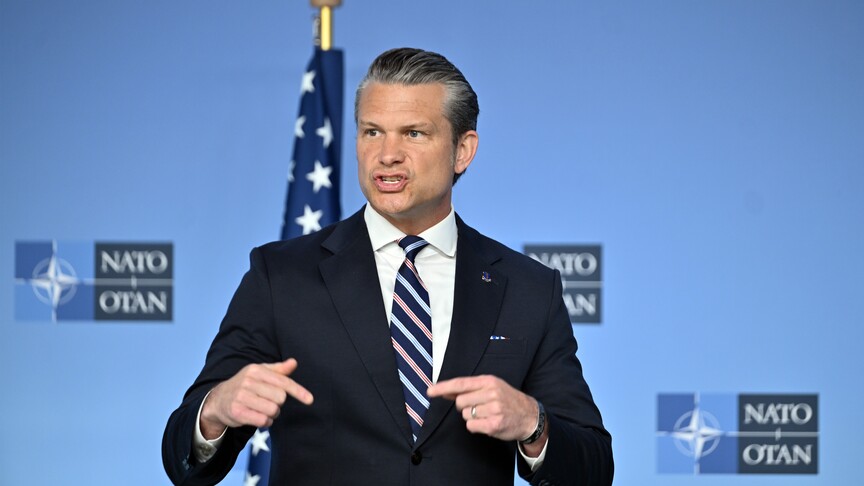
US Defense Secretary Hegseth on Thursday faced protesters while hosting the Trump administration’s DC Safe and Beautiful Task Force ceremony in Washington DC.
During the ceremony at Meridian Hill Park, which saw the gathering of National Guardsmen, dozens of demonstrators gathered near the park to protest Hegseth.
Footage shows the demonstrators chanting a short distance away from where Hegseth and roughly 200 members of the National Guard had gathered in the park
In social media posts, one protester was seen holding a Palestinian flag, while another person was holding a sign that reads “arrest Hegseth.” The protesters want a “Free DC,” according to social media posts.
In his address to the National Guard, Hegseth said that “this background noise is perfect,” referring to the protests.
“It’s the sound of ingrates, of ingratitude—of people who are so blinded by ideology they can’t see law and order and common sense in front of them,” he said.
Meridian Hill Park was repaired by the National Park Service and the Interior Department as part of a larger initiative to restore and enhance federal parks and public spaces throughout the nation’s capital in preparation for America’s 250th anniversary, which falls on this Saturday, July 4.
Though such beautification projects are typically popular with the public, the current initiative has been controversial both for its choice of projects and the use of no-bid contracts to hire firms to do the work, sometimes with disappointing results.
The work aligns with President Donald Trump’s DC Safe and Beautiful Task Force, established by a March 2025 executive order that directs federal agencies to coordinate public safety and beautification efforts across Washington.
-

 Denver, CO2 minutes ago
Who are the Top 5 offensive linemen in Denver Broncos history?
-

 Seattle, WA7 minutes ago
Seattle’s Lake Union to light up with big July 4 fireworks show for America’s 250th
-

 San Diego, CA14 minutes ago
New training program grants tribal members access to reservation land during emergencies
-
Milwaukee, WI17 minutes ago
Leaders of ‘United for Venezuela Emergency Relief Campaign’ grateful for support
-

 Atlanta, GA22 minutes ago
Mets celebrate America’s 250th with four-game series in Atlanta
-
 Minneapolis, MN29 minutes ago
‘Threads of Us’ explores how Minnesota immigrants hold onto home
-

 Indianapolis, IN32 minutes ago
Police advise against celebrating Fourth of July by shooting in the air
-

 Pittsburg, PA37 minutes ago
Fireworks Near Me: July 4th Events Around USC, Pittsburgh For 2026

