After a rare bipartisan push to help D.C., a bill that would allow the city to redevelop the eyesore that is the defunct RFK Stadium cleared the House Wednesday with overwhelming support.
Washington, D.C
House passes bipartisan bill to let D.C. redevelop RFK Stadium site


The mayor has long seen the RFK legislation as the first step to launching more serious talks with Commanders owner Josh Harris to lure the team back to its former home, and Wednesday’s passage puts Bowser closer to that goal — although it remains far from guaranteed.
“Tonight’s vote was a significant step forward in our efforts to unlock the full potential of the RFK Campus — for our residents and visitors, the community, and DC’s Comeback,” Bowser said in a statement.
The legislation was championed by Rep. James Comer (R-Ky.), chairman of the House Oversight Committee, which more typically has targeted D.C. on crime and policing issues. His leadership and partnership with Bowser and D.C. Del Eleanor Holmes Norton (D), the lead co-sponsor of the bill, became one of the most intriguing political developments last year and ultimately served as a powerful bipartisan combo that helped motor the bill over the House finish line.
Comer has said that he decided to introduce the legislation after conversations with Bowser about how redeveloping RFK could serve as a major economic boost for the city and could return the crumbling stadium into an asset for D.C., stadium or no.
On the floor Wednesday, Comer touted Congress’s intense oversight of the city — including its bipartisan swat-down of the city’s revised criminal code last year — and said this bill was an extension of that “constitutional duty.”
The bill “represents Congress doing its job to oversee the District by authorizing the best utilization of area land to help the city thrive,” Comer said. “We should want this for the nation’s capital city, a home to the taxpayers’ federal workforce and a city that hosts millions of American visitors and global tourists each year.”
The legislation would transfer administrative control of the 174-acre riverfront parcel from the federal government to D.C., for a term of 99 years with no rent costs, enabling a range of development possibilities from a football stadium to restaurants, shops and housing. The city would pay any costs associated with remediation or environmental assessments of the land, along with demolition of the vacant stadium and future development and maintenance of the site. Norton and Comer described the arrangement as a “win-win” for D.C. and the National Park Service, which would no longer bear the costs of maintaining the land. The bill would also set aside 30 percent of the land for park and open space and require maintaining access to the Anacostia River.
“We can’t allow the largest unused tract of land in DC to continue crumbling when it could be put to productive use,” Norton said on X, formerly Twitter.
Bowser and Council Chairman Phil Mendelson (D) sent a letter to House Minority Leader Hakeem Jeffries (D-N.Y.) with a similar message Wednesday morning. They urged support for the bill so the District could pursue a new development that could “create thousands of new jobs” and become “an attractive destination, not only for the enjoyment of District residents, but also for the 21 million visitors who travel to the nation’s capital annually.”
Perhaps strategically, they made no mention of a possible football stadium — which Mendelson has not been warm to in any case, and which was also an issue for some members of Congress who oppose the idea of using public funds or public land for a stadium. The legislation bars the use of federal funds for a stadium — but not local funds.
As the RFK bill wound its way through the House, the regional competition to host the Commanders at a new stadium hung prominently in the backdrop. Harris has talked with Bowser, Maryland Gov. Wes Moore (D) and Virginia Gov. Glenn Youngkin (R) about the possibility of a new stadium in one of the three jurisdictions — and in D.C., any more serious discussions are entirely reliant on Congress passing the RFK legislation.
The bill passed Wednesday despite unified opposition from the Maryland delegation, as Moore vies to keep the Commanders at their current home — which will soon no longer be called FedEx Field.
“Like other members of the Maryland delegation, I believe Prince George’s County in Maryland should be able to compete on a level playing field to keep the Washington Commanders,” Ivey said. “But this bill gives an unfair advantage to D.C. It’s most certainly not a level playing field when one interested jurisdiction receives a free transfer of federal government subsidized land.”
Raskin’s vote was not recorded, but when asked by a reporter why he did not vote, Raskin ran back into the House chamber to try to remedy that. He said he intended to vote no.
Raskin, typically one of D.C.’s staunchest home rule allies, said he did not view this bill as a home rule issue since it concerned federal land — which he said made restrictions on the land appropriate, such as not aiding multi-million-dollar sports franchises with local or federal public money.
Asked if he would oppose public funds for upgrades to FedEx Field, Raskin said it would depend. He said if D.C. got the gift of federal land and also put up public funds to lure the Commanders, he argued Maryland would struggle to compete and it would become unfair.
“It creates a very different scenario. It’s creating the problem I want to avoid. The problem I want to avoid is the federal government participating in a huge bonanza for a private franchise,” Raskin said.
Moore told reporters Wednesday he remained in “very, very close contact with the team.”
“My insistence and our insistence that the Commanders stay in Prince George’s County, it is not waning at all,” he said.
Virginians, meanwhile, have since been more focused on the potential of a new basketball and hockey arena for the Washington Wizards and Capitals after their billionaire owner Ted Leonsis announced a handshake deal with Youngkin to move the teams from D.C.’s Capital One Arena to a future home in Potomac Yard. That major loss for D.C. — and its downtown recovery — only raised the stakes for Bowser as she continues to pursue the Commanders.
Still, even with the bill’s House passage, a new football stadium at RFK — or any development there — remains a long way off.
First the bill will head to the Senate, where at the moment there is no obvious mantle-carrier to advocate for it. D.C. bills rarely get stand-alone consideration on the Senate floor, and the RFK bill would be subject to the filibuster, requiring the support of 60 senators to advance. Some noncontroversial bills can go up for a unanimous consent vote — though that would also be highly unlikely because of a certain pair of Marylanders who also want the Commanders to stay in their state.
Should the bill pass Congress, and get President Biden’s signature, D.C. would more formally enter the competition for the Commanders. The decision would be up to Harris. Moore has previously expressed openness to using public funds to upgrade their current stadium, and the state has already invested $400 million in the Blue Line corridor revitalization project in the surrounding area. Bowser and Mendelson had put up a $500 million offer to Leonsis to upgrade Capital One Arena to try to keep the teams, leading some observers to wonder if that could end up as a floor in possible Commanders talks.
Further still, Bowser would need support from the D.C. Council, which, while united on using public funds to keep the Capitals and Wizards, is divided on using public money to build a new football stadium. And surrounding neighbors have already shown skepticism to the plan, too.
Many have advocated to use the parcel for more affordable housing, something Bowser said should be included in any development there. She has said she envisions a vibrant mixed-use space with dining, park space and recreational opportunities — not a “a lot of asphalt parking and only one use.”
A few longtime members of Congress who spoke in support of the bill expressed nostalgia for the days RFK used to be a “cornerstone of our nation’s capital’s sporting legacy,” as Rep. Bennie Thompson (D-Miss.) put it.
“Just two miles from Capitol Hill, the RFK Stadium was a prime sports and entertainment venue for almost 50 years,” said Rep. James E. Clyburn (D-S.C.). “Today the stadium and the land that surrounds it sit vacant on the shore of the Anacostia River.”
The legislation, they urged, could finally change that.
Erin Cox contributed to this report.


An Air Force major was arrested in uniform on the steps of the Capitol after he called for the impeachment of President Donald Trump.
U.S. Capitol Police arrested Jason Watson, an active-duty service member, on Wednesday afternoon following remarks at a news conference where he said Trump and Vice President JD Vance should be removed from office.
The event was organized by the Removal Coalition, a group that lobbies members of Congress to impeach Trump, and attended by Rep. Al Green, D-Texas, who has repeatedly introduced articles of impeachment against Trump.
“I’m here with him because Rep. Green is the only member of Congress that has demonstrated the courage and conviction to … force a vote on articles of impeachment,” Watson said at the event. “If Congress followed his example, we could remove the entire Trump administration, but Congress remains unconvinced of the urgency and necessity for them to honor their oaths, so we must persuade them with our unrelenting, uncompromising civil resistance.”
Watson said he is not a Democrat and does not share policy positions with Green, who lost his re-election bid this year. Green’s office did not immediately respond to a request for comment on Watson’s arrest.
Capitol Police said in a statement that it “is generally against the law for the public to demonstrate on the House Steps unless they are with a Member of Congress.”
“Yesterday afternoon, a man was escorted to the House Steps by a Member of Congress,” the statement said. “When the Member of Congress left the area, our officers gave the man lawful orders to stop the illegal demonstration or he would be arrested. The man refused our lawful orders.”
Capitol Police identified the man as Watson, adding that he was arrested on charges of “Crowding, Obstructing, and Incommoding” and that it is legal to protest in other spots on the Capitol grounds.
Service members are subject to stricter laws than the average citizen when it comes to protesting. The Uniform Code of Military Justice prohibits officers from “using contemptuous language towards the President, Vice president, the Secretaries of War and of a military department, Congress, and certain other officials,” according to an Air Force memo last year.
An Air Force spokesperson said in a statement Thursday: “Service members must comply with all laws, regulations and policies governing conduct and the wear of the uniform. All Department of the Air Force personnel are expected to uphold the highest standards of discipline and professionalism, both on and off duty.”
All service members, not just members of the Air Force, are prohibited from participating in “political activities” in uniform.
Watson’s criticism of Trump and Vance focused on the administration’s actions in Venezuela and Iran, calling them “an unconstitutional usurpation of Congress’ authority and a violation of the War Powers Clause.”
“These violations resulted in the deaths of 13 service members and injuries of hundreds more,” he said, referring to the number of U.S. military deaths tied to the Iran war. “For this, the president and vice president must be impeached, convicted and removed.”
Watson also called the administration’s immigration policies and tactics unconstitutional.
The Removal Coalition did not immediately respond to a request for comment, and Watson could not be reached.
President Donald Trump responded to criticism of a financial disclosure that listed $1.4 billion in crypto earnings largely driven by meme coins.
Berk Kutay Gökmen
02 July 2026•Update: 02 July 2026
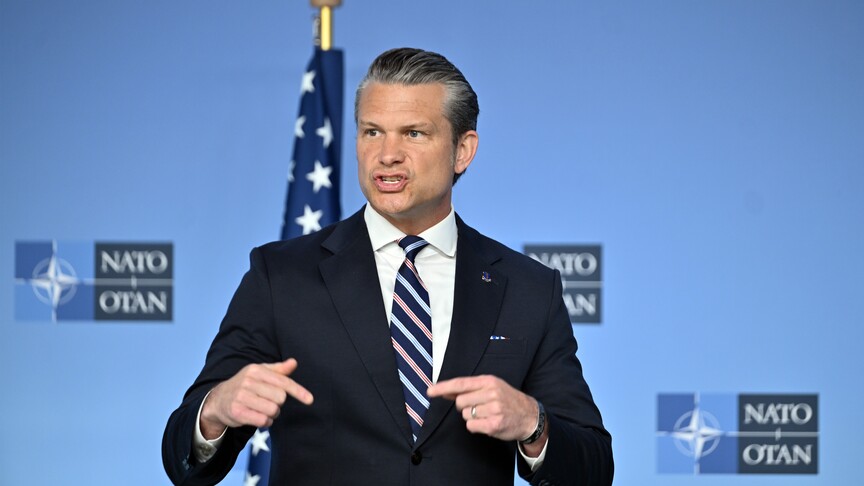
US Defense Secretary Hegseth on Thursday faced protesters while hosting the Trump administration’s DC Safe and Beautiful Task Force ceremony in Washington DC.
During the ceremony at Meridian Hill Park, which saw the gathering of National Guardsmen, dozens of demonstrators gathered near the park to protest Hegseth.
Footage shows the demonstrators chanting a short distance away from where Hegseth and roughly 200 members of the National Guard had gathered in the park
In social media posts, one protester was seen holding a Palestinian flag, while another person was holding a sign that reads “arrest Hegseth.” The protesters want a “Free DC,” according to social media posts.
In his address to the National Guard, Hegseth said that “this background noise is perfect,” referring to the protests.
“It’s the sound of ingrates, of ingratitude—of people who are so blinded by ideology they can’t see law and order and common sense in front of them,” he said.
Meridian Hill Park was repaired by the National Park Service and the Interior Department as part of a larger initiative to restore and enhance federal parks and public spaces throughout the nation’s capital in preparation for America’s 250th anniversary, which falls on this Saturday, July 4.
Though such beautification projects are typically popular with the public, the current initiative has been controversial both for its choice of projects and the use of no-bid contracts to hire firms to do the work, sometimes with disappointing results.
The work aligns with President Donald Trump’s DC Safe and Beautiful Task Force, established by a March 2025 executive order that directs federal agencies to coordinate public safety and beautification efforts across Washington.
Washington, D.C
Metro, DC leaders lay out more details on transit at new Commanders stadium – WTOP News

D.C. officials expressed an urgency Wednesday to begin preparing transit infrastructure for the opening in 2030 of the new Washington Commanders stadium on the old RFK Stadium campus.
D.C. officials expressed an urgency Wednesday to begin preparing transit infrastructure for the opening in 2030 of the new Washington Commanders stadium on the old RFK Stadium campus.
The work will impact far more than the single, cramped Metro station nearby.
During a roundtable discussion with District leaders, Metro General Manager and CEO Randy Clarke laid out the need for improvements to the existing Stadium-Armory Metro stop, and touted a new rapid bus transit line with dedicated lanes.
In tandem, those will be key to getting tens of thousands of people to events at the coming stadium, Clarke said.
“I absolutely believe the first couple of experiences that people have going to a Commanders game, going to some of the first big events, is going to dictate how people feel about taking transit,” D.C. Council member Charles Allen, who chairs the committee that oversees transportation projects, said. “So, we don’t have an option to get it wrong. We have to get it right.”
That’s why Clarke and other District leaders agreed that reaching a memorandum of understanding that lays out the roles, responsibilities and financials of these projects by July 23, the next Metro board meeting, is crucial.
“I think we’re all working towards that, and pretty optimistic,” Clarke said. “Then we’ve got to work really hard on design, we’ve got to work really hard on procurement, we’ve got to work really hard on construction.”
Clarke said the stadium’s ability to attract blockbuster events will depend on the transit agency and its ability to move people in and out of the complex.
“We’re not going to try to get, hosting the Super Bowl, we’re not going to try to host women’s World Cup, we’re not trying to get Taylor Swift and Beyoncé back here. I mean, at the end of the day, Metro is going to be the key to the success. We understand the pressure on us,” he said.
For the Stadium-Armory station, that means renovating the mezzanine and adding elevators to handle the increased demand. Clarke also talked about new street-level infrastructure to help manage the flow inside the station.
“So it’s very Disney-esque, where people feel like they’re constantly moving without actually going too far, if you know what I mean,” Clarke said. “Then we filter them where we need to go. That is a good example of what we need to do at the surface.”
But Metro won’t rely entirely on its trains. The roundtable also discussed what’s been dubbed the Gold Line, which would run buses from Union Station to the stadium.
Construction estimates for bus line are in the $75 million range, District Department of Transportation Director Sharon Kershbaum said
The Gold Line is to run through the heart of the H Street corridor, and transportation leaders said the impact will be everything the streetcar was supposed to be.
“This is now going to be the east-west corridor that we never were able to accomplish on the streetcar,” Kershbaum said.
“This is going to have frictionless service, because it will be center-running. So all of the issues — when a car double-parked and it stopped streetcar service — all of those things, we’ll be immune from. We are going to see the transportation service that was really never ever reached by streetcar achieved with this,” she said.
The vision for the Gold Line goes beyond the handful of weekends when NFL football is played at the stadium, and beyond initial Union Station-stadium route. Transportation officials see the buses eventually traveling between the Benning Road Metro Station and Rosslyn, Virginia.
“We want the Gold Line to solve the cross-town problem we’ve had in this community for a long, long time,” Clarke said.
That means providing access to the convention center and also solving the gridlock that fills up K Street NW every day. Clarke said coming up with dedicated lanes on K Street would actually be the most pivotal part of this new transit line.
“The downtown core of D.C. does not move, especially during p.m. rush hour,” Clarke said. “If you want people in Benning Road that may work, say on K Street, to have better transportation, solving K Street is equally as important, if not more important, because of time savings and reliability.”
Officials did not specify a timeline for the full expansion, but it would not be completed by 2030.
Where it does run, Gold Line buses would travel in the middle lanes, to avoid what caused problems for the Streetcar, which could grind to a halt when cars would double park. Building out the Gold Line would mean more changes to the way cars move along H Street in Northeast.
“You can’t do what you want to do and also keep all the parking,” At-Large Council member Christina Henderson said.
“There’s intersections where we’re going to have to take turns away at certain intersections, maybe parking in certain places,” Clarke said. “In other places parking could be kept, because we’re looking at putting platforms.”
Stadium-related transit construction will run far beyond H Street and the Stadium Armory stop.
“We do want to minimize outages, but there’s going to be significant outages to do this project,” Clarke said.
“It’s all about where we can turn trains around and how to manage that,” he added. “So if we do an outage to Stadium Armory, what that really means is we’re impacting customers from New Carrollton and Largo all the way through the system, and some people that are west of the system that want to go east of Stadium Armory won’t be able to.”
But with the project not even really in the design phase yet, it’s hard to plan out how and when those impacts will happen.
“We’ll be doing obviously overnight work,” Clarke said. “We’ll probably do some, what we call, early outs. Sometimes we’ll start at 10 o’clock at night. We might be able to do some single tracking on certain types of work. Other work is going to be complete shutdowns.”
“And the question is, is that going to be X amount of weekends or is it going to be like a two-, three-, four-week block at a time,” he added. “We’ve got to work through all of that.”
Get breaking news and daily headlines delivered to your email inbox by signing up here.
© 2026 WTOP. All Rights Reserved. This website is not intended for users located within the European Economic Area.
-

 New Jersey4 minutes ago
Legendary NJ Fourth of July lobster catch created record that will never be broken
-

 New Mexico7 minutes ago
$7K baby bond for each New Mexico child? What the state treasurer is proposing
-

 North Carolina12 minutes ago
Warsaw man extradited back to Duplin County in last year’s lottery ticket probe
-

 North Dakota19 minutes ago
North Dakota’s Vantis BVLOS system now open to UAS operators at no cost – Unmanned airspace
-

 Ohio22 minutes ago
Licking County real estate transfers for June 15-19, 2026, hit $697K
-

 Oklahoma27 minutes ago
Can Missouri football get revenge on Oklahoma? How Sooners shape up
-
Oregon34 minutes ago
Oregon Lottery Pick 4 results for July 2
-

 Pennsylvania37 minutes ago
‘Large and growing’ parasitic infection reported in 17 states, including Pa. and NJ

