Washington, D.C
Expanding estimates, unanswered questions: Checking the math on DC stadium deal


At a splashy announcement in late April, D.C. Mayor Muriel Bowser assured taxpayers their $1.1 billion investment in a new football stadium and entertainment complex would be money well spent — pledging that over 30 years the deal would bring in $4 billion in tax revenue.
A month later, her administration released a report from private consultants that upped that figure to $5.1 billion in tax revenue over a 30-year period.
But the News4 I-Team’s review of that new fiscal impact shows at least a third of those tax dollars will remain at the proposed Washington Commanders stadium site — a significant portion of the return promised to taxpayers.
Of the $5.1 billion private consultant CSL predicts the stadium and surrounding district will generate in tax dollars over 30-plus years, the I-Team found $1.7 billion will be spent running the stadium, maintaining the stadium and paying off the money D.C. borrows to build the stadium.
“Some of the tax revenue that’s generating that will stay on the campus is really meant to be able to maintain the quality of what’s there so it doesn’t degrade over time,” said D.C. City Administrator Kevin Donahue, adding those dollars would offset annual operating costs from public safety and civil enforcement associated with game days.
Donahue explained all sales taxes, food and beverage taxes, and ticket taxes generated at the stadium would stay in a fund used solely for the stadium expenses and upkeep.
It’s just one aspect of the $3.7 billion stadium complex deal now under consideration by the D.C. Council, which has discussed delaying a vote on the package Bowser proposed as part of the Council’s annual budget process.
Under the deal, the Commanders pledge to invest $2.7 billion of private money with more than $1 billion in D.C. taxpayer funds to revamp the RFK Stadium site in Ward 7.
The deal has come under fire, however, from taxpayer watchdogs who say District dollars would be better invested in District residents’ more urgent needs.
“This is really an investment in billionaire sports team owners. And what it is going to do is grow their profits while D.C. bears the cost,” Shira Markoff of the DC Fiscal Policy Institute told News4.
Markoff said that, at a time when necessities such as D.C. Medicaid and other safety nets face dramatic cuts, District residents deserve to know the full cost of the deal.
“This is D.C.’s money,” Markoff said. “We want to see it invested on behalf of D.C. residents to really grow our economy, you know, in ways that benefit D.C. workers and our most vulnerable population.”
But proponents of the deal, including Bowser, have argued there are few realistic alternatives for the RFK site, with estimates showing the Commanders complex would generate about 30,000 construction jobs and $4.2 billion in pay for those workers over three decades.
She has defended the multibillion-dollar tax revenue estimates as conservative, saying in early June: “When we look at the number of jobs created, tax revenue generated, the adjacent economic activity that is created, we think it could be even bigger.”
The I-Team asked for clarity on how the anticipated tax revenue changed from $4 billion over three decades to more than $5 billion in the private consultants’ report. The I-Team was told the private consultants aren’t available for media questions, but Donahue said the increase was a result of speeding up the projected opening of restaurants, shops and apartments surrounding the stadium.
“The bigger difference really was in the economic activity that’s happening outside the stadium,” Donahue told News4.
The I-Team wanted to see those dates and details and filed open records requests for the documents showing the initial projections and discussions around them.
The District provided the report breaking down the $5 billion figure but said neither the mayor, deputy mayor for economic development nor about a half dozen of their senior staffers had a copy of the first draft — which included the $4 billion figure — before reporting its promises in the stadium announcement.
The I-Team also was told the District could not locate a single email, text or voice message about it in its records.
The deal also projects as many as 6,477 multi-family residences around the stadium. That is almost five times as many residences in the District’s Wharf neighborhood, according to The Wharf’s website.
Under the deal, the Commanders have the right to develop the residences, but it’s unclear how many District dollars could go to that effort. The District already requires a portion of housing units to be designated as affordable and, according to Donahue, hasn’t ruled out providing additional funds for that purpose.
Donahue said District leaders arrived at the 6,477 number based off a master plan it has for the RFK site. But when the I-Team asked for a copy of that plan, which they said was prepared by outside consultants, they declined to release it.
Meanwhile, the D.C. Council hired an outside consultant to review the terms of the deal, which Bowser said must be approved by July 15 under its agreement with the Commanders. If that date passes, the Commanders could start negotiating again with Maryland or Virginia.
The team has said it hopes to open the new stadium by 2030.
Investigative producer Katie Leslie and photojournalist Derrick Cheston contributed to this report.
Sign up for our free deep-dive newsletter, The 4Front, to get standout News4 stories sent right to your inbox. Subscribe here.



(NEWS FROM THE STATES) – Visitors from across the United States traveled to the National Mall Thursday for the opening day of the Great American State Fair, a days-long event that is part of President Donald Trump’s Freedom 250 celebration of the nation’s semiquincentennial.
States and territories showed off cultural and agricultural exports at exhibits stretching nearly a mile. Attendees snapped photos on the small Grand Ole Opry stage in the Tennessee booth, kids tried putt-putt at Indiana’s miniature golf course and cowboys rode horses at Montana’s rodeo.
A 110-foot Ferris wheel slowly turned at the center of the freshly manicured lawn, framing the Washington Monument and the U.S. Capitol in the distance on either side. Nearby stood a model of Trump’s controversial “triumphal arch.”
People collected swag from each state — drawstring bags from Ohio, stickers from South Dakota, snacks from Tennessee — and could receive a stamp on state fair passports.

The fair is part of the larger Freedom 250 programming and kicked off Wednesday night with a rally on the mall featuring a speech from the president that closely resembled his remarks along the 2024 presidential campaign trail. The festivities will continue over Independence Day, when Trump will deliver a second speech followed by what is promised to be an impressive fireworks display.
The president will visit North and South Dakota as part of his Freedom 250 tour for the opening of the Teddy Roosevelt presidential library and Independence Day eve fireworks above Mount Rushmore.

Freedom 250 then extends into August with a high school athletic competition in Washington, D.C., dubbed the “Patriot Games” and a Freedom 250 INDYCAR race around the National Mall.
The administration’s celebration is separate from the America250 commission, created by Congress a decade ago, and which has its own nationwide programming this year.
From Lake Erie to the Ohio River
Ohio Gov. Mike DeWine and first lady Fran DeWine greeted guests in Ohio’s pavilion. The couple posed for photos in front of a map of the Buckeye State.
“We wanted to see on the wall all the different things, from Lake Erie to the Ohio River, all the different fun things you can do in Ohio,” the Republican governor said, adding the state has local celebrations and initiatives planned for the 250th anniversary, including “Movies in Ohio” for community showings of films that feature the state.

Ohio’s first lady showcased a children’s literacy exhibit on the opposite wall and touted the roughly 427,000 participants in the state’s partnership with the Dolly Parton Imagination Library, a program that mails free children’s books monthly to households with kids under age 5.
“We’ve mailed out 27 million books. We know that a child’s brain is 80% developed by age 3, so we want to get them those books early,” she said.
Reflecting on America’s milestone birthday, the governor said, “We’re always a work in progress, Ohio’s a work in progress, this country is a work in progress.”
“I think you know the thing we need to keep in mind, all of us, is there’s some essential core principles that we all believe in. … We may disagree about different policies, but the core principles are the same,” he said.
Cartwheels on the lawn
People from various states walked from exhibit to exhibit, while stopped in the nation’s capital during road trip vacations.
Tanya Geders, 43, of St. Louis, Missouri, did a cartwheel in the mall lawn, trying to persuade her son to join in. The family stopped at the state fair on their way to Virginia Beach.
“We’re like, well, if we go to the ocean, we can go to D.C. and what a better time to be here than the 250th anniversary,” Geders said.

Robyn Toman, 71, of Severn, Maryland, escorted her 12-year-old grandson Miles to meet DeWine and grab a photo with the governor.
Toman said she remembers the country’s bicentennial.
“I was a kid about his age, and I came in 1976. I said, ‘We’re gonna go, let’s go down to D.C. for a couple days and see this,’” she said.
“We’ve enjoyed it. We went over to the archives yesterday, and saw the Constitution, and the Declaration of Independence, and the Bill of Rights. And, oh, that was so nice, that was fantastic.”
Not all states are there. A spokesperson for Washington state’s lieutenant governor’s office told States Newsroom the administration declined to join because of “the costs to the state associated with participating.”According to news reports, Connecticut, Massachusetts, North Carolina, Oregon, Pennsylvania, Rhode Island and Vermont did not contribute exhibits, though many are still represented by flags outside the individual booths.The state officials did not immediately respond to States Newsroom for confirmation.
All states that reportedly did not participate, with the exception of Vermont, are Democratic-led.
See a spelling or grammatical error in our story? Please click here to report it.
Do you have a photo or video of a breaking news story? Send it to us here with a brief description.
Copyright 2026 KOTA. All rights reserved.
Washington, D.C
DC reaches settlement with man detained while protesting troops with Darth Vader song

The District of Columbia has reached a settlement agreement for an undisclosed amount of money with a resident who claims police illegally detained him for following an Ohio National Guard patrol while playing Darth Vader’s theme song from “Star Wars” on his phone — an act of protest against the Trump administration’s federal law-enforcement surge in the nation’s capital.
A court filing late Thursday says the plaintiff, Sam O’Hara, will drop his lawsuit’s claims against the District and four Metropolitan Police Department officers within three business days of receiving the settlement payment. The filing doesn’t specify a dollar amount for the deal between the district and O’Hara, who is represented by the American Civil Liberties Union of the District of Columbia.
In an email on Friday, an ACLU spokesperson referred to the settlement’s financial terms as “a significant amount” that O’Hara “is pleased with” but said they aren’t disclosing the dollar figure to protect his privacy. A spokesperson for D.C. Attorney General Brian Schwalb’s office declined to comment on the settlement.
O’Hara’s agreement with the district doesn’t resolve his related claims against an Ohio National Guard member. Attorneys for the Guard member, Sgt. Devon Beck, have asked a judge to dismiss O’Hara’s claims against him.
“He was there because that was his assigned duty,” Beck’s lawyers wrote. “This was not an accidental encounter or a one-time disagreement on a public sidewalk.”
An earlier court filing, in February, said O’Hara had reached a settlement agreement “in principle” with the district. In response, a judge agreed to suspend the case while they negotiated terms.
O’Hara sued the district last October, claiming police officers violated his First Amendment rights to free speech and his Fourth Amendment rights against unreasonable seizures and excessive force.
The ominous orchestral music of “The Imperial March” from Star Wars movies was the soundtrack for O’Hara’s peaceful protests against President Donald Trump’s ongoing deployment of Guard members in Washington. Millions of TikTok users have viewed O’Hara’s videos of his interactions with troops, according to his lawsuit.
A series of major events tied to the nation’s 250th anniversary celebrations promise to bring big crowds and heightened security. On the News4 Rundown: That security is likely to include more National Guard troops as a new report says there’s a limit to their impact on safety in D.C.
O’Hara, an artist who works in the hospitality industry, says he didn’t interfere with the Guard troops during their Sept. 11, 2025, encounter on a public street. One of the troops summoned Metropolitan Police Department officers, who stopped O’Hara and kept him handcuffed for 15 to 20 minutes before releasing him without charges, according to the lawsuit.
“The law might have tolerated government conduct of this sort a long time ago in a galaxy far, far away. But in the here and now, the First Amendment bars government officials from shutting down peaceful protests,” the suit says.
Trump, a Republican, issued an executive order declaring a crime emergency in Washington last August. Within weeks, hundreds of Guard troops and federal agents were helping police patrol the city. The surge inflamed tensions with residents of the heavily Democratic district. Hundreds of Guard members remain deployed in the district nearly a year later, with no clear end in sight.
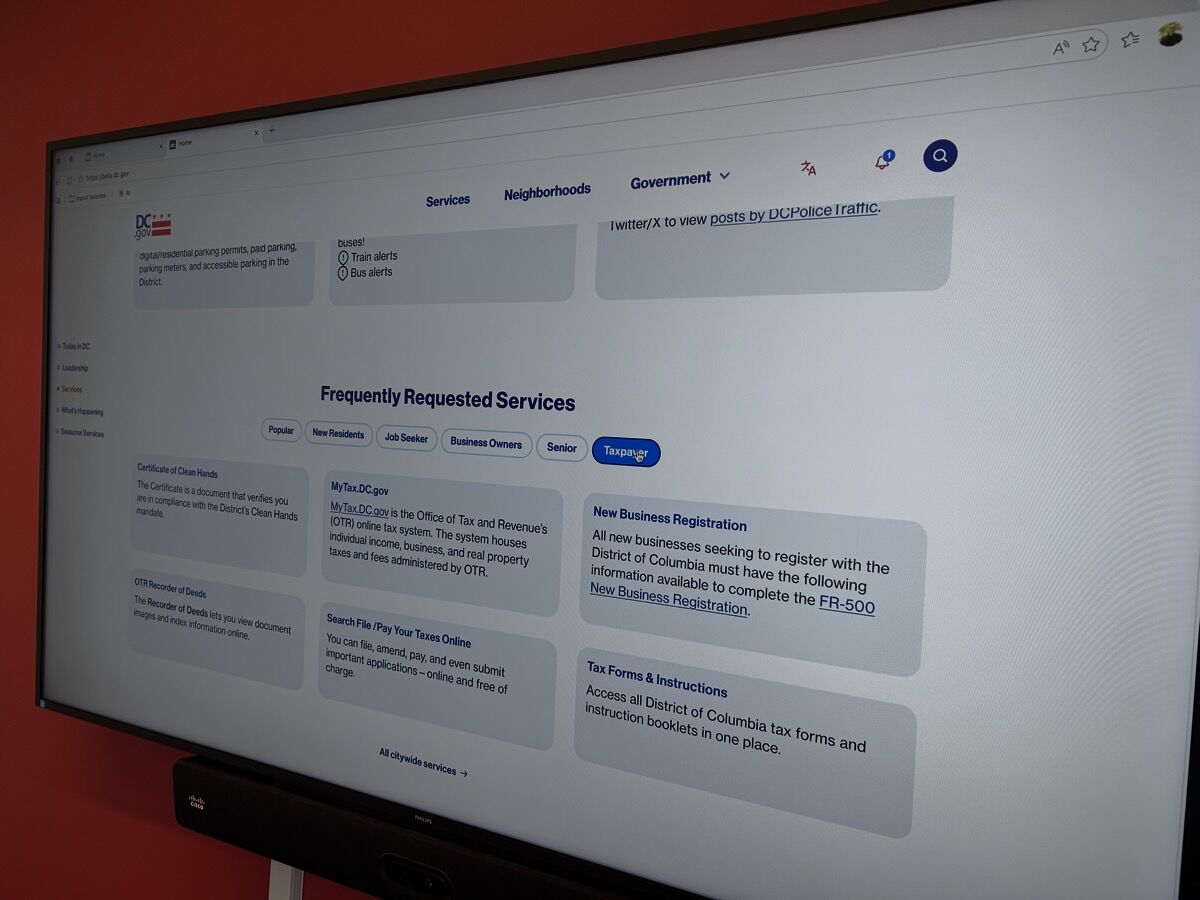
The overhaul is the first in more than a decade and comes in response to feedback that it’s hard to find information on the current site without being efficient at using Google or other search tools.

The D.C. government’s website is getting a complete revamp, a step city leaders hope will make it easier for residents, visitors and business owners to access the help they need.
The District unveiled a beta version of the new DC.gov — beta.dc.gov — and plans to have the redesigned site ready to launch before the end of the year.
The website’s overhaul is the first in more than a decade. It comes in response to feedback that it’s hard to find information on the current site without being efficient at using Google or other search tools.
“This website, it’s really going to eliminate the alphabet soup that you have to remember every day,” said Stephen Miller, the District’s chief technology officer. “So, do you need to know that it’s DPW that’s picking up your trash, or you just need to know that it’s dc.gov?”
The site is built on Drupal 11, which the city said has stronger built-in security features. It includes an integrated calendar and sections for seasonal government services.
Popular searches, based on site traffic data, will also be featured prominently on the main page.
“It’s going to show you, here’s popular services today, based on being a resident, based on being a new resident, based on being a job seeker, based on being a business owner, or based on just being a general resident of the city,” Miller said.
The project cost about $500,000 in dedicated funds.
“We’re setting this up so that you can just go in, say, ‘My trash was missed,’ and it’s going to tell you exactly how to fix that problem,” Miller said.
D.C.’s Office of the Chief Technology Officer is collecting feedback. Residents can leave comments on the beta site and at events at Haynes Senior Wellness Center and Eastern Market, among others, in the coming weeks.
An artificial intelligence-powered search tool, built using Google’s AI technology, will be included on the new DC.gov site after its official launch.
The District, Miller said, is “trying to clean up our content, because what we want to make sure is when we put AI into this site, it’s giving you the right information.”
“We see a lot of future use with AI,” Miller said. “I’d love to get to a point where it’s, ‘Hey Siri, renew my driver’s license,’ and we’ve laid out the foundation for something like that to happen in the future.”
Get breaking news and daily headlines delivered to your email inbox by signing up here.
© 2026 WTOP. All Rights Reserved. This website is not intended for users located within the European Economic Area.
-

 Arizona2 minutes ago
With water cuts looming in Arizona in US, locals fight data centres
-

 Arkansas5 minutes ago
Gubernatorial challengers talk ideas as Sanders skips debate – Arkansas Times
-

 California5 minutes ago
California GOP delegates on LGBT issues, LA decline, Medicaid fraud | Fox News Video
-

 Colorado17 minutes ago
What’s really killing a lot of cattle in Colorado? Hint: wolves aren’t the culprit (Opinion)
-

 Connecticut20 minutes ago
Person reported missing found dead in Brookfield
-

 Delaware25 minutes ago
Delaware ranks among top ice cream-loving states, study finds
-

 Florida32 minutes ago
Missing Florida diver found after multi-agency search
-

 Georgia35 minutes ago
Heat wave expected to bring potential dangerous conditions to South Georgia

