Washington, D.C
Disagree Better In D.C. – National Governors Association


Since launching the Disagree Better initiative last July, National Governors Association Chair Utah Governor Spencer Cox has been traveling around the country to raise awareness — hosting NGA events in New Hampshire and Colorado designed to show that Americans can work through our differences to find solutions to the most difficult problems facing our states and our country.
This week, as the nation’s Governors meet in Washington, D.C., for the 2024 NGA Winter Meeting, Governor Cox led several public forums to speak with thought leaders representing academia, philanthropy, business and government about the good work already happening and the need for more Americans to engage with the initiative to help address toxic polarization in America.
The Economic Club of Washington, D.C.
Governor Cox and Maryland Governor Wes Moore participated in a discussion at The Economic Club of Washington, D.C., on “The State of Bipartisanship in America.” PBS NewsHour’s Judy Woodruff moderated the conversation, which aired on PBS Books and will be repeated March 11 at 8 p.m. ET as part of the station’s Civic Learning Week coverage.
Governors Cox and Moore talked about the loss of community in America that has led people to opt out of society and opt in to insulated realities – watching news sources not to be informed, but to find validation. The Governors also discussed the impact of elevating political performers over those interested in addressing the challenges before us. The impact is acutely evident at the federal level, and Governors must deal with the consequences of dysfunction. Governor Moore noted that Governors don’t have the luxury of political performance because they have to achieve concrete results on a daily basis. Governor Cox added that our old way of looking at politicians through a left/right lens needs to change; instead, we should view leaders as builders or destroyers – and then reward the builders. With a message of civil dialogue as one of the best ways to seek solutions and compromise, the Governors then ran through what this could look like on polarizing issues such as abortion, DEI, immigration and gun control. Watch the entire session.
George Washington University
Governor Cox’s Disagree Better Initiative has prioritized visiting university campuses to meet with students and teach young Americans about healthy conflict and fostering open debate and free expression in higher education. Governor Cox visited two universities prior to the start of the NGA Winter Meeting to connect with students about ways to bring healthy conflict – the kind that leads to solutions rather than endless bickering – back to politics and the public square.
At George Washington University (GW), Governor Cox joined media voices Jonah Goldberg and Michel Martin for a discussion titled, “Disagree Better: How Politicians, the Public and the Press Can Turn Down the Heat.” The conversation, moderated by GW Professor Frank Sesno, was the second in the Sesno Series and aired on Sirius/XM radio in association with GW’s College of Professional Studies and the Bipartisan Policy Center.
Students representing voices from the left, right and center shared their opinions on some of the most topical issues of the day – expressing their concerns about the negative discourse permeating many political conversations. In response, Governor Cox sharing his belief that we need to understand the hearts and minds of the people we speak with, try to form relationships and ask thoughtful questions instead of demonizing those we may disagree with. Governor Cox also urged students to use the power of persuasion, sharing his belief that the parties have given up on persuading others, favoring an “all or nothing” attitude.
National Cathedral
Governor Cox and Governor Moore held a discussion at the National Cathedral titled “With Malice Toward None, With Charity for All.” Governor Cox then led a panel discussion about the Disagree Better initiative with ABC’s Donna Brazile, attorney Rachel Brand, legal scholar Ruth Okediji and nonprofit leader Tim Shriver. Columnist Peter Wehner and Joshua DuBois, Director of Faith-Based and Neighborhood Partnerships for the Obama Administration, also participated in the conversation.
Governors Cox and Moore reflected on their friendship and shared examples of the strong working relationships they share with colleagues of other political parties, noting the value of elected officials forming personal friendships. These experiences prompted Governor Cox’s decision to ask Governors to record video messages with an elected official of the opposite party. Research shows videos of this nature measurably reduce partisanship, and both Governor Cox and Governor Moore have recorded videos with officials of the opposite political party to support Disagree Better.
The Governors also highlighted their shared belief that common ground can be found through service and volunteerism. Governor Moore stated he thinks “service will save our nation,” and noted the recent launch of Maryland’s Service Year Option, the first-in-the-nation public service year program for high school graduates. Maryland is expanding service and volunteerism statewide, creating new pathways of service to meet community needs, enhance workforce development, and promote preparedness for both higher and vocational education.
Governor Cox praised Governor Moore’s service initiative, noting he’s working to advance similar legislation in Utah. Governors Cox and Moore explored Utah’s longstanding reputation for leading the country in public service and volunteerism, stressing that service helps bind people together, allowing Americans to see individuals instead of party lines and division, while also fostering community and common ground.
This event was sponsored by Deseret Magazine, which recently dedicated a special double issue to addressing America’s polarization problem, and held in partnership with the Wheatley Institute at Brigham Young University and Wesley Theological Seminary.
American University
“All of us, we have to demand more; we have to expect more.”
Governor Spencer Cox
Governor Cox visited American University to join NGA Vice Chair Colorado Governor Jared Polis in a conversation on the topic: “Democracy in Peril – Can America Overcome its Divisions?” Former NGA Chair Maryland Governor Larry Hogan moderated the discussion.
The Governors agreed “it’s going to take all of us” – not just elected officials but media, community groups and voters of all ages – to overcome toxic polarization. Governor Cox identified loneliness as a chief driver of political division. Citing the Andrew Putnam book “Bowling Alone,” Governor Cox noted declining participation in institutions – including churches, and civic organizations – that used to bind Americans. Seeking connection, people turn to the toxic combination of politics and social media: “As we’ve gotten away from those institutions, whether it’s religious or volunteer institutions, we’ve become withdrawn, and we have fewer real friends than ever before. But we’re wired for connection. We need it. So we start looking for tribes, and we’re finding unhealthy tribes. We hate the same people together on Facebook or Twitter, and that’s where we’re finding unhealthy connections.”
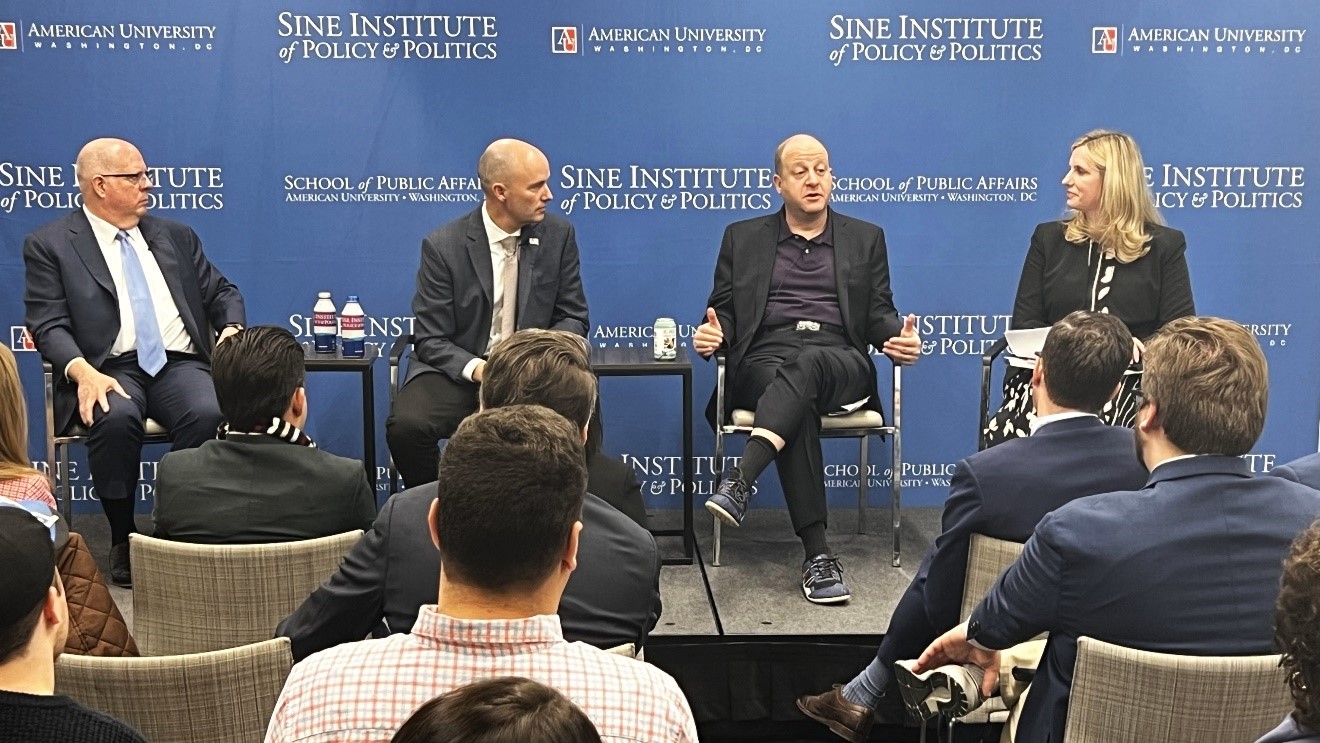
Disagree Better isn’t just about civility, Governor Cox emphasized. “It’s not just being nice to each other, although we certainly need more of that,” he explained. “It’s about disagreeing passionately and staying true to what you believe in, but not tearing down the other person, not using contempt to dehumanize the other side.”
Another misconception about Disagree Better, Governor Polis noted, is the idea that “it means everybody should be like a moderate and try to slice the issue in the middle.” In reality, Governor Polis stated, debate is valuable: “It’s very much okay and, in fact, a treasured part of our democracy that people have profound disagreements. It doesn’t mean that you have to abandon any of your principles or opinions. But it’s about how you disagree – [having] those discussions in a way that elevates them, rather than attack the motives of the other person or call them unAmerican.”
When it comes to what the students in the audience can do to help, Governor Cox encouraged them to be mindful of what they post on social media, “read deeply and widely” to ensure they are consuming accurate news, get involved in Braver Angels and other organizations working to tackle toxic polarization, and to evaluate political candidates not only on their policy positions but on whether their conduct as candidates is constructive and respectful.
You can watch the discussion here.
POLITICO’s 2024 Governors Summit
In addition to these conversations, POLITICO Live welcomed a bipartisan group of Governors to engage in conversations about state policy efforts around issues, including AI, economic development, infrastructure, housing and energy. Under the framework of exploring how the “laboratories of democracy are working overtime and ushering in a new era of policy making,” POLITICO moderators held one-on-one interviews on initiatives Governors are leading. Below is a selection of Governor’s remarks. Learn more about the event here.


4 things to know about the weather:
- Chances of rain in the morning
- Gusty Sunday
- Chilly Monday
- Temps will rise again through the work week
Download the NBC Washington app on iOS and Android to check the weather radar on the go.
After a nice and warm Saturday, changes arrive for part two of the weekend.
The first half of your Sunday will have a chance for showers. Winds will pick up with our next system and are expected to gust to about 20-30 mph. Cooler air will settle in, and lows Sunday night fall into the 40s.
Highs temps Monday will reach only into the mid to upper 50s.
However, temperatures will rise through the week, so you won’t need your jackets every day.
QuickCast
SUNDAY:
Showers, then partly cloudy
Wind: NW 10-15 mph
Gusts @ 30 mph
HIGH: Lower 60s
MONDAY:
Partly cloudy
Wind: NW 10-15 mph
Gusts @ 25 mph
HIGH: Upper 50s
Stay with Storm Team4 for the latest forecast. Download the NBC Washington app on iOS and Android to get severe weather alerts on your phone.
Washington, D.C
‘It’s a twilight zone’: Iran war casts deep shadows over IMF gathering in Washington

The most severe energy shock since the 1970s, the risk of a global recession and households everywhere stomaching a renewed surge in the cost of living – hitting the most vulnerable hardest.
In a sweltering hot Washington DC this week, the message at the International Monetary Fund meetings was chilling: things had been looking up for living standards around the world. But then came the Iran war.
“Some countries are in panic,” said the fund’s managing director, Kristalina Georgieva, addressing the finance ministers and central bank bosses in town for the IMF and World Bank spring meetings. “The sooner it [the Iran war] ends, the better for everybody.”
Such gatherings are not typically used to fight geopolitical battles. “You don’t get people shouting at one another at these things,” one senior figure remarked. But, as a record-breaking April heatwave swept the US capital, no one could ignore the mounting damage from the Iran war.
Those familiar with the mood over breakfast at a meeting of the G20’s representatives on Thursday, which included Donald Trump’s treasury secretary, Scott Bessent, and the outgoing US Federal Reserve chair, Jerome Powell – said the atmosphere in the room was sombre amid an open exchange of serious views.
“It is such a twilight-zone meeting,” said Mohamed El-Erian, a former IMF deputy managing director who is now chief economic adviser at the Allianz insurance group. “There are several shadows hanging over it: one is the shadow that comes from concern about the global economy as a whole.
“The second is that some countries are going to be particularly hard hit, and it’s mostly countries that very few people are talking about. But the third concern is the adding of insult to injury: the fact that the US, which started a war of choice, is going to be hit, but by a lot less than elsewhere in relative terms.”
Before Thursday’s breakfast, Rachel Reeves had started her day with an early-morning jog. Joined by her counterparts from Spain, Australia and New Zealand for a run down the iconic National Mall, she posted an Instagram selfie with a not-so-subtle dig: “Friends that run together – work together.”
A day earlier, the chancellor had told a CNBC conference that she thought “friends are allowed to disagree on things” as she criticised Trump’s Iran war as a “mistake” and a “folly” that had not made the world safer.
Speaking at a venue just steps away from the White House, before a one-on-one meeting with Bessent, she said this “fair message” was needed because UK families and businesses were feeling the pain from higher energy prices triggered by the conflict.
Those close to Reeves insist her meeting remained cordial. Britain and the US have significant shared interests in AI, financial services and trade. The chancellor also said the UK government had little time for the Iranian regime.
But with the IMF having warned on Tuesday that the Iran war could risk a global recession – in which Britain would be the biggest G7 casualty – it was clear Reeves had travelled to Washington ready to pick a fight.
“I’m struck by how vocal she has been and the words she used,” said one global financier. “We know the disagreement between Bessent and [European Central Bank president] Christine Lagarde earlier in the year. But that was in private.”
At a cocktail party held at the British ambassador’s residence for hundreds of diplomats and financiers – including the Bank of England’s governor, Andrew Bailey, the chief executive of Barclays, CS Venkatakrishnan, and dozens of senior figures – this transatlantic tension, weeks before King Charles’s US state visit, was a major topic of conversation.
The other, in the balmy residence gardens, was one of its former occupants, Peter Mandelson, as revelations about the former ambassador’s appointment threatened to further rock the UK government.
Before the war, the agenda for the IMF had been about global cooperation; the adoption of AI, jobs and work to eradicate poverty. Each of those tasks had now been complicated, but not least the task of countries working together.
For many at the meetings, the focus was on forging closer global cooperation without the world’s pre-eminent superpower.
“Everybody is talking about how you hedge against American decisions,” said David Miliband, the former UK foreign secretary, who now runs the International Rescue Committee. “You can’t do without them, because they’re 25% of the global economy. But, in a lot of fora, they’ve pulled out.
“So everyone has to think, how does one structure international cooperation? The old west is not coming back. And so everyone has to figure out how to position themselves for that world.”
For those gathering in Washington, there was irony in the fact that they were meeting in the halls of institutions founded, under US leadership, to promote global cooperation after the second world war. The whole idea of the Bretton Woods institutions was to avoid the dire economic conditions and warfare of the 1930s and 1940s. Yet this year’s meeting was taking place amid these intertwining problems.
In their conversations about the best economic policy response to the shock of conflict, the economists also knew the real power to make a difference lay two blocks across town from the IMF and the World Bank – behind the security cordons and construction equipment blocking the White House from public view. “It is not clear they can do anything about it,” said El-Erian.
Still, with a booming economy driven by AI – including Anthropic’s powerful Mythos model, the topic of much conversation – most countries cannot afford to completely break off US ties.
“People want to find ways to insulate themselves from the mess. But, on the other hand, they admire the US private sector,” El-Erian said. “The best way I’ve heard it put, is: they want to go long the private sector and short the mess. But it’s almost impossible to do.”

Washington, D.C. (7News) — Rosselli is the newest restaurant to open in DC.
Bringing in classic Italian flavors, Chef Carlos explained how he hopes his food is a unique addition to the Italian food scene in the DMV.
Chef also demoed a signature dish with Brian and Megan.
BE THE FIRST TO COMMENT
You can learn more and book your table here.
-

 South Dakota2 minutes ago
Nature: Prairie chickens in South Dakota
-

 Tennessee8 minutes ago
Tennessee baseball vs Ole Miss score, live updates, start time, Game 3
-

 Texas14 minutes ago
Texas needs at least $174 billion to avoid water crisis, state says
-
 Utah20 minutes ago
Multiple earthquakes detected near Kanosh
-

 Vermont26 minutes ago
Wrong-way driver stopped on I-89, charged with DUI
-

 Virginia32 minutes ago
Parachutist Slams into Jumbotron at Virginia Tech Spring Game
-

 Wisconsin44 minutes ago
US animal rights activists clash with police over Wisconsin dog breeder
-

 West Virginia50 minutes ago
The 2026 WVU Tommy Nickolich Award Goes to a Parkersburg Native