Washington, D.C
Disagree Better In D.C. – National Governors Association


Since launching the Disagree Better initiative last July, National Governors Association Chair Utah Governor Spencer Cox has been traveling around the country to raise awareness — hosting NGA events in New Hampshire and Colorado designed to show that Americans can work through our differences to find solutions to the most difficult problems facing our states and our country.
This week, as the nation’s Governors meet in Washington, D.C., for the 2024 NGA Winter Meeting, Governor Cox led several public forums to speak with thought leaders representing academia, philanthropy, business and government about the good work already happening and the need for more Americans to engage with the initiative to help address toxic polarization in America.
The Economic Club of Washington, D.C.
Governor Cox and Maryland Governor Wes Moore participated in a discussion at The Economic Club of Washington, D.C., on “The State of Bipartisanship in America.” PBS NewsHour’s Judy Woodruff moderated the conversation, which aired on PBS Books and will be repeated March 11 at 8 p.m. ET as part of the station’s Civic Learning Week coverage.
Governors Cox and Moore talked about the loss of community in America that has led people to opt out of society and opt in to insulated realities – watching news sources not to be informed, but to find validation. The Governors also discussed the impact of elevating political performers over those interested in addressing the challenges before us. The impact is acutely evident at the federal level, and Governors must deal with the consequences of dysfunction. Governor Moore noted that Governors don’t have the luxury of political performance because they have to achieve concrete results on a daily basis. Governor Cox added that our old way of looking at politicians through a left/right lens needs to change; instead, we should view leaders as builders or destroyers – and then reward the builders. With a message of civil dialogue as one of the best ways to seek solutions and compromise, the Governors then ran through what this could look like on polarizing issues such as abortion, DEI, immigration and gun control. Watch the entire session.
George Washington University
Governor Cox’s Disagree Better Initiative has prioritized visiting university campuses to meet with students and teach young Americans about healthy conflict and fostering open debate and free expression in higher education. Governor Cox visited two universities prior to the start of the NGA Winter Meeting to connect with students about ways to bring healthy conflict – the kind that leads to solutions rather than endless bickering – back to politics and the public square.
At George Washington University (GW), Governor Cox joined media voices Jonah Goldberg and Michel Martin for a discussion titled, “Disagree Better: How Politicians, the Public and the Press Can Turn Down the Heat.” The conversation, moderated by GW Professor Frank Sesno, was the second in the Sesno Series and aired on Sirius/XM radio in association with GW’s College of Professional Studies and the Bipartisan Policy Center.
Students representing voices from the left, right and center shared their opinions on some of the most topical issues of the day – expressing their concerns about the negative discourse permeating many political conversations. In response, Governor Cox sharing his belief that we need to understand the hearts and minds of the people we speak with, try to form relationships and ask thoughtful questions instead of demonizing those we may disagree with. Governor Cox also urged students to use the power of persuasion, sharing his belief that the parties have given up on persuading others, favoring an “all or nothing” attitude.
National Cathedral
Governor Cox and Governor Moore held a discussion at the National Cathedral titled “With Malice Toward None, With Charity for All.” Governor Cox then led a panel discussion about the Disagree Better initiative with ABC’s Donna Brazile, attorney Rachel Brand, legal scholar Ruth Okediji and nonprofit leader Tim Shriver. Columnist Peter Wehner and Joshua DuBois, Director of Faith-Based and Neighborhood Partnerships for the Obama Administration, also participated in the conversation.
Governors Cox and Moore reflected on their friendship and shared examples of the strong working relationships they share with colleagues of other political parties, noting the value of elected officials forming personal friendships. These experiences prompted Governor Cox’s decision to ask Governors to record video messages with an elected official of the opposite party. Research shows videos of this nature measurably reduce partisanship, and both Governor Cox and Governor Moore have recorded videos with officials of the opposite political party to support Disagree Better.
The Governors also highlighted their shared belief that common ground can be found through service and volunteerism. Governor Moore stated he thinks “service will save our nation,” and noted the recent launch of Maryland’s Service Year Option, the first-in-the-nation public service year program for high school graduates. Maryland is expanding service and volunteerism statewide, creating new pathways of service to meet community needs, enhance workforce development, and promote preparedness for both higher and vocational education.
Governor Cox praised Governor Moore’s service initiative, noting he’s working to advance similar legislation in Utah. Governors Cox and Moore explored Utah’s longstanding reputation for leading the country in public service and volunteerism, stressing that service helps bind people together, allowing Americans to see individuals instead of party lines and division, while also fostering community and common ground.
This event was sponsored by Deseret Magazine, which recently dedicated a special double issue to addressing America’s polarization problem, and held in partnership with the Wheatley Institute at Brigham Young University and Wesley Theological Seminary.
American University
“All of us, we have to demand more; we have to expect more.”
Governor Spencer Cox
Governor Cox visited American University to join NGA Vice Chair Colorado Governor Jared Polis in a conversation on the topic: “Democracy in Peril – Can America Overcome its Divisions?” Former NGA Chair Maryland Governor Larry Hogan moderated the discussion.
The Governors agreed “it’s going to take all of us” – not just elected officials but media, community groups and voters of all ages – to overcome toxic polarization. Governor Cox identified loneliness as a chief driver of political division. Citing the Andrew Putnam book “Bowling Alone,” Governor Cox noted declining participation in institutions – including churches, and civic organizations – that used to bind Americans. Seeking connection, people turn to the toxic combination of politics and social media: “As we’ve gotten away from those institutions, whether it’s religious or volunteer institutions, we’ve become withdrawn, and we have fewer real friends than ever before. But we’re wired for connection. We need it. So we start looking for tribes, and we’re finding unhealthy tribes. We hate the same people together on Facebook or Twitter, and that’s where we’re finding unhealthy connections.”
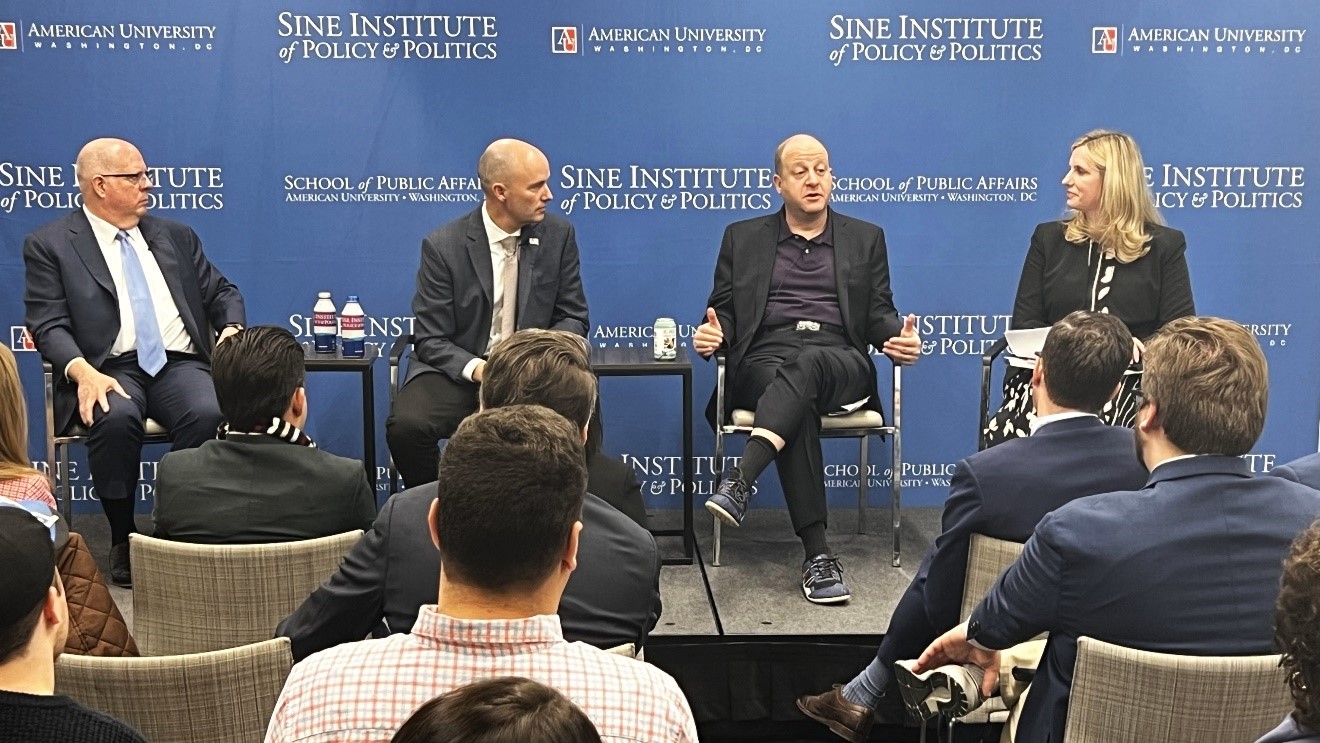
Disagree Better isn’t just about civility, Governor Cox emphasized. “It’s not just being nice to each other, although we certainly need more of that,” he explained. “It’s about disagreeing passionately and staying true to what you believe in, but not tearing down the other person, not using contempt to dehumanize the other side.”
Another misconception about Disagree Better, Governor Polis noted, is the idea that “it means everybody should be like a moderate and try to slice the issue in the middle.” In reality, Governor Polis stated, debate is valuable: “It’s very much okay and, in fact, a treasured part of our democracy that people have profound disagreements. It doesn’t mean that you have to abandon any of your principles or opinions. But it’s about how you disagree – [having] those discussions in a way that elevates them, rather than attack the motives of the other person or call them unAmerican.”
When it comes to what the students in the audience can do to help, Governor Cox encouraged them to be mindful of what they post on social media, “read deeply and widely” to ensure they are consuming accurate news, get involved in Braver Angels and other organizations working to tackle toxic polarization, and to evaluate political candidates not only on their policy positions but on whether their conduct as candidates is constructive and respectful.
You can watch the discussion here.
POLITICO’s 2024 Governors Summit
In addition to these conversations, POLITICO Live welcomed a bipartisan group of Governors to engage in conversations about state policy efforts around issues, including AI, economic development, infrastructure, housing and energy. Under the framework of exploring how the “laboratories of democracy are working overtime and ushering in a new era of policy making,” POLITICO moderators held one-on-one interviews on initiatives Governors are leading. Below is a selection of Governor’s remarks. Learn more about the event here.

Berk Kutay Gökmen
02 July 2026•Update: 02 July 2026
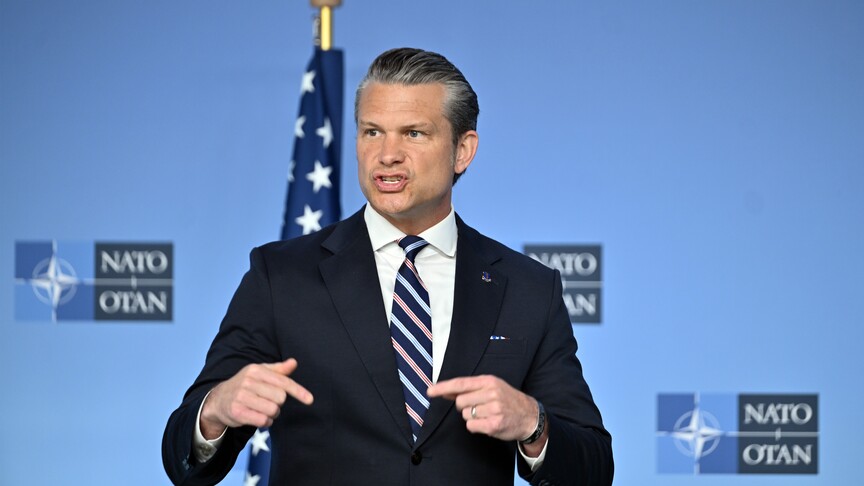
US Defense Secretary Hegseth on Thursday faced protesters while hosting the Trump administration’s DC Safe and Beautiful Task Force ceremony in Washington DC.
During the ceremony at Meridian Hill Park, which saw the gathering of National Guardsmen, dozens of demonstrators gathered near the park to protest Hegseth.
Footage shows the demonstrators chanting a short distance away from where Hegseth and roughly 200 members of the National Guard had gathered in the park
In social media posts, one protester was seen holding a Palestinian flag, while another person was holding a sign that reads “arrest Hegseth.” The protesters want a “Free DC,” according to social media posts.
In his address to the National Guard, Hegseth said that “this background noise is perfect,” referring to the protests.
“It’s the sound of ingrates, of ingratitude—of people who are so blinded by ideology they can’t see law and order and common sense in front of them,” he said.
Meridian Hill Park was repaired by the National Park Service and the Interior Department as part of a larger initiative to restore and enhance federal parks and public spaces throughout the nation’s capital in preparation for America’s 250th anniversary, which falls on this Saturday, July 4.
Though such beautification projects are typically popular with the public, the current initiative has been controversial both for its choice of projects and the use of no-bid contracts to hire firms to do the work, sometimes with disappointing results.
The work aligns with President Donald Trump’s DC Safe and Beautiful Task Force, established by a March 2025 executive order that directs federal agencies to coordinate public safety and beautification efforts across Washington.
Washington, D.C
Metro, DC leaders lay out more details on transit at new Commanders stadium – WTOP News

D.C. officials expressed an urgency Wednesday to begin preparing transit infrastructure for the opening in 2030 of the new Washington Commanders stadium on the old RFK Stadium campus.
D.C. officials expressed an urgency Wednesday to begin preparing transit infrastructure for the opening in 2030 of the new Washington Commanders stadium on the old RFK Stadium campus.
The work will impact far more than the single, cramped Metro station nearby.
During a roundtable discussion with District leaders, Metro General Manager and CEO Randy Clarke laid out the need for improvements to the existing Stadium-Armory Metro stop, and touted a new rapid bus transit line with dedicated lanes.
In tandem, those will be key to getting tens of thousands of people to events at the coming stadium, Clarke said.
“I absolutely believe the first couple of experiences that people have going to a Commanders game, going to some of the first big events, is going to dictate how people feel about taking transit,” D.C. Council member Charles Allen, who chairs the committee that oversees transportation projects, said. “So, we don’t have an option to get it wrong. We have to get it right.”
That’s why Clarke and other District leaders agreed that reaching a memorandum of understanding that lays out the roles, responsibilities and financials of these projects by July 23, the next Metro board meeting, is crucial.
“I think we’re all working towards that, and pretty optimistic,” Clarke said. “Then we’ve got to work really hard on design, we’ve got to work really hard on procurement, we’ve got to work really hard on construction.”
Clarke said the stadium’s ability to attract blockbuster events will depend on the transit agency and its ability to move people in and out of the complex.
“We’re not going to try to get, hosting the Super Bowl, we’re not going to try to host women’s World Cup, we’re not trying to get Taylor Swift and Beyoncé back here. I mean, at the end of the day, Metro is going to be the key to the success. We understand the pressure on us,” he said.
For the Stadium-Armory station, that means renovating the mezzanine and adding elevators to handle the increased demand. Clarke also talked about new street-level infrastructure to help manage the flow inside the station.
“So it’s very Disney-esque, where people feel like they’re constantly moving without actually going too far, if you know what I mean,” Clarke said. “Then we filter them where we need to go. That is a good example of what we need to do at the surface.”
But Metro won’t rely entirely on its trains. The roundtable also discussed what’s been dubbed the Gold Line, which would run buses from Union Station to the stadium.
Construction estimates for bus line are in the $75 million range, District Department of Transportation Director Sharon Kershbaum said
The Gold Line is to run through the heart of the H Street corridor, and transportation leaders said the impact will be everything the streetcar was supposed to be.
“This is now going to be the east-west corridor that we never were able to accomplish on the streetcar,” Kershbaum said.
“This is going to have frictionless service, because it will be center-running. So all of the issues — when a car double-parked and it stopped streetcar service — all of those things, we’ll be immune from. We are going to see the transportation service that was really never ever reached by streetcar achieved with this,” she said.
The vision for the Gold Line goes beyond the handful of weekends when NFL football is played at the stadium, and beyond initial Union Station-stadium route. Transportation officials see the buses eventually traveling between the Benning Road Metro Station and Rosslyn, Virginia.
“We want the Gold Line to solve the cross-town problem we’ve had in this community for a long, long time,” Clarke said.
That means providing access to the convention center and also solving the gridlock that fills up K Street NW every day. Clarke said coming up with dedicated lanes on K Street would actually be the most pivotal part of this new transit line.
“The downtown core of D.C. does not move, especially during p.m. rush hour,” Clarke said. “If you want people in Benning Road that may work, say on K Street, to have better transportation, solving K Street is equally as important, if not more important, because of time savings and reliability.”
Officials did not specify a timeline for the full expansion, but it would not be completed by 2030.
Where it does run, Gold Line buses would travel in the middle lanes, to avoid what caused problems for the Streetcar, which could grind to a halt when cars would double park. Building out the Gold Line would mean more changes to the way cars move along H Street in Northeast.
“You can’t do what you want to do and also keep all the parking,” At-Large Council member Christina Henderson said.
“There’s intersections where we’re going to have to take turns away at certain intersections, maybe parking in certain places,” Clarke said. “In other places parking could be kept, because we’re looking at putting platforms.”
Stadium-related transit construction will run far beyond H Street and the Stadium Armory stop.
“We do want to minimize outages, but there’s going to be significant outages to do this project,” Clarke said.
“It’s all about where we can turn trains around and how to manage that,” he added. “So if we do an outage to Stadium Armory, what that really means is we’re impacting customers from New Carrollton and Largo all the way through the system, and some people that are west of the system that want to go east of Stadium Armory won’t be able to.”
But with the project not even really in the design phase yet, it’s hard to plan out how and when those impacts will happen.
“We’ll be doing obviously overnight work,” Clarke said. “We’ll probably do some, what we call, early outs. Sometimes we’ll start at 10 o’clock at night. We might be able to do some single tracking on certain types of work. Other work is going to be complete shutdowns.”
“And the question is, is that going to be X amount of weekends or is it going to be like a two-, three-, four-week block at a time,” he added. “We’ve got to work through all of that.”
Get breaking news and daily headlines delivered to your email inbox by signing up here.
© 2026 WTOP. All Rights Reserved. This website is not intended for users located within the European Economic Area.

WASHINGTON, D.C. — Ohioans are among the visitors traveling to the nation’s capital this week for the Great American State Fair, part of the country’s 250th birthday celebration.
On Wednesday, visitors trickled into the Ohio state pavilion booth, which includes a map of Ohio’s most iconic places and an exhibit on several children’s initiatives championed by Gov. Mike DeWine, First Lady Fran DeWine and Lt. Gov. Jim Tressel.
“I wanted to come here, we wanted to see the sights here. We figured once in a lifetime,” said Carolyn Golamb of Fremont, who was visiting Washington, D.C. with her husband, Mark.
The fair has been a source of controversy after multiple musicians scheduled to perform at a kickoff concert withdrew, citing political concerns.
The event was organized by Freedom 250, a White House-backed group that has been accused of usurping the government’s official America250 commission, created by Congress 10 years ago for the same purpose. In addition, many elements of the fair have pushed a partisan message, such as President Donald Trump’s campaign-style rally on June 25 and events like “MAHA Mondays.”
Amid the controversy, attendance at the fair has been sparse.
Rep. Dave Taylor, R-Ohio, attributed the light turnout not to politics, but to forecasts of triple-digit heat this week.
“The weather is going to hold numbers down a little bit,” he said. “There’s a lot of walking to go from one place to another here, and people are here visiting with little kids. I think you’re going to see the numbers pick up as we get closer to Saturday for sure.”
Several visitors from Ohio said they did not notice any partisanship at the fair.
“That is the reason why I’m here, is because all of us have made a big positive contribution to what makes America great. And it’s not just one group or one party or anything. It’s all of us together,” said Toledo native Cassandra Newsome.
“It’s the 250th anniversary. No matter who was in power at the time, I still would be here,” said Mark Golamb.
The fair runs June 25 to July 10 on the National Mall.
-
 Science4 minutes ago
Contributor: Alcohol should be stigmatized like smoking
-
 Sports11 minutes ago
Thousand Oaks native Claire Liu finally reaches Wimbledon’s third round, will face Coco Gauff
-

 World19 minutes ago
Could water become a flashpoint between Islamabad and New Delhi?
-
 News44 minutes ago
Ukraine latest / Limits of military might / Can major powers regain dominance? : Sources & Methods
-

 Los Angeles, Ca2 hours ago
Juvenile charged with murder after 4-month-old Claremont infant thrown to her death
-

 Detroit, MI2 hours ago
Silence from Jalen Duren’s camp is what the Pistons want to hear
-

 San Francisco, CA3 hours ago
Jury deadlocked on 2 counts for Golden Gate Bridge pro-Palestinian protesters
-

 Dallas, TX3 hours ago
Ross Tower hits the market as Downtown Dallas sale wave builds

