Washington, D.C
DC man says he’s owed $340 million after incorrect winning Powerball numbers posted


A 60-year-old Washington, D.C., man thought he became an overnight multimillionaire but now he’ll have to argue in court to retrieve the $340 million fortune he says Powerball unlawfully denied him.
John Cheeks’ January 2023 Powerball ticket indicated he’d won $340 million, but when he attempted to redeem the prize, he got denied and told to throw his jackpot “in the trash can,” according to the complaint filed in November 2023.
Cheeks’ suit alleges he was deprived of his winnings due to “unlawful collusion” by Powerball, the Multi-State Lottery Association and Taoti Enterprises — a D.C.-based digital advertising agency that operates the D.C. Lottery website. The named defendants did not honor the posted winning Powerball numbers that matched Cheeks’ lottery ticket, according to the suit.
USA TODAY contacted Powerball, the Multi-State Lottery Association and Taoti Enterprises but did not receive a response.
“This is not merely about numbers on a website; it’s about the reliability of institutions that promise life-changing opportunities, while heavily profiting in the process,” Rick Evans, Cheeks’ attorney, told USA TODAY. “… We intend to collect every penny to which (Cheeks) is entitled to right this wrong.”
How did Cheeks find out he’d won?
Cheeks bought the “winning ticket” Jan. 6, 2023, from a licensed retailer, according to the suit. He told USA TODAY that he chose the ticket’s numbers by using family birthdates. The numbers Cheeks chose were “07-15-23-32-40” with a Powerball number of 2, the suit says.
“All the numbers that I have played are totally common significant related numbers to me and my life,” he said.
The live drawing of the numbers occurred Jan. 7, 2023, but Cheeks said he didn’t rush to check his ticket due to him being “exhausted as hell” from a meeting with his accountant that day. Unbeknownst to Cheeks, the winning numbers on the website that day matched the ticket he’d bought.
When Cheeks checked the D.C. Lottery website the following morning, he saw he’d won the jackpot due to his numbers matching the winning numbers, the suit says.
The odds of winning a Powerball jackpot are about 1 in 292.2 million.
“I couldn’t believe my eyes so I turned my laptop off, unplugged it, took it down and started it up again,” Cheeks said. “There were the numbers again, matching my ticket.”
Although Cheeks had possibly won millions, he recalled not being excited, but “exhausted” and “numb.”
With a clear head, Cheeks said he called a friend who told him to take a picture of the winning ticket because “you never know what could go wrong.” Cheeks held off from redeeming the ticket that day so he could wait and meet with advisors beforehand, he said.
Taoti claims posting of Cheeks’ numbers was ‘a mistake’
For the next three days, the D.C. Lottery website showed the winning numbers. By Jan. 10, 2023, the numbers on the website had changed and differed from the ones shown since Jan. 7, according to the suit.
During an administrative hearing May 2, 2023, Taoti claimed that it “accidentally” posted Cheeks’ winning numbers to the D.C. Lottery website Jan. 7, the suit says. The company then said the “mistake” wasn’t removed from the website until Jan. 9.
That the numbers were erroneously posted on the D.C. Lottery site explains why Cheeks’ personal numbers didn’t match the numbers Cheeks saw when he went to a licensed retailer and checked his ticket against what was posted at the Office of Lottery and Gaming claiming center in D.C., the lawsuit says.
More lottery: Powerball winning numbers for Feb. 17 drawing: Jackpot worth over $300 million
While at the claim center, one of the officials told Cheeks to throw the ticket away “in the trash can” and that “we’re not going to pay you for it,” he said.
“I gave the guy a look and said ‘I think I’ll just keep this,’” Cheeks said. “He looked at me and I walked out. That was a very humiliating day.”
Brittany Bailey, the project manager at Taoti, said in court documents that Cheeks’ “attempted scheme” is a way to capitalize on an “obvious error” on the D.C. Lottery website. Rather than posting random numbers on a “test website” by Taoti, as intended, they were mistakenly posted Jan. 6 on the D.C. Lottery Website, she said.
“First, any ordinary person knows that winning lottery numbers are not posted or advertised in advance; they cannot be because they have not been drawn yet,” Bailey said in the court filings. “Second, the list of numbers posted did not include a Powerball number, but simply a blank red ball. These red flags would cause any reasonable person to know that they were not the valid winning numbers for the following day.”
The test numbers posted on Jan. 6 remained on the D.C. Lottery website even after the correct numbers were posted, Bailey said. When Taoti employees saw the test numbers, they realized the error and took them down, she said.
What did Cheeks do with the Powerball ticket?
Cheeks’ Powerball ticket is currently in a safe deposit box, he said.
If Cheeks is granted the money, he said he’ll open up a bank like Homestead and HomeTrust that would help people who normally wouldn’t qualify for a home mortgage.
“We’re going to build (and) rehab homes from D.C., to Maryland, Virginia and any other place that we’re needed to help solve the homeownership crisis,” Cheeks said.
The Powerball jackpot grew to $754.6 million before a ticketholder in Washington state claimed the prize on Feb. 6, 2023.
Evans said the D.C. Lottery and Powerball are aggressively marketing to consumers in D.C. and others on a national and international stage. The companies’ failure to make a public service announcement once they realized the game was compromised only led to them selling more tickets and “generating an enormous amount of revenue,” he said.
“As the pot grows, more people play and DC and Powerball make tremendous amounts of money on those ticket sales,” Evans said. “… This lawsuit raises critical questions about the integrity and accountability of lottery operations and the safeguards—or lack thereof—against the type of errors that Powerball and the DC Lottery contend occurred in this case.”
Due to the D.C. Lottery and Powerball’s “alleged error,” Evans said Cheeks should be paid out the winnings because precedent exists of them paying declared winners when a similar situation occurred in Iowa.
Iowa lottery officials blamed an unspecified “human reporting error” in November 2013 after posting the wrong Powerball numbers, which remained on its website for more than six hours. Anyone who cashed in their winning tickets was still able to claim their prizes, which ranged from $4 to $200, the Associated Press reported.



WASHINGTON – Washington, D.C., mayoral candidate Kenyan McDuffie on Thursday conceded the Democratic primary race to Janeese Lewis George.
Although the official certification of the primary race is continuing, McDuffie said in a statement that “it is clear that the voters have chosen a different path.” The former member of the D.C. council said he had contacted Lewis George and congratulated her. He thanked his supporters and urged them to continue working for the city.
“The campaign may be over, but the work of building a safer, more affordable, more prosperous city continues.”
The Associated Press has not declared a winner in the race. Lewis George had a little less than 53% of the vote Thursday morning, which is just a few percentage points above the 50% threshold to avoid ranked choice voting.
The city is scheduled to release preliminary ranked choice voting results on Sunday. AP will call the race before then if it is clear that the ranked choice process will be avoided.
Lewis George has pledged to aggressively stand up to federal intervention into Washington, D.C.’s, affairs, setting up a potential showdown with President Donald Trump over his administration’s moves to challenge the city’s limited autonomy.
If the results stand, Lewis George is likely to win November’s general election in the heavily Democratic city. The winner in the general election will replace Muriel Bowser, who decided not to run again after three terms.
Lewis George would join Robert White Jr., who won the Democratic primary for the district’s delegate to Congress, as the top local officials who likely will contend with the federal government’s intentions for the city. They each campaigned on a promise to take a harder line than their predecessors against the Trump administration’s moves on the district, including its deployment of the National Guard on an ongoing, open-ended mission meant to fight crime.
“As mayor, I will work with anyone who makes D.C. safer,” Lewis George told a crowd of cheering supporters Tuesday night, “but I will also stand up to Trump.”
Washington has limited autonomy and federal leaders retain significant control over local affairs, including approval of the budget and laws passed by the D.C. Council.
Trump further encroached on that autonomy last year when he briefly federalized the city’s police force and deployed an ongoing law enforcement surge that included the National Guard. His efforts to downsize the federal government also roiled the capital region, costing thousands of people their jobs. And he has been reshaping the city by renovating storied landmarks and putting his name or image on buildings.
Lewis George, a self-described democratic socialist and a member of the D.C. Council, has already come under fire from Trump, who last week threatened to place the city under federal control if she won.
“Maybe we’d take back Washington, run it on the federal basis,” he said.
Lewis George, 38, and a third generation Washingtonian, has vowed to overrule an executive order by the city’s police chief permitting local law enforcement to cooperate with Immigration and Customs Enforcement agents. Lewis George argued the order “hurt the trust of our community.”
She also pledged to use any levers available to her through the city’s home rule compact to resist what she called authoritarian infringements on the district’s local governance.
“We have legal tools we can use to fight back,” she told the AP in an interview before the vote. “And we know that when we have gone to court, we’ve won.”
Bowser found herself walking a fine line between staying in Trump’s good graces and responding to the concerns of constituents, many of whom said she didn’t push back hard enough on Trump’s actions. Eleanor Holmes Norton, the 18-term, 89-year-old delegate to Congress, meanwhile, faced mounting concern from critics who said she wasn’t forcefully pushing back on the Trump administration’s moves against the city.
Copyright 2026 The Associated Press. All rights reserved. This material may not be published, broadcast, rewritten or redistributed without permission.
Darren Lyn
18 June 2026•Update: 18 June 2026
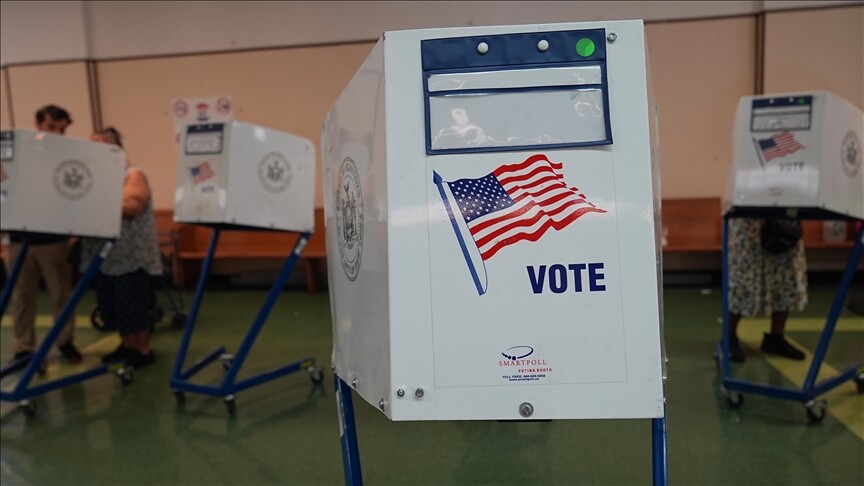
Democratic socialist Janeese Lewis George currently leads the vote tally as of Wednesday versus six other candidates in the Washington, DC Democratic mayoral primary, and if victorious, could be following in the footsteps of the most notable democratic socialist in the United States — New York Mayor Zohran Mamdani.
With 73% of the ballots counted since Tuesday’s primary election in the nation’s capital, the Associated Press (AP) has Lewis George leading with 52.9% of the vote. Her closest challenger is Kenyan McDuffie, who currently holds 36.5%.
The mayor’s office in the District of Columbia has traditionally been a Democratic stronghold, and political experts have said that any Republican challenger is not expected to put up meaningful competition for the mayor’s seat in the general election.
If Lewis George keeps her current lead and wins the majority, she will head to the November election as the favorite to replace three-term Mayor Muriel Bowser, who decided not to run for a fourth term.
A victory for Lewis George would be to the ire of US President Donald Trump, who told reporters that he could attempt a federal takeover of Washington if she won the mayor’s race, according to local media reports.
“We won’t put up with it,” Trump told reporters at a news conference.
Yet Trump has already seen a democratic socialist take power in America’s largest city, with the election of Mamdani as mayor of New York City.
Not to be outdone, the race for the mayor’s office in Los Angeles, California — the second largest city in the US by population — has a democratic socialist, Nithya Raman, in the runoff to vie for the position in November’s general election. Raman will face incumbent Democratic Mayor Karen Bass, who narrowly edged out Raman in the primary 34.3% to 29.0%.
In California’s 14th congressional district, two candidates will head to a runoff election to replace former US Rep. Eric Swalwell, who resigned from Congress in April amid allegations of sexual assault, including rape.
Aisha Wahab secured the first runoff spot on Tuesday with 38.3% of the vote, with the AP on Wednesday calling the second position to go to Melissa Hernandez, who tallied 17.2%.
The runoff election will be held on Aug. 18, with the winner finishing out the rest of Swalwell’s term.

At time of writing, the Associated Press estimates that around 64% of votes have been counted. Races where no candidate wins a majority of first choices will proceed to a ranked choice voting count – most likely the at-large Council and Ward 1 Democratic primaries. With RCV, all nominees will have support from a majority of their party – as will the winner in an at-large Council special election.
Mayor
In the closely watched mayoral race, Councilmember Janeese Lewis George leads with 52.8% of voters’ first choices, followed by former Councilmember Kenyan McDuffie at 36.6%. If Lewis George remains above 50% as the remaining votes are counted, a ranked choice tabulation will not be necessary to determine the winner.
Congressional delegate
Five candidates ran in the Democratic primary to succeed retiring Delegate Eleanor Holmes Norton. Councilmember Robert White won that election with 63.2% of first choices. Councilmember Brooke Pinto came in second with 21.5% of first choices.
At-large Council Democratic primary
Nine candidates ran for the Democratic nomination to succeed at-large Councilmember Anita Bonds. No candidate has won a majority of first choices. Oye Owolewa leads with 33.8%, followed by Lisa Raymond at 15.2% and Kevin Chavous at 13.8%. The result will likely be determined by a ranked choice voting count.
| Candidate | Share of first choices |
| Oye Owolewa | 33.8% |
| Lisa Raymond | 15.2% |
| Kevin B Chavous | 13.8% |
| Greg Jackson | 11.0% |
| Candace Tiana Nelson | 7.7% |
| Dwight Davis | 6.0% |
| Fred Hill | 5.4% |
| Dyana N. M. Forester | 3.7% |
| Leniqua’dominique Jenkins | 3.0% |
| Write-in | 0.4% |
In a choose-one election, Owolewa would have won the nomination despite 66% of voters voting for another candidate. In 2022, for instance, Councilmember Anita Bonds won the Democratic primary for this seat with only 36% of first choices. Now, ranked choice voting will ensure the nominee – whether Owolewa or someone else – has majority support.
At-large Council special election
In the special election for at-large Council, former Councilmember Elissa Silverman is leading with 54.8% of first choices, followed by appointed Councilmember Doni Crawford and Board of Education President Jacque Patterson, with 25% and 19% respectively. If Silverman maintains a majority of first choices, there will be no ranked choice tabulation.
Ward 1
In the competitive Democratic primary for Ward 1 councilmember, Aparna Raj leads with 47% of first choices. Depending on remaining ballots, Raj may win with a majority of first choices, or the winner may be determined by a ranked choice voting count.
Candidate
Share of first choices
Aparna Raj
46.7%
Michael Trindade Deramo
20.3%
Rashida Brown
17.2%
Jackie Reyes Yanes
10.0%
Terry Lynch
5.8%
Write-in
0.1%
Notably, in three Council races – the at-large Council Democratic primary, at-large Council special election, and Ward 1 Democratic primary – candidates cross-endorsed each other, asking voters to rank each other on their ballots. Past elections show that voters often listen to cross-endorsements by candidates they support, so it’s possible candidates who cross-endorsed will benefit when their races go to RCV tallies.
DC’s ranked choice voting elections offer a sharp contrast with the District’s recent past, in which candidates regularly won key primaries without majority support. Since 2012, every districtwide office and six of the eight wards have seen Democratic primaries won with less than 50% of the vote. Since 2020, Ward 2 and Ward 7 have had Democratic Council primaries won with less than 30% of the vote.
FairVote will post more analysis of the DC election over the coming week. In the meantime, visit Grow Democracy DC to learn more about RCV in DC.
-

 Vermont6 minutes ago
Possible tornado causes damage in small Vermont town during Thursday’s intense storms – The Boston Globe
-

 Virginia9 minutes ago
First responders train in Blacksburg
-

 Washington14 minutes ago
Washington State University Vancouver faculty, staff anxiously await details of 15% budget cuts
-

 Wisconsin21 minutes ago
President of Wisconsin’s largest mosque released from ICE custody
-

 West Virginia24 minutes ago
Community Catalyst Grant applications are open through West Virginia First Foundation through June 30 – WV MetroNews
-
 Wyoming29 minutes ago
250 Portraits self-portrait exhibition now on display throughout downtown Jackson
-

 Crypto36 minutes ago
Crypto’s Courtside Takeover: Digital Assets in Pro Tennis
-

 Finance39 minutes ago
Consumer confidence plunges among younger adults

