Washington, D.C
3 takeaways from the military parade and No Kings protests on Trump's birthday


Members of the U.S. Army Band “Pershing’s Own” watch fireworks at the end of a military parade commemorating the Army’s 250th anniversary on Saturday in Washington, D.C.
Julia Demaree Nikhinson/AP
hide caption
toggle caption
Julia Demaree Nikhinson/AP
The U.S. Army celebrated its 250th anniversary on Saturday with a massive military parade in Washington, D.C., against a backdrop of political division and protests savaging President Trump rippling across the country.
Trump, whose 79th birthday corresponded with the Army anniversary, had long dreamed of holding such a display of America’s military might.
The parade stirred up controversy for what opponents view as a politicization of the nation’s armed forces and a break from U.S. democratic norms, and sparked an organized No Kings protest movement across the country on Saturday.

Here’s how the day unfolded.
1. Stormy clouds didn’t rain on the parade
Despite threats of lightning and storms rolling into D.C., the parade went ahead as advertised.
It featured dozens of armored tanks and artillery vehicles, such as HIMARS, army aircraft, including Black Hawk helicopters and Apaches, and more than 6,000 uniformed troops. The idea was to walk viewers through the history of American military conflict, with some historical uniforms and vehicles being used.

Armored vehicles drive during the Army 250th Anniversary Parade in Washington, DC on June 14, 2025.
Alex Wroblewski/AFP via Getty Images
hide caption
toggle caption
Alex Wroblewski/AFP via Getty Images

Members of the U.S Army parade down Constitution Avenue, representing the Revolutionary War era.
Andrew Harnik/Getty Images
hide caption
toggle caption
Andrew Harnik/Getty Images
Additionally, 34 horses, two mules and one dog — a Blue Heeler named Doc Holliday — joined the march.
Mike Davis, a 30-year Army serviceman who was at the parade as a spectator, said he welcomed the flashy affair — that the military had been overdue for a big bash.

“The last time we’ve had a military parade of any sorts, I recall, is the Gulf War,” Davis said. “So, it’s been a long time and what better way to celebrate it than the 250th?”
Davis said that protests against the event cast a pall on what he thought should be a celebratory occasion, but that he also backed people’s First Amendment rights to speak out.
“We go to war and defend the nation’s rights for the citizens to do things like that, so more power to it,” he said.
The weekend festivities came with an expected price tag of between $25 million and $45 million, according to Army spokesperson Heather J. Hagan. That includes planned road repairs due to possible damage from tanks rolling on city streets.
2. Trump got the thing he has wanted for years
Trump wanted to hold the parade during his first term, but it was scrapped because it was deemed too expensive. He was inspired after attending the annual Bastille Day parade in France in 2017. That parade celebrates French mobs taking over the Bastille state prison in 1789.
In closing remarks following Saturday’s procession, he hailed the Army as the “greatest, fiercest and bravest fighting force” the world had ever seen.

President rump stands and salutes, flanked by Secretary of Defense Pete Hegseth and First Lady Melania Trump.
Mandel Ngan/AFP via Getty Images
hide caption
toggle caption
Mandel Ngan/AFP via Getty Images
“The Army keeps us free, you make us strong, and tonight you’ve made all Americans very proud,” he said. “Every other country celebrates their victories. It’s about time America did too. That’s what we’re doing tonight.”
After his speech, Trump was presented with a traditionally folded American flag — a gift usually reserved for the family members of fallen soldiers.
Since the parade was announced, there has been sharp criticism, particularly from Democratic lawmakers who called the showcase self-indulgent and a misuse of public funds.
“To use the military in this manner when Donald Trump is slashing veterans’ benefits to aggrandize himself, to communicate to the country his control over the military, is just another shameful act of this administration,” said Democratic Sen. Adam Schiff of California.
Other critics have said it’s a display of military force typically associated with autocratic governments in places like Russia or North Korea.
“It’s a vulgar display,” Democratic Gov. Gavin Newsom of California said during a news conference on Friday. “It’s the kind of thing you see Kim Jong Un, you see Putin, you see with dictators around the world that are weak.”
3. Protests spring up across the country
No Kings protests rippled peacefully across dozens of cities in the U.S.
Organizers estimated that more than 5 million people participated in more 2,000 planned protests, according to spokesperson Eunic Ortiz. While protests were peaceful, police in Culpeper, Va., arrested a man who “intentionally accelerated his vehicle into the dispersing crowd,” at the end of a protest. One person was hit, but no one was hurt, police said.
Tens of thousands marched peacefully in Philadelphia, where organizers were holding their main event, police said. Philadelphia was chosen as the hub, because “there’s an indelible link between Philadelphia and between the freedoms and the ideals that the country was founded upon,” said Joel Payne, spokesperson for MoveOn, one of the dozens of groups behind the No Kings protests.

Demonstrators hold signs as they march down Dolores street protesting the Trump administration during the No Kings rally in San Franscisco, Californina on June 14.
Nic Coury/AFP via Getty Images
hide caption
toggle caption
Nic Coury/AFP via Getty Images

A protestor holds a placard during a march down the Benjamin Franklin Parkway to the Philadelphia Museum of Art during a nationwide No Kings rally in Philadelphia on Saturday.
Erin Blewett/AFP via Getty Images
hide caption
toggle caption
Erin Blewett/AFP via Getty Images
Ezra Levin, co-founder and co-executive director of the nonprofit Indivisible, another No Kings coordinator, said the atmosphere at the event was joyful.
“Today what I saw was a boisterous, peaceful display of First Amendment rights,” he told NPR.
Thousands were at a Dallas protest, one of more than 60 planned in Texas, KERA reported. In Alaska, the theme was, “The only king I want is king salmon,” Alaska Public Media reported.

Shahera Hyatt of Sacramento made signs for her local event that read, “From Palestine to Mexico, border walls have got to go,” and “ICE, you’re fired.”
“I decided to go because I feel like with unchecked authority, Trump has led America into clear fascism,” she told NPR.
There were some feelings of unease amid the protesters, some of whom turned off their phones and avoided posting to social media.
“It does feel like there’s a vendetta against people who are exercising their rights to speak up against this administration,” said protester Ali Schoenberger of Sacramento. “So I feel like it’s important to protect my fellow protestors today and not expose them or even have it on my phone.”

Protesters rally in front of City Hall in Los Angeles on Saturday.
Mario Tama/Getty Images
hide caption
toggle caption
Mario Tama/Getty Images
“I am completely terrified of what’s going on in our country,” said protester Margo Ross of Watsonville, Calif. “I believe from the beginning it’s been a coup and a fascist overthrow, and I keep thinking, ‘Well, it can’t get worse.’ And then it gets worse and worse.”
Separately, U.S. Capitol Police said they arrested 60 protesters Friday evening after some pushed down barriers and ran toward the steps of the Rotunda. They say all 60 will be charged with unlawful demonstration and crossing a police line. Additional charges include assault on a police officer and resisting arrest. The groups behind the protests didn’t immediately respond to requests for comment.
The No Kings demonstrations were put together by a coalition of more than 200 organizations, including MoveOn, the American Civil Liberties Union, American Federation of Teachers and the Communications Workers of America. Protests were not planned in Washington, D.C., where the military parade was held.

Washington, D.C
What’s that noise? What you need to know about D.C. flyovers Friday and Saturday – WTOP News

Reagan National Airport will close for America 250 flyover rehearsals Friday and celebrations Saturday featuring the Thunderbirds, Blue Angels and more.

Reagan National Airport will close from 10 a.m. to 1 p.m. Friday for rehearsals ahead of this weekend’s America 250 celebrations, meaning people around D.C., Arlington and Alexandria may hear and see low-flying military aircraft.
According to Freedom 250 event organizers, Friday’s “Wings of Freedom” demonstrations over the National Mall will feature parachute teams, helicopters and military aircraft, including the U.S. Marine Corps’ MV-22 Osprey and F-35B, the Navy’s F-18F and F-35C, the Air Force’s F-22 Raptor, the Thunderbirds and a tri-bomber formation.
On Saturday, the FAA will close the airport from noon to midnight for the full celebration. All arrivals and departures at Reagan National are scheduled to end before noon.
Flyovers and demonstrations are scheduled throughout the afternoon and evening along the National Mall and Washington Monument grounds, including appearances by Air Force One, the Thunderbirds, Blue Angels, military aircraft fleet reviews, parachute demonstrations and B-2 stealth bombers.
Highlights include an Air Force One flyover scheduled for 7:03 p.m., a Thunderbirds demonstration beginning at 6:25 p.m., a tri-bomber formation at 6:02 p.m. and a stealth aircraft flyover at 7:38 p.m.
Friday’s schedule of flyovers and demonstration rehearsals along the National Mall and Washington Monument
- 10 a.m.: Golden Knights, Leap Frogs
- 10:15 a.m.: Army Helo Flyover
- 10:20 a.m.: USMC V-22 Osprey Demo
- 10:35 a.m.: USMC F-35B STOVL Demo
- 10:50 a.m.: USN F-18F Demo
- 11:10 a.m.: USN F-35C Demo Team
- 11:30 a.m.: USAF F-22 Raptor Demo
- 11:50 a.m.: NASA F-5s
- 12 p.m.: HUGE (1) Formation
- 12:05 p.m.: USAF Thunderbirds
- 12:55 p.m.: USAF Tri-Bomber
Saturday’s schedule of flyovers and demonstration along the National Mall and Washington Monument
- 1:14 p.m.: – NASA F-5 Flyover
- 1:24 p.m.: -NASA Fleet Review
- 1:44 p.m.: USCG Helo Flyover
- 1:54 p.m.: USCG Fixed Wing Flyover
- 2:09 p.m.: Golden Knights, Leap Frogs
- 2:29 p.m.: Army Helo Flyover
- 2:44 p.m.: USAF Fleet Review – Wave 1 – Heavies
- 2:54 p.m.: USAF Fleet Review – Wave 2 – AFSOC
- 3:04 p.m.: USAF Fleet Review – Wave 3 – Fighters
- 3:29 p.m.: Executive Rotary Wing Airlift
- 3:39 p.m.: USMC Fleet Review – Wave 1 – Rotary
- 3:49 p.m.: USMC Fleet Review – Wave 2 – Fixed Wing
- 3:59 p.m.: USN Fleet Review – Wave 1 – Rotary
- 4:09 p.m.: USN Fleet Review – Wave 2 – Fixed Wing
- 4:19 p.m.: USN Fleet Review – Wave 3 – Fighters
- 4:21 p.m.: USN F-18F Demonstration
- 4:59 p.m.: USN Blue Angels
- 5:26 p.m.: USMC MV-22 Osprey Demonstration
- 5:44 p.m.: USAF Fleet Review – Fighters
- 6:02 p.m.: USAF Tri-Bomber Formation
- 6:05 p.m.: USN F-35C Demonstration
- 6:25 p.m.: USAF Thunderbirds Demonstration
- 7:03 p.m.: Air Force One Flyover
- 7:07 p.m.: USAF Thunderbirds Delta Break
- 7:17 p.m.: HUGE 1 Flyover Led by the Newly Renovated Air Force One
- 7:38 p.m.: U.S. Stealth Airpower Flyover
- 7:39 p.m.: F-22 Raptor Demo
- 7:53 p.m.: F-22 Raptor in Afterburner
- 7:59 p.m.: B-1 Flyover
- 8:07 p.m.: B-1’s in Afterburner
- 8:11 p.m.: HUGE ONE Fly Over Review
- 8:22 p.m.: Golden Knights Twilight Jump
- 10:36 p.m.: B-1 Afterburner Night Pass
Get breaking news and daily headlines delivered to your email inbox by signing up here.
© 2026 WTOP. All Rights Reserved. This website is not intended for users located within the European Economic Area.

An Air Force major was arrested in uniform on the steps of the Capitol after he called for the impeachment of President Donald Trump.
U.S. Capitol Police arrested Jason Watson, an active-duty service member, on Wednesday afternoon following remarks at a news conference where he said Trump and Vice President JD Vance should be removed from office.
The event was organized by the Removal Coalition, a group that lobbies members of Congress to impeach Trump, and attended by Rep. Al Green, D-Texas, who has repeatedly introduced articles of impeachment against Trump.
“I’m here with him because Rep. Green is the only member of Congress that has demonstrated the courage and conviction to … force a vote on articles of impeachment,” Watson said at the event. “If Congress followed his example, we could remove the entire Trump administration, but Congress remains unconvinced of the urgency and necessity for them to honor their oaths, so we must persuade them with our unrelenting, uncompromising civil resistance.”
Watson said he is not a Democrat and does not share policy positions with Green, who lost his re-election bid this year. Green’s office did not immediately respond to a request for comment on Watson’s arrest.
Capitol Police said in a statement that it “is generally against the law for the public to demonstrate on the House Steps unless they are with a Member of Congress.”
“Yesterday afternoon, a man was escorted to the House Steps by a Member of Congress,” the statement said. “When the Member of Congress left the area, our officers gave the man lawful orders to stop the illegal demonstration or he would be arrested. The man refused our lawful orders.”
Capitol Police identified the man as Watson, adding that he was arrested on charges of “Crowding, Obstructing, and Incommoding” and that it is legal to protest in other spots on the Capitol grounds.
Service members are subject to stricter laws than the average citizen when it comes to protesting. The Uniform Code of Military Justice prohibits officers from “using contemptuous language towards the President, Vice president, the Secretaries of War and of a military department, Congress, and certain other officials,” according to an Air Force memo last year.
An Air Force spokesperson said in a statement Thursday: “Service members must comply with all laws, regulations and policies governing conduct and the wear of the uniform. All Department of the Air Force personnel are expected to uphold the highest standards of discipline and professionalism, both on and off duty.”
All service members, not just members of the Air Force, are prohibited from participating in “political activities” in uniform.
Watson’s criticism of Trump and Vance focused on the administration’s actions in Venezuela and Iran, calling them “an unconstitutional usurpation of Congress’ authority and a violation of the War Powers Clause.”
“These violations resulted in the deaths of 13 service members and injuries of hundreds more,” he said, referring to the number of U.S. military deaths tied to the Iran war. “For this, the president and vice president must be impeached, convicted and removed.”
Watson also called the administration’s immigration policies and tactics unconstitutional.
The Removal Coalition did not immediately respond to a request for comment, and Watson could not be reached.
President Donald Trump responded to criticism of a financial disclosure that listed $1.4 billion in crypto earnings largely driven by meme coins.
Berk Kutay Gökmen
02 July 2026•Update: 02 July 2026
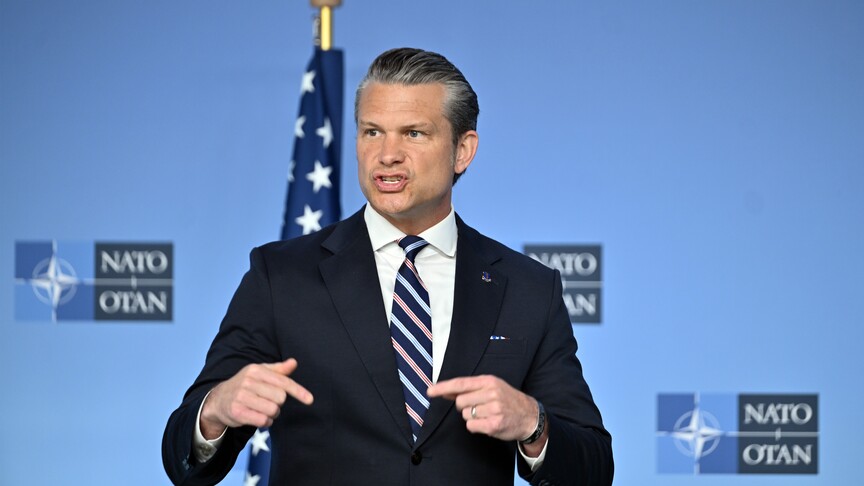
US Defense Secretary Hegseth on Thursday faced protesters while hosting the Trump administration’s DC Safe and Beautiful Task Force ceremony in Washington DC.
During the ceremony at Meridian Hill Park, which saw the gathering of National Guardsmen, dozens of demonstrators gathered near the park to protest Hegseth.
Footage shows the demonstrators chanting a short distance away from where Hegseth and roughly 200 members of the National Guard had gathered in the park
In social media posts, one protester was seen holding a Palestinian flag, while another person was holding a sign that reads “arrest Hegseth.” The protesters want a “Free DC,” according to social media posts.
In his address to the National Guard, Hegseth said that “this background noise is perfect,” referring to the protests.
“It’s the sound of ingrates, of ingratitude—of people who are so blinded by ideology they can’t see law and order and common sense in front of them,” he said.
Meridian Hill Park was repaired by the National Park Service and the Interior Department as part of a larger initiative to restore and enhance federal parks and public spaces throughout the nation’s capital in preparation for America’s 250th anniversary, which falls on this Saturday, July 4.
Though such beautification projects are typically popular with the public, the current initiative has been controversial both for its choice of projects and the use of no-bid contracts to hire firms to do the work, sometimes with disappointing results.
The work aligns with President Donald Trump’s DC Safe and Beautiful Task Force, established by a March 2025 executive order that directs federal agencies to coordinate public safety and beautification efforts across Washington.
-

 Los Angeles, Ca8 minutes ago
2 arrested after 3 LASD deputies injured during East L.A. World Cup celebration
-

 Detroit, MI26 minutes ago
Ex-girlfriend in custody after Taylor man found fatally stabbed, police say
-

 San Francisco, CA38 minutes ago
Marina braces for Golden Gate Bridge fireworks show, massive crowds
-

 Dallas, TX41 minutes ago
Maradona’s ‘Hand of God’ ball heads to auction in Dallas
-

 Miami, FL46 minutes ago
Miami-Dade sheriff urges residents to celebrate Fourth of July safely
-

 Boston, MA53 minutes ago
Jaylen Brown says Celtics showed ‘lack of respect’ after trade to 76ers – The Boston Globe
-

 Denver, CO56 minutes ago
Who are the Top 5 offensive linemen in Denver Broncos history?
-

 Seattle, WA1 hour ago
Seattle’s Lake Union to light up with big July 4 fireworks show for America’s 250th

