Virginia
Tony Bennett’s Ego-Driven Final Act as Virginia Coach


Tony Bennett was emotional and candid in saying goodbye to the Virginia Cavaliers and college basketball Friday. And perhaps calculating, too.
Bennett said he didn’t reach this decision to abruptly retire, less than three weeks before Virginia’s opener, until a recent fall getaway with his wife. He acknowledged thinking about it in the spring, when rumors were flying in the sport that he might hang it up. But then he signed a recruiting class, and a contract extension, and said he was excited for the season … until he suddenly wasn’t.
Maybe that’s an honest accounting of how it all went down. But this could be construed as a shrewd move designed to do two things:
Bennett isn’t built for college hoops in the 2020s, a time when athletes have more freedom and a lot of adults struggle with the concept. This was the last act of a coach who craves control.
Bennett’s lack of adaptation to the modern world has little to do with his stodgy, stultifying but largely successful playing style. It’s more related to modern rules and player movement. (It’s less about NIL—he acknowledged that players should be compensated.)
He’s an old 55 when it comes to the current state of the game, and he freely admitted that Friday. More than any of the other national championship coaches who have retired in recent years—from Jay Wright to Jim Boeheim to Mike Krzyzewski to Roy Williams—Bennett plainly stated that the current state of affairs is driving him away.
He called himself “a square peg in a round hole.” He said his staff “pulled me along” in the new era by handling most of the conversations with players’ agents. He said college athletics “is not in a healthy spot,” and that it needs to “get back to regulations and guardrails. There’s things that need to change.”
NCAA regulations and guardrails have been getting routed in the courts for the past several years, so this yearning for yesteryear might be a losing fight. But there was one battle Bennett could still win, and that was the timing and nature of his retirement.
If he’d retired last spring, the transfer portal would have opened for 30 days for the Virginia players. The Cavaliers’ roster likely would have scattered. That’s the way of the world now. It happens almost everywhere that a coaching change occurs.
Same thing if he’d retired during the summer, or anytime before classes began at Virginia Aug. 27. Even for another month after that, players likely could have transferred and found an immediate spot at a school that is on a quarter system and didn’t begin classes until late September.
Doing it now, smack in the middle of the semester, leaves those players with nowhere to go. That includes five incoming transfers, from Florida State, San Diego State, Kansas State, Duke and Vanderbilt. It also includes two freshmen. They’re pawns in Bennett’s program preservation chess game.
And now Sanchez is in charge of moving those pawns around the board. If Bennett had stepped down in the spring, maybe Sanchez gets the job but maybe not—Virginia athletic director Carla Williams would have been able to make that call and conduct a search, if she so desired. Doing it mere weeks before the season opener forces Virginia to go along with Bennett’s personal succession plan for 2024–25 at least.
This is an ego-and-control play, though he’s hardly the first to do it. It’s a tried-and-true move for basketball coaches who have been successful enough to call their own shot.
Oct. 9, 1997: Dean Smith retired at North Carolina, gifting the job to assistant coach Bill Guthridge. While winning a lot and taking the Tar Heels to two Final Fours, Guthridge only lasted three seasons before stepping down himself.
Nov. 30, 2000: None other than Dick Bennett, Tony’s dad, stepped down three games into the season at Wisconsin, and seven months after taking the Badgers to the Final Four. He was 57 years old, just two years older than Tony is now. Bennett handed the job to Brad Soderberg, who finished the season but didn’t keep the job. (Soderberg has worked for Tony Bennett at Virginia since 2021.)
Dick Bennett came out of retirement in 2003 to be the coach at Washington State. After three seasons he turned the program over to … Tony Bennett.
Sept. 12, 2012: Jim Calhoun retired at Connecticut, amid some strife and controversy. But after winning three national championships, Calhoun had the clout to hand-pick successor Kevin Ollie. He won a surprise natty in 2014 but was fired by 2018.
Dec. 15, 2015: Bo Ryan, who followed Soderberg as the successor to Dick Bennett at Wisconsin, went to the Dick Bennett retirement playbook. After going to the Final Four the previous season, Ryan announced that the 2015-16 season would be his last and he’d be replaced by assistant Greg Gard. Then Ryan waffled on whether he would retire. Then he did, abruptly, 12 games into the season, and Gard took over.
With those retirements, the players left behind were stuck in place for that season—and then faced a year sitting out if they chose to move to a new school. At least now, Virginia players can participate in 2025–26 at their new school. But they have effectively been held hostage for 2024–25.
(December graduate transfers, if there are any candidates for that on this Virginia team, could play as soon as the spring semester somewhere else. That might be difficult, due to scholarship availability and playing time and rotations being set. But it’s allowable under NCAA rules.)
Bennett is held in universally high regard in his profession and around college athletics. His It’s The System’s Fault retirement at a young age will generate a new spasm of despair over the state of things. Some concerns are justified, but many are exaggerated—and not much is going to change on account of Tony Bennett.
This last act of a coach who craves control is only a win for him and his hand-picked successor. It doesn’t beat back the advancing tide of the new era.


CLARKSBURG, W.Va. (WBOY) — West Virginia has plenty of state symbols, be it the black bear as the state animal, the cardinal as the state bird or the rhododendron as the state flower, but did you know that the Mountain State also has its own official gun?
The Hall Flintlock Model 1819 was first manufactured in Harpers Ferry by John H. Hall in 1811 and was adopted by the United States Army in 1819, making it the first breech-loading rifle ever adopted by a country’s military.
-

Model 1819 Hall Breechloading Rifle presented by Congress to Gustavous A. Bird for his participation in the Battle of Plattsburgh 9/11/1814 by John C. Bird via the Smithsonian Institution -
Model 1819 Hall Breechloading Rifle presented by Congress to Gustavous A. Bird for his participation in the Battle of Plattsburgh 9/11/1814 by John C. Bird via the Smithsonian Institution


All of this information is listed in Senate Concurrent Resolution 7, which was introduced and passed during the 2013 West Virginia Legislative session, and officially recognizes the Model 1819 as the official firearm of the State of West Virginia.
On top of being created in West Virginia, the resolution also points out that the rifle saw use during the Civil War, an event that directly led to West Virginia’s statehood.
While having an officially recognized state firearm may seem far-fetched, West Virginia is not the only state that has one. As a matter of fact, a fifth of the states in the country have officially designated a state firearm, including West Virginia’s neighbors in Kentucky and Pennsylvania.

CHARLOTTE, N.C. — In this world of college football, with the transfer portal and recruiting battles, bad blood is present more than ever before between head coaches.
That’s not the case between the Virginia Tech head coach and Clemson head coach Dabo Swinney, however. In fact, Franklin revealed at ACC Kickoff on Thursday that the two are actually close friends, dating back to their time at the Nike trip that various coaches take over the summer.
“Dabo’s my guy,” Franklin said on Thursday. “We go way back. We’ve been on the Nike trip for a long time. His wife and my wife are friends.”
The long-time Penn State head coach is making the move to the ACC after being fired from the Nittany Lions in October. 12 seasons of being with the program had Franklin hold a 44-21 record against top 10 opponents, an impressive record for a new conference foe of Swinney’s.
But when that trip comes around, there’s a camaraderie between Swinney and Franklin and both of their wives. In fact, the two hang out with each other instead of the other coaches at times. It simply comes to an “edgy” time in college athletics that raises tempers.
“I’m going to be honest, I wouldn’t say we’re necessarily like the type of people that love a lot of other coaches and a lot of other programs,” Franklin said. “It’s hard when you just compete year-round.”
On Swinney’s end, there are a few who could immediately come to mind among Clemson fans. Perhaps the most recent would be Ole Miss coach Pete Golding, who played the most significant role in the tampering of former linebacker Luke Ferrelli.
It’s a select list of coaches who make the good side of the Tigers’ head coach, and Franklin is certainly on that list. On the other hand, Hokies’ head coach has Swinney on his own shortlist.
“Obviously, tremendous respect for what he has built at Clemson and what he’s done at Clemson, and what he’s done for the ACC,” he said.
The two will see that close relationship face off at Memorial Stadium this upcoming season. Clemson will host the Hokies on Oct. 24 in what could be a potential title-eliminator for the ACC Championship.
Of course, the last game that we’ve seen the Tigers play in was against Franklin’s former team in Penn State at the Bad Boy Mowers Pinstripe Bowl. That game ended in a 22-10 contest that saw a foundation of Franklin players end Clemson’s season in disappointment.
Swinney will see many of those players once again in October, including starting quarterback Ethan Grunkemeyer, in that contest. The anticipated Hokie starter recorded 260 yards and two passing touchdowns on the Tigers in the Bronx that day.
Although friends become foes, another ACC coach has given Swinney his flowers for what he’s been able to do for the conference. In the upcoming moments, Franklin will look to prepare his team to prove itself on one of the biggest stages in the ACC, while Swinney looks to put his team back at the top of a conference he’s dominated for over 15 years.
Follow

MARTINSVILLE, Va. (WSET) — Extreme drought conditions in parts of Virginia have prompted an emergency drought warning for a wide swath of the region, including Bedford, Campbell, Charlotte, Franklin, Halifax, Henry, Mecklenburg, Patrick, Pittsylvania and Roanoke counties, along with the cities of Danville, Roanoke, Salem and Martinsville.
The governor has warned that if conditions worsen, she will activate mandatory nonessential water-use restrictions.
In Martinsville, city leaders have issued a voluntary water conservation notice and are urging residents and businesses to cut back where they can. The request comes as local businesses that rely heavily on water say the drought is already affecting day-to-day operations.
SEE ALSO: Botetourt County residents adjust daily routines as voluntary water restriction continues
John Hughes, owner of John’s Car Wash, said the dry conditions have hit his business hard in recent weeks. “For the last 3 weeks, it’s been hitting pretty hard. We done three yesterday and haven’t done anything today with the drought and hot weather. Yeah, I’m really concerned about it,” Hughes said.
Restaurants are also feeling the strain. David Kitzmiller, an owner of Be Wiched, said water is essential for routine tasks such as washing dishes and preparing some menu items.
“We use a lot of water for washing dishes and some of our recipes if they limit us in anyway defiently can’t produce and its a scary aspect,” Kitzmiller said.
Kitzmiller added that cutting back is not always realistic for businesses that must meet sanitation needs. “Not really feasible for a business that depends solely relies on water to wash their dishes, so that can’t definitely be an impact there,” he said.
City leaders emphasized that the conservation request is voluntary for now, but they are encouraging everyone to do their part by taking shorter showers, turning off the faucet when it is not in use, washing only full loads of laundry, and limiting outdoor watering whenever possible.
-
 Politics5 minutes ago
A new piece of Democrats’ midterm strategy: Being ‘practical’
-
 Science11 minutes ago
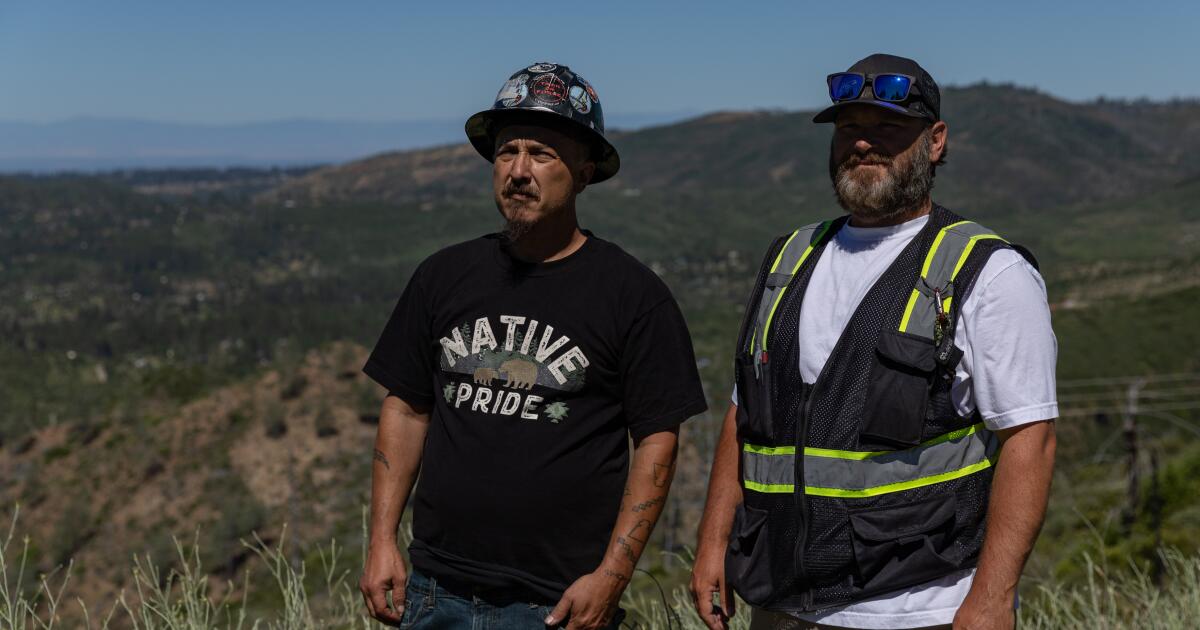
After wildfires destroyed 95% of this California tribe’s forests, members uncovered 1,200 ancestral sites
-
 Sports17 minutes ago
World Cup championship and third-place game: Start times and how to watch
-

 World29 minutes ago
Rule of Law in Hungary shows ‘radical change’ under Magyar, EU says
-

 News59 minutes ago
Where Wildfire Smoke Is The Worst Right Now—And What To Do About It
-

 Los Angeles, Ca3 hours ago
LADWP begins long-term repairs after West Hollywood water main rupture
-

 Detroit, MI3 hours ago
Livestream: Mayor Sheffield, Detroit health chief to address wildfire smoke threat
-
 San Francisco, CA3 hours ago
A sculpture of a giant naked woman goes on sale in San Francisco. Bring a crane

