Texas
Texas Freeze: ERCOT can do better than counting on failure-prone Gas


Frozen Pipelines covered in Ice and Snow power outage during Winter Storm Uri caused by natural gas … [+]
Texas, along with most of the country, is about to get hit with an Arctic blast that will plunge temperatures to extreme lows. But the all-too-recent memory of Winter Storm Uri in February 2021 causing rolling blackouts, hundreds of deaths, and billions in unexpected utility bills leaves Texans more worried than the rest of the country about their power staying on next week.
Unfortunately, their worries are real despite Governor Abbott’s insistence that all will be fine. Almost three years after that traumatic event, Texas’ state legislature and regulators have done little to insulate their constituents for the next big freeze beyond requiring weatherization inspections, a woefully insufficient measure.
Instead, Texas policymakers used the tragedy to subsidize expensive and unreliable fossil fuels. The state legislature’s main response to Uri was authorizing billions in state money to double down on the main cause of its last disaster: natural gas power plants.
Gas plants are “disproportionately vulnerable to failure”
The Federal Energy Regulatory Commission and the North American Electric
AEP
Gas
GAS
Fortunately, the market forces that Texas Republicans tried hard to suppress are too strong, and ended up saving ERCOT during last summer’s extreme heat waves, when the state was hotter than 99% of the Earth’s surface.
Because of the free market orientation of Texas’ electricity system, it produces more electricity from renewables than any other state and is second only to California when it comes to grid scale battery capacity. And as I outlined in an earlier article, these clean resources kept the grid float and Texans cool in unbearable heat.
These same renewables and batteries will make a meaningful difference next week. During the worst of the upcoming freeze wind power is expected to produce at least 10 GW on the coldest mornings, with solar adding at least 7 GW mid-day along with 3 GW of batteries that can ensure clean power can meet atleast a fifth of ERCOT’s forecasted peak demand of 80 GW.
Renewables and batteries aren’t a silver bullet
However, renewables and batteries are not a magical replacement for unreliable natural gas plants. Other extremely cost-effective measures can prepare the Texas grid to weather future big freezes, as noted by Energy Innovation researchers in the aftermath of Winter Storm Uri.
The first is energy efficiency. Texas, and much of the south, has poorly insulated houses that rely on inefficient electric resistance heaters. Fortunately, technological advancements and policy delivered through the Inflation Reduction Act point to a better way. Replacing these resistance heaters with heat pumps that are often three times as efficient can cut consumer electricity bills using a federal tax credit to offset much of the upfront cost.
(From the Big Freeze Report: ERCOT slide showing cold weather impacts on electricity consumption by … [+]
Texas energy expert Doug Lewin estimates inefficient resistance heaters in poorly insulated homes contributed 30-40 GW of demand during Uri’s worst conditions, accounting for 45-55% of the total load and thereby precipitating the grid collapse.
The Texas Public Utility Commission has been authorized by the state legislature to develop rules to increase residential energy efficiency, but the agency hasn’t even started the process more than seven months after the bill was signed by the Governor. Texas has a golden opportunity to pass strong energy efficiency standards that could result in a heat pump boom in the state aided by Inflation Reduction Act tax credits.
The second is ending the Texas grid’s isolation by connecting it with the rest of the country. A geographically larger grid is a more reliable grid – make the grid larger than the storm, as they say.
It makes intuitive sense – the nearby Southeast and Southwest experience different weather patterns and temperatures, with different impacts on renewable and fossil power plants’ reliability. And it would have dramatically reduced the astronomical power price spikes that hit customers during Uri. A recent report by Grid Strategies found that if the Texas grid had been connected to adjacent regions during Uri it would have yielded savings “approaching $1 billion for 1 GW of additional ties between ERCOT and the Southeast, and over $100 million for most of the other [nearby regions]”.
Even outside of extreme events, connecting Texas’ ERCOT grid to the rest of the country can save consumers lots of money. A recent study from Lawrence Berkeley National Laboratory found some of the most valuable opportunities for interregional transmission lie in exchanges between Texas and surrounding regions.
LBNL study showing that Texas will benefit the most from grid interconnection
What comes after this storm?
With another big freeze bearing down on Texas, it’s hard to witness the understandable angst that Texans feel about whether their grid will hold up. What makes it worse is that we’ve known for years how to make the grid more resilient against extreme weather.
I hope that blackouts, sky high bills, and unnecessary suffering never happen during extreme weather events. But what comes after the storm is where hope becomes reality. For a reliable grid, Texas policymakers just need to take common sense actions.



A day off at the pool — and a little sunburn — didn’t stop the Minnesota Twins’ momentum.
Brooks Lee hit a three-run homer as Minnesota scored multiple runs in the first inning for the third consecutive game, and the Twins went on to complete a series sweep of the Texas Rangers with a 9-3 win Thursday.
Minnesota has won four games in a row and scored 25 runs in the three-games series in Texas. The two teams had a rare, mid-series day off on Wednesday with the England-Croatia World Cup game being played in Arlington.
“We’re locked in every day,” Lee told Audra Martin on the team’s broadcast. “Yesterday, taking time off, lay out by the pool, get a little burnt and then right back to it. We did a good job getting focused. I feel like we do that with rain delays, too, just lock back in and we’re doing it.”
Lee’s 12th homer capped a four-run first off Jack Leiter (3-7). Trevor Larnach made it 6-0 in the fourth with a two-run shot to straightaway center that just cleared the extended glove of leaping Alejandro Osuna. Larnach’s third hit was an RBI single in the fifth, and Ryan Kriedler hit a two-run homer in the eighth.
Joe Ryan (5-3) struck out seven but needed 97 pitches to get through five scoreless innings while allowing three singles. Leiter was done after the fourth, and has given up 17 runs while losing three starts in a row.
The Twins never trailed in the sweep that extended their winning streak to four, matching their longest this season. Their 14-5 record at Globe Life Field is the best for any American League opponent since the ballpark opened in 2020.
Wyatt Langford, Ezequiel Duran and Justin Foscue hit solo homers for the Rangers, who have lost five of six games. They are 0-15 when giving up multiple runs in the first inning.
Twins DH Josh Bell, who was born in nearby Irving and grew up in the area, had an RBI single before Lee’s homer. Bell hit a three-run homer in the first inning of the series-opening 4-2 win Monday, and had an RBI single for a 2-0 lead in the first of a 12-2 win on Tuesday.
“We’re just passing the baton each time,” Lee said of the offensive output. “Our guys are hot. They feel good and they came out swinging today. It was awesome to see. We’ve done that for a while now.”
Up next
Twins rookie left-hander Connor Prielipp (2-4, 5.26 ERA) starts Friday at Arizona. The Diamondbacks are scheduled to start right-hander Michael Soroka (8-3, 3.11).

Watch CBS News

A Texas state trooper was killed in a crash in the Panhandle, becoming the 244th Texas Department of Public Safety officer to die in the line of duty since 1823, according to the agency.
Sergio Romero, 27, died Wednesday after a semi-truck pulled in front of him as he attempted a traffic stop around 4 p.m. on U.S. 287 in Childress County, DPS said.
In a statement, Col. Freeman F. Martin praised Romero’s courage, integrity, and service.
“Today, we grieve the loss of one of our own,” Martin said. “… Our hearts break alongside his family, friends, fellow troopers, and all who loved him. We will never forget the ultimate sacrifice he made in service of his fellow Texans.”
Romero previously served with the Hall County Sheriff’s Office before joining DPS as part of Class B-2025 in Childress, the agency said.
He is survived by his wife, Francisca, and their two young sons.
Funeral arrangements are pending. The crash remains under investigation.
-

 Technology4 minutes ago
Barret Zoph is out at OpenAI again after just five months
-

 World10 minutes ago
Iran hardliner behind US deal warns Tehran won’t honor agreement if Trump fails to deliver
-

 Politics17 minutes ago
Top GOP lawmaker rallies around conservative school board member facing calls to resign
-

 Sports25 minutes ago
2026 World Cup Odds: How Far Can Mexico Go After Winning Group A?
-

 Technology32 minutes ago
6 in 10 identity crimes now begin with a new account
-
 Business35 minutes ago
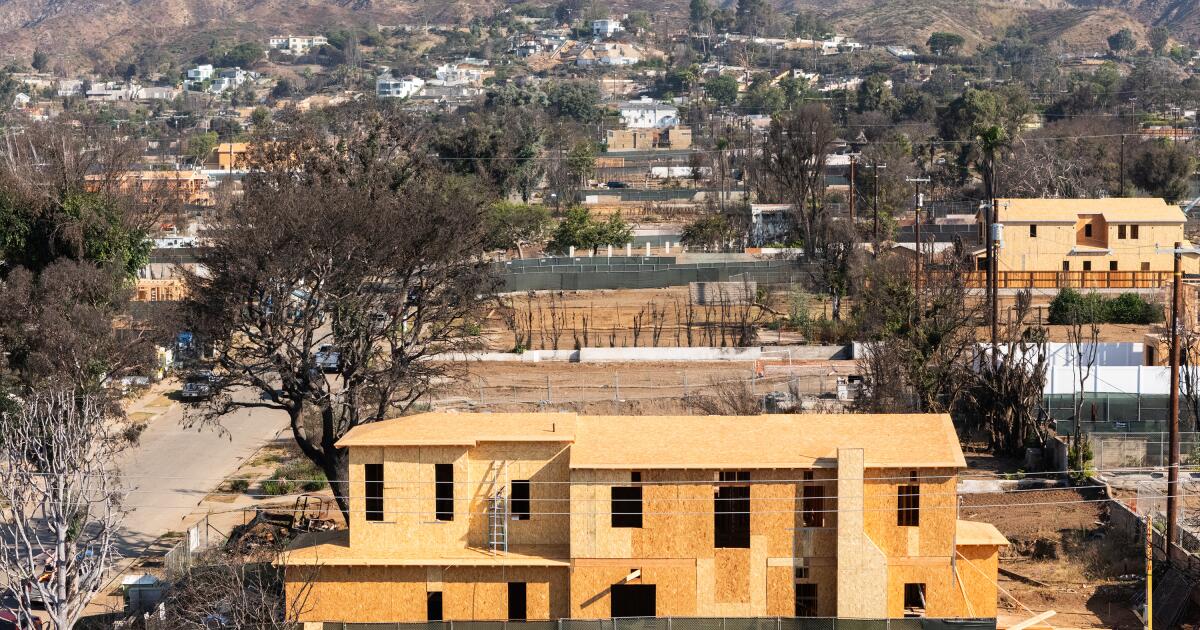
January 2025 wildfire victims seek tougher penalties against State Farm over claims handling
-
 Entertainment40 minutes ago
Review: ‘Sugar,’ with Colin Farrell as an alien private eye, gets a new and improved second season
-
 Politics50 minutes ago
Political watchdog fines Newsom for failing to report $5.5M in solicited donations on time

