Texas
Study Finds High Levels of Hydrogen Sulfide in Central Texas Oilfield – Inside Climate News


The first readings Abigail Edgar took of hydrogen sulfide and methane at oilfields in Caldwell County in 2021 were so high that she thought her equipment was malfunctioning.
“It was off the scales. Methane was off the scales and hydrogen sulfide was off the scales,” said Edgar, a master’s student in geography at Texas State University. “The monitor would immediately start beeping when I crossed the property line.”
Edgar was recording dangerous levels of hydrogen sulfide at wells on private property in Caldwell County, 30 miles southeast of Austin. Hydrogen sulfide is a toxic and highly flammable gas often found in oil and gas formations. During the course of her research, the gas was so potent at three separate wells that Edgar’s respirator did not provide enough protection and she had to leave for her safety.

Explore the latest news about what’s at stake for the climate during this election season.
Edgar teamed up with University of Cincinnati environmental scientist Amy Townsend-Small, an expert on methane, to take another round of measurements in 2023. They found the wells were directly releasing gas—including hydrogen sulfide (H₂S) and methane—into the atmosphere in a process called venting. Some of the wells venting gas were alongside public roads. Others were next to backyards and driveways.
In a paper published in Environmental Research Communications last week, Edgar, Townsend-Small and other authors at Texas State University and the University of Maryland report H₂S readings at 46 wells around Caldwell County. Hydrogen sulfide concentrations at 13 of the wells were at least 300 parts per million (ppm)—the maximum reading on the measuring device. Eight other sites had readings over 100 ppm. Exposure to 100 ppm of H₂S is immediately dangerous to life or health, according to the National Institute for Occupational Safety and Health. The study warns these H₂S levels are a hazard for people living and working in the area.
“Here in Texas we rely heavily on the oil industry and protect the oil industry. And I think rightfully so,” Edgar said. “But there has to be something done for these neighbors. We’re slowly poisoning these communities.”


Oilfield companies are required to adopt protocols to protect workers from hydrogen sulfide. But the general public is often exposed to low-level concentrations. The gas can disperse for miles downwind, especially during cold weather. Symptoms of low to mid-level H₂S exposure include headaches, nausea, coughing and nose and eye irritation. The gas is also present at landfills, wastewater treatment facilities and large animal feedlots.
State rules prohibit the waste of natural gas through venting and flaring except under certain circumstances. But researchers found that venting was commonplace in Caldwell County after the gas processing plant there closed down in 2017. Inside Climate News found that the Railroad Commission of Texas, which regulates oil and gas extraction, has not issued any recent exceptions for venting or flaring gas in the county.
The agency did not respond to questions about gas venting or hydrogen sulfide exposure in the area. Spokesperson Patty Ramon said, “Our rules, permitting and inspection systems are designed to protect public safety and the environment.”
The Texas Commission on Environmental Quality (TCEQ) regulates ambient concentrations of hydrogen sulfide. Agency spokesperson Richard Richter said that the measurements in the study cannot be used to evaluate the exposure to the general public. He said that in an unspecified number of TCEQ investigations in Caldwell County since 2017 the H2S concentrations in ambient air did not exceed state standards.
Production Flatlined in the Luling Oilfield
The railroad town of Luling in Caldwell County, about 50 miles south of Austin, boomed after Edgar B. Davis struck oil in 1922. Wells in the Luling oilfield cut diagonally across the county, dotting unincorporated areas like Stairtown and within the Luling city limits.
The oil patch was largely tapped out by the 1980s, but low-production wells keep pumping to this day. In June 2024, the most recent month with available data, operators in Caldwell County reported producing less than 71,000 barrels of oil. That places Caldwell at 63 out of 199 oil-producing counties in Texas that month.
Amid production declines, the Luling Oil Museum still invites visitors to learn about the town’s drilling heritage. The other main attraction in Luling, population 5,500, is the annual Watermelon Thump festival.
The Luling oilfield is one of many across Texas characterized by gas high in hydrogen sulfide.

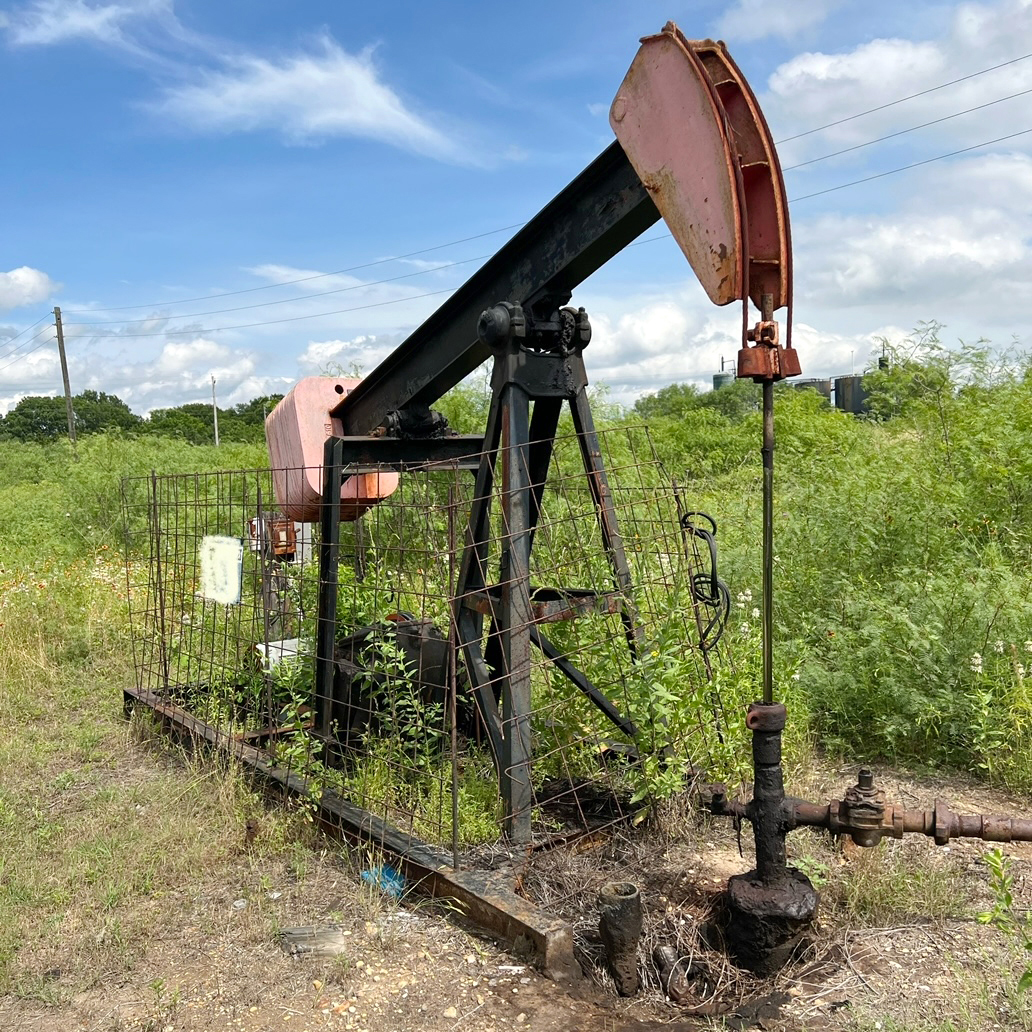
The pungent “rotten egg” smell emanating from the Luling oil fields is so ubiquitous that local media outlets have dubbed it the “Luling effect.” People as far as Austin have called 911 to report the smell, which comes from hydrogen sulfide and other chemicals.
The Railroad Commission implements State Rule 36, requiring operators to report the hydrogen sulfide concentration at wells, determine the radius of exposure and report any accidental releases of H₂S. Operators are required to install signs and restrict public access to sites with a risk of exposure.
Groundlevel hydrogen sulfide concentrations over 0.08 ppm, averaged over a 30-minute period, are prohibited by state law if the emissions affect residential or commercial property. In an investigation earlier this year, the Houston Chronicle and The Examination found that residents in the Permian Basin often report symptoms of H₂S exposure, but state regulators rarely issue meaningful penalties to the companies responsible for the pollution.
When the TCEQ records elevated H2S levels in ambient air, the agency’s goal is to identify the source and ensure the emissions are stopped, its spokesperson said. He reiterated that because the study’s measurements were taken at the wellhead, the readings were not in violation of TCEQ standards.
Low Producing Oil Wells, But High Hydrogen Sulfide Emissions
Texas State University’s Edgar contacted landowners in Caldwell County to find sites to measure hydrogen sulfide and methane emissions.
Edgar said that the landowners were unaware that gas was being directly vented on their property. She said one resident had been asked by his doctor if he could be suffering hydrogen sulfide poisoning.
“They were happy to have somebody take notice of it,” she said.
The researchers selected 46 wells to study. The oldest had been drilled in the 1930s, but most were drilled in the 1960s through 1980s. All the wells are considered marginal, with less than 15 barrels of oil production a day. (In contrast, fracked wells in Texas can produce thousands of barrels a day.) The team took direct measurements from the wellhead using a Bascom-Turner Gas Rover and an Indaco Hi-Flow Sampler. Hydrogen sulfide was measured over a five-minute period.
The methane emissions measured at the wells were similar to previous studies of marginal oil wells. Hydrogen sulfide concentrations ranged from zero parts per million to at least 300 parts per million, the maximum reading on the Gas Rover.
“These wells are so close to so many people. And they are emitting a hazardous substance that could be affecting so many people.”
Hydrogen sulfide can be immediately lethal at concentrations over 700 ppm. Exposure to more than 500 ppm will cause people to collapse within five minutes. An oilfield worker and his wife were killed by H₂S exposure in Odessa in 2019.
Hydrogen sulfide dissipates and would be found in lower concentrations in public areas near the wells. While not as well understood as acute, high-level exposure, research shows that chronic, low-level H₂S exposure also has health effects. One 2023 literature review of over 100 previous studies found that chronic community H₂S exposure at average concentrations below 0.01 ppm has been associated with health effects including eye, nose, respiratory and neurological symptoms. The authors write that individuals with underlying health conditions such as asthma could be particularly at risk.
The University of Cincinnati’s Townsend-Small said the Caldwell County wells are deserving of study because of the anecdotal evidence of strong H₂S smells and their proximity to large urban areas.
“These wells are so close to so many people,” she said. “And they are emitting a hazardous substance that could be affecting so many people.”
Townsend-Small said plugging the Caldwell County wells or capturing the gas is “low-hanging fruit” to reduce methane emissions and health effects of hydrogen sulfide without significant impacts to oil production.
This story is funded by readers like you.
Our nonprofit newsroom provides award-winning climate coverage free of charge and advertising. We rely on donations from readers like you to keep going. Please donate now to support our work.
Donate Now
Edgar said it is unclear whether the Railroad Commission or the TCEQ is responsible for regulating venting at oil wells when it contributes to air pollution. She said one simple step would be for Railroad Commission staff to record H₂S levels when they make field visits in Caldwell County.
“I was not able to come up with any good answers to whose fault is this, who should fix it, and how it should be fixed,” she said.
She said her greatest concern is for oilfield workers and neighbors who live next door to wells.
‘Part of Being in the Oilfields’
Luling city manager Mark Mayo said people coming through town often comment on the smell.
But Mayo, who grew up in the Permian Basin, is no stranger to the odor of sour gas. He said he didn’t think Luling residents are at risk from hydrogen sulfide.
“Just because it has a smell doesn’t mean it’s always bad,” he said. “That’s part of being in the oilfield.”


But he took note of discrepancies documented in the study. Researchers found that some wells listed as “active” with the Railroad Commission were no longer producing. Others listed as “inactive” or “plugged” were still producing. Mayo said the city relies on the agency to ensure oil companies are following state rules, including those for hydrogen sulfide.
“That’s the Railroad Commission’s place,” he said. “As far as the city, we don’t have the ability or the equipment to stay up on that.”
Air quality experts have long known that Caldwell County is a locus of hydrogen sulfide emissions. But there are no stationary H₂S monitors to track community levels of exposure.
Neil Carman, the Lone Star Sierra Club’s clean air director, previously worked as an air pollution control inspector for the TCEQ. Carman said to prove that emissions exceed the TCEQ standards would require 30-minute readings, subtracting any contributions of H₂S from upwind, instead of the five-minute measurements of the study. But he did not doubt that excess H₂S is being released.
“Luling, Texas, there is a huge mess out there,” he said. “I’ve been through many times. I’d say almost every time I’d get a headache.”
Carman said that memory loss and insomnia are other frequent symptoms of exposure.
“It’s really unacceptable and outrageous to the people in these communities,” Carman said.
Sharon Wilson of the nonprofit Oilfield Witness has researched compliance with the Railroad Commission’s hydrogen sulfide rules. In a previous report, she found that many companies fail to submit the H9 form reporting the H₂S level at wells.
“Texas has a gas problem. We have a hydrogen sulfide problem and it’s putting people at risk,” Wilson said. “We see the high levels of hydrogen sulfide from the few air monitors there are in the Permian Basin.”
Wilson travels the Texas oil fields measuring methane emissions with a thermal camera. She said often the hydrogen sulfide fumes are so overwhelming she can’t leave her vehicle.
“Texans are not receiving equal protection from oil and gas pollution,” she said. “We need more monitors in all areas of oil and gas activity.”
About This Story
Perhaps you noticed: This story, like all the news we publish, is free to read. That’s because Inside Climate News is a 501c3 nonprofit organization. We do not charge a subscription fee, lock our news behind a paywall, or clutter our website with ads. We make our news on climate and the environment freely available to you and anyone who wants it.
That’s not all. We also share our news for free with scores of other media organizations around the country. Many of them can’t afford to do environmental journalism of their own. We’ve built bureaus from coast to coast to report local stories, collaborate with local newsrooms and co-publish articles so that this vital work is shared as widely as possible.
Two of us launched ICN in 2007. Six years later we earned a Pulitzer Prize for National Reporting, and now we run the oldest and largest dedicated climate newsroom in the nation. We tell the story in all its complexity. We hold polluters accountable. We expose environmental injustice. We debunk misinformation. We scrutinize solutions and inspire action.
Donations from readers like you fund every aspect of what we do. If you don’t already, will you support our ongoing work, our reporting on the biggest crisis facing our planet, and help us reach even more readers in more places?
Please take a moment to make a tax-deductible donation. Every one of them makes a difference.
Thank you,


Martha Pskowski
Reporter, El Paso, Texas
Martha Pskowski covers climate change and the environment in Texas from her base in El Paso. She was previously an environmental reporter at the El Paso Times. She began her career as a freelance journalist in Mexico, reporting for outlets including The Guardian and Yale E360. Martha has a B.A. in Environmental Studies from Hampshire College and a master’s degree in Journalism and Latin American Studies from New York University. She is a former Fulbright research fellow in Mexico.


hosting the Athletics in the club’s home opener on Thursday, April 1. The complete 2027 schedule was announced today
by Major League Baseball.
The Rangers’ season opener on March 25

In an incident that was horrific beyond words, late last month, a stunned family watched in horror as a car plowed into the Katy, Texas home of a 76-year-old mother and grandmother, killing her. The driver has been charged with manslaughter.
In the aftermath of the crash, it emerged that the car in question was a Tesla, and that the driver was making use of full self-driving mode (FSD) around the time the crash occurred. The victim’s family has named Tesla and the driver as defendants in a lawsuit. But per Electrek, Tesla was able to view crash data very quickly after the incident, and the head of AI at the company, Ashok Elluswamy, said the driver “manually overrode self-driving by pressing the accelerator all the way to 100% of the accel pedal in this residential area.”
In the days after the crash, Tesla fans took issue with coverage that characterized the car as in FSD when the crash occurred. CEO Elon Musk seemed to agree, replying to a post, “Yes, this makes no sense. FSD drives slowly through neighborhood streets and this was a high speed crash!”
But Musk seems to be assuming bad faith, as if coverage implied FSD had suddenly shifted into, perhaps, some kind of previously unannounced homicidal maniac mode and attacked a house. If anyone was saying this is what happened, they should apologize. It’s clearly not what happened.
And on Wednesday, the National Transportation Safety Board (NTSB) largely confirmed Tesla’s version of events. Their report reads, in part:
“Electronic data recovered from the vehicle indicated that before the crash, the driver manually overrode FSD (Supervised) by pressing the accelerator pedal to 100%, and the vehicle’s speed was greater than 70 mph when the crash occurred.”
But cooler heads had noted weeks earlier that, like with good old fashioned cruise control, accelerating doesn’t boot you from FSD. The car takes the input, and stays in FSD. The question isn’t one of mechanics and technology, but one of philosophy: if FSD is meant to be “driving” when someone jams on the accelerator in a residential area, FSD may not be the “driver” in one important sense, but the car was still in FSD mode.
Because as much as Tesla would probably like FSD to be a total non-factor in the incident, that may not be the case either.
ABC News noted that, according to court documents, the driver claimed he “passed out” with the car in FSD on the highway, and that’s the last thing he remembers before the crash. He says he wasn’t sick, and medical records show no seizures, cardiac episodes, drugs, or alcohol.
A local Fox affiliate says records show the car was making deliveries for DoorDash while in FSD in the “hours and minutes leading up to the crash.” While in a neighborhood, it apparently signaled it was going to turn left onto one street, but instead the pedal went to the metal. This took the Tesla onto the victim’s cul-de-sac instead, and put it on its fateful collision course with her house.
To make matters weirder, other court records now show, per Electrek, that the driver had Googled the terms, “Tesla fsd not aggressive enough 2026,” “FSD is not aggressive enough for city driving,” and “Tesla fsd too timid.” That’s the kind of thing you Google when you’re looking for a Reddit post from someone sharing your consumer gripe.
In any case, the odds aren’t good that the driver wanted this to happen, nor that Tesla programmed its cars with evil intent. But FSD was being used around the time of this unusual fatal incident, and the public deserves to know more. Fortunately, a lot more will come out as the lawsuit progresses.

AUSTIN – Texas Attorney General Ken Paxton said Wednesday he has secured a settlement of bankruptcy claims against genetic testing company 23andMe stemming from a 2023 data breach that exposed personal information, including some genetic ancestry data, of 6.9 million customers worldwide.
Paxton’s office said the settlement includes $150 million for a multistate coalition of 42 states. But because of limited funds in 23andMe’s bankruptcy estate and competing claims, the states’ recovery will be $18 million paid immediately, with Texas receiving $1,266,860.
23andMe disclosed in October 2023 that attackers had accessed accounts affecting 6.9 million consumers. Some of the information was later posted for sale on the dark web, according to Paxton’s office, which said the company learned of the breach months after the data became publicly available. The office said 23andMe initially denied a breach and later blamed consumers’ account settings and password practices.
Paxton joined a multistate investigation that concluded 23andMe used unreasonable security practices and failed to implement adequate safeguards against hacking, the office said.
23andMe filed for bankruptcy protection in March 2025. Paxton’s office said the settlement incorporates privacy and cybersecurity requirements, including enhanced security standards, comprehensive risk assessments and creation of an independent advisory board, along with enforcement of state privacy laws and continued consumer data deletion rights.
“Companies that collect and profit from Texans’ most personal information have a legal duty to protect it,” Paxton said in a statement.
The company also agreed to a $46.75 million class-action settlement in the bankruptcy case for affected U.S. consumers who submitted claims by Feb. 17, 2026, Paxton’s office said.
Copyright 2026 by KPRC Click2Houston – All rights reserved.
-

 Maryland5 minutes ago
Washington Nationals 1st-round pick from Potomac Md. signs contract – WTOP News
-

 Michigan11 minutes ago
Michigan AG Dana Nessel visits Kalamazoo to address rising energy prices
-

 Massachusetts17 minutes ago
Springfield attorney named to 2026 Massachusetts Super Lawyers list
-

 Minnesota23 minutes ago
Hundreds of Canada wildfires prompt US air quality alerts as smoke spreads south
-

 Mississippi29 minutes ago
Mississippi homeowners blame a noisy data center plant for sleepless nights. The mayor’s advice? “Consider selling.”
-

 Missouri35 minutes ago
Missouri health officials report 80 current cases of cyclosporiasis
-

 Montana40 minutes ago
Ye & French Montana Sued Over Sample of Paparazzi Fight Video: ‘Don’t Take No Photos!’
-

 Nebraska47 minutes ago
Twelfth Nebraska county temporarily bans data centers

