Texas
Frigid temperatures, possible snow prompt First Alert Weather days for North Texas


NORTH TEXAS – The first of three First Alert Weather days is in effect due to dangerously cold wind chills and a low chance of flurries or light snow in North Texas.
A cold front moved in overnight, dropping temperatures into the 20s and wind chills into the single digits.
A cold weather advisory is in effect until 9 a.m.
While there will be some sunshine, the combination of breezy, northerly winds and colder air will create a blustery day. The warmest it will feel is in the mid- to upper-20s by the afternoon.
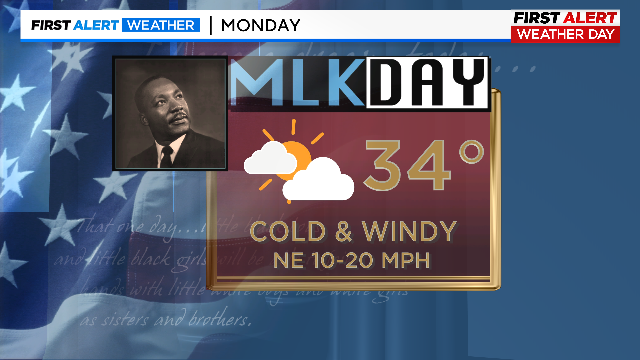
Clouds are expected to roll in on Martin Luther King Jr. Day, with temperatures similar to those on Sunday — a frigid morning with afternoon wind chills in the 20s.
Many MLK Day parades have been postponed due to the expected single-digit and low teen wind chills in the morning.
Monday night, North Texas is expecting snow.
With the cold ground and temperatures, there could be minor travel impacts.
Snowfall amounts are expected to remain under a half inch, with most of it being flurries.
Heavier snowfall amounts are expected well south of North Texas, along the coast and into southern Louisiana. New Orleans hasn’t seen significant snow in 17 years, and the biggest snowfall in Houston in the last 100 years was 4.4 inches in 1960.
The cold air is expected to hang around North Texas until Wednesday afternoon.
Overnight lows are not expected to rise above freezing until Saturday.
Please remember to cover plants and pipes, bring in pets and check on neighbors.




Six Flags Over Texas’ new record-breaking dive coaster, Tormenta Rampaging Run, is now scheduled to open on Thursday, July 9, park officials announced Wednesday.
It had been scheduled to open on June 26 as part of the park’s 65th anniversary, but that was delayed due to longer-than-expected testing of the high-flying roller coaster.
When it announced the delay, the park said on social media, “… it ensures that when Tormenta charges out of the gates, it will be a ride experience worthy of its name – bold, intense, and unforgettable.”
Ride will break six world records
The Tormenta Rampaging Run is inspired by Spain’s Running of the Bulls. The coaster will be located in a new section of Six Flags called Rancho de la Tormenta, featuring Cocina Abuela – a Spanish/Latin American restaurant.
The ride, designed by coaster manufacturer Bolliger & Mabillard, will begin with a 309-foot climb, followed by a 95-degree beyond-vertical drop, and will include sharp turns, airtime moments, and multiple inversions.
It will break six records when it opens: the tallest dive coaster (309 feet), the fastest dive coaster (87 mph), the longest dive coaster (4,199 feet), the tallest vertical coaster loop (179 feet), the highest Immelmann inversion (218 feet), and the highest 95-degree beyond-vertical drop (285 feet).
CBS News Texas will provide updates should additional information become available.

Texas
Phoenix Merchant Partners and Texas Capital Alternative Asset Management Form Strategic Relationship

Phoenix Merchant Partners, an independent alternative asset manager, and Texas Capital Alternative Asset Management (TCAAM), a wholly owned subsidiary of Texas Capital Bancshares, formed a strategic relationship to provide customized capital solutions and direct lending to the core middle market across a diverse range of industries.
The relationship integrates the corporate and investment banking coverage network of Texas Capital with the structuring, underwriting and multi-cycle portfolio management expertise of Phoenix. Capitalizing on this powerful combination, Phoenix will launch its first vehicle, Spurstone Credit, in Q3/26. Structured as a perpetual-life, non-traded closed-end credit fund, Spurstone will be headquartered in Dallas, Texas.
Spurstone has already attracted interest from a group of anchor institutional investors. The vehicle’s investment mandate will focus primarily on delivering senior secured financing solutions to core middle-market businesses with annual revenues between $100 million and $1 billion that are currently underserved in private credit.
“As the only full-service financial services firm headquartered in Texas, we continuously look for ways to serve the needs of companies and their owners, both in Texas and in our industries of focus across the country. Working with Phoenix expands and accelerates our ability to offer proprietary private credit financing solutions to deserving clients. The Phoenix team shares our disciplined approach to asset structuring, capital preservation and portfolio management, as well as our passion for providing exceptional client service and delivering comprehensive solutions,” Daniel Hoverman, head of corporate and investment banking at Texas Capital and president of TCAAM, said.
The vehicle’s strategy is designed to address a critical structural liquidity gap for non-sponsored, family-owned and founder-led mid-market enterprises requiring flexible, non-dilutive senior capital to fund organic growth, strategic acquisitions and balance sheet optimizations.
“Proprietary origination remains the single biggest differentiator in the private credit landscape,” Art Mbanefo, founder and CEO of Phoenix, said. “Working with TCAAM unlocks unparalleled access to high-quality, founder-owned businesses across Texas and other economic centers like California, New York and Illinois. Together, we are bridging the liquidity gap for exceptional middle-market companies.”
Spurstone will be advised by a newly formed, Phoenix-sponsored registered investment adviser, Ryestone Advisors, which is currently applying for registration with the U.S. Securities and Exchange Commission. TCAAM will be a minority economic investor in Spurstone’s investment adviser.
-

 Louisiana9 minutes ago
Louisiana State Police introduce two new K-9 officers
-

 Maine12 minutes ago
Lil Wayne Apologizes After Failing to Appear at His Own Concert: ‘I’m So Sorry’
-

 Maryland17 minutes ago
Maryland’s $48 million purchase of Laurel Park approved by state’s Board of Public Works
-

 Michigan24 minutes ago
Michigan ‘defined’ by waves of immigration that keep shifting
-

 Massachusetts27 minutes ago
Massachusetts state police use robotic dog and drone in highway standoff
-

 Minnesota32 minutes ago
Luverne, Minnesota’s 65-foot nutcracker, may be the tallest in the world
-

 Mississippi39 minutes ago
Mississippi Lottery Mississippi Match 5, Cash 3 results for July 1, 2026
-
Missouri42 minutes ago
Missouri Lottery Powerball, Pick 3 winning numbers for July 1, 2026

