Texas
Elvis Andrus, longtime Texas Rangers shortstop, to announce retirement


ARLINGTON – Former Texas Rangers shortstop Elvis Andrus is announcing his retirement on Friday.
Not only is Andrus announcing his retirement, but he will be retiring as a Texas Ranger.
The Rangers acquired Andrus from the Atlanta Braves in July 2007 when he was a minor leaguer. He made his major league debut on opening day in 2009, remaining a Ranger until 2020 when he was traded to the Oakland A’s.
Andrus is the Texas Rangers’ all-time leader with 305 stolen bases, ranks second in games, at-bats (6,366), and triples (48), and is third in runs (893) and hits (1,743).
Between 2021 and 2023, he played in the minor leagues. He hasn’t played in 2024 although he was in spring training with the Arizona Diamondbacks on a minor league contract.
Andrus is a two-time American League All-Star, in 2010 and 2012. He was the Rangers’ Rookie of the Year in 2009 and the team’s Player of the Year in 2017.
The club said that former teammate and current special assistant to the general manager Michael Young and former Ron Washington will join Andrus at the announcement on Friday.
Andrus and Young will participate in the ceremonial first pitch before Friday’s game against the Los Angeles Angels.
How to watch Elvis Andrus’ retirement announcement
- What: Elvis Andrus’ retirement announcement
- Date: Friday, Sept. 6
- Time: 2:30 p.m.
- Location: Globe Life Field, Arlington, Texas
- Online stream: Live on CBS News Texas in the player above and on your mobile or streaming device.



Texas
Phoenix Merchant Partners and Texas Capital Alternative Asset Management Form Strategic Relationship

Phoenix Merchant Partners, an independent alternative asset manager, and Texas Capital Alternative Asset Management (TCAAM), a wholly owned subsidiary of Texas Capital Bancshares, formed a strategic relationship to provide customized capital solutions and direct lending to the core middle market across a diverse range of industries.
The relationship integrates the corporate and investment banking coverage network of Texas Capital with the structuring, underwriting and multi-cycle portfolio management expertise of Phoenix. Capitalizing on this powerful combination, Phoenix will launch its first vehicle, Spurstone Credit, in Q3/26. Structured as a perpetual-life, non-traded closed-end credit fund, Spurstone will be headquartered in Dallas, Texas.
Spurstone has already attracted interest from a group of anchor institutional investors. The vehicle’s investment mandate will focus primarily on delivering senior secured financing solutions to core middle-market businesses with annual revenues between $100 million and $1 billion that are currently underserved in private credit.
“As the only full-service financial services firm headquartered in Texas, we continuously look for ways to serve the needs of companies and their owners, both in Texas and in our industries of focus across the country. Working with Phoenix expands and accelerates our ability to offer proprietary private credit financing solutions to deserving clients. The Phoenix team shares our disciplined approach to asset structuring, capital preservation and portfolio management, as well as our passion for providing exceptional client service and delivering comprehensive solutions,” Daniel Hoverman, head of corporate and investment banking at Texas Capital and president of TCAAM, said.
The vehicle’s strategy is designed to address a critical structural liquidity gap for non-sponsored, family-owned and founder-led mid-market enterprises requiring flexible, non-dilutive senior capital to fund organic growth, strategic acquisitions and balance sheet optimizations.
“Proprietary origination remains the single biggest differentiator in the private credit landscape,” Art Mbanefo, founder and CEO of Phoenix, said. “Working with TCAAM unlocks unparalleled access to high-quality, founder-owned businesses across Texas and other economic centers like California, New York and Illinois. Together, we are bridging the liquidity gap for exceptional middle-market companies.”
Spurstone will be advised by a newly formed, Phoenix-sponsored registered investment adviser, Ryestone Advisors, which is currently applying for registration with the U.S. Securities and Exchange Commission. TCAAM will be a minority economic investor in Spurstone’s investment adviser.
Texas
Texas man admits embezzling $3.2 million to pay student loans, fuel online gambling, prosecutors say

A Texas man who siphoned off millions from his employer to wipe out tens of thousands in student loan debt and bankroll extensive online gambling has pleaded guilty to federal embezzlement charges, prosecutors said.
Mitchell David Slentz, 34, of Kyle, pleaded guilty in federal court to embezzling more than $3.2 million from Austin Freight Systems, according to the U.S. Attorney’s Office for the Western District of Texas.
Financial oversight role detailed
Prosecutors said Slentz held broad responsibility for Austin Freight Systems’ finances, managing accounting operations, overseeing financial reports and internal controls, and handling vendor payment requests submitted to JPMorgan Chase.
Between October 2023 and March 2025, Slentz executed 147 fraudulent payments, diverting $3,277,937.35 into his personal accounts via interstate wire transfers. He used part of the stolen money to make two student loan payments — $25,000 and $33,887. He also gambled heavily on an online platform, depositing and winning more than $1 million, the U.S. Attorney’s Office said.
Charges and court proceedings
Slentz was charged on May 14, appeared on June 8, and pleaded guilty Monday to wire fraud and engaging in monetary transactions with criminally derived proceeds.
A federal judge will determine Slentz’s sentence based on U.S. Sentencing Guidelines and statutory factors.
Investigation led by the FBI task force
The FBI Austin White Collar Crime Task Force handled the investigation.
CBS News Texas will provide updates as more information becomes available.

Tuesday morning is off to another warm start, with temperatures in the 70s. Expect another day with breezy winds, hot temperatures and Saharan dust in the sky. Most of the dust will move out of North Texas by Wednesday.
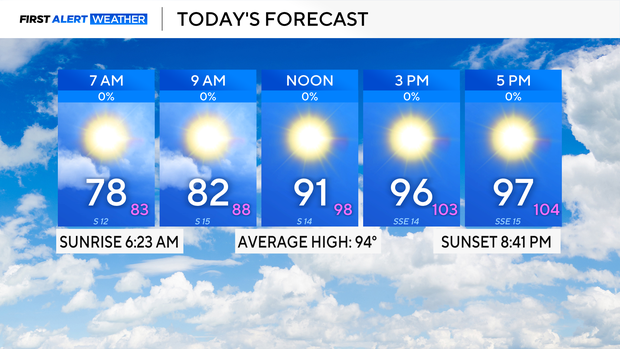
Temperatures on Tuesday afternoon will feel like triple digits, and this trend will continue into the Fourth of July weekend. Because dew points will drop slightly toward the end of the workweek, high temperatures should finally reach the 100° mark by Saturday.
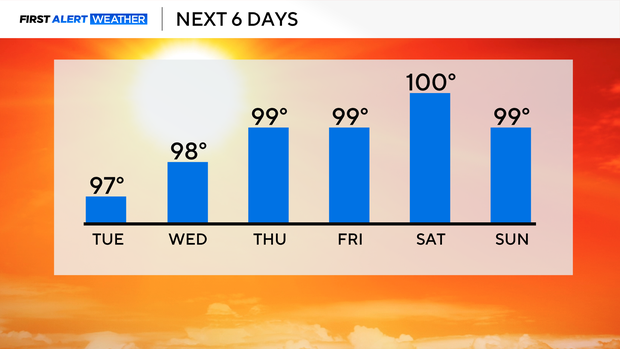
There’s just a slim 10% chance of showers in the forecast for Friday and Saturday, with slightly better rain chances on Sunday and Monday at 20%. Until then, temperatures will continue to heat up, and the feel-like temperatures will be at 100°+ each day. Stay cool.

-
Sports5 minutes ago
2026 World Cup knockout round TV schedule, game previews and results
-

 World17 minutes ago
Russian gas imports rise despite EU phase-out
-

 News40 minutes ago
Woman survives falling 1,500 feet down Mount Shasta
-

 Los Angeles, Ca2 hours ago
Man dies after violent solo crash in Sherman Oaks
-

 Detroit, MI2 hours ago
Priority Waste CEO shares progress on plan to fix disruptions, delays across Metro Detroit
-

 San Francisco, CA3 hours ago
The San Francisco Church That Holds America’s Secrets
-

 Dallas, TX3 hours ago
Crews battle large fire at Pilates studio in Uptown Dallas, officials say
-

 Miami, FL3 hours ago
alaïa clads first miami boutique in pink mosaic tiles, from interior to facade


