Texas
Arrington, top athlete prospect in ’26, picks A&M


Texas A&M beat Oregon to the commitment of five-star athlete Brandon Arrington on Thursday, securing the Aggies their highest-ranked pledge under second-year head coach Mike Elko.
Arrington, a 6-foot-1, 180-pound speedster from Spring Valley, California, is the No. 1 athlete prospect and 14th overall recruit in the 2026 ESPN 300. Projected to play cornerback at the next level, Arrington took official visits to Penn State, Washington, Texas A&M, Alabama and Oregon this spring before narrowing his finalists to the Aggies and Ducks and announcing his commitment in a ceremony at California’s Mount Miguel High School Thursday afternoon.
Arrington told ESPN that his connections with Texas A&M assistants Jordan Peterson and Bryant Gross-Armiento and the development path the program presented him were central drivers in his decision to join the Aggies’ 2026 class.
“The relationship goes back to day one, for real,” he said. “They’ve been locked in with me, recruiting me hard from the very start. The environment feels like home. The people care about football there.”
Arrington’s pledge marks the latest and most significant piece of recruiting momentum for a Texas A&M class that began the week ranked No. 7 in ESPN’s team rankings for the 2026 cycle.
The Aggies added along the offensive line Monday with four-star offensive tackle commit Samuel Roseborough (No. 123 overall), then edged Texas for four-star rusher K.J. Edwards (No. 106) on Tuesday in a major in-state recruiting win. In Arrington, Texas A&M has its fourth ESPN 300 pledge in the month of June and a prospect who would rank as the program’s highest-rated signee since five-star defensive tackle David Hicks (No. 8 overall) in the 2023 cycle if Arrington ultimately signs later this year.
Upon Arrington’s commitment, Texas A&M will next turn its attention to No. 1 overall recruit Lamar Brown and elite wide receiver prospect Ethan “Boobie” Feaster (No. 23 overall), both of whom are expected to announce their commitments early next month. Five-star defensive end Richard Wesley (No. 19) and top 50 offensive tackle John Turntine III represent another pair of priority targets as Elko and the Aggies seek to land a second top 10 class in as many cycles.
A nationally competitive sprinter who plays two-ways at Mount Miguel, Arrington now headlines an impressive Texas A&M defensive backs class in 2026. Illinois flip Victor Singleton (No. 55) previously stood as the program’s top-ranked pledge in the cycle, and between Arrington’s move and the early June commitment of four-star Camren Hamiel (No. 86), the Aggies now hold pledges from three of ESPN’s top 15 cornerback prospects in the 2026 class.
Arrington, considered among the fastest prospects in the cycle, projects as a raw talent with a high-developmental ceiling at the next level.
He flirted with California high school track and field records earlier this spring when Arrington posted personal bests in the 100-meter (10.24 seconds) and 200-meter (20.37) events. Texas A&M coaches have compared Arrington’s combination of height, length and speed to the build of former Aggies All-SEC selection Will Lee, and talent evaluators believe Arrington can develop into an elite Power 4 cornerback when he turns his sole attention to football in college.
“I tell everyone about him: If his ceiling is a 10, he’s only at a three right now,” said Mount Miguel head coach Verlaine Betofe. “Once he gets to the next level, he’s going to explode. I think he has first-round talent.”
With Arrington’s pledge, the top end of the 2026 athlete class is expected to settle further in the coming days and weeks. Four-star recruit Joey O’Brien (No. 102 overall) is set to announce his commitment Friday with Clemson, Notre Dame, Oregon and Penn State among his finalists. Texas and USC reach late June as the leading contenders for athlete Jalen Lott, No. 108 in the 2026 ESPN 300, ahead of his scheduled announcement on July 8.


In an incident that was horrific beyond words, late last month, a stunned family watched in horror as a car plowed into the Katy, Texas home of a 76-year-old mother and grandmother, killing her. The driver has been charged with manslaughter.
In the aftermath of the crash, it emerged that the car in question was a Tesla, and that the driver was making use of full self-driving mode (FSD) around the time the crash occurred. The victim’s family has named Tesla and the driver as defendants in a lawsuit. But per Electrek, Tesla was able to view crash data very quickly after the incident, and the head of AI at the company, Ashok Elluswamy, said the driver “manually overrode self-driving by pressing the accelerator all the way to 100% of the accel pedal in this residential area.”
In the days after the crash, Tesla fans took issue with coverage that characterized the car as in FSD when the crash occurred. CEO Elon Musk seemed to agree, replying to a post, “Yes, this makes no sense. FSD drives slowly through neighborhood streets and this was a high speed crash!”
But Musk seems to be assuming bad faith, as if coverage implied FSD had suddenly shifted into, perhaps, some kind of previously unannounced homicidal maniac mode and attacked a house. If anyone was saying this is what happened, they should apologize. It’s clearly not what happened.
And on Wednesday, the National Transportation Safety Board (NTSB) largely confirmed Tesla’s version of events. Their report reads, in part:
“Electronic data recovered from the vehicle indicated that before the crash, the driver manually overrode FSD (Supervised) by pressing the accelerator pedal to 100%, and the vehicle’s speed was greater than 70 mph when the crash occurred.”
But cooler heads had noted weeks earlier that, like with good old fashioned cruise control, accelerating doesn’t boot you from FSD. The car takes the input, and stays in FSD. The question isn’t one of mechanics and technology, but one of philosophy: if FSD is meant to be “driving” when someone jams on the accelerator in a residential area, FSD may not be the “driver” in one important sense, but the car was still in FSD mode.
Because as much as Tesla would probably like FSD to be a total non-factor in the incident, that may not be the case either.
ABC News noted that, according to court documents, the driver claimed he “passed out” with the car in FSD on the highway, and that’s the last thing he remembers before the crash. He says he wasn’t sick, and medical records show no seizures, cardiac episodes, drugs, or alcohol.
A local Fox affiliate says records show the car was making deliveries for DoorDash while in FSD in the “hours and minutes leading up to the crash.” While in a neighborhood, it apparently signaled it was going to turn left onto one street, but instead the pedal went to the metal. This took the Tesla onto the victim’s cul-de-sac instead, and put it on its fateful collision course with her house.
To make matters weirder, other court records now show, per Electrek, that the driver had Googled the terms, “Tesla fsd not aggressive enough 2026,” “FSD is not aggressive enough for city driving,” and “Tesla fsd too timid.” That’s the kind of thing you Google when you’re looking for a Reddit post from someone sharing your consumer gripe.
In any case, the odds aren’t good that the driver wanted this to happen, nor that Tesla programmed its cars with evil intent. But FSD was being used around the time of this unusual fatal incident, and the public deserves to know more. Fortunately, a lot more will come out as the lawsuit progresses.

AUSTIN – Texas Attorney General Ken Paxton said Wednesday he has secured a settlement of bankruptcy claims against genetic testing company 23andMe stemming from a 2023 data breach that exposed personal information, including some genetic ancestry data, of 6.9 million customers worldwide.
Paxton’s office said the settlement includes $150 million for a multistate coalition of 42 states. But because of limited funds in 23andMe’s bankruptcy estate and competing claims, the states’ recovery will be $18 million paid immediately, with Texas receiving $1,266,860.
23andMe disclosed in October 2023 that attackers had accessed accounts affecting 6.9 million consumers. Some of the information was later posted for sale on the dark web, according to Paxton’s office, which said the company learned of the breach months after the data became publicly available. The office said 23andMe initially denied a breach and later blamed consumers’ account settings and password practices.
Paxton joined a multistate investigation that concluded 23andMe used unreasonable security practices and failed to implement adequate safeguards against hacking, the office said.
23andMe filed for bankruptcy protection in March 2025. Paxton’s office said the settlement incorporates privacy and cybersecurity requirements, including enhanced security standards, comprehensive risk assessments and creation of an independent advisory board, along with enforcement of state privacy laws and continued consumer data deletion rights.
“Companies that collect and profit from Texans’ most personal information have a legal duty to protect it,” Paxton said in a statement.
The company also agreed to a $46.75 million class-action settlement in the bankruptcy case for affected U.S. consumers who submitted claims by Feb. 17, 2026, Paxton’s office said.
Copyright 2026 by KPRC Click2Houston – All rights reserved.

-
 Science3 minutes ago
California employer health premiums will cost as much as a new car in 2027
-
 Sports9 minutes ago
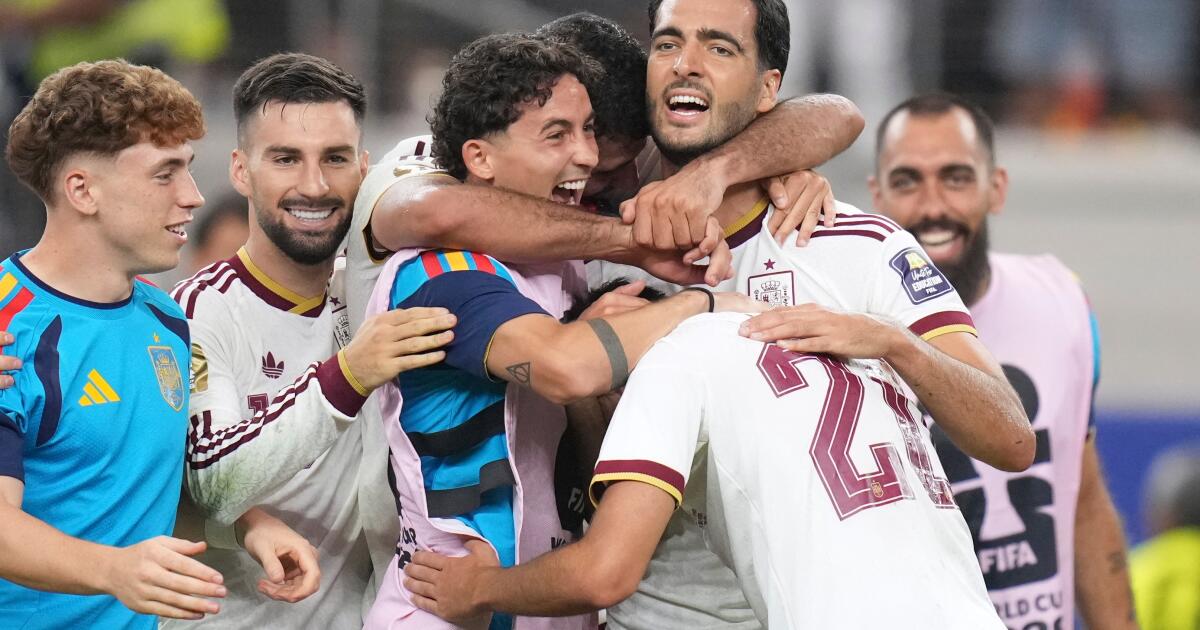
How Spain ‘recaptured the spirit of 2010’ in its run to the World Cup final
-

 World21 minutes ago
Fake Hezbollah video threatening attack on France possibly Russia-tied
-

 News51 minutes ago
Trump’s ‘American Flag Blue’ in the Lincoln Memorial pool is already gray — and the Olympic canoer ‘vandal’ is fighting his arrest | Fortune
-

 Los Angeles, Ca2 hours ago
Water main break floods West Hollywood streets, traps cars
-

 Detroit, MI3 hours ago
Detroit’s air quality early Thursday ranked as hazardous, worst in the world
-

 San Francisco, CA3 hours ago
‘It was a scene from the Titanic’: Fishermen recall rescuing passengers from sinking boat in SF Bay
-

 Dallas, TX3 hours ago
Big picture takeaways from the Dallas Mavericks first week at Summer League

