Texas
2 baby bald eagles hatch near Dallas during Texas Winter Storm


KAUFMAN COUNTY, Texas – Two bald eagle chicks were born this week at the John Bunker Sands Wetlands Center in North Texas, hatching amid a winter storm as their parents sheltered the nest from rain, cold and high winds.
What we know:
The eaglets hatched from eggs laid on Dec. 18 and Dec. 21, according to the wetlands center. The hatching came as a winter storm moved through the area, dumping rain and ushering in freezing temperatures. The nest is located near Combine, Texas, about 30 minutes southeast of Dallas.
Executive Director of the John Bunker Sands Wetlands Center, Kayleigh Bucur, said staff could do little more than observe the bald eagles. It has become a focal point for eagle watchers across the region as staff members and thousands of online viewers have been closely monitoring the nest through a YouTube live-stream, as the incubation period reached its final days.
The female eagle, referred to as Mom, is noticeably larger than the male, referred to as Dad. As Mom handled most of the incubation duties, Dad hunted and brought food back to the nest. Bucur tells The Post that they do not name the baby eagles but number them based on the number they were hatched. The two newborns are JBS 24 and JBS 25.
With the two new hatchlings, the John Bunker Sands Wetlands Center has now recorded 25 eaglets since monitoring began in 2014. Of those, 20 have successfully fledged.

Courtesy: John Bunker Sands Wetlands Center
Dig deeper:
On Jan. 25, 2026, shortly after the birth of JBS 24, Dad flies in to meet his new offspring and check on the family and Mom finally allows him to take charge and leaves to grab a meal and get some rest. Mom has been on the nest since early Friday morning, steadfast in the frightful, frigid weather.
Mom and Dad’s second chick hatched in the early morning of Jan. 26. Mom had her attempts at the first feeding of both chicks.
JBS 25 is described to still have a few damp feathers from hatching and generally has its back to the camera in the video. JBS 24 is described as a bit more mobile, it can sit up and is starting to have some control of its bobbing head.
Mom manages to connect JBS 24 with a little food, while JBS 25 still has plenty of nutrients from absorbing the egg yolk during the hatching process.
It won’t be long before the chick can grab at the morsels Mom offers, according to the center.
During the process of hatching, the chicks absorb the nutritious egg yolk and can go without being fed for a day or two. The chicks will rest and dry off after hatching and will sit up and chirp to the parents when they’re ready for their first meal outside the shell.
What they’re saying:
“We’ve been on what we call ‘PIP watch,’” said Bucur. “That’s when the chick starts breaking into the air sac inside the egg and mom can actually hear chirping. From there, hatching is entirely up to the chick.”
Bucur described the organization’s inability to intervene with the birth of the baby eagles.
“They’re federally protected, and truly, you just have to trust the eagles. They’re seasoned parents, and they know what they’re doing.”
Winter Storm Warning, Eagle Egg Watch | The Post
We’re in the final hours to prepare for this weekend’s winter storm, as multiple counties in North Texas are under a winter storm warning. Meanwhile, two bald eagles are expected to welcome babies during the winter storm. A livestream is available to watch the eggs hatch.
The backstory:
The nest itself has a unique history, originally built on an energized electrical tower that supplied power to Dallas. In 2014, utility crews and wildlife agencies worked together to relocate the nest without disturbing it, lifting it by crane and securing it to a replica tower about a quarter mile away. That partnership included Mica Steelworks, The Chapman Group, Oncor, U.S. Fish and Wildlife Service, Texas Parks and Wildlife Department, and several private contractors. The replica tower still stands about 100 feet tall.
Bald eagles’ mate for life, and this same pair has returned year after year. Since the relocation, the new nest has grown to nearly 700 pounds and spans about nine feet across.
What’s next:
The chicks are expected to remain in the nest for several weeks and could begin attempting flight by April.
The John Bunker Sands Wetlands Center offers public programs, eagle walks and live-stream access to the nest, allowing visitors to follow the young birds’ progress as they grow.
The Source: Information in this article was provided by an interview conducted by FOX 4’s Lauren Przyby and Shannon Murray. Additional information was provided by the John Bunker Sands Wetlands Center.



Texas
Texas man admits embezzling $3.2 million to pay student loans, fuel online gambling, prosecutors say

A Texas man who siphoned off millions from his employer to wipe out tens of thousands in student loan debt and bankroll extensive online gambling has pleaded guilty to federal embezzlement charges, prosecutors said.
Mitchell David Slentz, 34, of Kyle, pleaded guilty in federal court to embezzling more than $3.2 million from Austin Freight Systems, according to the U.S. Attorney’s Office for the Western District of Texas.
Financial oversight role detailed
Prosecutors said Slentz held broad responsibility for Austin Freight Systems’ finances, managing accounting operations, overseeing financial reports and internal controls, and handling vendor payment requests submitted to JPMorgan Chase.
Between October 2023 and March 2025, Slentz executed 147 fraudulent payments, diverting $3,277,937.35 into his personal accounts via interstate wire transfers. He used part of the stolen money to make two student loan payments — $25,000 and $33,887. He also gambled heavily on an online platform, depositing and winning more than $1 million, the U.S. Attorney’s Office said.
Charges and court proceedings
Slentz was charged on May 14, appeared on June 8, and pleaded guilty Monday to wire fraud and engaging in monetary transactions with criminally derived proceeds.
A federal judge will determine Slentz’s sentence based on U.S. Sentencing Guidelines and statutory factors.
Investigation led by the FBI task force
The FBI Austin White Collar Crime Task Force handled the investigation.
CBS News Texas will provide updates as more information becomes available.

Tuesday morning is off to another warm start, with temperatures in the 70s. Expect another day with breezy winds, hot temperatures and Saharan dust in the sky. Most of the dust will move out of North Texas by Wednesday.
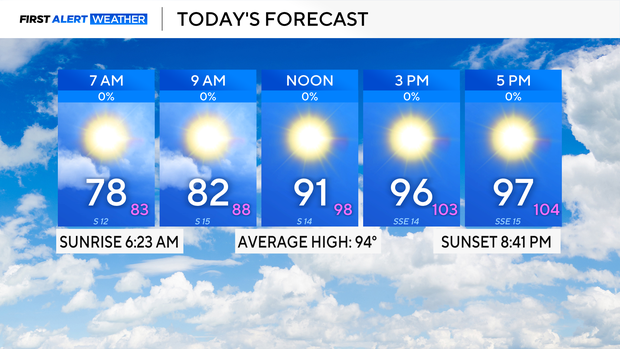
Temperatures on Tuesday afternoon will feel like triple digits, and this trend will continue into the Fourth of July weekend. Because dew points will drop slightly toward the end of the workweek, high temperatures should finally reach the 100° mark by Saturday.
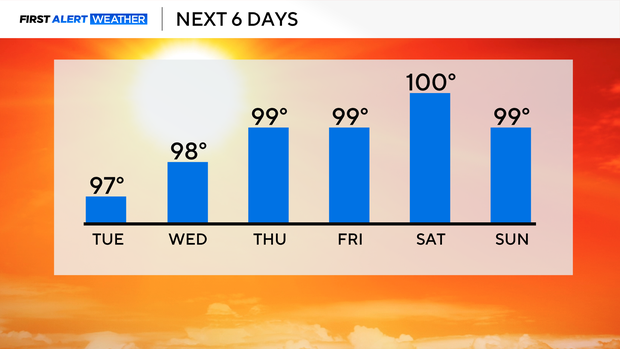
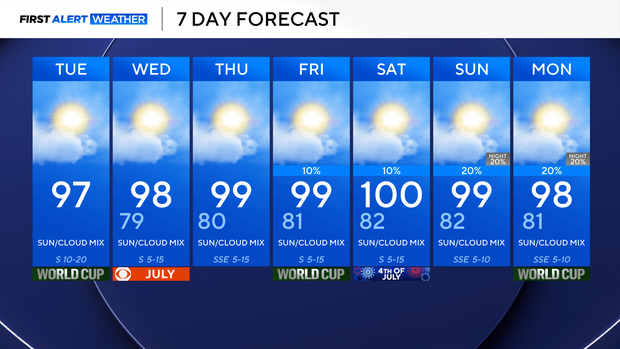
There’s just a slim 10% chance of showers in the forecast for Friday and Saturday, with slightly better rain chances on Sunday and Monday at 20%. Until then, temperatures will continue to heat up, and the feel-like temperatures will be at 100°+ each day. Stay cool.

The Texas Longhorns are in a lull before firing on all cylinders ahead of the 2026 season, looking to once again handle expectations that are larger than most programs experience, for the season year in a row.
Ahead of the season, though, head coach Steve Sarkisian is already gaining victories on the road before even kicking off. After a slow start on the recruiting trail, the Longhorns are in full swing, stacking elite pieces for the 2027 cycle.
Now it is no different, as the program has landed a commitment from Jason Johnson, one of the most sought-after defensive line prospects in the country, and a big piece of the Longhorns recruiting class for the cycle.
Who is Johnson?
Johnson is widely viewed as one of the most slept on prospects in the class. He is ranked as the No. 42 defensive line prospect in the class and is a top 60 prospect in the state of Texas. Despite his star rating, though, he is one of the most sought-after prospects in the class, including multiple offers from elite programs around the country.
Standing at 6-foot-3, 270 pounds, he has the size of an edge defender but the strength and bull-rush ability of an interior defender, combining an elite mix of speed and power that makes him difficult to handle in the interior.
Johnson has a lot of projectability in his frame, and has the strength already to go with it. As he continues developing at the next level, he has the chance to turn into a legitimate interior wrecker at the college level.
Where Johnson Will Impact the Longhorns Future
The Longhorns have been the beneficiaries of elite defensive linemen under the reign of Sarkisian, and that won’t change for the upcoming season or beyond. The program has shown a profound ability to develop talent across the front of the defense and will continue to do so.
For Johnson, the defensive front is manned by veterans across it, with talented underclassmen waiting in the wings for their turn on the field. It also doesn’t help that, so far, he is the lowest-rated defensive line commit of the class for the Longhorns.
Still, the coaching staff, including defensive coordinator Will Muschamp love what Johnson brings to the field, and that was one of the reasons that his class ranking didn’t bother them. He will get the time to develop in the program, and could turn into a vital piece of the future.
Sign up to our free newsletter and follow us on Facebook, X and Instagram for the latest news.
Add us as a preferred source on GoogleFollow
-

 Miami, FL4 minutes ago
Reports: Heat add potent bench scorer in Tim Hardaway Jr.
-

 Boston, MA7 minutes ago
Boston Pops gearing up for major July 4th celebration: ‘You only turn 250 once’ – Boston News, Weather, Sports | WHDH 7News
-

 Denver, CO12 minutes ago
Colorado wildfires destroy more than 100 structures, force more evacuations
-

 Seattle, WA19 minutes ago
Will Katie Wilson’s endorsements help or hurt Seattle’s position in Olympia?
-
 San Diego, CA22 minutes ago
Marine missing after training activity off San Diego is declared dead
-

 Milwaukee, WI27 minutes ago
Career minor-leaguer Garrett Stallings gets his shot with the Brewers
-

 Atlanta, GA34 minutes ago
FIFA Fan Festival Atlanta bracing for huge crowds, high heat
-

 Minneapolis, MN36 minutes ago
North Minneapolis Heritage Park tenants swelter as $500K grant sits locked for furnaces

