South-Carolina
NHC monitoring area for development as heavy rain continues over South Florida

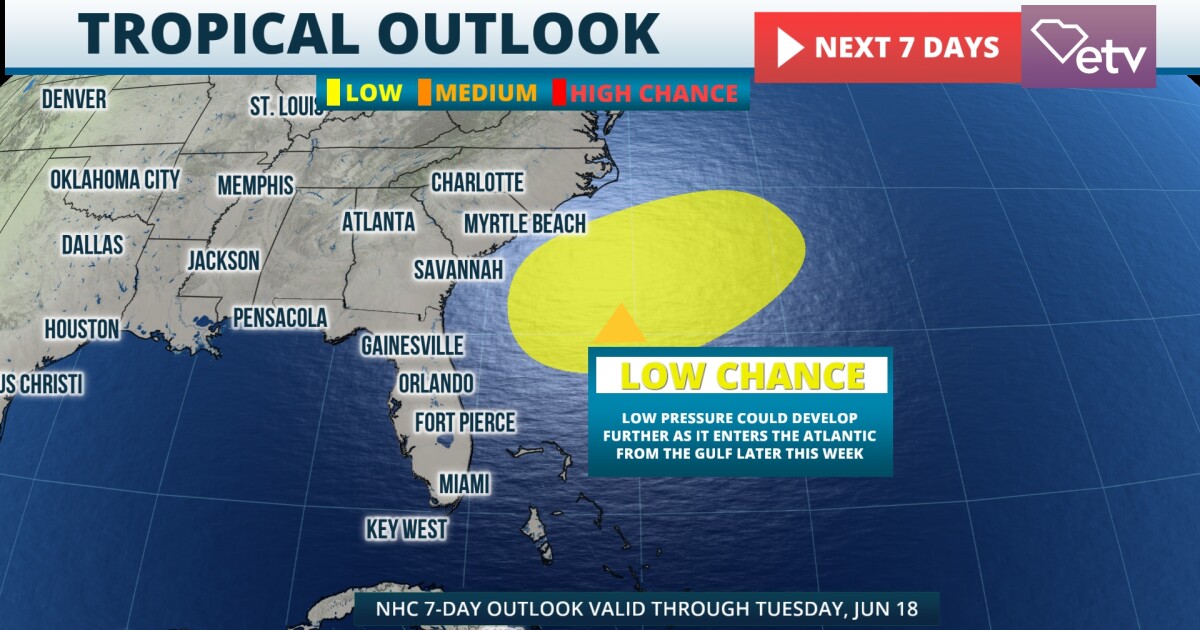
The National Hurricane Center (NHC) is watching a disturbance in the Gulf of Mexico that could develop into a tropical system after it crosses Florida and moves off the southeastern coast of the US in the coming days. The disturbance is called Invest 90L. Invest is short for “investigation,” and refers to a weather system the NHC is investigating. When tropical systems become “invests”, it allows forecasters to run specialized computer models on them for indicators of possible development. Computer forecast models have been showing a weak low-pressure system forming offshore of the Carolinas as we head towards the weekend. The National Hurricane Center is giving it a slight chance (20%) of developing into at least a tropical depression. However, the upper-level winds are not favorable for fast or significant tropical development. Regardless of development, the area of disturbed weather should not pose a threat to the Carolinas.
Elevated wave heights and rip currents may be possible towards the end of the week for Carolina beaches. Rain is expected to stay offshore.

June makes up about 2% of historical Atlantic tropical cyclone activity. Since 1950, a little more than half of the seasons have had at least one named storm develop in June. While the month of June is usually not very active in the tropics, any named storms that do form tend to occur close to the United States, particularly in the Gulf of Mexico, the western Caribbean Sea and near the Southeast and mid-Atlantic coasts. These storms typically track toward the north or northeast, which means the Gulf and Southeast coasts of the U.S. could potentially be in their path.
Make sure you keep up with the forecast for any changes and get the latest tropical outlooks at https://www.nhc.noaa.gov/


(WPDE) — A social media post from U.S. Rep. William Timmons is drawing attention to a South Carolina election-law scenario that could shape whether some members of Congress decide to run for Sen. Lindsey Graham’s open U.S. Senate seat.
Under the timeline outlined, a sitting member of Congress could win reelection to the U.S. House and also win the open U.S. Senate seat on Election Day, Nov. 3. Because a person cannot serve in both offices, the lawmaker would have to choose.
If the member chose the Senate seat, the change would take effect when the new Congress is sworn in on Jan. 3. At that point, the person would leave their House seat to serve in the Senate.
Unlike a U.S. Senate vacancy, a U.S. House seat cannot be filled by appointment. Instead, a special election would be required to choose a new representative. Until that special election is held, the House seat would remain vacant.
Timmons said the temporary vacancy could matter because the House elects its speaker when the new Congress begins on Jan. 3. With Republicans expected to hold a narrow majority, Timmons argues that even one temporary vacancy could make it more difficult for Speaker Mike Johnson to secure enough votes to keep the speaker’s gavel.
The next step in the process comes Tuesday, when candidate filing for the special Republican primary opens. Filing closes July 28.
Observers will be watching whether the issue affects who files for the race and whether any lawmakers propose changes to the election process.

Less than 72 hours after the sudden passing of South Carolina Senator Lindsey Graham, his sister was sworn in to finish his term.
Darlene Graham Nordone took the oath on Tuesday, saying it’s what her brother would have wanted.
Having served in the Senate for almost two and a half decades, Senator Graham was well-liked by his Republican colleagues, generally well-respected by Democrats, and well-known across the country.
Taking the oath on the Senate floor, Darlene Graham Nordone, the younger sister of Lindsey Graham, officially became his successor. A ceremonial swearing-in followed in the old Senate chamber.
Senator James Lankford (R-OK) prayed for Graham’s family Monday as he remembered his friend.
“He’s a person that loved his body, loved the country, and loved the people of South Carolina. And it showed,” said Lankford.
Senator Alan Armstrong (R-OK), who went through a similar selection and swearing-in process just a few months ago, told Bloomberg TV he had come to respect Graham during their brief overlap.
“People knew him for somebody that would speak his mind and was clear and convincing in his argument,” said Armstrong.
As a strong backer of Ukraine, one of Graham’s final acts was to get White House backing for a bipartisan Russia sanctions bill.


Greenville County budget passes with key funding shifts
Greenville approves $473M budget with $44.6M going to public safety, $27.5M to roads, $3.5M for Greenlink while cutting affordable housing to $1M.
South Carolina has been operating under a temporary spending measure for the past two weeks after a small committee of House and Senate members has yet to finalize the budget.
After another day of stalled discussions, Sen. Tom Davis, R-Beaufort, said lawmakers have three options to keep the government funded. One of those options is operating under a continuing resolution, a temporary funding measure that keeps state agency funding the same as the previous financial year, until next year.
The General Assembly’s budget conference committee, a six-member group — three each from the House and Senate — met for a brief budget discussion on July 14. The committee decided quickly to adjourn until 2 p.m. on July 15 after failing to make progress on a spending plan.
Conference committee members are struggling to come to an agreement on property tax relief and earmarks, which are budget allocations set aside for specific projects. The committee most recently met on June 30, the day before fiscal year 2027 was set to start, and decided to push its next meeting out two weeks to give staff the time to collect information on the main differences between the Senate and House budgets.
The committee reconvened on July 14, facing the same challenges as it did during the meeting in late June. Though the legislature has not finalized a budget for fiscal year 2027, state agencies are being funded at last year’s levels due to a continuing resolution.
However, the state will not be able to allocate funds for state employee raises and teacher salary bumps if lawmakers don’t pass a new budget.
“It’s important for the people of South Carolina to remember that government is open,” Davis said. “This is not a situation like in Washington, D.C. where state government is shutting down.”
Davis told his fellow committee members that he thinks they have three options: keep operating under a continuing resolution for the next year, pass a budget without property tax cuts or earmarks, or decide which earmarks can be removed to include some measure of property tax relief.
“Mr. Chairman, I think those are the three options in front of us right now,” Davis said.
House Ways and Means Committee Chair Rep. Bruce Bannister, R-Greenville, said he thinks the state can have a budget and that relying on a continuing resolution is an “absolute failure of this conference committee to do their job.”
“In the next couple of days, we’re obviously going to be working hard,” Bannister said. “I’d like to do that in good faith.”
According to Davis, the House budget includes about $315 million in earmarks while the Senate version has about $130 million. He added that the Senate has $240 million in its budget for a property tax cut, which the House does not have.
The senator from Beaufort also said that there are rules in place that restrict how the conference committee can negotiate. He said for many of the earmarks, the committee either has to approve all funding for a specific project or no funding. The House also had not passed a property tax bill, limiting the committee to using a budget proviso to pass the funding.
“It becomes difficult for the House to agree to a property tax cut via proviso,” Davis said. “The rules constrain them in that regard.”
The conference committee will resume budget discussions on July 15 at 2 p.m. Davis said he hopes the committee can come to an agreement by the end of the week. The budget would still need approval from the House, Senate and governor before it is final.
Bella Carpentier covers the South Carolina legislature, state, and Greenville County politics. Contact her at bcarpentier@gannett.com.
-

 Utah3 minutes ago
Muslim man stabbed at Utah mall over his religion, authorities say
-

 Vermont9 minutes ago
Ben & Jerry’s Foundation says it will shut down amid legal dispute with parent company – VTDigger
-

 Virginia15 minutes ago
Drought emergency declared for parts of Virginia; governor warns of water restrictions
-

 Washington21 minutes ago
Trump fires WA US Attorney within an hour
-

 Wisconsin27 minutes ago
Wisconsin Lottery Powerball, Pick 3 results for July 15, 2026
-

 West Virginia33 minutes ago
Concerned West Virginians speak out against proposed Monongalia County power plant – WV MetroNews
-

 Wyoming39 minutes ago
July 15 recap: Wyoming news you may have missed today
-

 Crypto45 minutes ago
Luno Pushes South Africa to Rewrite Crypto Rules Through Parliament, Not Proclamation

