North Carolina
State Efficiency Bill Involving AI Advances in North Carolina

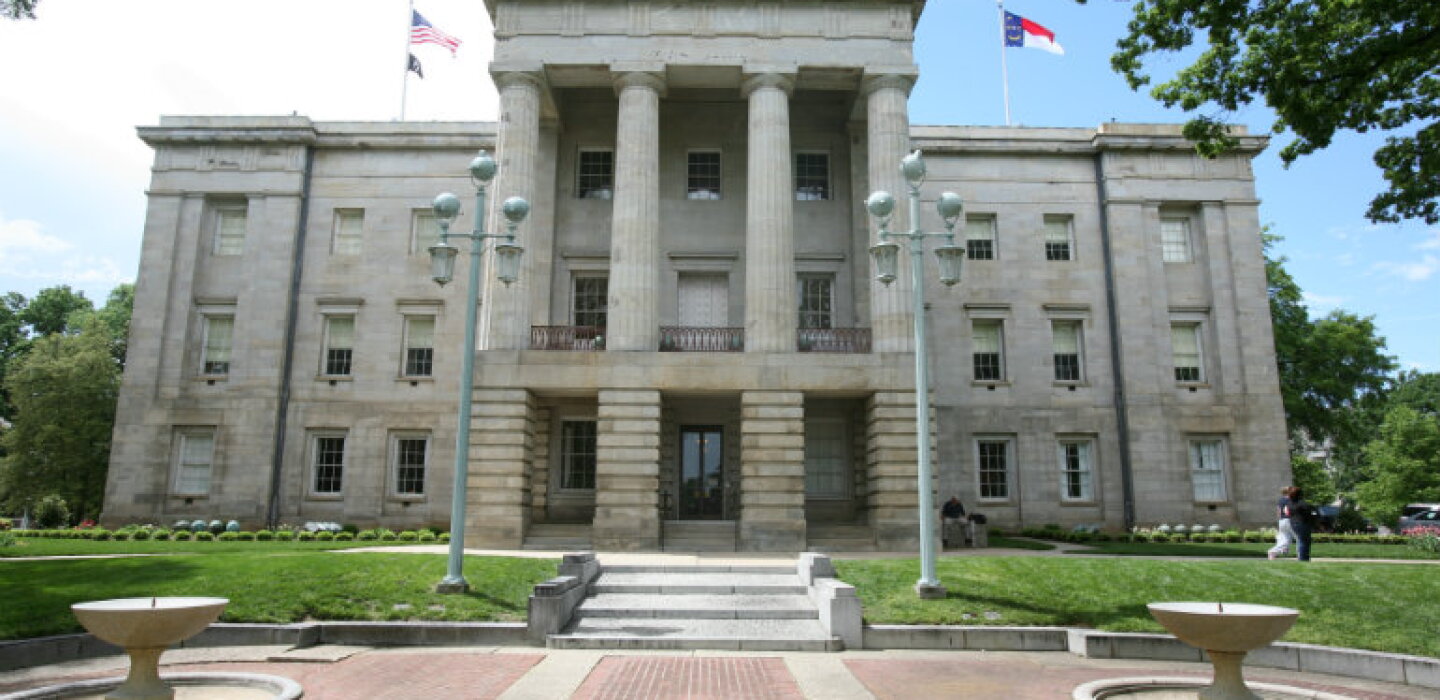
(TNS) — A N.C. Senate bill that would review state agency performance and staffing levels, relying in part on the use of artificial intelligence, cleared its first committee step Wednesday.
Senate Bill 474, titled “The DAVE Act,” was recommended by the Senate Regulatory Reform committee after nearly 30 minutes of at times contentious debate.
Although the bill is being fast-tracked to gatekeeper Rules and Operations committee, the legislation is expected to be inserted into the 2025-26 state budget bill to fund additional state Auditor office job positions.
Senate leader Phil Berger, R-Rockingham, is in the rare role of being a primary bill sponsor.
According to a news release from Berger’s office, the legislation is designed to “get a complete picture” of how state agencies are utilizing taxpayer funds “and determine if the agency should continue to exist.”
The acronym DAVE stands for Division of Accountability, Value and Efficiency, which would be housed in the State Auditor’s office of Republican Dave Boliek.
Bill sponsors say the key areas for state agency review — so far — includes: amounts spent, including the entities receiving funds and the intended purpose of the amounts spent; effectiveness of any amount spent in achieving the intended purpose of that spending; and duplicative spending.
Each agency is to report all job positions that have been vacant for six months or more. Agency reports would have an Oct. 1 filing deadline.
SB474 was amended to establish a sunset that was not specified, but to occur after the 2028 general election, and allow Boliek to request annual reports.
Berger said SB474 “facilitates the auditor’s ability to move forward on examining how monies that are appropriated by the General Assembly … are actually deployed … effectively deployed and whether or not there’s a failure on the part of an executive agency to utilize the funds as directed by the legislature.”
The bill is likely to join the growing list of Republican-sponsored bills that may serve as the first test of Democratic Gov. Josh Stein’s ability to sustain a veto vote.
Senate Republicans hold a 30-20 supermajority that gives them the votes to override a Stein veto. However, House Republicans are one vote shy of a supermajority at 71-49.
Boliek, in his first term as auditor, said SB474 empowers the state Auditor’s Office “to do that what we already have the authority to do” in terms of auditing for operational, funding and overall program efficiency.”
Boliek said the proposed objectives of SB474 should draw bipartisan support.
“What this bill does is it puts together the legislature, the executive branch and the state Auditor’s Office,” Boliek said.
“It is designed to do better government, a date-centered approach that gets real, impactful results.”
Boliek claimed SB474 is needed in part because previous state auditors provided “bread and butter financial audits that are a 30,000-foot views that does not — quite frankly — give members of this body the type of information you need and you expect … to make competent, judgmental decisions as they run their agencies.
“My commitment is to do this in a nonpartisan way that’s data centric. … not emotion. The proof will be in the pudding.”
Boliek said the expanded use of artificial intelligence is warranted “because we’ve got to start somewhere in the state of North Carolina because it’s coming, and there’s no better place than the state Auditor’s Office to get started with that.”
Several Senate Democratic committee members critical of SB474 claimed Senate GOP leaders want to establish a N.C. version of the controversial federal DOGE initiative led by billionaire Elon Musk.
They expressed concerns that state departments and agencies, already are dealing with staffing vacancies reaching 20% to 25%, could have their workforce experience more cuts based on assessments from artificial intelligence algorithms.
Sen. Caleb Theodros, D-Mecklenburg, said there needs to be firm restraints and transparency on the use of artificial intelligence in evaluating the performance of agencies and their employees.
Berger said legislators will employ artificial intelligence as a tool in determining funding appropriation levels and whether state funds are being wasted or not.
“Your comments point out exactly why we need something like this,” Berger said.
Sen. Lisa Grafstein, D-Wake, said the auditor’s office focuses on accounting functions, and is not meant to be a program evaluator of the work of state employees and “whether they are necessary.”
“I think we are getting really close to the idea that we’re demonizing state employees who are trying to do their jobs, and folks who are trying to make our communities better.”
Sen. Sophia Chitlik, D-Durham, said moving forward with SB474 is harmful when state government is struggling to fill about 14,000 job vacancies, in part because of the pay scale compared with the private sector.
“Behind every one of these jobs there is a reason for them, a community need,” Chitlik said.
“It strikes me as actually very inefficient to potentially leave it up to AI to eliminate them because we can’t fill them.”
Chitlik said the DOGE initiative is putting about 35,000 federal jobs in N.C. at risk of elimination.
She cited as an example the elimination of a UNC Health laboratory workforce dedicated to studying youth vaping “because their NIH (National Institutes of Health) grant had the word equity in it.”
“We do not need to look any further than our state for examples of what happens when you let an algorithm take control of our workplace,” she said.
Berger responded by saying Boliek “has no authority to discharge anyone. He has the authority to identify problems in any discharge.”
“Any elimination of positions would be left up to the General Assembly.”
Sen. Woodson Bradley, D-Mecklenburg, said it is critical that whatever authority that DAVE is given by the legislature has bipartisan support.
“We can’t let this infect the entire (state) budget, not let it hurt people with zero accountability,” she said.
Meanwhile, public speakers called out Senate Republican leadership for what they termed hypocrisy.
They said the call for more stringent evaluations of how government agencies operate runs counter to legislators sticking into the 2023 state budget bill language that allows legislators to determine whether documents are public records, shield them from public release and destroy them if they choose.
© 2025 the News & Record (Greensboro, N.C.). Distributed by Tribune Content Agency, LLC.

North Carolina
North Carolina man accused of shooting and killing another tourist inside of a Broward Airbnb, police say

A Fourth of July trip to South Florida ended in tragedy after a 21-year-old North Carolina man was shot and killed inside a Hollywood Airbnb, according to police.
Investigators say Jaydon Williams, 21, was shot multiple times early Saturday morning at a vacation rental in the 1900 block of Funston Street. Hollywood police have arrested 21-year-old Devian Blount, also of North Carolina, and charged him with first-degree murder.
Officers responded to the home around 1 a.m. Saturday, following reports of a shooting. They arrived to find Williams suffering from multiple gunshot wounds. He was transported to Memorial Regional Hospital, where he died.
According to the arrest report, Williams was on a FaceTime call with his girlfriend at the time of the shooting. She told investigators she heard someone accuse Williams of stealing, followed by a verbal argument and several gunshots.
The incident has left neighbors shaken in the typically quiet Hollywood community. While some residents noted they were aware that the home operated as a short-term rental, others expressed concerns about the property’s transient nature.
“That’s a bad idea to me to have an Airbnb in this neighborhood where so many people and kids live,” said neighbor Dorell Green. “Different types of people come and go. You don’t know who is coming or leaving.”
Ivette Santana, another resident, said her primary concern is the violence. “I don’t care about the Airbnb,” Santana said. “My problem is the shooting over there.”
Blount is being held without bond at the Broward County Jail.
CBS News Miami has contacted Airbnb to determine if the property remains in operation. We are also working to contact the property’s owners.

The video above is a live stream of WBTV and affiliated programming, and may not be directly related to the article below.
CHARLOTTE, N.C. (WBTV) – A sickness causing explosive diarrhea across the United States has been reported in North Carolina.
State health officials confirmed on Tuesday, July 7, that at least 145 cases of cyclosporiasis had been reported in North Carolina since May 1.
According to the state’s health website, cyclosporiasis is an intestinal illness caused by a parasite known as cyclospora. Sickness is often brought on by consuming food or water that is contaminated with the parasite.
The state’s website says it usually takes a week for symptoms to show up after consuming the contaminated food or water.
Among the symptoms are:
- Watery diarrhea with frequent, sometimes explosive bowel movements
- Loss of appetite
- Weight loss
- Stomach cramps/pain
- Bloating
- Increased gas
- Nausea
- Fatigue
Health officials said cyclospora is often associated with fresh herbs and produce that are served uncooked. They said because those items often go uncooked, it is imperative for them to be cleaned prior to eating.
According to the CDC, healthy people who contract cyclosporiasis usually recover without treatment but may have symptoms for a few days to a month or longer. In other cases, the sickness can be treated with antibiotics.
As of mid-June, the CDC reported cyclosporiasis cases in 17 states. At that point, no deaths had been reported.
Also Read: One US state is now reporting 700+ cases of ‘explosive’ diarrhea linked to parasite
Copyright 2026 WBTV. All rights reserved.

As the Manns Harbor Bridge over the Croatan Sound nears its 70th birthday, it’s getting what North Carolina Department of Transportation Resident Engineer Pablo Hernandez recently called “the first major renovation that I’m aware of in my 28-, almost 29-year career here in Dare County.”
The bridge, he added quickly, needs work, but overall, “the fact is that we got almost 70 years out of it without a tremendous amount of maintenance investing.”
Hernandez also added that the work that had been done, mainly minor concrete repairs and a paint job about every 25 to 30 years, “but the current project seems to be the most complete.”
When the William B. Umstead Bridge, as it is officially known, opened to traffic in December 1956, Outer Banks newspaper the Coastland Times described it as “a fine Christmas present for the Southern Albemarle region,” adding that it “will make possible a lot of holiday visiting, particularly on the Dare County mainland.”

The bridge connects mainland Dare County with Roanoke Island and the Outer Banks. This delivered 20th century amenities to the isolated hamlets and towns of mainland Dare County that had yet to be electrified. With the bridge carrying connections for electric power and telephones, “some eight families will have electric lights for the first time” in the sleepy fishing village of Mashoes. And in the longstanding, unincorporated Manns Harbor community, “the bridge makes possible modern telephone,” the Coastland Times reported.
Although the bridge may appear to be in surprisingly good shape, it is a solid 40 years beyond its expected lifespan, and when the $33.75 million project began in summer 2023, uncertainty remained about the extent of repairs needed.
The original price tag has risen: “Estimated projections of total costs are currently around $45 million,” Hernandez wrote in an email. “We are doing what we can to control the costs but not to the detriment of the structure.”
“Until you’re there, you don’t know what you’re going to find, just like with an old house,” Hernandez said, “you start renovating it, and things need attention.”
The project is a blend of modern materials and traditional, often hands-on applications. Resurfacing the deck, for example, was completed using an epoxy that included an aggregate material to provide a textured surface. During the application process, the bridge was closed for nine months.

“All of those layers of the epoxy, as well as the aggregate to provide the textured surface, were all applied by hand, so over 300,000 square feet of bridge deck was rolled and squeegeed with these four separate layers of epoxy,” Hernandez explained.
The decision to apply the new surface in this way, instead of using “specialty trucks and pavers,” was in part because of the bridge’s 70-year-old design and the weight of the materials. “We don’t put a lot of what we call dead load on the bridge,” said Hernandez.
Other factors were also considered. “The deck was in surprisingly solid, good condition,” Hernandez said, “so there was no need to remove an inch just to put back another inch.”
The epoxy used is a viscous material that seals any cracks that may have developed.
Hernandez said the bridge design has a “certain robustness to begin with. It’s kind of like building a a deck on your house when you use a six-by-six post or an eight-by-eight or four-by-four post.”
Home to purple martins, pre-dedication damage
The bridge has for years been home to thousands of purple martins during summer. Hernandez, in response to Coastal Review’s query, was emphatic that the birds’ droppings had not damaged the bridge. He pointed out that the aerobatic birds roost on the bridges steel beams and atop the caps, concrete members that support the steel beams and are only there at night.
“From my experience, we have not seen a tremendous amount of bird droppings,” he said. Hernandez cited as evidence one night when he was with the Purple Martin Society conducting bird surveys. “We provided a boat and there were hundreds of thousands flying around. I don’t think anybody got nailed (with droppings).”

The most recent work has been below the bridge deck and the view down there is concerning. On the north side of the bridge, toward the mainland side, an entire piling is missing. In its place, iron girders support this part of the bridge. A March 1957 storm took out the piling before the bridge was officially dedicated the following month.
A grain barge, the C. W. Curlett “struck the bridge when it got out of control, said to have been due to the failure of one of the two motors. It swung down and struck the North side of bridge, shattering one of the huge concrete piles, so that the reinforcing steel inside it was exposed and bent,” the Coastland Times reported.
Just to the east of the bridge’s center rise, workers have been lowered to assess its condition. One worker taps the concrete with a hammer while another makes notes of their observations.
“They are listening for a hollow or dull sound,” Hernandez explained. “This indicates a deteriorated concrete layer. If it is solid, it will have a distinct sharp, pinging sound.”
Repairs to the concrete pilings are now the project’s focus. The concrete is showing its age, largely because of the limited materials available in 1956, as compared to current designs. The bridge pilings, Hernandez said, were only “mildly” reinforced. “It just has reinforcing bars in it.”

The reinforcing bars, or rebar, is exposed through cracks in the concrete. Repairs involve removing any rust from the iron and replacing the concrete. Although there is visible rust on the rebar, the one-inch bars are still in good shape with only basic maintenance needed to clean the rust and repack the concrete.
Hernandez compared the Manns Harbor Bridge pilings to those supporting the nearby new Lindsay C. Warren Bridge, aka the Alligator River Bridge, a project to replace the early 1960s-era structure that Hernandez also supervises. The pilings there are prestressed, by “basically taking a very dense and durable cable and stretching it, pouring concrete around it, and then letting that elastic force come back in (and) help squeeze the concrete together, so you get a denser piling that can go through a lot more cycles without any kind of cracking.”
Looking back: State awards $450M deal to build new Alligator River bridge
The cracks in the Umstead Bridge were not unexpected after seven decades. Temperature variations and cycles of freezing and thawing in a marine environment will cause the material to develop small fissures. Once air reaches the rebar, the iron begins to rust. Conversely, below the surface of the water, in what is considered anaerobic conditions, “the concrete is dense and sound, and the rebar is protected from water and oxygen,” Hernandez replied in an follow-up email. “The majority of the deterioration of the concrete and rebar is in the splash zone where there his ample oxygen to facilitate the corrosion process of ferrous metals.”
Repacking the piling concrete is one of the most labor-intensive, hands-on parts of the project. After removing the damaged concrete and cleaning the rebar of rust, barges form a protected area around the work zone under the bridge. On a barge deck, workers mix Speed Crete Blue Line, a product described by Hernandez as a “rapid-setting underwater concrete repair mortar.” According the manufacturer, Euclid Chemical, the product will set in three to five minutes after coming in contact with water.
Three divers are also employed in the repairs, reaching into buckets of mortar, pulling out a handful and pushing it into the voids and continuing the process until the piling is back to its original specs.
The mortar creates an airtight seal, protecting the rebar inside the piling. Then the pilings get an additional layer of protection.
“After we do the concrete piling, we come back with an epoxy-saturated carbon-fiber sheet of fabric and wrap that around the piling shell,” Hernandez said.
The bridge is considered one of the state’s “high-value bridges,” Hernandez said, referring to bridges within a $50 to $70 million range replacement cost.
Hernandez noted an NCDOT assessment of the bridge that asked, “Could we invest in a significant bridge preservation effort to get another 20, 30 or 40 years of life out of those structures?”
The repairs, Hernandez said, are going well, but the work originally slated for a Nov. 26 completion date that is “around the corner,” is unlikely to wrap up as scheduled. “Unfortunately we’re not going to be complete with the concrete repairs.”
-

 News27 seconds ago
Manhattan Building’s Columns Buckled Beneath New Addition, Images Show
-
 Lifestyle37 minutes ago
Can you say no to a friend’s wedding? : It’s Been a Minute
-

 Technology45 minutes ago
The robotaxi law that could ban Tesla
-

 World52 minutes ago
US urges donors to abandon UNRWA funding as UN defends agency’s mission
-

 Politics55 minutes ago
EXCLUSIVE: FBI adds alleged COVID fraudster accused of taking $5M from kids’ meal program to Most Wanted list
-

 Health1 hour ago
One walking habit could signal a healthier brain after 80, scientists say
-

 Sports1 hour ago
New Jersey pro wrestling promotion bringing the fight to the beach
-

 Technology1 hour ago
Are airline miles still worth it?

