North Carolina
Delta Sigma Theta Sorority, Inc. honors the legacy and fortitude of N.C. civil rights leader Dr. Willa Cofield


At the nexus of Black History Month and Women’s History Month, North Carolina educator and civil rights leader Dr. Willa Cofield was recently honored for her ongoing impact through activism.
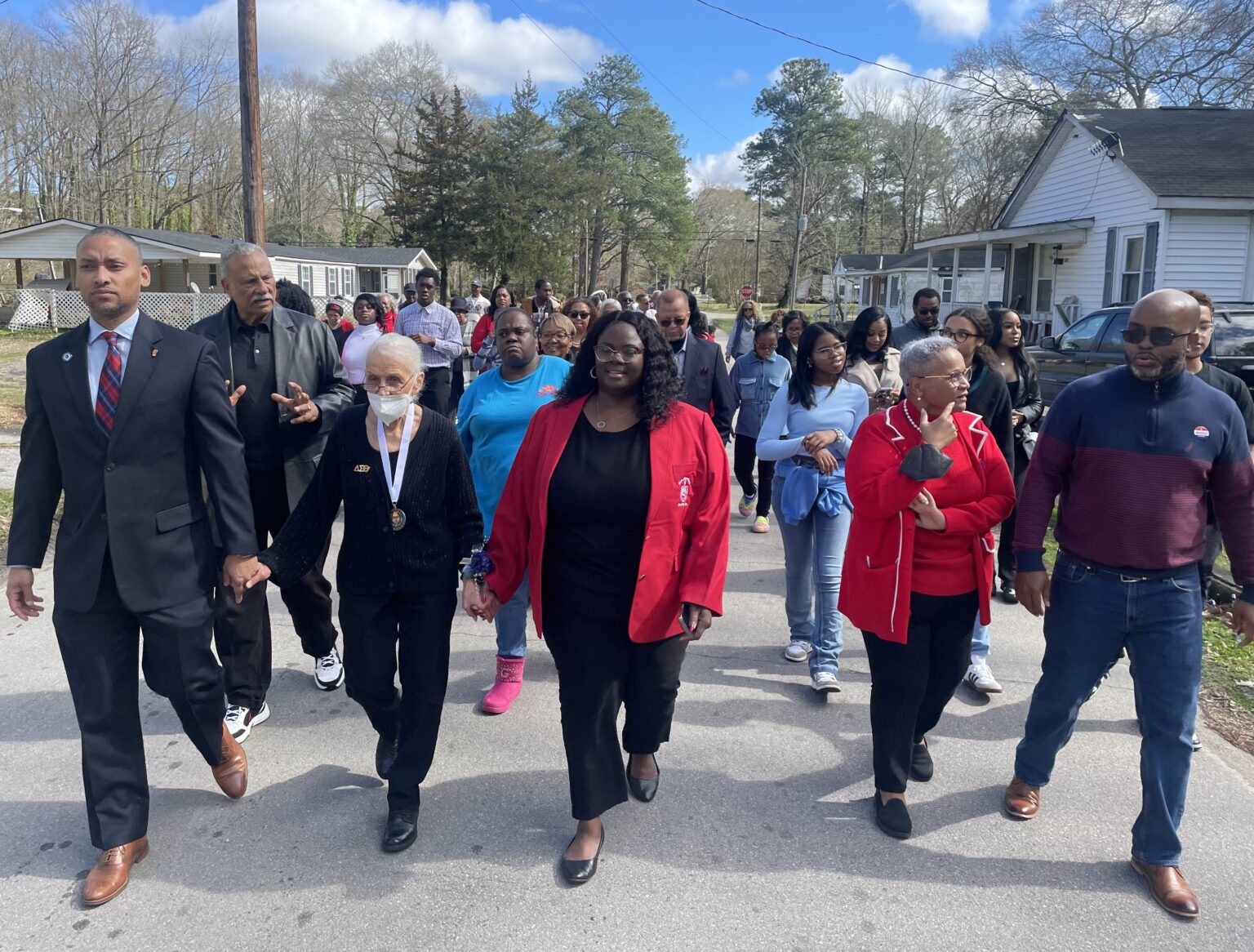
The Enfield-Roanoke Rapids Alumnae Chapter of Delta Sigma Theta Sorority, Inc. recognized Dr. Cofield’s impact on March 2. The ceremony, hosted at First Baptist Church in Enfield, consisted of a voter awareness initiative, documentary screening, and march to Dr. Cofield’s new historic marker.
Delta Sigma Theta’s political awareness and involvement
Delta Sigma Theta Sorority, Inc. (DST) is a private, nonprofit organization with over 1,000 collegiate and alumnae chapters throughout the world. It is one of nine organizations that is part of the National Pan-Hellenic Council, also referred to as the “Divine Nine.” The sisterhood was founded on Jan. 13, 1913 by 22 women on the campus of Howard University. Deltas commit to a lifetime of public service, the first action dating back to the Women’s Suffrage March of 1913.

Since its establishment in 1975, the Enfield-Roanoke Rapids Alumnae (ERRA) chapter has specifically served Halifax and Northampton counties in North Carolina. Their recent event in Enfield focused on “political awareness and involvement,” one of the sorority’s national initiatives that are collectively termed the “Five Programmatic Thrusts.”
Ahead of the final days before the primary elections in North Carolina, ERRA extended an open invitation for candidates to attend, offered presentations to spread voter awareness, and discussed critical legislative issues at local, state, and national levels. In addition, family, friends, sorority sisters, and former students all recognized Dr. Cofield for her contributions as an educator and activist from the community.
A victory for both civil rights and academic freedom
Several major cities across the south have been identified as landmarks in the civil rights movement, particularly during the mid-through-late 1900s. Dr. Cofield continues to amplify the history and work that transpired in rural regions like Eastern North Carolina in the fight for social justice.
The Halifax County native transitioned to Virginia to pursue higher education at Hampton Institute, now Hampton University. It was there that her journey as a Delta took root as one of 37 women to charter the Gamma Iota chapter of the sorority.
In the years following, Dr. Cofield became an educator, teaching English at the all-Black Thomas S. Inborden High in Enfield. She was terminated because of her leadership in mobilizing her students through voter rights education during her time in the classroom. These kinds of actions are what contributed to the displacement of Black educators during that period.

According to the N.C. African American Heritage Commission (NC AAHC), in 1964, the larger Halifax Voters’ Movement successfully raised Black voter registration in the county, in addition to executing other non-violent demonstrations such as economic boycotts of white-owned businesses that discriminated against Black patrons.
Compounded by Dr. Cofield’s and her family’s deep civil rights and political engagement, they became targets for hatred and intimidation tactics from local law enforcement and the Klu Klux Klan. At the ceremony, Dr. Cofield shared her vivid recollection of a burning cross that the Klan planted in her front yard.
Despite the threats on her life, with the support of the National Education Association (NEA), Southern Conference Educational Fund (SCEF), and other advocates, Dr. Cofield filed a lawsuit against the Halifax County School Board and the State of North Carolina. The NCAAHC states that the ruling for the Johnson vs. Branch case ultimately impacted 100,000 teachers in the American South, adding that, “A victory for Johnson would mean protection for those current educators and future generations of Black teachers who would protest and demonstrate for the cause of civil rights.”

In August 1966, the Southern Patriot newspaper quoted John Salter, then a SCEF organizer, who described Dr. Cofield as “one of the very few teachers in that whole northeast section of the state who took a positive public stand on civil rights.” The court case decision was “a tremendous victory for both civil rights and academic freedom,” he added.
Rodney Pierce is a middle school social studies teacher at Gaston Stem Leadership Academy with Northhampton County Schools. Having learned of the history in Enfield, he submitted the application for the NCAAHC N.C. Civil Rights Trail for a Johnson vs. Branch historical marker to be placed in Enfield.
In celebration, Dr. Cofield led the march on March 2 from First Baptist Church to the location where a piece of her legacy is now publicly engraved.

‘Where were you when the whistle blew?’
Dr. Cofield eventually moved to New Jersey, where she received her doctorate in urban planning at Rutgers University. At the age of 95, Dr. Cofield continues her work as an activist and educator.
She has held roles with various organizations and programs over the decades, some of which include the North Carolina Fund, Livingstone College, the New Jersey Department of Education, and the SEED Project. Dr. Cofield also co-founded the NJ Black Women’s History Conference, a nonprofit whose mission statement is “to educate its members and the larger community regarding the historical achievements and contemporary concerns of Black women.”
Dr. Cofield has further explored storytelling through film in recent years. In 2011, she produced a documentary titled, “The Brick School Legacy.” Having been raised in Enfield, she grew up just a few miles away from what is now the Franklinton Center at Bricks. The Brick School, founded by Thomas Sewell Inborden in 1895, provided education for Black students in Eastern North Carolina and was the school that Dr. Cofield’s mother, Mae Cofield, graduated from. This documentary is the first of two produced by Dr. Cofield, capturing the oral history of the school and the land located in Whitakers, North Carolina.
Dr. Cofield’s second documentary, “The 9 O’Clock Whistle,” was co-produced by Karen Riley and Gail Cruise-Roberson. A screening was provided at the ceremony, where she shared that the title refers to a whistle that blew throughout the town once the clock struck 9 p.m. The documentary explains that the sound signaled that all of the Black people had to go home — a representation of segregation and injustice that rang throughout the south.
“The 9 O’Clock Whistle” official website provides the following description of the documentary’s contents:
“Set in the 1960s in Enfield, North Carolina, a small segregated town in northeastern North Carolina, the story unfolds through the memories of participants, some of whom were only fourteen and fifteen years old when the events took place. These brave souls stood up to mental and physical intimidation tactics and fought back, along with their adult counterparts. It was a Black Lives Matter movement that was 58 years ahead of its time.”
The narratives shared in “The 9 O’Clock Whistle” are also captured in a book format. For more information on how to request a screening of the documentary, visit the 9whistle website.



ASHEVILLE, N.C. (WLOS) — The North Carolina Arboretum has announced a new season of “Spring Into the Arb!”
The “Spring Into the Arb!” is in its second year, with its series of plant shows and sales, science and nature activities, music, and art, allowing people to reemerge and reconnect with nature.
The season begins with Nature Play Day on Saturday, March 14, continuing through April, May, and June with new activities every weekend.
TROLLS DRAW LARGE WEEKEND CROWD, FORCING N.C. ARBORETUM TO TEMPORARILY CLOSE
According to a news release, throughout the season, guests can enjoy the following:
- Asheville Orchid Festival, annual Ikebana and Rose shows
- Purchase plants at the Spring Plant Sale and Market
- Get back to their native roots with Native Azalea Day, Mountain Science Expo, and Nature Play Day
The series culminates with Bonsai in the Blue Ridge in June, according to the release.
The release says guests and members are invited to drop in on the newly-opened Arbor Eatery in the Arboretum’s Education Center, which is open from 10 a.m. to 4 p.m. daily. Hours extend to 5 p.m. beginning April 1.
Spring Into the Arb events and programs are included with the regular Arboretum parking fee of $25 per vehicle. Arboretum Society Members get in free.
NC ARBORETUM MARKS BIRD DAY WITH WALKS, DEMOS AHEAD OF GREAT BACKYARD BIRD COUNT
According to the release, additional admission is required for the Asheville Orchid Festival and Bonsai in the Blue Ridge.
A full list of the Spring Into the Arb 2026 events includes:
- Nature Play Day: March 14
- Asheville Orchid Festival: March 28 to 29
- Music in the Mountains Day: April 4
- Arbor Day Celebration: April 11
- Native Azalea Day: April 18
- Mountain Science Expo: April 25
- World Bonsai Day: May 9
- Change of Seasons: Spring into Ikebana: May 16 to 17
- The Asheville-Blue Ridge Rose Society Exhibition: May 22 to 24
- The Arb in Focus: 40 Views for 40 Years: Opening May 23
- Spring Plant Sale and Market: May 29 to 30
- Bonsai in the Blue Ridge: June 4 to 7
For more information, visit here.

A copy of Michael Jordan’s 1983 “Sports Illustrated” cover debut sold for $229,360 on Saturday night at Goldin, obliterating the previous record for a graded magazine.
Before Saturday, the previous record was the $126,000 paid for Jordan’s 1984 SI debut in a Bulls uniform entitled “A Star Is Born.”
“Sports Illustrated” magazines are very common and people kept them, but collectors narrowed the category by making rarer newsstand copies most collectible, and graded condition of those copies to narrow the most desirable down further.
Then, in July, came PSA to challenge CGC in the grading space.
The record UNC Jordan, with teammate Sam Perkins on the cover, was the only PSA 9.6. The question is, with PSA’s grading just beginning, are there others our there?
It’s possible, but that Jordan issue presents a challenge because it has a gatefold that makes it more challenging to press out defects.
The big price will likely create a group of opportunists who will now take raw subscription copies of this issue and get them graded for potential arbitrage.
But it won’t be that easy. A CGC 8.0 newsstand edition sold for $4,636 in October.
Whether the big price also creates more grading and selling of rare magazines remains to be seen, but PSA’s entrance into the space has definitely turned heads.
PSA has graded more than 50 of this particular issue, the second most commonly graded after the “Star is Born” issue.
Darren Rovell is the founder of cllct and one of the country’s leading reporters on the collectibles market. He previously worked for ESPN, CNBC and The Action Network.

Warmer temperatures are bringing North Carolina’s ski season to a close, with several mountain resorts announcing closing dates. Beech Mountain will close after its annual Pond Skim on March 14, while Appalachian Ski Mountain plans to stay open through March 15 for its Meltdown Games.
Web Editor : Mark Bergin
Reporter : Eric Miller
Posted

Lulu Kesin of Greenville News wins writing awards for South Carolina basketball

These 15 South Dakota counties will see DUI checkpoints this month

Titans free agency: Tennessee signing offensive weapons to help QB Cam Ward, bolstering coach Robert Saleh’s defense, reports say

Texas Officials Unveil Amended Hemp Rules With Strict ‘Total THC’ Limits But Lower Licensing Fee Than Previously Floated – Marijuana Moment

Widow of protester killed files lawsuit against organizers of Utah ‘No Kings’ rally

Florida High School Football Rankings: Top 25 teams – Oct. 21

Cleary's 21 help Le Moyne down Central Connecticut State 69-64 in OT

How old is Bo Nix? What to know about Oregon quarterback ahead of 2024 NFL Draft

99th annual Pony Swim held in Virginia

Indiana Members Credit Union announced as new anchor tenant at Bottleworks District

China-linked birth tourism under scrutiny as GOP lawmakers press Trump admin for answers

What defence support could Ukraine offer Middle East states amid Iran war?

Warrants served in New Jersey, Pennsylvania as feds look into possible NYC terrorism

Video: Airports Struggle to Staff T.S.A. During Partial Government Shutdown

Before-and-after satellite imagery offers a rare look at damage inside Iran
-

 Wisconsin1 week ago
Setting sail on iceboats across a frozen lake in Wisconsin
-

 Massachusetts7 days ago
Massachusetts man awaits word from family in Iran after attacks
-

 Maryland1 week ago
AM showers Sunday in Maryland
-

 Florida1 week ago
Florida man rescued after being stuck in shoulder-deep mud for days
-

 Pennsylvania4 days ago
Pa. man found guilty of raping teen girl who he took to Mexico
-

 News1 week ago
2 Survivors Describe the Terror and Tragedy of the Tahoe Avalanche
-

 Sports5 days ago
Keith Olbermann under fire for calling Lou Holtz a ‘scumbag’ after legendary coach’s death
-

 Virginia5 days ago
Giants will hold 2026 training camp in West Virginia