Maryland
Ditching the gas tax and charging per mile; Maryland testing new way to fund transportation needs

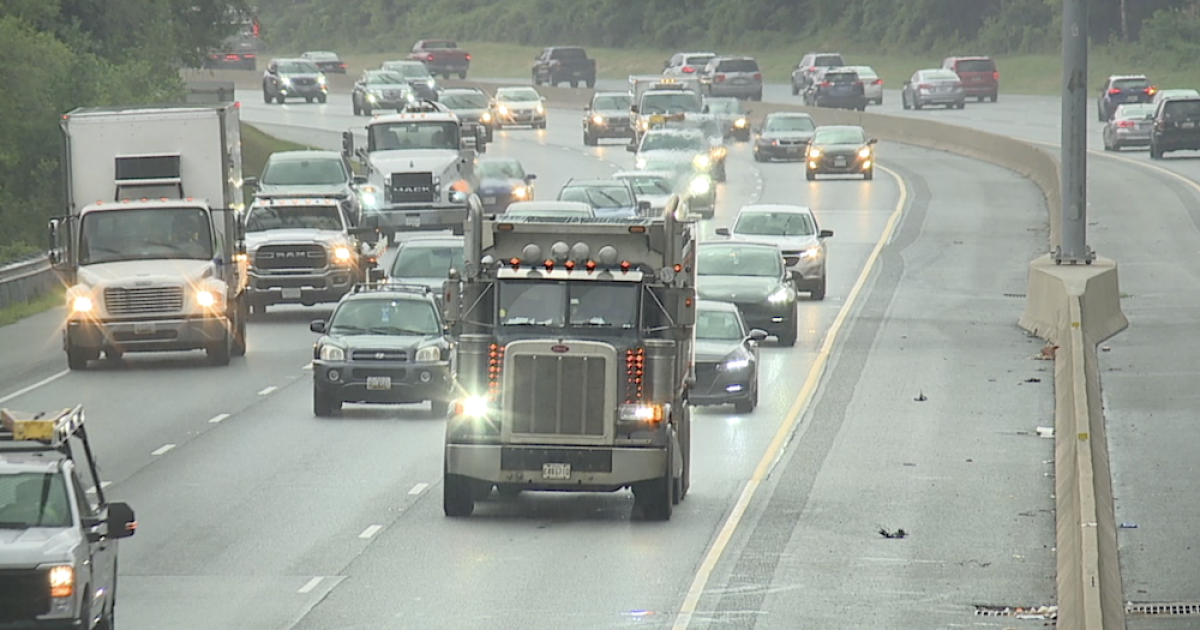
BALTIMORE — Faced with a $3.3 billion transportation budget shortfall, the Maryland Department of Transportation had to make tough funding choices. State leaders scrambled to balance the deficit by pausing certain improvement projects and raising registration fees. They’re also considering a new way of collecting revenue from drivers.
Earlier this year, MDOT, in partnership with The Eastern Transportation Coalition, launched a pilot program testing the mileage-based user fee (MBUF).
“So, it’s pretty simple in concept. If you use the roads, you pay for the roads. You use the roads more, you pay for the roads more, so it’s really creating that link between use and payment and getting away from the fuel tax as being the way we fund transportation,” said Trish Hendren, executive director for The Eastern Transportation Coalition (TETC).
As cars become more fuel efficient and drivers switch to electric vehicles, less gallons of fuel are being sold. In addition, the fuel tax rate in Maryland declined from 47 cents per gallon to 46.1 cents per gallon, due to an inflation adjustment. MDOT expects this to further impact the amount of fuel tax revenue generated adding that the fuel tax revenue is the “largest source of funding for transportation in Maryland, comprising nearly one-third of annual revenues to the Transportation Trust Fund. The Transportation Trust Fund funds the operation and maintenance of transit, road and bridge, port, and airport facilities across Maryland,” a MDOT spokesperson wrote in an email to WMAR-2 News Mallory Sofastaii.
“This is not a Maryland issue, this is a transportation issue that every state needs to really think about how we’re going to close that gap,” said Hendren.
Hendren’s coalition of 19 states plus D.C. was awarded federal grant money to explore the feasibility of the mileage-based user fee. In Maryland, around 150 drivers participated in the pilot program that ended on May 31. Drivers had their mileage tracked through odometer readings, a plug-in device, vehicle reporting data, or a phone app.
Hendren said the cost to drivers is comparable to the state’s fuel tax, which she said averages around $27 per month.
One concern they’ve received is how the fee might impact rural commuters.
“Right now, rural communities are actually paying more than some of their urban counterparts in fuel tax. And you’re thinking, why is that? It’s because a lot of those vehicles in rural communities, on average, are larger and a bit older. So right now, it’s not necessarily a fair situation. So, if we moved to a distance-based approach, what the data is showing us is that rural communities may pay less,” Hendren said.
The results of the pilot program are expected to be released in August.
Currently, four states have enacted legislation authorizing the collection of per-mile fees: Oregon, Utah, Virginia, and Hawaii. These are voluntary programs for drivers with fuel-efficient and/or alternative fuel vehicles. In exchange for paying by the mile, they’re exempt from paying an annual registration surcharge on their vehicles.
Meanwhile, Maryland has increased its registration fees by 64 percent from $135 to $221 for two years and a 73 percent increase for heavier vehicles upping the two-year rate from $187 to $323.
Maryland car owners will soon be forced to pay significantly higher registration fees
EV drivers will eventually have to pay an annual surcharge between $100 to $125, most likely starting July 1, 2025.
“The challenge with a flat fee is really about fairness, and we need to have that discussion in the transportation field with the general public, with elected officials. So, somebody only drives, I don’t know, a thousand miles a year, versus someone who’s driving 12,000 miles a year, but they’re paying the same annual flat fee. Is that how we want to fund transportation?” asked Hendren.
She understands it’s a challenging road ahead trying to navigate from a 100-year-old system, but she said her organization is focused on finding a fair and sustainable solution.
To see how much you’d pay under the mileage-based user fee model, TETC created an online calculator. Drivers input details about their car and how far they drive per month. It’ll then show the estimated difference between the fuel tax and MBUF.
And for answers to frequently asked questions on the MBUF, click here.


MARYLAND (WBFF) — Maryland Gov. Wes Moore said he plans to call a special session in Annapolis to redraw the state’s congressional district maps, reviving a contentious redistricting fight that stalled earlier this year.
“The status in Maryland is we are going to have a special session,” Moore said in an interview on CNN. Asked, “You are going to do it?” Moore replied, “We are going to do it.”
Moore told CNN the goal is for lawmakers to return to Annapolis and produce a new map. “Our House and our Senate will get together. They will come up with a resolution and bring it to my desk,” Moore said. “But the core criteria I’ve laid out is…doing nothing is not an option.”
It would be Moore’s second attempt at redistricting. Earlier this year, an advisory commission appointed by the governor proposed a map that would stretch the mostly Republican 1st Congressional District into largely Democratic Howard and Anne Arundel counties. The change would put Maryland’s only Republican member of Congress into a district with more Democratic voters.
The proposal drew sharp criticism during a hearing. “Governor Moore and Democrats in Annapolis, you are stealing our voice and our vote,” one speaker said. Moore responded, “It’s an important question of what’s the value of one vote and I think the answer to that is ‘what’s the value of democracy.’” Del. Kathy Szeliga said, “How can you ask us to trust democracy when you are taking it so lightly.”
ALSO READ | Gov. Wes Moore selected as Democratic nominee for Maryland’s next governor: AP
The measure passed in the House but never came to a vote in the Senate. In Annapolis today, Senate Democrats gathered to discuss what to do next.
“I think they’re meeting to figure out what can we do to make sure the judges don’t get involved and overturn what they’re trying to do,” said political analyst John Dedie.
A UMBC poll last year found only a fourth of Maryland voters considered redistricting a priority, with crime, education and health care viewed as more important.
Szeliga criticized Moore’s push, saying, “It’s unfortunate Wes Moore is doing the bidding of Democrats in Washington and not paying attention to the residents in the great state of Maryland.” Dedie said, “In many ways what he’s pursuing is future aspirations.”
Maryland’s last attempt to redraw congressional lines four years ago ended up in court, where a judge threw out the proposed maps, finding they were the product of “extreme partisan gerrymandering.” Szeliga, who successfully fought that court battle, said she is prepared to challenge another effort. “If they try to illegally change the constitution to make it unconstitutional we will challenge that,” she said.
Dediesaid a special session now appears likely. “The train has left the station. It’s just a matter of when it will arrive in Annapolis for special session,” he said.

One of the most unique ships featured in Sail250 Maryland and Airshow Baltimore can be found docked at the Baltimore Peninsula.
USS Marinette LCS25 is one of the most functional ships in the Navy fleet. At 370 feet long with 80 crew members, the ship has a helicopter landing pad and hangar, two rib boats in the belly of the vessel, and heavy artillery, including a cannon.
The ship has four engines, two of which are like jet engines, meaning it can sprint ahead of other vessels to intercept watercraft. It can also truck side to side and spin 360 degrees with controllable reversing and steering deflector buckets attached to the stern of the jet propulsion system. It can also traverse the littoral zones, water close to shore, and navigate waters as low as 15 feet deep.
“Where we shine is our ability to operate where other ships can’t,” said Cdr. Brian Sims, the ship’s executive officer. “For a 370-foot ship, one of the smallest in the fleet, it packs a punch. We can go 40 plus knots.”
The ship is used in counternarcotics missions primarily on the East Coast and in the Caribbean.
It is based in Jacksonville, Florida, but was built in Marinette, Wisconsin, which is where the ship gets its name. It began operating in 2023 and has yet to deploy. The ship can be out on the water for weeks or even months.
“We go out and find drug trafficking individuals and intercept, and the Coast Guard then takes over and arrests,” Sims said.
The pilot house is where the ship truly shines. An officer and junior officer monitor the radar and navigation, while another sailor sits at the helm and oversees steering the vessel and monitoring the engines.
“This is a very unique design for Navy ships,” Sims added.
The ship also hosts several heavy artillery pieces, including a cannon on the bow with different types of rounds to combat different threats. It can fire 220 rounds in a minute.
With its rich Naval history, Baltimore is playing host to some of the Navy’s finest, and the crews are equally as excited to be here in Maryland, the backbone of the Navy, celebrating 250 years of American history.
“Baltimore is a fantastic city, steeped in maritime tradition. Of course, we have Fort McHenry that we sailed past and rendered honors to when we arrived,” Sims said. “Having the ability to be in this role in this position on board this ship to celebrate the nation’s 250th, it’s an absolute honor, and one that, one that gives us all pause, and lets us reflect on where we’ve come as a nation.”

 As Maryland families head into another hot summer, many are about to receive an unpleasant reminder of just how badly some state leaders failed to address Maryland’s growing energy problems this year.
Higher energy bills are not coming by accident. They are the predictable result of years of poor planning and a continued refusal by Democratic leadership in Annapolis to confront the real issue facing our state: Maryland does not produce enough electricity to meet its own growing energy needs.
Instead of seriously addressing that challenge during this year’s legislative session, Democratic leaders celebrated passage of the so-called Utility Relief Act (House Bill 1532), which offers Marylanders roughly $12 in savings per month. At a time when families are facing soaring energy costs driven by a massive shortage of reliable in-state power generation, that is not meaningful relief. It is a political talking point designed to avoid the larger conversation Maryland desperately needs to have.
Our state imports nearly half of the electricity it uses. Nearly half of the power keeping homes cool, businesses operating and communities functioning every day comes from outside our borders. Yet even as demand for electricity continues to rise, Maryland continues falling behind on building the reliable generation capacity needed to support our future.
That is not a serious long-term strategy.
Families across Maryland are already struggling with inflation, rising housing costs and economic uncertainty. Energy bills are becoming another major financial burden for working families, seniors and small businesses. But instead of focusing on increasing reliable power supply, meaning fully lowering consumer costs, and strengthening Maryland’s long-term energy security, Annapolis continues offering temporary fixes that fail to address the underlying problem.
The reality is simple: Maryland needs more power generation, and every responsible energy source should be part of the conversation. Natural gas, nuclear, renewables, battery storage, clean coal and emerging technologies all have a role to play in creating a more reliable and affordable energy future for our state.
Maryland also needs a broader conversation about the role experienced infrastructure providers and utilities can play in strengthening reliability and supporting future generation needs. These are organizations that already manage the systems Marylanders depend on every day and understand the long-term planning required to maintain dependable service.
Reliable and affordable energy is not a partisan issue. It is a basic requirement for economic growth, business investment and everyday quality of life.
As summer begins and air conditioners start running around the clock, Maryland families will once again be reminded that energy policy decisions made in Annapolis have real world consequences.
Unfortunately, they are paying for those consequences every month.
Del. Jason Buckel is the Minority Leader of the Maryland House of Delegates and represents Allegany County in the Maryland General Assembly.
-

 Montana5 minutes ago
EXCLUSIVE: 2 ‘Exceptionally Rare’ Ski-In, Ski-Out Montana Mansions Head to Auction in Big Sky—and Could Sell for a Serious Steal
-

 Nebraska8 minutes ago
Today in History – June 26: University of Nebraska holds first commencement
-

 Nevada13 minutes ago
Nevada’s EV market is booming. Here’s why apartment charging could be the next challenge.
-
 New Hampshire20 minutes ago
A mom is thankful for Dismas Home – which is expanding recovery services to Rochester
-

 New Jersey23 minutes ago
New Jersey Supreme Court requires transparency for facial recognition evidence
-

 New Mexico28 minutes ago
NM PRC hears pushback on El Paso Electric rate hike that could add $40 a month
-

 North Carolina35 minutes ago
May home sales increase over 6% from last year in western North Carolina
-

 North Dakota38 minutes ago
North Dakota Supreme Court reverses dismissal of contractors’ lawsuit against city of West Fargo

