Georgia
Turning Toward Moscow: Georgia's Political Crisis and the Future of European Integration – The Soufan Center


Intelbrief / Turning Toward Moscow: Georgia’s Political Crisis and the Future of European Integration
AP Photo/Zurab Tsertsvadze
Bottom Line Up Front
- Georgia is currently facing its largest political upheaval since gaining independence, as widespread protests have unfolded in response to the ruling Georgian Dream party’s decision to suspend European Union accession talks until 2028.
- In response to Georgia’s democratic decline under GD, the EU has frozen the country’s accession process and imposed sanctions on key officials, with similar actions taken by the U.S. and Baltic states.
- Russia has engaged in a strategy of hybrid warfare, utilizing disinformation campaigns to prop up the pro-Russia Georgian Dream party and regain its influence in the South Caucasus.
- Georgia’s overt transition away from the West could impact neighboring Armenia, which may face greater obstacles in its EU integration efforts and increase its vulnerability to pressures from Azerbaijan, Russia and Türkiye.
Georgia is currently facing its largest political upheaval since gaining independence, as widespread protests have erupted in response to the ruling Georgian Dream (GD) party’s decision to suspend European Union (EU) accession talks until at least 2028. Irakli Kobakhidze, prime minister and leader of GD, announced the decision after the European Parliament passed a resolution on November 28 rejecting the outcome of Georgia’s October 2024 parliamentary elections, calling for a new election to be held within one year under international observance. It further called for the EU and its member states to impose sanctions on several Georgian high-ranking officials, including Kobakhidze, and oligarch and founder of the GD, Bidzina Ivanishvili.
The EU resolution follows a series of setbacks in Georgia’s EU integration process. In June, Brussels froze Georgia’s accession talks and rescinded €121 million in financial assistance, citing democratic backsliding incompatible with European values. GD leaders have rejected Brussels’ demands to repeal several Kremlin-style laws that have been implemented in recent years, such as the controversial “foreign agents” bill, which mirrors Russian legislation utilized to suppress dissent through the curtailing of media freedoms. Another is the “Family Values” bill, adopted to restrict LGBTQ+ rights. The ruling party has framed the European Parliament’s recent decision as “blackmail,” accusing Brussels of interfering in Georgia’s sovereignty. These events have underscored the EU’s inability to steer Georgia away from its deepening ties with Moscow.
In response to GD’s suspension of accession talks, approximately 100,000 protesters gathered outside parliament in Tbilisi, with demonstrations having already spread to at least eight cities since November 29, in response to the EU’s resolution regarding the Georgian elections. These protests have been met with a violent crackdown by authorities, deploying the use of water cannons, tear gas, and rubber bullets. Footage has circulated online showing police violently attacking unarmed demonstrators, leading to over 220 arrests, including prominent opposition leader Zurab Japaridze. Approximately 44 individuals have been hospitalized, with many more injured. Georgian authorities have also reported at least 21 police officers wounded. Protesters responded with Molotov cocktails and firework launchers.
As a result of the unrest, the EU recently announced that it is now reassessing its visa facilitation agreement with Georgia, potentially suspending it if democratic standards continue to erode. Moreover, the Baltic states of Lithuania, Latvia, and Estonia have imposed travel bans on high-ranking GD officials and law enforcement officers allegedly implicated in human rights violations during the ongoing protests. The United States has also responded, suspending its strategic partnership with Georgia, which was established in 2009 to promote democratic values and economic cooperation.
Kobakhidze’s announcement to halt EU talks has confirmed popular fears of the country’s overt pivot away from the West to more closely align with Russia. Many Georgians strongly support EU integration, with a 2023 poll by the International Republican Institute suggesting that this number is as high as 89% of the population. During its time as parliament’s ruling party, GD has maintained a facade of pro-European rhetoric, simultaneously resisting the reforms required by Brussels to achieve accession. This shift is a stark reversal for a country that has been viewed as a forerunner of democratic aspirations in the post-Soviet sphere.
Georgian Dream’s rise to power in 2012 initially promised pro-Western reforms and closer ties to NATO and the EU. However, in recent years, the party has progressively embraced a Eurosceptic stance, as evidenced by its increasing reliance on anti-Western legislation and its emphasis on preserving Georgia’s cultural values, while simultaneously asserting that it is not anti-EU. This deliberate ambiguity on future European integration was viewed by many as a strategy to maintain popular support while also consolidating power through increasingly authoritarian measures.
During the recent 2024 elections, GD utilized fear mongering to gain votes, framing the opposition’s pro-European stance as antagonistic to Russia. Campaign materials juxtaposed images of war-torn Ukrainian cities with peaceful Georgian towns, leveraging public fears of Russian retaliation to achieve electoral dividends. These concerns are rooted in Georgia’s recent history, such as the 2008 war with Russia over the breakaway regions of Abkhazia and South Ossetia, as well as Moscow’s 2014 annexation of Crimea. GD’s narrative of strategic caution resonated with voters, in the context of Russia’s ongoing war in Ukraine. This has heightened Georgia’s sense of vulnerability, especially as Russian military forces continue to occupy these breakaway regions, which are internationally recognized as part of Georgian territory. These security concerns, coupled with many opposition figures’ association with unpopular figures from the pre-2012 government, which was riddled with corruption, have allowed GD to maintain its grip on power.
It is increasingly clear that Russia has also assisted GD in remaining in power, prioritizing its influence efforts in Georgia, with Moscow leveraging a range of hybrid warfare tactics to manipulate political outcomes and propagate anti-Western narratives. For example, during 2019 protests in Tbilisi, a Russian-backed television network was implicated in the spread of disinformation to exacerbate unrest. The Kremlin also has strong ties with figures within GD, including Ivanishvili, who has been accused of having pro-Russian sympathies and links to Moscow’s influence operations, as well as strong financial ties to Russian state-owned Gazprom. Most recently, Russia used various hybrid tactics to allegedly assist GD in rigging the October parliamentary elections. The Kremlin has many reasons for taking such a heavy hand in Georgian affairs. For one, it likely seeks to reassert its dominance over the South Caucasus, utilizing Georgia as a gateway. Georgia is in a strategic location, vital for global trade routes and regional security. Russia’s successes in influencing Georgia’s political landscape have raised concerns that these strategies could be emulated in nearby Moldova, facilitating the Kremlin’s encroachment pursuits.
GD’s pivot toward Moscow is reflected in its foreign policies. Georgian imports of Russian natural gas through Gazprom have increased, reinforcing energy reliance on Moscow at a time when other regional actors have diverted away from Russian energy sources following Russia’s invasion of Ukraine. China has also become a key player in Georgia’s development, financing major infrastructure projects such as the Baku-Tbilisi-Kars railway and the controversial Anaklia Deep Sea Port. These projects, which aim to position Georgia as a crucial logistical link between Europe and Asia, highlight the gaps left by insufficient Western investment. Georgia’s multi-vector foreign policy echoes the balancing acts of countries like Türkiye and Hungary, which maintain ties with both the East and the West. Georgia’s limited resources make this strategy precarious, rendering it vulnerable to external pressures from more assertive states.
Georgia’s shift away from the West could transform regional alliances. Armenia now represents the sole South Caucasus state that is actively in pursuit of EU membership. This isolation has the potential to thrust Armenia closer to Iran. Both nations share opposition to the Zangezur corridor – a contentious project backed by Türkiye, Azerbaijan and Russia. The corridor represents a pressing danger for Armenia’s territorial and strategic interests. The proposed corridor would cut through Armenia’s southern Syunik province and result in a permanent Azerbaijani military presence within its borders. Moreover, Georgia’s alignment with Russia, combined with Russia’s growing ties to Azerbaijan could undermine the established Türkiye-Azerbaijan alliance. In conjunction, these shifts could establish a new regional bloc which would exert significant pressure on Armenia, highlighting a need to seek stronger ties with Iran to counter this threat. However, its strained ties with Russia and limited alternatives inhibit its options.



Georgia
With voting over, Georgia’s election to replace Marjorie Taylor Greene could be test of Trump’s influence

Polls have closed in the Georgia 14th Congressional District special election to elect who will replace Marjorie Taylor Greene in Congress.
The seat has been vacant since January, when Greene resigned following a monthslong public fight with President Trump over foreign policy issues and the release of documents involving the Jeffrey Epstein case. A week before she announced her plans to resign, Mr. Trump said he would support a primary challenge against her.
Twenty-two candidates filed to run for the seat, but the number dropped to 17 candidates — 12 Republicans, three Democrats, one Libertarian, and one independent — all of whom appeared on Tuesday’s ballot.
Among the top candidates are former District Attorney Clay Fuller, who was endorsed by Mr. Trump, former Republican state Sen. Colton Moore, and Democrat Shawn Harris, a retired Army brigadier general who lost to Greene in the 2024 race for the seat.
Harris has raised more than $4.3 million for the race, with about $290,000 in the bank.
Greene has declined to endorse anyone in the race.
Georgia voters enthusiastic to choose their representative
Voters in Rome, Georgia, said they expect to return and vote in what is likely to be a runoff election because of the number of candidates.
“Too many people that think they’re politicians — some I know personally that has no experience, that, you know, Washington would just swallow them up like it does most people,” one voter said.
“What I look for in a candidate is tell me your policies. That’s the problem that I have with both sides today,” another voter said. “They attack each other, they hate each other, and they don’t ever get around to telling you what their actual policies are.”
Despite voters saying they planned to return to the ballot box, Floyd County Republican Vice Chair David Guldenschuh said the complicated schedule had party heads worried.
“There’s real fatigue out there, and I sense and feel for them,” he said.
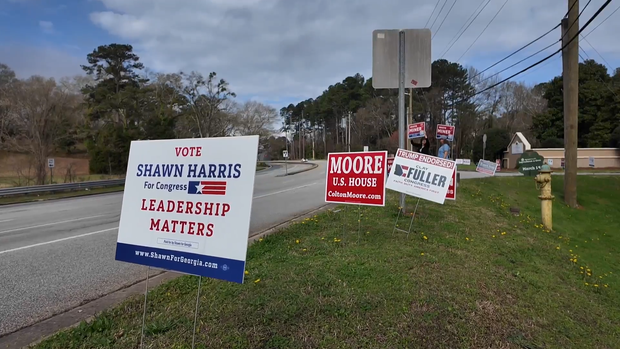
Still, Guldenschuh said he doesn’t feel like the crowded field would hurt the GOP’s chance to hold the seat that Greene once occupied.
“I think that, you know, we have an unusual situation here. We all appreciated and loved Marjorie. And when she and Trump had the falling out, we still supported both here in this district, even though they weren’t getting along very well. And still are, as I understand,” he said. So I do know that this district is very solid conservative, and from Floyd County north, it’s really conservative. So I don’t see a big change going on now.”
Vincent Mendes, the chair of the county’s Democratic Party, expected Harris to get to the runoff, but said it would take effort to flip the seat.
“We will have to work our butts off to make him win if he gets to a runoff, but that’s how we should treat every single election,” Mendes said.
A local race with national implications
CBS News Political Director Fin Gómez said this special election is about more than just one seat in Congress. It’s being watched by politicians across the state and around the nation as an early indicator of where the Republican Party and its voters stand right now.
Gómez said this race could offer one of the first real tests of Mr. Trump’s influence within the party, with the president throwing his support behind Fuller.
The results could show whether the Republican base is still fully aligned with him after his rift with Greene.
The key question, according to Gómez: Does the president still have the influence that he did back in 2024?
“I do think that if Clay Fuller does well, even if he doesn’t clear the threshold that’s needed to avoid a runoff, I think that bodes well for the president, because that means Republican voters are still adhering to what the president says, and it shows the influence that that the president still has on the Republican Party, including in northwest Georgia,” he told CBS News Atlanta.
If another candidate, such as Moore, pulls off a win, it could signal the Republican base isn’t always following the president’s lead.
“If Fuller does not when I think it would surprise a lot of the Trump faithful who really adhere to who he supports in these type of elections, but if, let’s say, if it doesn’t go Fuller’s way and Moore picks off this win, I think what you are seeing is that the base might be a little more unpredictable, similar to what we saw perhaps in 2010.”

Special election marks start of busy campaign stretch
With how crowded the field is, it is very likely that this will be only the first step to choosing Greene’s replacement. Georgia’s special election rules require a candidate to win a majority of votes. If that threshold is not met, the top two candidates will go on to the April 7 runoff.
Whoever eventually wins the seat will serve out the rest of Greene’s term — a relatively short time in office. If they want to remain in the seat, they’ll have to run again in the May 19 party primaries. That race could possibly go to a party runoff, which would take place on June 16. The winners of the primaries will advance to the general election in November.
Last week, 10 Republicans, including Fuller and Moore, qualified to run in November’s election for a full two-year term. Harris also qualified, the sole Democrat who did in what has been rated as the most Republican-leaning district in Georgia by the Cook Political Report.
Mr. Trump carried the 14th Congressional District with 68% of the vote in the 2024 election, with Greene receiving over 64%. Republicans want that rightward trend to continue in the district. Democrats are hoping that the potential GOP infighting and crowded field could help them secure a surprise electoral win, shrinking the already-narrow margins in the U.S. House of Representatives.
Republicans currently control 218 House seats to the Democrats’ 214.

People cheer for President Trump en route to his speaking engagement at the Coosa Steel Corporation on Feb. 19 in Rome, Ga. Trump delivered remarks on the economy and affordability as the state started voting to replace the seat vacated by former Republican Rep. Marjorie Taylor Greene.
Chip Somodevilla/Getty Images
hide caption
toggle caption
Chip Somodevilla/Getty Images
Stay up to date with our Politics newsletter, sent weekly.
ATLANTA — Voters in Northwest Georgia are choosing who should replace former Republican Rep. Marjorie Taylor Greene. Voting closes in the district’s special election on Tuesday night.
The election will test the weight of President Trump’s endorsement of one of the candidates in a crowded race. Some voters say the president’s choice is not who they think would best support the conservative MAGA movement championed by both Trump and Greene.
Greene resigned at the beginning of this year, leaving Georgia’s 14th Congressional District without representation in Congress — and slimming the GOP’s majority in the House — following a bitter split with Trump.

Greene rose to prominence over five years in office as a strong ally of Trump, bombastically attacking critics and pushing the MAGA movement’s “America First” policy. Yet the two had a very public clash after she pushed for the release of documents related to convicted sex offender Jeffrey Epstein. Greene has also been sharply critical of Trump’s actions abroad, saying he has strayed from his promises to focus domestically.
With Trump now in the second year of his second term, other high-profile spats with key parts of his MAGA coalition have erupted over his administration’s handling of other issues, including sweeping tariffs, immigration policy and more. More recently, rifts have emerged over the war with Iran.
Some, like Greene, argue that though Trump helped create the “America First” worldview, he is not the sole arbiter of what it looks like.

Most of the GOP candidates in the special election have said they want to focus on Trump’s priorities and the concerns of their district, rather than become headlines themselves — an approach they say Greene embraced in her public disputes with Democrats and even with members of her own party.
“The difference between Marjorie and I is I will not use the press to become a celebrity,” Republican Star Black said during a candidate forum on Feb. 16. “I will use the press to actually show what I have done — the accomplishments,”
Trump has endorsed Clay Fuller, a district attorney in northwest Georgia for the state’s Lookout Mountain Judicial Circuit. He emphasized his support last month during a visit to Rome, part of the state’s 14th District, where he held a rally to tout his administration’s economic policy.
Fuller called himself a “MAGA warrior” at the event.

Republican congressional candidate Clay Fuller (left) shakes hands with President Trump as he arrives on Air Force One at Russell Regional Airport on Feb. 19 in Rome, Ga.
Chip Somodevilla/Getty Images
hide caption
toggle caption
Chip Somodevilla/Getty Images
“I really like him,” said rally attendee Jill Fisher. “I think he’s a strong candidate, seems like a very nice family man with some great values. And I think he’ll add a lot to Congress.”
Highlighting Fuller’s military service as an Air Force veteran, an ad for his campaign says, ” ‘America First’ is the story of his life.”
Fuller faces several other GOP candidates in the primary, including former state Sen. Colton Moore. Moore won elections for the state Legislature in the district before and is considered one of the most right-leaning lawmakers at the state level.
“I’m 100% pro-Trump,” Moore declared in his campaign announcement video.

He’s made a few headlines of his own. Last year, Moore was arrested for attempting to enter the House chambers in Atlanta to attend the State of the State address by GOP Gov. Brian Kemp. Moore argued he had a constitutional right to enter the chamber. Moore had been banned from entering the chambers by the state’s Republican House Speaker Jon Burns for disparaging comments he made about a late Georgia lawmaker at his portrait unveiling.
Moore’s record matters for some GOP voters even more than Trump’s endorsement. Less Dunaway, 14th district voter, says he’s a strong supporter of Trump, but thinks Moore will do a better job carrying out the president’s agenda than Trump’s own pick.
“He actually knows what he’s doing,” Dunaway said of Moore. “He was a state representative, a state senator. He was the first one to fight the people over the 2020 election in Georgia.”
Moore was one of a group of GOP state lawmakers who called on lawmakers to investigate or impeach Fulton County District Attorney Fani Willis after she charged Trump and others with trying to overturn the 2020 election in Georgia, when Trump and his allies pushed baseless claims of widespread election fraud.

Fuller insists Trump made the right choice in supporting his bid.
“I think they’re looking for someone to carry President Trump’s banner, support his agenda, and fight for him on Capitol Hill,” Fuller told Georgia Public Broadcasting last month.
Still some Republicans who attended the February rally left undecided.
“I don’t just blindly follow what [Trump] says,” said Clay Cooper of Rome.
Still, Cooper said that Trump’s endorsement means he will give Fuller more thought. “[Fuller is] someone that [Trump] thinks aligns very much with his messaging, with his actions, so that certainly weighs in,” Cooper said.
Unlike a partisan primary, all the candidates — Republicans, Democrats and third party candidates — will be on the same ballot for voters in the special election. If no one gets over 50% of the vote, the two top vote-getters regardless of party will advance to a runoff on April 7.
Follow the results below as polls close on Tuesday at 7 p.m. ET.
NPR’s Padmananda Rama contributed to this report.


Cleveland Cavaliers Creating Space Outside Arena to Honor 2016 Championship Team

3 Top Texas Longhorn Recruiting Targets Were Blown Away By Their Visits to Austin

What to know about the Alabama man granted clemency two days before his execution

Alaska High School Girls Basketball 2026 ASAA State Championship Brackets – March 10

WATCH: How Helping One Woman provides hope and support with ‘Girl’s Night Out’

Florida High School Football Rankings: Top 25 teams – Oct. 21

Cleary's 21 help Le Moyne down Central Connecticut State 69-64 in OT

How old is Bo Nix? What to know about Oregon quarterback ahead of 2024 NFL Draft

99th annual Pony Swim held in Virginia

Indiana Members Credit Union announced as new anchor tenant at Bottleworks District

Map: 2.3-Magnitude Earthquake Reported North of New York City

Trump stirs GOP primary drama with visit to Massie’s Kentucky home turf

Israeli air strike targets building in south Lebanon

Ed Martin, outspoken Justice Department lawyer, is formally accused of ethical violations | CNN Politics

Trump reveals top issues GOP should focus on to secure midterms victory: ‘I’ve never been more confident’
-

 Wisconsin1 week ago
Setting sail on iceboats across a frozen lake in Wisconsin
-

 Massachusetts1 week ago
Massachusetts man awaits word from family in Iran after attacks
-

 Maryland1 week ago
AM showers Sunday in Maryland
-

 Pennsylvania5 days ago
Pa. man found guilty of raping teen girl who he took to Mexico
-

 Florida1 week ago
Florida man rescued after being stuck in shoulder-deep mud for days
-

 Detroit, MI5 days ago
U.S. Postal Service could run out of money within a year
-

 Miami, FL6 days ago
City of Miami celebrates reopening of Flagler Street as part of beautification project
-

 Sports6 days ago
Keith Olbermann under fire for calling Lou Holtz a ‘scumbag’ after legendary coach’s death