Georgia
Trump Georgia case ensnared in legal arguments during testimony about romantic relationship


By KATE BRUMBACK, ALANNA DURKIN RICHER and ERIC TUCKER
ATLANTA — Georgia prosecutors sought to knock down misconduct allegations against Fulton County District Attorney Fani Willis on Friday, calling her father to the witness stand to testify about his knowledge of her romantic relationship with the special prosecutor she hired to lead Donald Trump’s case.
On the second day of an extraordinary hearing that could result in Willis and her office being removed from the case against the former president, Willis’ father, John Clifford Floyd III, testified that he had not met special prosecutor Nathan Wade until last year and didn’t find out until weeks ago that they had been in a relationship. Defense attorneys have been trying to show that the romantic relationship existed before Willis hired Wade.
TODAY: Donald Trump fraud verdict: $364 million penalty in New York civil case
Prosecutors also sought to bolster Willis’ testimony that Wade was not the district attorney’s first choice to lead the case against Trump. Former Georgia Gov. Roy Barnes testified that Willis approached him in 2021 about serving as special prosecutor, but that he turned it down in part because he had “mouths to feed” at his law practice and because he was concerned about potential threats of violence that could come with the job.


The hearing, with testimony about cash stashes in homes, romantic dalliances and vacations to exotic locales, lent a soap opera feel to one of the most politically consequential prosecutions ever initiated by a county district attorney. Thousands watched a livestream of the proceedings, even during tedious lawyerly exchanges about legal theory, while some prominent local figures — including Atlanta’s current mayor — dropped in to witness the hearing in person.
Yet despite the public intrigue and the potential to undermine the integrity of the case, it was far from clear by midday Friday that defense lawyers had succeeded in presenting indisputably persuasive evidence to push Willis or Wade out of the prosecution.
Wade’s former law partner and divorce attorney, Terrence Bradley, was described by the defense as a key witness who would testify that Willis and Wade began dating before Wade was hired. There have been differing accounts about when the relationship began. Wade and Willis have said they didn’t start dating until 2022, but a former Willis friend and co-worker testified Thursday that she saw them hugging and kissing before Wade was hired in November 2021.
Bradley repeatedly refused to answer questions about Wade and Willis, citing attorney-client privilege. But he did acknowledge texting with the defense attorney who first revealed the existence of Willis and Wade’s relationship.
Prosecutors opted not to put Willis back on the witness stand on Friday, avoiding the spectacle of more deeply personal testimony from the the district attorney. On the witness stand Thursday, Willis forcefully pushed back against any suggestion that her relationship with Wade created a conflict of interest and accused a defense attorney of trying to smear her with salacious lies in an effort to discredit the case against Trump. Willis and Wade have both acknowledged they were in a relationship, but say their personal lives have no bearing on their ability to prosecute the case.
Even if the allegations don’t derail the case, they threaten to taint the public’s perception of one of four criminal proceedings facing the former president, and have provided an opening for Trump and his Republican allies to try to cast doubt on the case’s legitimacy as he vies to reclaim the White House in November.
Trump immediately jumped on the allegations in hopes of discrediting the entire case, part of a yearslong pattern of deflecting attention away from his own conduct by highlighting the personal lives and lapses in judgment — both perceived and real — of the officials investigating him. His use of the word “lover” to refer to Wade echoed his attacks years earlier on two FBI officials who had an extramarital relationship and exchanged derogatory text messages about him during the FBI’s investigation into Russian election interference.
Willis and Wade’s relationship was first revealed by Merchant, an attorney for Trump co-defendant Michael Roman, a former campaign staffer and onetime White House aide. Merchant has alleged that Willis personally profited from the case, paying Wade more than $650,000 for his work and then benefiting when Wade used his earnings to pay for vacations the pair took together.
Wade testified that he and Willis took trips together, but said Willis paid him back in cash for some expenses that he had charged to his credit card. Defense attorneys have sought to cast doubt on the claim that Willis paid Wade in cash, pressing both of them on why Willis would use cash and if they had any evidence that she paid him with it.
Floyd, Willis’ father, seemed to support his daughter’s assertion that she keeps large amounts of cash at home with his testimony that he always told his daughter to have six months of cash on hand.
“It’s a Black thing,” Floyd said. “Most Black folks, they hide cash, they keep cash.”
It’s unclear when the judge might rule on whether Willis and her office should be disqualified from the case. Judge Scott McAfee said during a hearing Monday that Willis could be disqualified “if evidence is produced demonstrating an actual conflict or the appearance of one.”
Willis’ removal would be a stunning development in the most sprawling of the criminal cases against Trump. If she were disqualified, a council that supports prosecuting attorneys in Georgia would need to find a new attorney to take over. That successor could either proceed with the charges against Trump and 14 others or drop the case altogether. Even if a new lawyer went forward with the case, it would very likely not go to trial before November, when Trump is expected to be the Republican nominee for president.
Willis and Wade’s relationship was first revealed by Merchant, an attorney for Trump co-defendant Michael Roman, a former campaign staffer and onetime White House aide. Merchant has alleged that Willis personally profited from the case, paying Wade more than $650,000 for his work and then benefiting when Wade used his earnings to pay for vacations the pair took together.
Richer reported from Boston. Associated Press writer Adriana Gomez Licon in Miami contributed to this report.



Pennsbury Baseball Zuckerman District One Championship PIAA
Pennsbury junior Brendan Zuckerman smacks an RBI single to left in the Falcons’ 7-run first inning of District One 6A championship victory
Ryan Zuckerman is last on the alphabetical list of the 335 college and high school baseball players attending the June 22-27 MLB Draft Combine in Phoenix.
What the 2023 Pennsbury graduate did in his lone season at Georgia Tech has garnered him plenty of attention from MLB scouts regardless of where his name is on a list that includes Holy Ghost Prep grad Aiden Robbins, a Texas outfield standout who is expected to go as early as late in the first round, fellow Pennsbury graduate Joe Tiroly, an infielder from Virginia, and Pennsbury senior right-handed pitcher Keller Bradley.
MVP of the Atlantic Coast Conference Tournament for the conference champion Yellow Jackets, second-team All-American by the National Collegiate Baseball Writers Association and leader in home runs (23) and RBIs (79, tied for eighth in the country) for the high-powered Georgia Tech offense are just a few of Zuckerman’s notable accomplishments heading into the July 11-13 draft. He is projected to go toward the middle of the 20 rounds.
“It’s pretty surreal for sure,” said Zuckerman, 21. “It’s something I dreamed of my whole life.”
In a season filled with memorable moments, perhaps most impressive was Zuckerman being named ACC Tournament MVP after hitting three home runs with six RBIs and batting .571 (8 for 14), culminating in a 13-6 championship game win over North Carolina in Charlotte. He also was a first-team All-ACC selection at third base.
Zuckerman and Georgia Tech went into the NCAA Atlanta regional as the nation’s No. 2 seed. Though the 50-11 Yellow Jackets ended up being eliminated by losing twice to Oklahoma, including 8-7 in 10 innings for the regional title, Zuckerman can only rave about his experience at Georgia Tech.
“If you would have told me that’s how the season for me and each of us on the team would’ve gone, I would’ve been extremely happy,” Zuckerman said. “It was probably the best decision I ever made in my life.”
After a solid sophomore season at Pitt in which he hit .295 with 16 doubles, 13 home runs, 48 RBIs and 48 runs scored, Zuckerman believed transferring would help him develop into a more pro-ready player and allow him to win more games. And Georgia Tech checked all the boxes
In addition to his career-best home run and RBI numbers, Zuckerman led Georgia Tech in 2026 with 24 multi-RBI games while establishing career-highs in batting average (.345), runs (71), hits (80), walks (37), slugging percentage (.720) and on-base percentage (.438). He batted fifth in the order.
The 6-foot-4, 230-pound Zuckerman, who always had a strong arm, also worked hard to improve his defense at third base, resulting in 15.99 defensive runs saved for the season, which was the 13th-highest total in college baseball.
“I like to say I’m arguably the best third baseman in the country,” he said.
As a senior playing third at Pennsbury, Zuckerman hit .465 with an on-base percentage of .563, plus six doubles, six home runs, 23 RBIs and scored 26 runs.
“In high school, he was incredible for us,” said Pennsbury head coach Joe Pesci. “(A year ago), he decided to go from a mid- to low ACC team to the best team in the ACC. Surrounding himself with amazing players at Georgia Tech, he’s kind of elevated his game.”
Since the conclusion of the collegiate season, Zuckerman has been working out in preparation for the MLB Draft Combine and, ultimately, the draft. He’s been splitting his time between Yardley and Atlanta.
MLB teams have indicated Zuckerman’s power bat and defense are two of his strengths, while he’s focusing on improving his swing selection and making more contact at the plate.
Zuckerman is looking forward to hearing his name called by one of the 30 major league clubs. Whether a team views him as a third baseman, first baseman, corner outfielder or even second baseman doesn’t really matter to him.
“I think right now I’m in a great position to go and play professional baseball and start my journey up to the big leagues,” Zuckerman said. “The goal is not to get drafted – it’s to play MLB.”
Tom Moore: tmoore@couriertimes.com; @TomMoorePhilly is a sports columnist for PhillyBurbs.com. Support our journalism with a subscription.
Georgia
Georgia pair charged with murder after bartender’s dismembered remains found in lake outside Atlanta

NEWYou can now listen to Fox News articles!
A Georgia pair have been charged with murder after allegedly slaughtering a bartender and dumping his dismembered remains in a lake, according to authorities.
Mario Andre Barber, 46, and Brittany Amber Baker, 42, were arrested on Monday for allegedly murdering Jamal Rashad Parker, 37, in a home outside of Atlanta, the Douglas County Sheriff’s Office said in a press release.
Investigators discovered Parker’s remains in May in the Dog River Reservoir, located about 30 miles outside Atlanta.
Parker’s identity was confirmed using DNA comparison technology after his father contacted authorities to report that the victim’s tattoos matched his son’s ink, local station WSB-TV reported.
MINNESOTA MAN ACCUSED OF DISMEMBERING GIRLFRIENDS, HIDING BODIES IN STORAGE UNITS ENTERS PLEA
Mario Andre Barber, 46, and Brittany Amber Baker, 42, are charged with murder. (Douglas County Sheriff’s Office)
Investigators believe the two suspects killed Parker inside a home in Douglasville where Baker lived.
Late last month, investigators were observed leaving the home with a reciprocating saw and cleaning supplies, according to WSB-TV.
Police have not disclosed if Parker knew his alleged killers. However, a GoFundMe created by a family member described the pair as “people he knew and trusted.”
SUZANNE SIMPSON’S DNA FOUND ON MURDER SUSPECT HUSBAND’S SAW THAT CAN CUT METAL
A family member described Jamal Rashad Parker as a bartender, musician and artist with “a beautiful soul and spirit.” (GoFundMe)
The suspects pleaded not guilty in court on Tuesday and are being held without bond. Both have lengthy criminal records, according to reports.
“I want them to be punished. And I don’t even think a life sentence is good enough,” Parker’s dad, Charles Parker, told WSB-TV outside the courthouse.
“It’s the kind of stuff you see on TV, but I mean … they had no remorse,” he added.
In addition to bartending at Ms. Icey’s Kitchen & Bar in Atlanta, the victim was a musician and artist with “a beautiful soul and spirit,” according to the GoFundMe page created to cover burial costs.
Investigators believe the two suspects killed the victim inside a home in Douglasville. (Douglas County Sheriff’s Office)
CLICK HERE TO DOWNLOAD THE FOX NEWS APP
“He loved life and the people he met along his journey in life. He was a musical artist, visual artist, and a professional bartender who enjoyed creating new drinks. This has totally devastated our family and friends and has left us heartbroken,” the fundraiser reads.

The Georgia Bulldogs are trying to flip cornerback recruit Preston Glasco just over a week after he committed to the Connecticut Huskies.
Glasco, a member of the class of 2027, announced his commitment to UConn on June 10. Since committing to UCONN, Georgia has hosted Glasco on an official visit and offered him a scholarship (back on June 18).
The 6-foot-3, 190-pound cornerback has excellent length and size. Glasco has impressive athleticism and ran a 4.47-4.57 second 40-yard dash (hand timed) during a recent workout with the South Carolina Gamecocks.
Glasco plays high school football for Grayson High School in Loganville, Georgia. He’s unranked as a recruit, but that’s bound to change soon. The unranked cornerback plays against a stout level of competition at Grayson, who is a Georgia high school powerhouse.
Glasco has scholarship offers from Army, Yale, Boston College, Penn and more. He’s a great student and appears to be healthy after he was recovering from a surgery around this time last year. The talented Grayson cornerback has also gone on recent visits to South Carolina and Vanderbilt.
Coach Kirby Smart and Georgia currently don’t have any cornerback commitments in the class of 2027.
Georgia football offers Preston Glasco
“Blessed to receive an offer from the University of Georgia,” Glasco said after Georgia offered him.
Glasco visits UGA football
Follow UGA Wire on Instagram, Facebook, X (formerly Twitter) or Threads for more Georgia football recruiting coverage!
-
 Politics3 minutes ago
Supreme Court says ex-LAPD officer may be sued for excessive force in street shooting
-
 Sports11 minutes ago
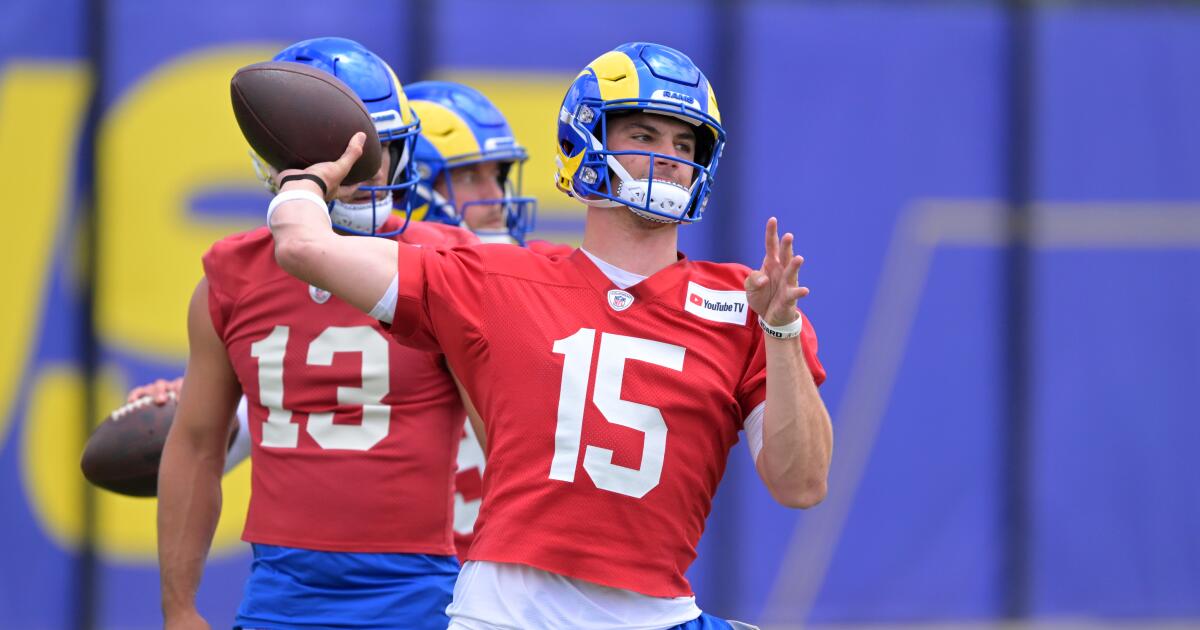
Rams QB Ty Simpson embracing an unusual bedtime routine to spur his development
-

 World21 minutes ago
Lebanon Latest: Israeli attacks surge despite ceasefire efforts
-
 News48 minutes ago
Supreme Court allows a ruling that ends a tool to protect minority voters in 7 states
-

 New York2 hours ago
How a Security Guard Lives on $46,000 a Year in the East Bronx
-

 Los Angeles, Ca2 hours ago
L.A. Tenants Union trying to save business owner given eviction notice ‘without reason or discussion’
-

 Detroit, MI2 hours ago
Grace Hanke crowned Miss Michigan 2026
-

 San Francisco, CA3 hours ago
The U.S. Government Secretly Tested Biological Weapons. The Citizens of San Francisco Paid the Price.

