Georgia
Teen and father charged in Georgia school shooting will stay in custody


WINDER, Ga. (AP) — The 14-year-old suspect in a shooting at a Georgia high school that killed four people and his father will both stay in custody following back-to-back court hearings Friday morning where their lawyers declined to seek bail.
At 14-year-old Colt Gray’s hearing, the teen was advised of his rights along with the charges and penalties he faced.
After the hearing, Colt Gray was escorted out in shackles at the wrists and ankles in khaki pants and a green shirt. The judge then called Colt Gray back to the courtroom to correct an earlier misstatement that his crimes could be punishable by death. Because he’s a juvenile, the maximum penalty he would face is life without parole. The judge also set another hearing for Dec. 4.
WATCH: Students mourn 4 killed in Georgia school shooting as investigators explore past threats
Shortly after Colt Gray’s hearing, his father, Colin Gray, was brought into court. Colin Gray, 54, was charged Thursday in connection with the shooting at Apalachee High School in Winder, outside Atlanta. Nine people were also hurt in Wednesday’s attack.
Colin Gray, dressed in a gray-striped jail uniform at Friday’s hearing, answered questions in a barely audible croak, giving his age and saying he finished 11th grade, earning a high school equivalency diploma.
About 50 onlookers were in the courtroom for the hearings, in addition to news media and sheriff’s deputies. Some family members of victims in the front row hugged each other and one woman clutched a stuffed animal.
Before the hearings at the Barrow County courthouse, court workers set out boxes of tissue along courtroom benches, and relatives and community members began to trickle into the courtroom Friday morning in advance of the hearings for the son and father.
READ MORE: Father of 14-year-old Georgia school shooting suspect arrested on multiple charges
According to arrest warrants obtained by The Associated Press, Colt Gray is accused of using a “black semi-automatic AR-15 style rifle” to kill two students and two teachers at the school. Authorities have not offered any motive or explained how he obtained the gun or got it into the school.
Colin Gray was charged Thursday in connection with the shooting, including with counts of involuntary manslaughter and second-degree murder, Georgia Bureau of Investigation Director Chris Hosey said.
“His charges are directly connected with the actions of his son and allowing him to possess a weapon,” Hosey said.
It’s the latest example of prosecutors holding parents responsible for their children’s actions in school shootings. In April, Michigan parents Jennifer and James Crumbley were the first convicted in a U.S. mass school shooting. They were sentenced to at least 10 years in prison for not securing a firearm at home and acting indifferently to signs of their son’s deteriorating mental health before he killed four students in 2021. The Georgia shootings have also renewed debate about safe storage laws for guns and have parents wondering how to talk to their children about school shootings and trauma.
The morning court hearings for the father and son came as police in the Atlanta suburb of Dunwoody said schools there and nationwide have received threats of violence since the Georgia shooting, police said in a statement. The Georgia Bureau of Investigation also noted that numerous threats have been made to schools across the state this week.
Before Colin Gray’s arrest was reported, the AP knocked on the door of a home listed for him seeking comment about his son’s arrest.
Colt Gray was charged as an adult with four counts of murder in the deaths of Mason Schermerhorn and Christian Angulo, both 14, Richard Aspinwall, 39, and Cristina Irimie, 53.
A neighbor remembered Schermerhorn as inquisitive when he was a little boy. Aspinwall and Irimie were both math teachers, and Aspinwall also helped coach the school’s football team. Irimie, who immigrated from Romania, volunteered at a local church, where she taught dance.
Colt Gray denied threatening to carry out a school shooting when authorities interviewed him last year about a menacing post on social media, according to a sheriff’s report obtained Thursday. Conflicting evidence on the post’s origin left investigators unable to arrest anyone, the report said. Jackson County Sheriff Janis Mangum said she reviewed the report from May 2023 and found nothing that would have justified bringing charges at the time.
The attack was the latest among dozens of school shootings across the U.S. in recent years, including especially deadly ones in Newtown, Connecticut; Parkland, Florida; and Uvalde, Texas. The classroom killings have set off fervent debates about gun control but there has been little change to national gun laws.
It was the 30th mass killing in the U.S. so far this year, according to a database maintained by The Associated Press and USA Today in partnership with Northeastern University. At least 127 people have died in those killings, which are defined as events in which four or more people die within a 24-hour period, not including the killer — the same definition used by the FBI.
Martin reported from Atlanta. Associated Press journalists Charlotte Kramon, Sharon Johnson, Mike Stewart and Erik Verduzco in Winder; Trenton Daniel and Beatrice Dupuy in New York; Eric Tucker in Washington; Russ Bynum in Savannah, Georgia; Kate Brumback in Atlanta; and Mark Thiessen in Anchorage, Alaska, contributed to this report.



Welcome to the Daily Briefing. Here’s what’s breaking this morning:
Nicole Fallert here, wishing I were frolicking in this superbloom. Wednesday’s headlines begin with a Georgia special election and then we’ll talk about that Team USA World Baseball Classic loss.
Who will replace Marjorie Taylor Greene?
Trump-endorsed Republican Clay Fuller, a former prosecutor, came in second among a field of more than a dozen candidates in Georgia’s special election on Tuesday to replace Marjorie Taylor Greene, who resigned from the U.S. House of Representatives in January after months of clashing with the president.
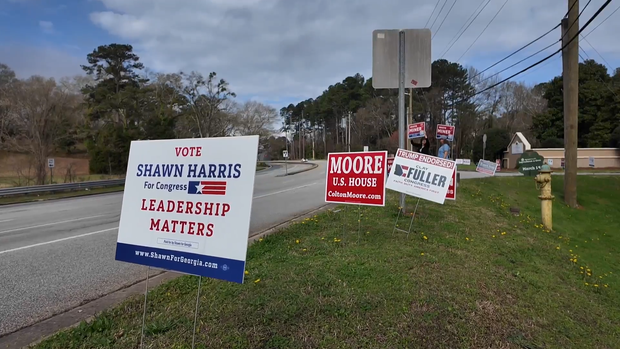
Retired Brigadier General Shawn Harris, one of just three Democrats on the ballot, topped the votes after consolidating most of his party’s support. But neither candidate received the required threshold under Georgia law of more than 50% to win outright. That means the two are headed for an April 7 runoff election.
Mississippi also had a primary election on Tuesday. See the results.
And this all begs the question: Can Trump run both a war and a midterm campaign at the same time?
More news to know now
- Should we worry about Iran sleeper cells? Trump said the administration is “on top of” possible Iranian sleeper cells operating inside the U.S. — offering few details about their existence and level of potential threat.
- Don’t miss your flight! Americans are enduring long wait times as a partial federal government shutdown strains staffing at the Transportation Security Administration. Check these resources before waiting too long to leave for the airport.
- It’s been six years since the COVID-19 pandemic began. On March 11, 2020, the World Health Organization (WHO) declared COVID-19 a global pandemic. Here’s a look back at what happened since.
Dunk!
NBA history made
Miami Heat’s Bam Adebayo scored 83 points on Tuesday against the Washington Wizards. Yes, 83. That’s the second-most points scored in an NBA game, surpassing late Basketball Hall of Famer Kobe Bryant.
Something to talk about
Italy just upset USA baseball
Team USA suffered one of the most embarrassing losses in World Baseball Classic history, 8-6 to Italy in front of a stunned crowd at Daikin Park on Monday. Now, they must rely on Italy to beat Mexico on Wednesday night, or hope a tiebreaker works in their favor.
Before you go
Have feedback on the Daily Briefing? Shoot Nicole an email at NFallert@usatoday.com.
Georgia
With voting over, Georgia’s election to replace Marjorie Taylor Greene could be test of Trump’s influence

Polls have closed in the Georgia 14th Congressional District special election to elect who will replace Marjorie Taylor Greene in Congress.
The seat has been vacant since January, when Greene resigned following a monthslong public fight with President Trump over foreign policy issues and the release of documents involving the Jeffrey Epstein case. A week before she announced her plans to resign, Mr. Trump said he would support a primary challenge against her.
Twenty-two candidates filed to run for the seat, but the number dropped to 17 candidates — 12 Republicans, three Democrats, one Libertarian, and one independent — all of whom appeared on Tuesday’s ballot.
Among the top candidates are former District Attorney Clay Fuller, who was endorsed by Mr. Trump, former Republican state Sen. Colton Moore, and Democrat Shawn Harris, a retired Army brigadier general who lost to Greene in the 2024 race for the seat.
Harris has raised more than $4.3 million for the race, with about $290,000 in the bank.
Greene has declined to endorse anyone in the race.
Georgia voters enthusiastic to choose their representative
Voters in Rome, Georgia, said they expect to return and vote in what is likely to be a runoff election because of the number of candidates.
“Too many people that think they’re politicians — some I know personally that has no experience, that, you know, Washington would just swallow them up like it does most people,” one voter said.
“What I look for in a candidate is tell me your policies. That’s the problem that I have with both sides today,” another voter said. “They attack each other, they hate each other, and they don’t ever get around to telling you what their actual policies are.”
Despite voters saying they planned to return to the ballot box, Floyd County Republican Vice Chair David Guldenschuh said the complicated schedule had party heads worried.
“There’s real fatigue out there, and I sense and feel for them,” he said.
Still, Guldenschuh said he doesn’t feel like the crowded field would hurt the GOP’s chance to hold the seat that Greene once occupied.
“I think that, you know, we have an unusual situation here. We all appreciated and loved Marjorie. And when she and Trump had the falling out, we still supported both here in this district, even though they weren’t getting along very well. And still are, as I understand,” he said. So I do know that this district is very solid conservative, and from Floyd County north, it’s really conservative. So I don’t see a big change going on now.”
Vincent Mendes, the chair of the county’s Democratic Party, expected Harris to get to the runoff, but said it would take effort to flip the seat.
“We will have to work our butts off to make him win if he gets to a runoff, but that’s how we should treat every single election,” Mendes said.
A local race with national implications
CBS News Political Director Fin Gómez said this special election is about more than just one seat in Congress. It’s being watched by politicians across the state and around the nation as an early indicator of where the Republican Party and its voters stand right now.
Gómez said this race could offer one of the first real tests of Mr. Trump’s influence within the party, with the president throwing his support behind Fuller.
The results could show whether the Republican base is still fully aligned with him after his rift with Greene.
The key question, according to Gómez: Does the president still have the influence that he did back in 2024?
“I do think that if Clay Fuller does well, even if he doesn’t clear the threshold that’s needed to avoid a runoff, I think that bodes well for the president, because that means Republican voters are still adhering to what the president says, and it shows the influence that that the president still has on the Republican Party, including in northwest Georgia,” he told CBS News Atlanta.
If another candidate, such as Moore, pulls off a win, it could signal the Republican base isn’t always following the president’s lead.
“If Fuller does not when I think it would surprise a lot of the Trump faithful who really adhere to who he supports in these type of elections, but if, let’s say, if it doesn’t go Fuller’s way and Moore picks off this win, I think what you are seeing is that the base might be a little more unpredictable, similar to what we saw perhaps in 2010.”

Special election marks start of busy campaign stretch
With how crowded the field is, it is very likely that this will be only the first step to choosing Greene’s replacement. Georgia’s special election rules require a candidate to win a majority of votes. If that threshold is not met, the top two candidates will go on to the April 7 runoff.
Whoever eventually wins the seat will serve out the rest of Greene’s term — a relatively short time in office. If they want to remain in the seat, they’ll have to run again in the May 19 party primaries. That race could possibly go to a party runoff, which would take place on June 16. The winners of the primaries will advance to the general election in November.
Last week, 10 Republicans, including Fuller and Moore, qualified to run in November’s election for a full two-year term. Harris also qualified, the sole Democrat who did in what has been rated as the most Republican-leaning district in Georgia by the Cook Political Report.
Mr. Trump carried the 14th Congressional District with 68% of the vote in the 2024 election, with Greene receiving over 64%. Republicans want that rightward trend to continue in the district. Democrats are hoping that the potential GOP infighting and crowded field could help them secure a surprise electoral win, shrinking the already-narrow margins in the U.S. House of Representatives.
Republicans currently control 218 House seats to the Democrats’ 214.

People cheer for President Trump en route to his speaking engagement at the Coosa Steel Corporation on Feb. 19 in Rome, Ga. Trump delivered remarks on the economy and affordability as the state started voting to replace the seat vacated by former Republican Rep. Marjorie Taylor Greene.
Chip Somodevilla/Getty Images
hide caption
toggle caption
Chip Somodevilla/Getty Images
Stay up to date with our Politics newsletter, sent weekly.
ATLANTA — Voters in Northwest Georgia are choosing who should replace former Republican Rep. Marjorie Taylor Greene. Voting closes in the district’s special election on Tuesday night.
The election will test the weight of President Trump’s endorsement of one of the candidates in a crowded race. Some voters say the president’s choice is not who they think would best support the conservative MAGA movement championed by both Trump and Greene.
Greene resigned at the beginning of this year, leaving Georgia’s 14th Congressional District without representation in Congress — and slimming the GOP’s majority in the House — following a bitter split with Trump.

Greene rose to prominence over five years in office as a strong ally of Trump, bombastically attacking critics and pushing the MAGA movement’s “America First” policy. Yet the two had a very public clash after she pushed for the release of documents related to convicted sex offender Jeffrey Epstein. Greene has also been sharply critical of Trump’s actions abroad, saying he has strayed from his promises to focus domestically.
With Trump now in the second year of his second term, other high-profile spats with key parts of his MAGA coalition have erupted over his administration’s handling of other issues, including sweeping tariffs, immigration policy and more. More recently, rifts have emerged over the war with Iran.
Some, like Greene, argue that though Trump helped create the “America First” worldview, he is not the sole arbiter of what it looks like.

Most of the GOP candidates in the special election have said they want to focus on Trump’s priorities and the concerns of their district, rather than become headlines themselves — an approach they say Greene embraced in her public disputes with Democrats and even with members of her own party.
“The difference between Marjorie and I is I will not use the press to become a celebrity,” Republican Star Black said during a candidate forum on Feb. 16. “I will use the press to actually show what I have done — the accomplishments,”
Trump has endorsed Clay Fuller, a district attorney in northwest Georgia for the state’s Lookout Mountain Judicial Circuit. He emphasized his support last month during a visit to Rome, part of the state’s 14th District, where he held a rally to tout his administration’s economic policy.
Fuller called himself a “MAGA warrior” at the event.

Republican congressional candidate Clay Fuller (left) shakes hands with President Trump as he arrives on Air Force One at Russell Regional Airport on Feb. 19 in Rome, Ga.
Chip Somodevilla/Getty Images
hide caption
toggle caption
Chip Somodevilla/Getty Images
“I really like him,” said rally attendee Jill Fisher. “I think he’s a strong candidate, seems like a very nice family man with some great values. And I think he’ll add a lot to Congress.”
Highlighting Fuller’s military service as an Air Force veteran, an ad for his campaign says, ” ‘America First’ is the story of his life.”
Fuller faces several other GOP candidates in the primary, including former state Sen. Colton Moore. Moore won elections for the state Legislature in the district before and is considered one of the most right-leaning lawmakers at the state level.
“I’m 100% pro-Trump,” Moore declared in his campaign announcement video.

He’s made a few headlines of his own. Last year, Moore was arrested for attempting to enter the House chambers in Atlanta to attend the State of the State address by GOP Gov. Brian Kemp. Moore argued he had a constitutional right to enter the chamber. Moore had been banned from entering the chambers by the state’s Republican House Speaker Jon Burns for disparaging comments he made about a late Georgia lawmaker at his portrait unveiling.
Moore’s record matters for some GOP voters even more than Trump’s endorsement. Less Dunaway, 14th district voter, says he’s a strong supporter of Trump, but thinks Moore will do a better job carrying out the president’s agenda than Trump’s own pick.
“He actually knows what he’s doing,” Dunaway said of Moore. “He was a state representative, a state senator. He was the first one to fight the people over the 2020 election in Georgia.”
Moore was one of a group of GOP state lawmakers who called on lawmakers to investigate or impeach Fulton County District Attorney Fani Willis after she charged Trump and others with trying to overturn the 2020 election in Georgia, when Trump and his allies pushed baseless claims of widespread election fraud.

Fuller insists Trump made the right choice in supporting his bid.
“I think they’re looking for someone to carry President Trump’s banner, support his agenda, and fight for him on Capitol Hill,” Fuller told Georgia Public Broadcasting last month.
Still some Republicans who attended the February rally left undecided.
“I don’t just blindly follow what [Trump] says,” said Clay Cooper of Rome.
Still, Cooper said that Trump’s endorsement means he will give Fuller more thought. “[Fuller is] someone that [Trump] thinks aligns very much with his messaging, with his actions, so that certainly weighs in,” Cooper said.
Unlike a partisan primary, all the candidates — Republicans, Democrats and third party candidates — will be on the same ballot for voters in the special election. If no one gets over 50% of the vote, the two top vote-getters regardless of party will advance to a runoff on April 7.
Follow the results below as polls close on Tuesday at 7 p.m. ET.
NPR’s Padmananda Rama contributed to this report.

2-year-old boy bitten in face by two pit bulls in Miami Gardens backyard, police say

Shay Maloney’s overtime goal lifts Boston Fleet to road victory

Our dumpling challenge boils down to eight Denver metro restaurants

Seattle goal overturned for goalie interference as Predators complete 4-2 comeback win

Padres roster review: Miguel Andujar

Florida High School Football Rankings: Top 25 teams – Oct. 21

Cleary's 21 help Le Moyne down Central Connecticut State 69-64 in OT

How old is Bo Nix? What to know about Oregon quarterback ahead of 2024 NFL Draft

99th annual Pony Swim held in Virginia

Indiana Members Credit Union announced as new anchor tenant at Bottleworks District

EXCLUSIVE: ICE says El Paso detention facility will stay open under new contractor after $1.2B deal scrapped

Von der Leyen ‘acting outside of competence,’ Araud tells Euronews

Wheelchair curler Steve Emt’s path from drunk driver to three-time Paralympian

Map: 2.3-Magnitude Earthquake Reported North of New York City

Trump stirs GOP primary drama with visit to Massie’s Kentucky home turf
-

 Wisconsin1 week ago
Setting sail on iceboats across a frozen lake in Wisconsin
-

 Massachusetts1 week ago
Massachusetts man awaits word from family in Iran after attacks
-

 Pennsylvania6 days ago
Pa. man found guilty of raping teen girl who he took to Mexico
-

 Detroit, MI5 days ago
U.S. Postal Service could run out of money within a year
-

 Miami, FL7 days ago
City of Miami celebrates reopening of Flagler Street as part of beautification project
-

 Sports6 days ago
Keith Olbermann under fire for calling Lou Holtz a ‘scumbag’ after legendary coach’s death
-

 Virginia7 days ago
Giants will hold 2026 training camp in West Virginia
-

 Culture1 week ago
Try This Quiz on the Real Locations in These Magical and Mysterious Novels