Andrea Adelson, ESPN Senior WriterAug 27, 2024, 07:19 AM ET
Close
ACC reporter.
Joined ESPN.com in 2010.
Graduate of the University of Florida.
When Billy Napier first got the call about the open Florida coaching job, he asked himself a question: “How did Florida end up there?”
“There” was not only 13 years removed from its last national championship and its last SEC title, but far behind rival Georgia, now a national power. Florida fans had been accustomed to winning championships. Even Napier grew up in Georgia watching Steve Spurrier dominate the Bulldogs.
“What do we need to do,” he wondered, “to right the ship and maybe change the attitude and approach?” Napier poked around to see what was wrong with the program and what would need to be done to fix it. Satisfied the administration would help him modernize the football program, Napier took the job.
Now headed into Year 3, Napier has overhauled everything, from the roster (only 12 players remain from his first team) to staffing, organization and approach. The problem is the on-field results have not yet followed, putting an even larger spotlight on Napier — who is 11-14 at Florida — and the Gators as they head into their highly anticipated opener against rival Miami on Saturday.
“I’m not a fool,” Napier said when asked about people who think the clock may be ticking on his tenure. “Part of leadership is you’ve got to have some self-awareness, and you have to make tough decisions. You have to make necessary changes. We’ve done that. I have a ton of confidence. This is all just part of the story.”
The story at the moment is about a Florida program that has been on a roller coaster since Urban Meyer stepped down following the 2010 season. Will Muschamp, Jim McElwain and Dan Mullen all found brief periods of success — each won at least 10 games once — but none of them made it a full four seasons as head coach.
As Florida struggled to find stability at head coach, Kirby Smart elevated Georgia to a national championship contender in short order, turning the tables on a rivalry the Gators dominated in the 1990s and 2000s. In nine seasons with the Bulldogs, Smart has lost to Florida just once. That has only added to the consternation among a Florida fan base eager to see a return to success.
The coaching transitions and slip from atop the SEC East affected recruiting, too. Since 2015, Florida has signed just two recruiting classes ranked in the top 10 — in a state known as a recruiting hotbed. The Gators are now recruiting players who were babies the last time they hoisted the national championship trophy.
Advertisement
Something more likely to be top of mind: Florida has posted three straight losing seasons for the first time since the 1940s and failed to make a bowl game last year for the first time since 2017.
“Once upon a time, there was a standard out there that we were the best of the best, and we are working to get back to that,” running back Montrell Johnson Jr. said during SEC media days, before minor knee surgery in August left his status for the opener in doubt. “That kind of makes me mad at times that we haven’t upheld it.”
When Napier made his calls during his interview process to find out why Florida had not won consistently enough, he learned the Gators had fallen behind with both their facilities and budget and were woefully behind from a recruiting, staffing, organization and sport science perspective.
His predecessors worked out of the same offices and meeting rooms inside the football stadium that had been used for decades. Players had to walk to and from practice fields located a quarter mile away and across a busy main road from their locker room inside the stadium. Mullen spearheaded the drive to get a $85 million standalone football facility built — it opened in 2022 and connects to the indoor practice facility.
Napier also asked for a significantly larger staff. The team’s support staff went from 45 people to 62. Florida has increased its assistant coach salary pool nearly $3 million to $7.5 million; another $5.3 million has gone to support staff.
Advertisement
The recruiting budget also has mushroomed to $2.89 million — after ranking No. 14 among SEC schools in Mullen’s final year, when the budget was $900,000. According to the latest athletic department operating budget in 2022-23, Florida spent $90.2 million on football.
Now Florida is in line with other SEC schools after years of complaints that these two specific areas were holding the program back. As one person familiar with the program pointed out, Napier has been given everything he wanted. But the on-field results are not there yet. Napier points to the rapidly changing college football landscape — including transfer rules and NIL — as one reason.
“I knew it was going to be very challenging because in our league, you’re chasing the top of the mountain,” Napier said. “To get there, it takes multiple cycles. The evolution and the chaos of our sport in the last couple of years is what’s been challenging.”
What has not helped is the way Florida has played. In Year 1, Florida had future No. 4 pick Anthony Richardson but won six games. Last year, special teams gaffes turned the Gators into a punchline at times. Napier never hired a special teams coordinator, and mistakes cost Florida in multiple games. Against Utah in the season opener, the Gators got a penalty after two players wearing the same number went onto the field during a punt, resulting in a penalty. The Utes got a first down and eventually scored on the drive in a 24-11 victory.
Later in the season against Arkansas, the field goal unit was coming onto the field as the offense was trying to spike the ball at the end of regulation to set up a game-winning field goal. The penalty forced a longer kick, which Trey Smack missed. Florida ranked in the bottom four in the SEC in field goal percentage (.750).
Advertisement
And though the Gators made improvements on defense, they still struggled on that side of the ball as well. They allowed Missouri to convert a fourth-and-17 with 38 seconds remaining, leading to a last-second field goal to give the Tigers a come-from-behind win. Florida ended last season on a five-game losing streak. In three of those games, the Gators had a fourth-quarter lead.
To address the issues, Napier overhauled his staff headed into 2024. Joe Houston came from the New England Patriots as an analyst, specifically focusing on special teams. Ron Roberts came in as co-defensive coordinator and linebackers coach, a veteran presence to help Austin Armstrong, the youngest coordinator in the SEC at 31. Napier also hired a new strength and conditioning coach and nutritionist.
“We’re close,” Napier said. “We’ve got a good thing going. I think maybe what you hear on the outside is not necessarily what it’s like on the inside. So, we’re anxious to get out there and play this year. This is the best team we’ve had since I’ve been here.”
Off-field headlines have not helped, either. Napier and two co-defendants are the subject of a lawsuit filed by former Florida signee Jaden Rashada over a failed NIL deal in 2022; Napier has said he feels “comfortable” with his actions and has filed a motion to dismiss the suit.
Florida athletic director Scott Stricklin has said he fully supports Napier, telling reporters at SEC spring meetings in May after Rashada filed his lawsuit, “I’ve got a tremendous amount of trust for Billy, not only who he is as a person, but how he conducts himself and how he treats other people.”
Advertisement
In addition to the lawsuit, Florida lost several high-profile players to the portal, including Trevor Etienne, who ended up at rival Georgia, and Princely Umanmielen, who went to Ole Miss and has publicly criticized the Florida strength program.
The focus in Gainesville is on the players who have opted to stay. Napier points to the team leadership, starting with quarterback Graham Mertz, who returns for a second and final season with the Gators after transferring from Wisconsin in 2023. Though Florida signed elite prep quarterback D.J. Lagway, the No. 8 player in the ESPN 300, Mertz is entrenched as the starter.
Mertz had the best season of his career in 2023, completing 72% of his passes while throwing for 20 touchdowns and a career-low three interceptions. One opposing coach praised the job Mertz did last season, calling him a difference-maker. Mertz, though, was not satisfied with his team’s losing record.
“You go back and you just turn on the games we lost, we just didn’t execute,” Mertz said. “We had too many penalties. We might have made the wrong read on a play. There are so many different things. We needed to get better, and that’s where I’ve seen across the board everybody’s been putting in that effort to hold up their end of the bargain.”
Still, it is impossible to talk about Florida without addressing Napier and his long-term future. The Gators’ schedule this year is ranked among the toughest in the nation with four games against preseason top-10 teams (Georgia, Texas, Ole Miss, Florida State) and four others against teams in the top 25 (Miami, Tennessee, Texas A&M, LSU).
Advertisement
Those familiar with the program said they knew the rebuild would take time because of the program Napier inherited, and because of the timeline of the vast overhaul he laid out. Napier would be owed a $25 million buyout if Florida decided to make a change after this season. The Gators have spent $20 million to buy out McElwain and Mullen. Would there be an appetite to keep spending money to get back on the coaching carousel for a fifth time in 14 years?
Three people familiar with the program said they believe Florida cannot keep hiring and firing coaches every four years — it will only keep setting the program back.
“I don’t think he has to do too much to save his job because there’s so much invested in the whole staff and everything,” Spurrier said. “I hope we can have a winning season. I predicted a winning season and [a win in] a bowl game. If we can do that, I think that would make everybody happy right now.”
Napier says he understands the speculation about his job security comes with his position, and that is not unique to Florida.
“Florida’s a lot like some of the other places I’ve worked,” he said. “When it’s good, it is phenomenal. When it’s bad, it’s horrendous. So, I think that’s the leadership challenge — trying to stay objective and stay steady and really evaluate things for what they are.” To that end, he said, “We’ve got work to do, and we’re in the middle of that.” Even if outsiders have put him on a proverbial “hot seat,” that term does not exist inside the Florida athletic department. Napier says he feels confident that those with decision-making power are behind him.
Advertisement
“You’ve got to deal with the outside noise, but you know the administration, you understand the heavy hitters, the big investors, they’re fully behind you,” Napier said. “They’re helping you solve problems. They’re invested in your team.”
In response to the idea coaches are no longer allowed enough time to build their programs, Napier said: “When you really look at college football, how many times has [winning right away] happened? Very rarely. Depending on the roster you inherit and the league you compete in, all those things matter. We’re chasing the 1 percent here, so it’s going to take some time to get there.”
Napier harks back to his late father, Bill, a high school football coach who inspired him and his brothers to become football coaches. Bill Napier was interwoven into the fabric of their community in Chatsworth, Georgia, as the winningest coach in Murray County High history.
“My dad, he wanted to win because he wanted that community to be proud,” Billy Napier said. “I’ve met former players, I’ve met investors, I’ve met die-hard Gators on the road in the springtime. That’s motivating to me, to get this right so that these people can wear their orange and blue and be proud of it again.”
If he does that, nobody will have to ask that question that he asked himself three years ago.
This Week in South Florida Full Episode: March 1, 2026
PEMBROKE PARK, Fla. — On the latest episode of “This Week in South Florida” host Janine Stanwood welcomes President and CEO of the Jewish Federation of Broward County Audra Berg, Secretary General of the Assembly of the Cuban Resistance Orlando Gutierrez-Boronat, Division Director of Flood Control and Water Supply Planning for the South Florida Water Management District Carolina Maran, State Rep. Juan Carlos Porras and State Rep. Kevin Chambliss.
The full episode can be seen at the top of this page.
Copyright 2026 by WPLG Local10.com – All rights reserved.
Advertisement
Janine Stanwood
Janine Stanwood is a Emmy award-winning reporter and anchor. She joined Local 10 News in February 2004 as an assignment editor.
South Florida leaders are taking preventative measures to keep residents safe after the U.S. and Israel launched major strikes on Iran early Saturday morning.
Miami-Dade County mayor Daniella-Levine Cava issued a statement reacting to the military operation that President Trump dubbed on Truth Social as “Operation Epic Fury.”
The statement reads: “The escalating conflict between the United States, Israel, and Iran poses serious risks to regional stability and international safety.”
She goes on to say that her thoughts are “with the people of Israel and the Jewish community here in South Florida who are watching these events with worry and uncertainty.” She also says the Iranian people “deserve peace, safety, dignity, and the freedom to live without repression.”
Advertisement
Of the Trump administration’s decision to launch the military operation, Levine-Cava writes: “Any military action taken without congressional authorization is a dangerous precedent, and we must learn from our nation’s past challenges. What must come next is a serious effort to restore stability and pursue diplomacy, not further violence.”
As for measures she will be taking, she says she asked her Chief of Public Safety to “ensure public safety agencies are aware and ready to activate plans in case of any disruption.”
The Miami-Dade Sheriff Rosie Cordero-Stutz also issued a statement saying that MDSO is “taking immediate security measures by increasing patrols to ensure the safety of our residents.” She said that they have increased security presence around places of worship, cultural centers, and schools.
“Our thoughts and prayers are with the servicemen and women protecting our national security interests around the globe,” Cordero-Stutz wrote.
Aventura Police have also responded to the current situation on X, saying that they are monitoring the “current situation in the Middle East with our local, state, and federal partners.”
Advertisement
@aventurapoliceis monitoring the current situation in the Middle East with our local, state and federal partners. At this time there are no known or credible threats to the US or Miami-Dade County. In an abundance of caution, we have implemented a heightened security posture with directed patrols at our religious facilities and other sensitive locations throughout @cityofaventuraWe will continue to monitor and report any suspicious behavior.https://x.com/aventurapolice/status/2027787245164335222/photo/1
X/Aventura Police
They go on to say: “At this time, there are no known or credible threats to the U.S. or Miami-Dade County.” However, they note that in “an abundance of caution,” they will be increasing security in religious facilities and other locations they deem as “sensitive” throughout the city.
Advertisement
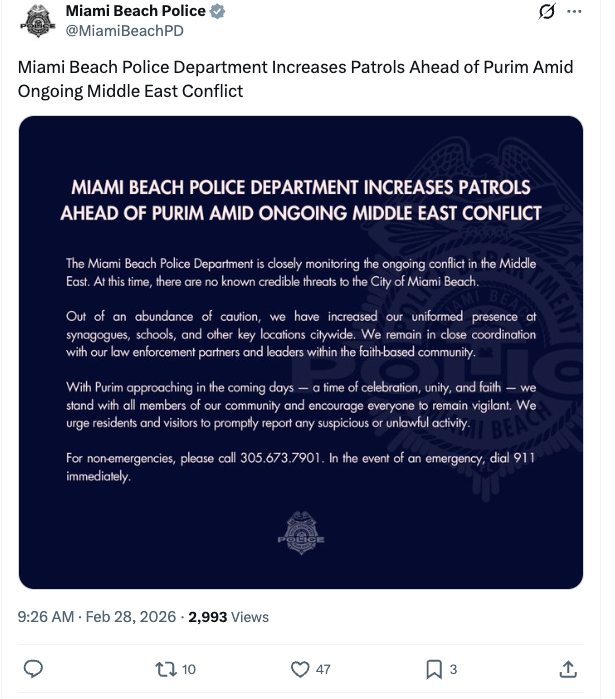
The City of Miami Beach also posted its statement to X, saying it is also “closely monitoring the ongoing conflict in the Middle East.” They also note that at this time, there are no known credible threats to the city.
They write: “Out of an abundance of caution, we have increased our uniformed presence at synagogues, schools, and other key locations citywide. We remain in close coordination with our law enforcement partners and leaders within the faith-based community.”
Miami Beach Police Department Increases Patrols Ahead of Purim Amid Ongoing Middle East Conflicthttps://x.com/MiamiBeachPD/status/2027752171173773807/photo/1
X/Miami Beach Police
They also urge residents to report any “suspicious or unlawful activity” to call their non-emergency number at 305-673-7901 or, if it is an emergency, call 911.
Advertisement
Other cities’ police departments, such as Bal Harbour, Sunny Isles Beach, and Hallendale Beach, posted on their social media that they will also increase security measures after the U.S.-Israel strikes on Iran.