Delaware
Delaware Gov. Meyer says he will eliminate state’s ‘electric vehicle mandate’ – WHYY


‘Going to make a weaker Delaware with worse air quality’
Dustyn Thompson, who heads Delaware’s chapter of the Sierra Club, said he’s disappointed by Meyer’s plan to eliminate the mandate.
Thompson predicted the move would both reduce sales of zero-emission vehicles in Delaware and damage air quality. He also said Meyer is assisting Republican President Donald Trump, who pledged during his Jan. 20 inaugural address that he would “revoke the electric vehicle mandate.” A total of 17 states — including New Jersey and Maryland, but not Pennsylvania — have adopted the California zero-emission vehicle standard known as Advanced Clean Cars II.
“It’s going to make a weaker Delaware with worse air quality and it’s going to do Trump’s job for him,” Thompson said. “So fundamentally, we don’t support either of those two things and by process of elimination, we don’t support pulling out of the program.”
Thompson said that since Carney enacted the mandate in November 2023, “we’re seeing far more in-state sales being registered in the state of Delaware than out-of-state sales being registered in the state of Delaware for clean cars. If we pull out, you can expect an exact opposite reaction to the market in Delaware.”
While Meyer didn’t specify how he would seek to terminate the mandate, Thompson speculated that the governor would have to go through the same process Carney did to put it in place: Give notice of his intention, hold public hearings and seek comments from the public before making it official in the Delaware Register of Regulations.
“We’re obviously going to advocate against pulling out of the program entirely, and of course targeting Meyer if that’s the route that we’re going to go through,” Thompson said.
Charlie Burton, president of the I.G. Burton chain of dealerships in Delaware, countered that while he sells EVs and owns one himself, he’s delighted that the governor plans to eliminate the mandate.
“I’m tickled to death,” Burton said. “I like the [electric] car. I’m not against the car. What I don’t want, and I don’t think the public wants, is to be told what stocking levels I have to do and what I have to sell and what they have to buy.

“I think that was the wrong approach to the car because it’s kind of like, ‘This is what your new thing is and you got to buy it.’ Whereas I think, ‘Hey, here’s an option, man. It’s electric, we got gas [vehicles] here, too.’ So I’m glad he’s getting rid of it, but the market’s not going to go away. There’s been too much investment in electric and battery development and all that. But in addition, it’s just a really great car.”
Burton’s Milford dealerships will be holding an event Saturday to showcase EVs and answer questions from prospective buyers.
Meyer’s assertion that the mandate will be stricken also comes after a legislative effort by Republican state Rep. Lyndon Yearick to eliminate it hit a roadblock in the Democrat-dominated state House.
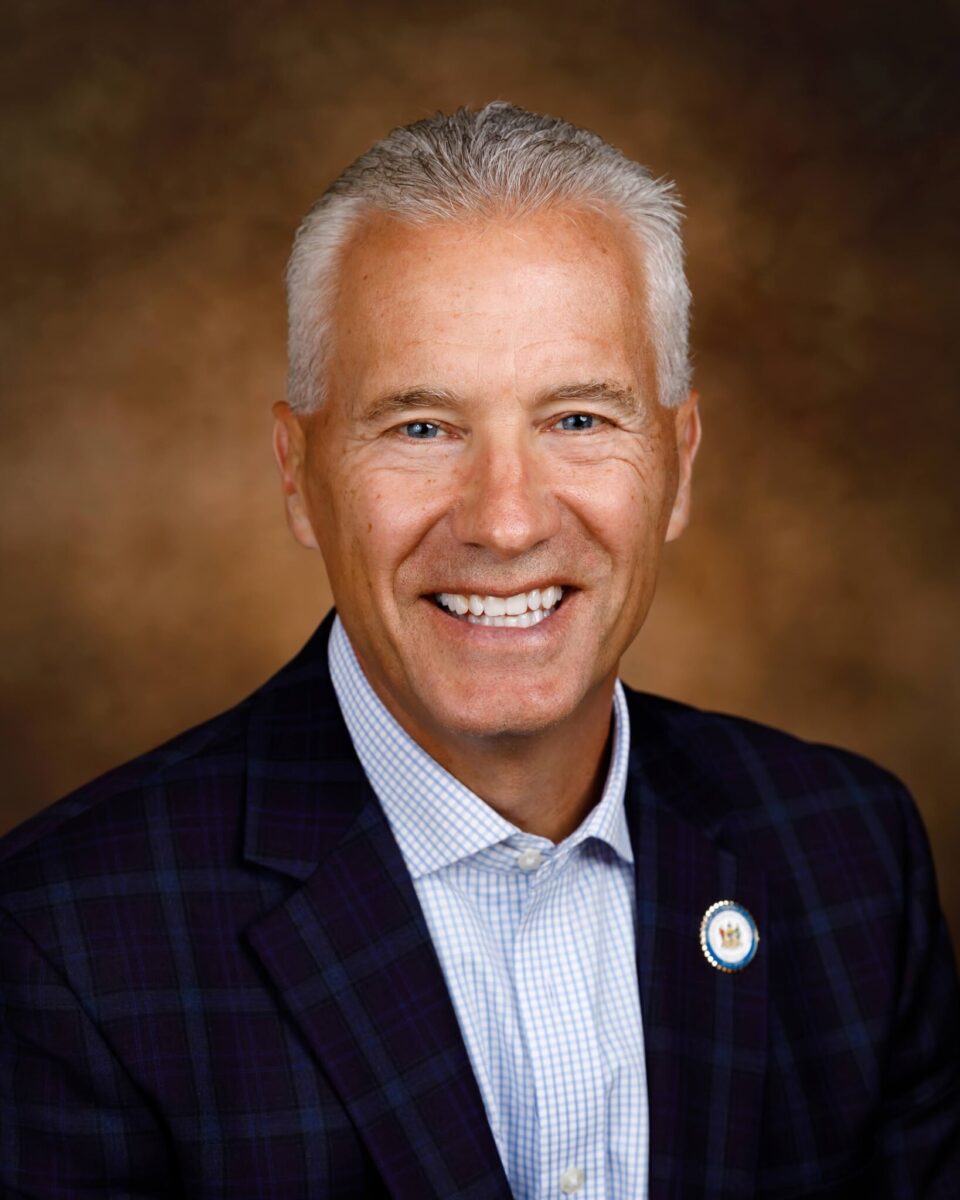
Yearick’s bill was blocked by Democrats in the House Natural Resources and Energy Committee from advancing to the full House for a vote.
Told by WHYY News of Meyer’s remarks about ending the mandate, the Kent County lawmaker said he hopes the governor follows through and doesn’t backtrack.
“I’ll be cautiously optimistic,” Yearick said. “We want what I would view as the most favorable outcome in regard to our consumer’s choice here in Delaware. Hopefully, he does the right thing and strikes it from the regs.”
This story was supported by a statehouse coverage grant from the Corporation for Public Broadcasting.



Delmarva Power objects to applying legislation to interim rate
The debate among commissioners over the breadth of their oversight on utility rates comes as the company has pushed back on the group, limiting its interim rate increase to half of its total request, even while it faced criticism from commissioners that it is “cruel” and “tone deaf” for continuing to press for rate hikes.
Delmarva Power, an investor-owned utility, serves 344,000 residential and nonresidential customers in the state. Its parent company, Exelon Corporation, is the nation’s largest regulated electric and gas utility.
Its customers pay a supply and a delivery charge for gas and electricity. The supply of energy comes from PJM Interconnection, a regional grid serving Delaware, Pennsylvania, New Jersey and several other states. Delmarva Power profits through the distribution fee.
Delmarva Power Region President Marcus Beal said they need to file rate hike requests to recoup money it spends on improving and maintaining the infrastructure.
“Our equipment is extremely expensive, the items that we buy, the transformers, they’re very large, complex things to build,” Beal said. “Even something as simple as a treated pole of a certain size can be very pricey, so we spend a lot of money on the grid itself.”
Under Delaware law, interim rates can be approved seven months after a rate case is filed, while the full petition is being considered by the commission. Prior to the legislation, 100% of the rate request could be implemented. The bill caps interim rates at 50% and allows 75% of the ask to go into effect after 12 months. The bill also puts limits on Delmarva Power’s infrastructure spending.
Delmarva Power spokesperson Matt Ford said the commission overstepped its authority to cut the interim rate as much as they did and the company has argued in its PSC submissions that SB 326 did not apply to the rate increase request filed in December because it had yet to be signed into law. Meyer said he signed the bill Monday.
“Delmarva Power further reserves its objections to the applicability of the legislation, should it become effective, including its impermissible retroactive application,” the utility company said in comments filed Monday afternoon with the commission.
In addition, Delmarva Power has objected to halving $23.2 million in distribution system improvement charges as part of the interim rate commissioners approved. The fee allows utility companies to recover project costs and depreciation between full rate case proceedings.
“My suggestion is, if you don’t like it, appeal it,” Iorii said.
It’s unclear whether the utility plans to appeal the order. Ford said they were reviewing it and its implications.
Tweedie said he hopes they decide not to appeal.
“If they appeal this, what they are essentially saying is, ‘We want to extract more money from our customers than the commission intended to allow,’” he said.

Delaware State Police have identified the man who was struck and killed by a vehicle while lying on the roadway in Harrington, Delaware.
On Monday, July 13, 2026, Jimmy Burgess, 62, was struck by a Chevrolet Silverado driving westbound near the 1500 block of Whiteleysburg Road.
According to police, the Silverado, which was operated by a 17-year-old boy from Milton, Delaware, was unable to stop once he saw Burgess on the road, striking him. The driver of the Silverado was not injured during the crash.
Burgess was transported to an area hospital where he was pronounced dead, said police.
The roadway was closed for approximately three hours while the scene was investigated and cleared.
The Delaware State Police Troop 3 Collison Reconstruction Unit continues to investigate this crash.
Troopers ask anyone with information about the crash contact Sergeant M. Long at (302) 698-8518.
Information can also be provided by sending a private Facebook message to the Delaware State Police, or by contacting Delaware Crime Stoppers at 1-(800) 847-3333

Where the music grew
Soon playing the restaurant piano became part of Leonard’s regular routine.
In early 2024, a friend encouraged him to record himself playing the old instrument and post the videos online.
The series, “Putting the Chinese restaurant on to jams,” featured Leonard performing R&B, funk and soul covers in the restaurant and interacting with customers. Before long, the videos found an audience online.
Leonard made one thing clear: It was never about building a following; it was about having peace.
As more videos were posted, he invited his friend to join him. In every live stream, viewers suggested adding more instruments and upgrading the sound system, which he initially thought was ridiculous.
“We started bringing speakers. We started to make music. We started to remix music,” he said. “We pretty much treated it as a public studio at that point.”
Word continued to spread of Leonard’s music and the Chinese restaurant where he played. Drummers, bass players, saxophonists and singers began making their way to the restaurant, transforming an ordinary neighborhood takeout spot into an open jam session where no two performances were ever the same.
“Everything is bliss. So it’s not planned. We just show up,” he said. “I may start a groove — and usually it’s like R&B, gospel, funk, soul, somewhere in that vein — and then it takes off, because the drummer may have a way that he wants to add to the groove. We all just feed off of each other, and then we create something. It’s almost like magic.”
Audiences became part of the performance. Some sang along. Others danced. Many pulled out their phones to capture the moment. Customers who stopped in for dinner often stayed long after their food was ready.
“You’ll have some people come in, maybe to order food, and then they’ll forget that they’re in a restaurant because of everything that is happening,” he said. “They may order food and then stick around for maybe 10 to 15 minutes and then leave.”
For Leonard, the biggest change wasn’t the growing audience or the recognition. It was rediscovering the confidence he thought he had lost.
“When I picked up the … DoorDash at the Chinese restaurant, that piano was my reminder of leaning more towards my creative side and not really pushing it all the way to the side,” he said.
“Me being able to bring things to life in a Chinese restaurant with a piano, able to reach a lot of people from across the globe, it definitely built my spirit back up.”
An imperfect piano; a perfect community
As the jam sessions grew, Leonard realized they were becoming something larger than just music.
“The piano being out of tune and not really in good shape … I actually thought it… would actually push more people away from it,” he said.
Instead, the opposite happened.
Leonard said he believes the piano’s imperfections are what made the phenomenon possible. Because the instrument is out of tune, musicians have to adapt to it and to one another, creating a sense of collaboration and shared purpose.
“We can still make it adhesive if we all agree to be in tune with the piano,” he said.
He hopes people leave the restaurant with more than a memorable performance.
“I hope they feel recharged,” he said. “They leave that restaurant feeling great, and they feel like they can do whatever they want to do. No matter what goes on in the world.”
The jam sessions have also introduced Leonard to opportunities he never imagined, connecting him with other artists and collaborators. He has even produced a couple of songs with British singer-songwriter, rapper and producer KWN.
“Honestly, I just hope it grows in a direction where it needs to,” Leonard said. “I’m just following God at this point, because I mean, to me, a year ago, I didn’t really see this happening. But it just happened.”
Leonard said he hopes to continue creating music similar to his jam sessions, curating spaces where strangers become collaborators and where art feels accessible to anyone.
-

 South Dakota3 minutes ago
South Dakota confirms three cyclosporiasis cases as CDC investigates growing outbreak
-

 Tennessee9 minutes ago
How did your school district do? New TCAP scores released across Southeast Tennessee
-

 Texas15 minutes ago
Texas Rangers Announce 2027 Regular Season Schedule
-

 Utah21 minutes ago
Utah man arrested again for allegedly abusing dog twice in three months
-

 Vermont27 minutes ago
A Vermont couple builds an 800-square-foot home on a budget – The Boston Globe
-

 Virginia33 minutes ago
Virginia Tech HC James Franklin Gives High Praise For Clemson’s Dabo Swinney
-

 Washington39 minutes ago
Will air quality be even worse in Washington DC on Friday?
-

 Wisconsin45 minutes ago
LIVE UPDATES: Wisconsin air quality, wildfire smoke blankets region

