Delaware
Breast cancer young survivor wants to help others cope


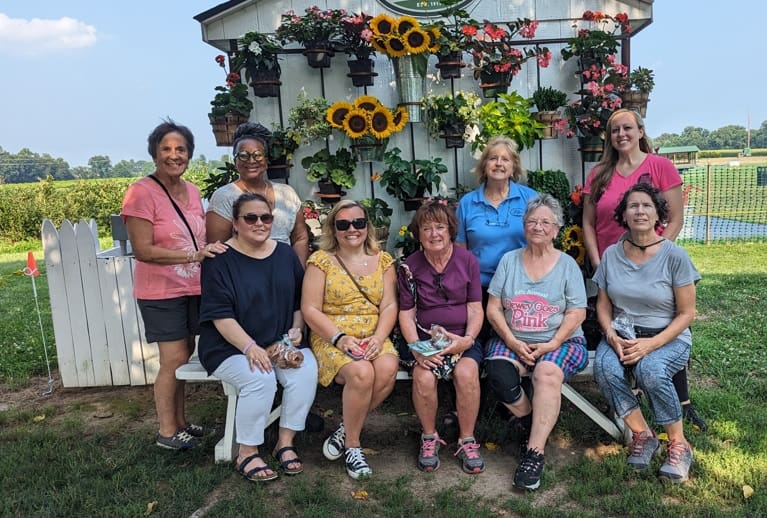
The Delaware Breast Cancer Coalition’s Young Survivors in Action outings often include women of many ages, all diagnosed before the age of 40,
Stephanie Cumella was only 32, with two young children, when she was diagnosed with a deadly form of breast cancer.
The disease threw her world into chaos as she tried to cope with treatment, work, family life and more.
It would also lead her into a career change, working with young breast cancer survivors who, like her, were diagnosed in their 20s or 30s.
“I can’t really speak for everybody but I know for me your kids are in sporting events or they’re in some sort of class play, or they have things that they have to go to,” she said. “It’s very hard to really take care of yourself and make that time because your life really kind of revolves around being a mom, being a wife and being a homemaker.”
Her first interaction with the Delaware Breast Cancer Coalition was at the time of her diagnosis, when the nurse navigator put her in touch with the Coalition’s Lois Wilkinson.
Wilkinson talked about her story, which started with a diagnosis at age 47. She left Cumella with the feeling that the Coalition offered a place of community. Even so, it was a few years before she attended a DBCC event.
That came at a Survivor’s Night at the Blue Rocks.
Cumella chose that event because it was a family event and because other events had been during the work day or at times that were hard for her to fit into the demands of her paralegal work, treatment regimen and family schedule.
Seven years later, she’s a Coalition Survivorship Specialist and program manager of its Young Survivors in Action program.
Her work with DBCC started when the company she worked for encouraged their workers to get back to a local charity. She chose to volunteer at the Monster Mile walk in Dover. a breast cancer fundraiser. That led to more volunteering and, finally, an invitation to join the team as a survivorship specialist.
Cumella says her goal is to help young women and men find lasting friendship and bonds that helps them cope with the traumatic experience of cancer.
“You know, a lot of times you feel like you’re alone in it, even if you’ve had a partner that walked right next to you,” she said. “It’s definitely different having been in those shoes.”
She found simply talking with women who had the same experience to be emotional, supportive and ultimately healing.
“It’s just taking that initial step and trusting that we’re very welcoming and making sure that everybody has a good time,” she said.

DBCC’s Young Survivor in Action programs are designed to foster friendships and relationships among those who have experienced the disease.
Diagnoses rising
Women being diagnosed with breast cancer at a younger age is a rising national trend. It’s still considered unusual, affecting only about 5% of women under age 40, but the rate of those diagnoses have been rising at 2% a year, according to Breastcancer.org.
The median age at diagnosis is 62, meaning that half of the women are diagnosed before age 62 and half are diagnosed afterward, the website said.
Many of the young women are diagnosed when they are pregnant or around the birth of a child, partly because pregnancy hormones encourage the growth of some cancers.
Cumella said the youngest woman she’s known who was diagnosed with breast cancer was 28.
About 300 people have reached out or participated in Young Survivors programs in the last 18 months, Cumella said.
While Young Survivors focuses on those under the age of 40, many of the regular participants are people who were diagnosed young and have lived to be in their 40s, 50s and 60s.
“You are still a young survivor, you just happen to be over the age of 40,” Cumella said.
Their participation also helps younger women see that there can be a long, fruitful life after treatment, Cumella said.

Stehanie Cumella and her children at one Young Survivors in Action family outing.
She discovered her own cancer after finding a lump in her right breast when she was trying to figure out why it was hurting.
The doctor she went to see wasn’t particularly worried about the lump, mostly because of her age. He didn’t suggest a mammogram but when Cumella asked for one, he readily agreed.
That led to a diagnosis of triple negative cancer, one of the hardest to cure. Cumella later found out she had the BRAC1 gene mutation, a marker that put her at high risk for breast and ovarian cancer.
Cumella chose to have a bilateral mastectomy, removing both breasts, followed by eight rounds of chemotherapy. Two years later she had surgery to remove her ovaries and ovarian tubes. Finally, she had breast reconstruction called a DIEP flap, using her own body tissue.
She’s been cancer-free for seven years.
Cumella and her husband, Anthony, have been married for 15 years and have a son who’s about to turn 11 and a daughter who is 9.
She says she’s made some wonderful friends through the Young Survivors program and recently had a full-circle moment.
“A survivor asked me to be there for them during their last treatment, be there for them as they rang the bell,” she said. “It was such a magical moment to be there and months afterward, the survivor told me that ‘you continue to provide a listening ear and empathy and you always go above and beyond to make me feel special and accepted.’
“Hearing this was so rewarding and brought me to tears. It is in those moments, spoken or unspoken, that I truly feel as though I am making a difference.”

Young Survivor in Action outings cover a range of topics and interests.
Cumella plans events online and in person. They range from exercise-related program to arts and crafts to meditation. One of her upcoming in-person events is an Aug. 3 full body sound bath.
Each month, the program offers FUNctional Fitness, an exercise class that requires no equipment and is suitable for all fitness levels; Yogalates, a combination of yoga and pilates; and Healing Meditation.
Many program events are exclusively for breast cancer survivors, partly to create opportunities to ask questions about things like fertility, sex, having children and telling children.
IN THE NEWS: Kent County will have a Catholic high school starting in 2025
There are also several special events open to survivors and their families such as the upcoming Survivor’s Night at the Blue Rocks on Aug. 29.
Cumella also oversees the Coalition’s healthy cooking program, Yes to Health, which is open to anyone who is interested.
She said she wants people to know that she’s there for anybody diagnosed with breast cancer, particularly young women and men, and wants them to feel comfortable about reaching out.
The best way to contact her is through her email, [email protected], which pops up on her phone, too.
You can follow the group’s activities on Facebook and on Instagram.
Upcoming Young Survivor events
June 27, 6 p.m.: Clay Sea Creatures and Pinch Pots, Middletown
July 3, 9:30 a.m.: Yogalates, DBCC’s Young Survivors in Action Facebook page
July 12, 11:30 a.m.: FUNctional Fitness, DBCC’s Young Survivors in Action Facebook page
July 17, 9:30 a.m.: Healing Meditation, DBCC’s Young Survivor in Action Facebook page
Aug. 3, 1 p.m.: 1.5 hour full body sound bath, Newark Natural Foods Community Room
Aug. 29, 6:35 p.m.: Survivors Night at the Blue Rocks, Wilmington
Betsy Price is a Wilmington freelance writer who has 40 years of experience, including 15 at The News Journal in Delaware.
Post Views: 1


The Hagley Museum and Library houses a collection of patent models
The Hagley Museum and Library houses the nation’s second-largest collection of patent models, many of which the public never gets to see.
For most, 41 years of service is more than enough. For State Librarian Annie Norman, though, even retirement can’t slow her down.
“The work is never done; there’s always something to do,” she said. “I’m going to have to continue to help in other ways.”
Norman will step away this fall after 24 years as the Delaware state librarian and director of the Delaware Division of Libraries.
Throughout her tenure, Norman made waves; the director helped create the Delaware Library Consortium, which allowed all of Delaware’s Public libraries to share items, and brought the library system along during a wave of technological change. For these achievements, she was named to the Delaware Women’s Hall of Fame in 2016 and appointed by President Joe Biden as a member of the National Museum and Library Services Board.
We spoke with Norman as she wraps up an accomplished career about her proudest achievements, and the state of libraries in 2026.
Question: As you look back on your tenure, what was your proudest accomplishment?
Answer: What I’ll be known for more than anything is probably the statewide library catalog and consortium. The politics of bringing all of those libraries together, after years of there being four separate library catalogs in Delaware, took about eight years. More recently, I think bringing the school libraries into that catalog is going to be really significant. We’ve got more than 50 school libraries to be a part of the statewide catalog, something we think can really help with the literacy crisis in this state.
One of the biggest challenges of your tenure was adjusting to the large wave of technology that came about. How have you and the Delaware libraries handled it?
It’s been very systematic. We have a great IT team that helps manage for us, as well as the state funding 100% of library technologies. The growth of the iPhone has certainly had a huge impact on literacy, but we’re really just working hard to bring back the excitement of reading.
The Delaware libraries’ programming have always been a popular resource. How important do you view these offerings to local communities, and will they continue to expand?
Yes, libraries are about enrichment, which means helping support people in things like entrepreneurship, education and innovation. We’ve had libraries start up job centers, which were so successful we could expand to entrepreneurship, and even help with more basic social needs, by starting a “social innovation team” to help with more of the social services-type work.
Where we still struggle is we can only help people access Delaware systems to help with their needs, not fix things within those systems. For that reason, we always encourage these systems to work with us, so the Delaware library system can fit everyone’s needs.
Cuts toward libraries just occurred in New Castle County, with the potential for more to come. How will the library system look to stay afloat?
Because of the economy, because of federal changes, things can get difficult, it’s not the first time we’ve experienced budget cuts. We’ve progressed significantly over the years, but there is much more work to do, and I don’t know that the public understands how critical libraries and librarians are to literacy.
The power of walking into a library and being able to choose what you want to read for a child is powerful, and until people understand that, we can’t achieve our literacy goals.
Adam Denn is an intern reporter for Delaware Online/The News Journal. You can reach him at apdenn@delawareonline.com.
Inspiration
Do you have a suggestion for our Inspiration page? E-mail Tammy Paolino at tpaolino@usatodayco.com

DELAWARE COUNTY, Ohio — People in Delaware County said it feels like new housing developments are popping up on every corner.
WSYX
“What haven’t you noticed, right? The whole area just exploded,” said Scott Shonebarger.
Scott Sanders, the executive director of the Regional Planning Commission, said companies like Intel and other industries are a main driver for thousands of people moving to Delaware County.
With the big boom comes an urgent need for more housing.
John Wicks is the developer at Real Property Design and Development.
He has spent over a decade building homes for families in Delaware County.
Wicks said the Olentangy School District is one of the hottest spots for new homes.
“I started with one high school up until the 90s, then now we’re up to four up to five different high schools so it’s just a big draw,” said Wicks. “It’s a beautiful community.”
The district has grown into the fourth largest in Ohio with a new elementary school opening next year, and a fifth high school in 2028.
Wicks said the growth has presented some challenges over the years like labor shortage and some opposition.
“It’s become a big issue for a lot of people that live in and around these areas. They tend to oppose new growth and new development, so restrictions have gotten a little bit harder. Costs have obviously gone up over the last 20 years,” said Wicks.
The planning commission says between 275,000 and 350,000 people could call Delaware County home by 2040.
That’s up from 214,000 in 2020.
Scott Shonebarger said he supports growth but wonders when is enough.
“I mean to a certain extent I think you know at some point right you have to have some sort of boundaries I think, getting into the fact that now you have five high schools,” said Shonebarger. “What’s the limit?”

Police in Wilmington, Delaware, shot and killed a 19-year-old man Wednesday night.
The incident happened in a residential area near 24th and Jessup streets just after 11 p.m., Wilmington police said in a news release. The person who was shot has not been publicly identified.
Officers were monitoring a large crowd gathered outside when they saw a man exit a home with a handgun and point it toward the crowd, police say.
When officers approached the man, he ran away and a foot pursuit began, police say.
At some point in the chase, an officer fired their weapon and hit the 19-year-old. The man was taken to a local hospital, where he later died.
Police say they recovered a loaded gun from the man and that the officer was not injured.
Video filmed at the scene shows a crowd of residents gathered outside after the shooting.
Police are asking anyone with more information to come forward. The shooting is under investigation by the Delaware Department of Justice and Wilmington police.
-
 Lifestyle6 minutes ago
L.A. Affairs: After decades of near-misses, I finally told him: ‘I’m not leaving here without you’
-
 Politics9 minutes ago
Trump budget request omits funds for L.A. fire relief, prompting criticism from senators
-
 Science14 minutes ago
EPA touts crackdown on smuggled pesticides in L.A. visit
-
 Sports21 minutes ago
Commentary: Did Padres curse themselves by messing with that anti-Dodgers FTD burger?
-

 World29 minutes ago
Copernicus lead warns extreme heat measures needed or deaths to ensue
-

 News54 minutes ago
“It’s blood money”: Family of exonerated man in Texas yogurt shop murders speaks out after settlement
-

 Los Angeles, Ca2 hours ago
Woman ambushed, violently attacked by robber in downtown Long Beach
-

 Detroit, MI3 hours ago
Where to watch Houston Astros vs Detroit Tigers: TV channel, start time, streaming for June 26

