Dallas, TX
On Nov. 22, 1963, Dallas became ground zero for conspiracy thinking


In 2013, Mayor Mike Rawling shepherded into existence “the 50th,” the first-ever city-sponsored Nov. 22 event held in Dealey Plaza. Finally, Dallas citizens had a civically sanctioned event that allowed them permission to publicly honor a fallen president. At the time, Rawlings discreetly sidestepped the most controversial of the issues attached to the assassination: Who actually killed John Kennedy?
Today in Dallas, more than six decades after the fact, it is important that we finally and unapologetically address that issue: There was no great conspiracy. Lee Harvey Oswald acted alone when he killed the president. Jack Ruby acted alone when he shot Oswald. The Warren Commission got it right. It is well past time for this historical reckoning, and it is particularly important that it be pronounced here.
In Dallas, we’ve borne an immense historical burden because of our conspiracy-mongering past. In the aftermath of the assassination, the whole city became a pariah, its citizens treated like accomplices to the murder. We were labeled “the City of Hate,” and it took us decades to recover from the toxic fallout.
A month before Kennedy’s visit, Time magazine had already labeled Dallas “A City Disgraced.” This followed the ugly incident at Adlai Stevenson’s Dallas appearance and recalled the embarrassing 1960 “Mink Coat Mob” incident, where Lyndon and Lady Bird Johnson were jostled and spat upon.
By 1963, Dallas had proved itself, in the eyes of the rest of America, as a hotbed of virulent Red Scare paranoia that could not tolerate civil debate. Kennedy’s advisers warned him not to visit Dallas because of the likelihood of violence. Kennedy himself explained to his staff as he made his final approach to Dallas: “We’re heading into nut country today.”
When he left Dallas, he was in a coffin, and the script for our ostracization had already been written.
Nut Country
Today, our entire nation is in danger of becoming “Nut Country.” Those 1963 events in Dallas have become the origin point of a newer, more infectious strain of conspiracy paranoia.
Today our contemporary culture has become so mired in conspiracy thinking that our ability to confront the greatest challenges of our age is threatened. The World Health Organization has called it an “infodemic.” A study published in the American Journal of Tropical Medicine and Hygiene in 2020 found that at least 800 people may have died due to coronavirus-related misinformation during the first three months of 2020. We are less prepared to respond to the next pandemic, climate change or the misinformation that plagues our elections than ever before. All of this, to a large extent, because of the brain-fog produced by conspiracy beliefs.
Conspiracy narratives are attractive; they help simplify a mystifying world. Take a few established facts, weave them into a comprehensive narrative — taking whatever leaps of logic and dismissing any inconvenient counter evidence necessary — and there you have it: a complex situation reduced to a simple parable.
Jim Marrs provides a good illustration of this process. The former Fort Worth journalist’s 1993 book, Crossfire: The Plot That Killed Kennedy, became a “go-to” conspiracy guide. As he sold more books, he expanded his focus, eventually concocting an entire conspiracy universe, involving the Trilateral Commission, Freemasons, the pyramids of Giza and space aliens.
Marrs’ big career break occurred when he linked up with Oliver Stone for the 1991 film JFK. As Stone transformed Dealey Plaza into a huge stage set for his grand conspiracy spectacle, he and Marrs used New Orleans prosecutor Jim Garrison’s 1967 Clay Shaw conspiracy case as their template for demonstrating a massive government JFK cover-up.
The actual Shaw case was dismissed by the jury in less than an hour, and Garrison’s lack of supporting evidence was considered a great embarrassment by even conspiracy buffs. Hugh Aynesworth wrote in Newsweek: “If only no one were living through it — and standing trial for it — the case against Shaw would be a merry kind of parody of conspiracy theories, a can-you-top-this of arbitrarily conjoined improbabilities.”
Nonetheless, Stone’s film was a Hollywood blockbuster. If the big JFK assassination conspiracy did not exist in fact, Stone and Marrs had ensured its existence in Hollywood myth.
Mainstream conspiracies
Three decades after the assassination, JFK conspiracy theorizing had gone mainstream. With the advent of the internet in the 1990s, the world of conspiracy speculation was supercharged. As a new generation of hyperconnected conspiracist thinkers was figuring out new ways to spread and monetize their work, the Kennedy conspiracy fable became the template for an amazingly versatile, all-purpose conspiracy system available for any ideology. It became a powerful and influential American myth.
Of course, conspiracies do exist. At any one time there are a number of significant conspiracy cases winding their way through our legal system. Prominent past cases include business fraud against Enron, a number of criminal cases brought against organized crime groups, and the conspiracy charges brought against the accomplices of John Wilkes Booth in the death of Abraham Lincoln. Even with rigorous demands of veracity and rules of evidence, it is possible to prove actual conspiracy in our legal system.
On the other hand, it is also possible to disprove bogus conspiracy accusations. Garrison’s case against Clay Shaw is a case in point. As are the scores of cases alleging the 2020 presidential election was stolen. Conspiracy theories, because they rely on missing information, do not often survive the scrutiny of the legal process.
Today, the court of public opinion is often divorced from systems of fact-checking. Our conspiracy theories bounce around in a super-heated media environment where there are fewer guardrails against misinformation than anytime in the past, and fewer procedures for validating evidence.
JFK researchers have performed a thoroughgoing critique of every aspect of the Warren Commission Report, but they have never disproved its basic assertions. You can watch the Zapruder film 1,000 times and each time it shows the results of the shots fired by Lee Havey Oswald from this sixth-floor perch. You can muck around in the gruesome photographic documentation of Kennedy’s autopsy and the same is true. We don’t need to exhume Oswald’s body from the grave again. It is well past time to end this macabre game-playing. Enough of “what could have happened”; it is time to reckon with what did.
There is no nefarious secret government that controls our lives. We live in a very messy democracy that is often difficult to understand. The true danger of conspiracy theories is that they inevitably manufacture an evil “other,” a secret cabal of adversaries intent on doing harm. This scapegoating often strips political or ideological opponents of their humanity, reducing them to villains rather than fellow citizens whom we might engage in dialogue.
Today, despite so much that unites us as Americans, we are a dangerously divided nation. Conspiracy thinking has contributed to this.
We do indeed live in an age when skepticism is a vital survival tool, but conspiracy thinking turns rational skepticism on its head, replacing facts with dangerous misinformation. President Kennedy did not die as the result of a conspiracy. His death was a tragedy, and that requires a deeper type of wisdom to fathom.
City of Truth
It is time to recognize the price this city has paid for its nurturing of conspiracy thinking and clearly pronounce: the JFK conspiracy theorists have utterly failed to make their case. After all this time, there is not a single JFK conspiracy theory that offers enough evidence to warrant serious consideration.
What history does show is that misplaced doubt about Kennedy’s death has contributed to the ever-expanding plague of conspiracy thinking that currently confounds our democracy.
Today, Dealey Plaza remains a mecca for conspiracy tourism. Each year it is the pilgrimage point for the Nov. 22 JFK Remembrance. Last year’s event was typical.
As 12:30 approached, the exact moment Kennedy was shot, one of the last speakers stepped to the podium. Judyth Vary Baker, who proclaims herself Oswald’s secret lover, recounted Oswald’s aborted mission to deliver a bioweapon to kill Fidel Castro and how Oswald was actually trying to save the president. It was also important, she said, to remember the government has a proven cure for cancer but is withholding it from the public to ensure higher profits for the medical industry.
Among the 200 or so attendees milled a newer generation of conspiracy thinkers. Many of these QAnon adherents wore distinctive T-shirts featuring images of John Kennedy, his son John, and Donald Trump, illustrating their theory that the two Kennedys would soon be resurrected to aid Trump in his battle with his political enemies who commonly kidnap children and feast on their blood.
At the JFK vigil, there was a striking divergence of views, but everyone was united in their conviction that our democracy has been stolen.
I suggest that on the 61st anniversary of the assassination, we find a better message. We can take up President Kennedy’s challenge to do something for our country and commence the hard work of taking care of the truth. We can take a huge stride toward reclaiming our democracy and the common ground of civil discourse by swearing off our growing addiction to conspiracy thinking.
Tim Cloward is author of “The City That Killed the President: A Cultural History of Dallas and the Assassination.”
We welcome your thoughts in a letter to the editor. See the guidelines and submit your letter here. If you have problems with the form, you can submit via email at letters@dallasnews.com



The fiercest legislative primary fights Tuesday in North Texas were inside the GOP.
In Dallas County, two moderate GOP incumbent representatives faced challengers after being censured by their own county party.
In Collin County, several Republican state House members were fending off rivals running to their right.
The Dallas Morning News will provide live election results this evening when the polls close at 7 p.m. Results will be updated throughout the evening for statewide races and Dallas, Collin, Denton, Ellis, Kaufman, Rockwall and Tarrant counties.
Dallas County, House District 108
Republican Morgan Meyer, first elected in 2014, was challenged by attorney Sanjay Narayan in a district that includes the Park Cities, Oak Lawn and Preston Hollow.
Narayan criticized Meyer for backing renewable energy expansion and for being censured by the Dallas GOP last year.
Meyer was among House Republicans targeted after disputes over the House speaker vote and chamber rules. He and other lawmakers called the censure effort unconstitutional.
In the campaign, Meyer focused on property tax relief and emergency preparedness after the Camp Mystic tragedy.
Small business owner Allison Mitchell is unopposed in the Democratic primary.
Dallas County, House District 112
Republican Angie Chen Button, who has represented the district covering parts of Dallas, Richardson and Garland since 2009, drew three primary opponents.
Button has highlighted her support for small businesses and public schools and her bipartisan record. A senior member of the Ways and Means Committee, she would play a key role in the state’s property tax debate if reelected.
Dallas-area delegation in the Texas House of Representatives on Sunday, May 30, 2021, showing State Rep. Angie Chen Button, R-Garland, in the chamber.
Bob Daemmrich / Bob Daemmrich/CapitolPressPhoto
Opponents Chad Carnahan and Tina Price attacked Button for being censured by the Dallas GOP last year, a move she and other lawmakers have criticized as an internal party power struggle.
Carnahan, a businessman, said he wants to lower property taxes and prevent Shariah in Texas.
Price said she would improve public schools and spur the re-use of old buildings. Also in the GOP race: Perry E. Barker Sr.
Democrat Zach Herbert was unopposed.
Collin County, House District 61
Two Republicans are seeking to represent the district that covers most of McKinney and parts of Frisco and Celina.
Incumbent Keresa Richardson, who was elected in 2024, and former state Rep. Frederick Frazier both support eliminating property taxes.
Richardson, an entrepreneur, said she would expand the Texas voucher-like program for education.
Frazier, a former police officer and McKinney City Council member, was more cautious about expanding the program.

Frederick Frazier speaks as Rep. Keresa Richardson looks on during a candidate forum for Republicans in Collin County ahead of the March primary election at Prestonwood Baptist Church in Plano, Texas, Tuesday, February 10, 2026.
Anja Schlein / Special Contributor
Two political newcomers, Jackie Bescherer and Brittany Black, are running in the Democratic primary. Both oppose Texas’ voucher program and vow to increase public education funding.
Collin County, House District 67
Republican Rep. Jeff Leach, first elected in 2012, faces Matt Thorsen in a district that includes parts of Plano, Allen, McKinney and Melissa.
Leach has highlighted his conservative record, including legislation barring Shariah in Texas courts. He also served as a House impeachment manager during Attorney General Ken Paxton’s 2023 trial, a role he has defended amid backlash from activists.
Thorsen, a small business owner and former youth pastor, helped lead the effort to censure Leach last year. He has criticized Leach’s impeachment role and accused him of siding with Democrats on House rules.
Both support eliminating property taxes, expanding education savings accounts and oppose the development formerly known as EPIC City. Two Democrats are also running, though the district has leaned Republican.
Collin County, House District 70
Three Republicans are competing for the nomination to run against incumbent Democrat Mihaela Plesa, who is running unopposed in her party’s primary.
Democrat Mihaela Plesa responds to questions during a District 70 Candidate Forum hosted by Raise Your Hand Texas at Plano ISD Academy High School in Plano on Wednesday, Oct. 19, 2022.
Liesbeth Powers / Staff Photographer
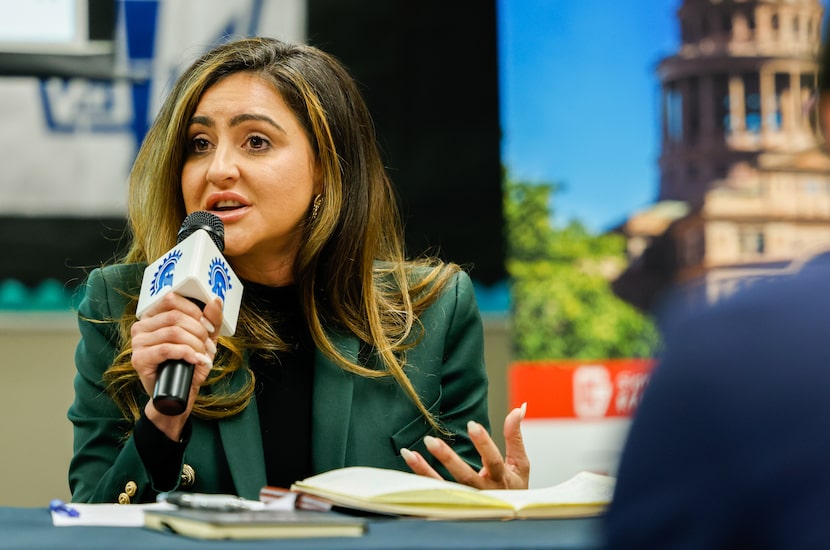
George Flint, a former district judge and Collin County Republican Party Chair, emphasized eliminating property taxes and securing the border in his campaign.
Jack Ryan Gallagher, an attorney, said he would attract companies to North Texas, improve public schools and partner with local law enforcement if elected.
Michael Hewitt, an attorney, said he would gradually lower property taxes and work to keep Texas a business-friendly state.
The district includes parts of Plano, Richardson and Far North Dallas.
Dallas, TX
Dallas Fed says ‘older, experienced workers’ likely have less cause for concern about AI job displacement

Artificial intelligence hasn’t yet triggered the broad job losses many feared — at least not for experienced workers.
That’s the takeaway from a new analysis by J. Scott Davis, an assistant vice president at the Federal Reserve Bank of Dallas, who examined employment and wage trends in industries most exposed to artificial intelligence.
Davis argues the data tell a more nuanced story — one that’s challenging the traditional career ladder, and helping older employees earn a bit more.
Since ChatGPT’s debut in late 2022, overall US employment has risen about 2.5%, according to Davis’ analysis, which uses an AI exposure index developed by researchers and published in the Strategic Management Journal. At the same time, employment in the sectors most exposed to AI has slipped by roughly 1%.
Wages tell a different story. The average weekly pay nationwide has climbed 7.5% since fall 2022. And across the most AI-exposed industries, wages have grown faster, up 8.5%.
If AI were simply replacing workers, both employment and wages would likely be falling, Davis wrote.
Instead, Davis points to a divide between “codified” knowledge — the kind learned from textbooks and in university courses — and “tacit” knowledge gained from hands-on work experience.
“Returns on job experience are increasing in AI-exposed occupations,” Davis wrote. “Young workers with primarily codifiable knowledge and limited experience will likely face challenging job markets.”
Using Bureau of Labor Statistics data, his analysis found that the occupations most exposed to AI tend to offer larger pay premiums for experienced workers.
In roles with less hands-on experience, AI exposure is associated with weaker wage growth, he wrote.
Workers under 25 in AI-exposed industries have also experienced employment declines, according to Davis’ analysis.
“There appears to be less cause for concern about widespread job displacement for older, experienced workers,” he wrote.
A less dire picture… so far
The findings offer a counterpoint to the more apocalyptic predictions about AI’s impact on the labor market.
Last week, Citrini Research published a memo, written from the hypothetical perspective in 2028, that theorized how AI could crush the US jobs market and trigger a broad-based market collapse.
“What if our AI bullishness continues to be right…and what if that’s actually bearish?” the memo asked.
Top executives inside the AI companies are worried about jobs, too.
Dario Amodei, the CEO of Anthropic, the company that runs Claude, warned that AI could eliminate 50% of entry-level office jobs. OpenAI’s head of product, Olivier Godement, said the life sciences, customer service, and computer engineering industries were all about to get automated. And Boris Cherny, the creator of Claude Code, said that he doesn’t believe the job title “software engineer” will exist next year.
For now, at least, the Dallas Fed paints a different picture of today’s jobs market. It points to less mass displacement and market ruptures — and more power for employees who already have their foot in the door.

A tribute to a family dog is now helping other animals. Daisy’s Memorial Dog Stick Library encourages dogs to take and leave sticks on their walks near White Rock Lake. Kimberly Haley-Coleman stopped by The Post to talk about the tribute.
Posted

Police search for suspect, accomplice after teen injured in shooting outside Detroit school gym

Celebrated San Francisco historic landmark, the Huntington Hotel officially reopens

GOP candidates for Texas House face off in Collin County, Park Cities, North Dallas

First Alert: Mix of snow and rain today, then looking ahead to warmer weather

Former Avs defenseman launches beer brand in Denver

Florida High School Football Rankings: Top 25 teams – Oct. 21

Cleary's 21 help Le Moyne down Central Connecticut State 69-64 in OT

How old is Bo Nix? What to know about Oregon quarterback ahead of 2024 NFL Draft

99th annual Pony Swim held in Virginia

Indiana Members Credit Union announced as new anchor tenant at Bottleworks District

Fraud-plagued Minnesota sues Trump admin for withholding $243M in Medicaid payments

Is Iran expanding attacks to target energy and civilian sites in the Gulf?

Trump claims US stockpiles mean wars can be fought ‘forever’; Kristi Noem testifies before Congress – US politics live

War in the Middle East: Iran’s broad retaliation in the Gulf • FRANCE 24 English

Melania Trump presides at UN Security Council meeting • FRANCE 24 English
-

 World6 days ago
Exclusive: DeepSeek withholds latest AI model from US chipmakers including Nvidia, sources say
-

 Massachusetts6 days ago
Mother and daughter injured in Taunton house explosion
-

 Denver, CO6 days ago
10 acres charred, 5 injured in Thornton grass fire, evacuation orders lifted
-

 Louisiana1 week ago
Wildfire near Gum Swamp Road in Livingston Parish now under control; more than 200 acres burned
-

 Oregon4 days ago
2026 OSAA Oregon Wrestling State Championship Results And Brackets – FloWrestling
-

 Florida3 days ago
Florida man rescued after being stuck in shoulder-deep mud for days
-

 Technology1 week ago
Arturia’s FX Collection 6 adds two new effects and a $99 intro version
-

 News1 week ago
Video: How Lunar New Year Traditions Take Root Across America