South
California safeguard protecting beachgoers from sharks on life support, expert warns

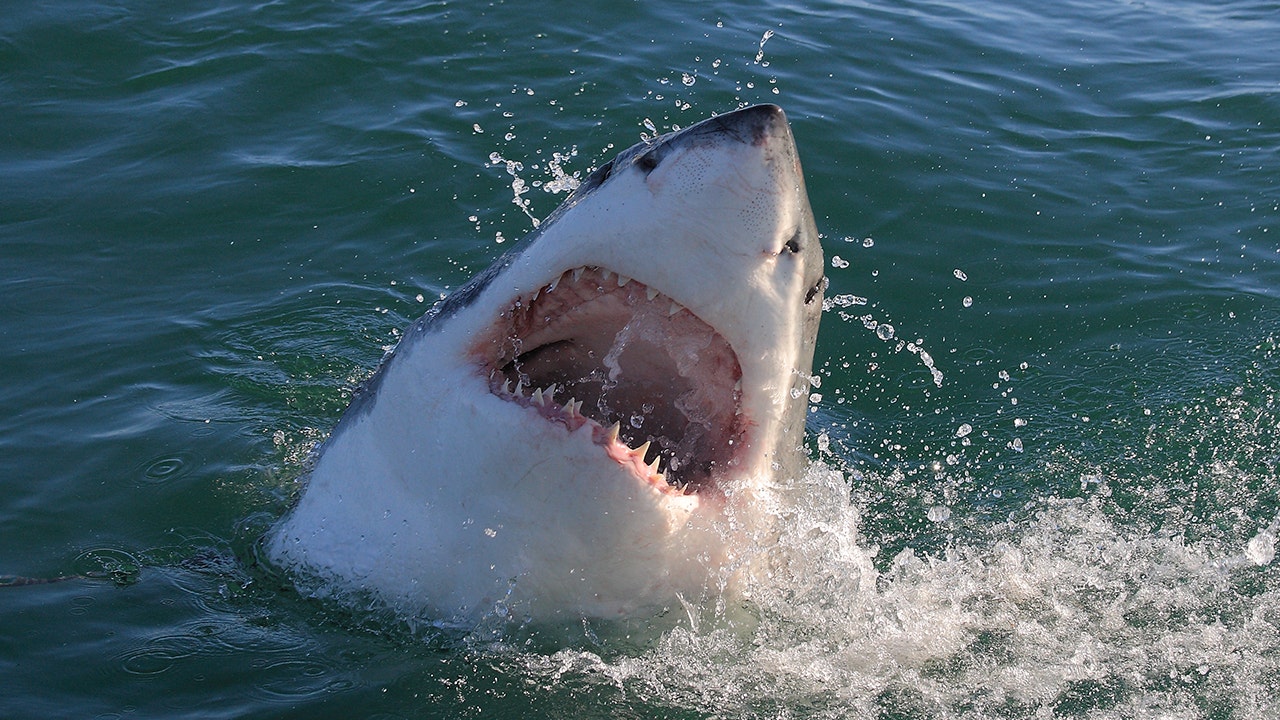
A renowned shark research center in California is in danger of shutting down after the state pulled funding for a program that provides safeguards against attacks.
Chris Lowe, the director of the Shark Lab at Cal State Long Beach, told Fox News Digital that the program monitors great white sharks along Southern California’s coastline.
“In 2018, we received funding from the state of California to start the California Shark Beach Safety Program. And that was because there were more and more white sharks being seen along the California coastline, particularly along public beaches,” Lowe said.
“And this raised a concern for lifeguards who are responsible for keeping people safe. So they asked us, why are the sharks here? And are they a risk to people?” Lowe said. “And at the time, we didn’t really know.”
SOUTHERN CALIFORNIA BEACHGOERS WARNED OF SPIKE IN SHARK ATTACKS THIS SUMMER AMID CUT OF RESEARCH FUNDING
The Shark Lab at Cal State Long Beach is in danger of running nearly out of funds by the summer and may have to shut down programs that monitor sharks. (iStock)
Lowe said that after the program launched they have been able to use the funds to tag over 300 juvenile white sharks, with 235 of the sharks with active transmitters.
He said that they chose to tag great white sharks since 97% of bites in California in the last century are from these large predators.
The shark expert explained that the program also has 120 acoustic receivers along the sunny California coastline to “listen” for tagged sharks, as well as drone equipment.
“This enables us to provide lifeguards with data about what sharks are off their beaches. How long are they going to be there, what are they doing, and when are they going to leave,” Lowe said.
A great white shark swimming in the ocean. (iStock)
Lowe said that their research has found that sharks are “around people all the time” and that they “largely ignore people.”
“We also use drones, and that’s been an important part of our monitoring as well, because then we could see where sharks were in proximity to people and then address questions about what the risk is,” Lowe said. “And some of our data have indicated that sharks are around people all the time in Southern California. And the sharks largely ignore people.”
3 GREAT WHITE SHARKS PING NEAR GEORGIA, SOUTH CAROLINA COASTS: ‘IT’S MOVING DAYS’
Without the program, Lowe said, lifeguards would not be able to properly manage Southern California beaches from sharks.
“We don’t think that if the program gets shut down, we’re not going to see a spike in shark bites. What we think is the monitoring is helping lifeguards better manage beaches,” Lowe said.
“For example, let’s say a nine-foot shark, which is still a juvenile, is off a public beach, and it’s been there for days or weeks, and lifeguards know that from our acoustic telemetry monitoring data or even our drone data, but no surfers are reported seeing that shark,” he said. “Normally they would close a beach, but why close the beach if the shark is there all the time and nobody’s seeing it, and it’s not bothering anyone?”
On Friday, July 14, 2023, at about 12:15 p.m. PT, San Diego Fire-Rescue lifeguards patrolling about 100 yards from shore at Blacks Beach spotted three juvenile great white sharks. (San Diego Fire-Rescue Department)
The shark expert explained that the lifeguards have a wealth of information available to help determine if the beach needs to be shut down.
“If a tagged shark is detected off the beach, lifeguards get that data right away from our real-time buoys, and then they can click on a link that will tell them about where that shark is, how big that shark is, where it’s been, and what they’ll see is that quite often these sharks have visited other beaches, or they’ve been at their beach for weeks or months at a time.”
He explained that lifeguards no longer need to shut down the beach, they can just post a public warning about a shark’s presence.
FLORIDA BEACHGOER WRANGLES SHARK CAUGHT ON FISHING ROD: VIDEO
“In the past, anytime a white shark was seen off a beach, they would close the beach, or they pulled people out of the water,” Lowe said. “And now, they don’t have to close a beach. They’ll post signs warning the public that this is white shark habitat, but because of all the data we’ve accumulated over the last five years, they don’t have to shut the beach down.”
Lowe said that the local economy is negatively impacted if a beach is closed.
“Every time they close the Southern California beach, that results in an economic impact on that community,” Lowe said. “Just by learning more about the sharks, we’ve reduced the number of beach closures which have economic impacts on the California community.”
“What it’s done is it saved our coastal communities a lot of money from unnecessary beach closures,” he said.
A large white shark looks straight into the camera. Captured in the clear blue waters of South Australia. Three great whites were pinged this week off the coast of the southeast United States, researchers said. (iStock)
Lowe said that California has seen a rise in great white sharks in recent years, in part, because of continued conservation efforts.
“Our white shark numbers have been going up steadily, and that’s because white sharks have been protected in California since 1994,” Lowe said.
He said that an increased number of sharks in California’s oceans has “raised a big concern.”
“With increasing numbers of sharks, we just didn’t know if that was going to increase the probability of people being bitten,” Lowe said. “And with young sharks using beaches as their nursery habitat, that raised a big concern because we have a lot of people in the water off Southern California year round and among the sharks.”
CALIFORNIA BUDGET CRISIS WORSE THAN NEWSOM PROJECTED, AS STATE WATCHDOG WARNS DEFICIT COULD REACH $73B
Lowe said that if they do not raise funding from local supporters, they will be forced to shut down.
An aerial view of the California State Capitol on February 01, 2023, in Sacramento, California. (Justin Sullivan/Justin Sullivan)
He said that funding was cut because of California’s “very poor” state budget this year.
“Our program was funded for five years and we received funding in 2018. We stretched that $3.75 million state funding to six years,” Lowe said. “We were been very frugal with our funds and getting a lot of good information.”
“Our funding runs out in June and because of state budget, is very poor this year,” he said. “It doesn’t look like we’re going to be refunded.”
CLICK HERE TO GET THE FOX NEWS APP
He said that they are seeking private funding from individuals and foundations.
“We use a lot of technology in our shark research, and a lot of those tech companies are based here in California. So we’re kind of hoping that maybe some of our big tech companies might be willing to pitch in and help us out,” he said.



Austin, TX
More dangerous Texas floods expected after at least 2 killed and hundreds of people rescued in high water, governor says – WTOP News

AUSTIN, Texas (AP) — More dangerous Texas floods expected after at least 2 killed and hundreds of people rescued in…
AUSTIN, Texas (AP) — More dangerous Texas floods expected after at least 2 killed and hundreds of people rescued in high water, governor says.
Copyright
© 2026 The Associated Press. All rights reserved. This material may not be published, broadcast, written or redistributed.

HUNTSVILLE, Ala. (WAFF) – Soccer is rapidly growing in Alabama and there aren’t enough officials to accommodate.
The 2026 FIFA World Cup had an impact on the growth of the sport.
“Instead of the World Cup arriving in America, America has arrived at the World Cup,” AHSAA Soccer Officials Coordinator Cedric Thomas said. “Watch parties across the county has showcased how America has reacted to the beautiful game.”
The 2026 World Cup reminded fans within North Alabama how special the game of soccer is and the game is rapidly growing in the Valley.
“It’s larger than any football program,” Alabama State Youth Referee Administrator Thomas Russell said. “We have more recreational soccer players than all of football combined.”
The rapid growth has created issues across the state. The biggest issue is the lack of soccer officials in Alabama.
There are around 900 certified soccer referees in Alabama, but the state needs about 1,500 for all games at all levels to operate smoothly.
“You cannot have an official game without officials,” Thomas said. “You can see the impact on the kids faces when only one or two referees show up and you need a third to make it an official game.”
The impact goes beyond the whistle. Referees in soccer have the ability to teach young athletes during games.
“We don’t coach them in the game, but we can teach them what they can and can’t do,” Russell said. “You can see a good referee who works with the kids and interacts with the kids. One that doesn’t just call a foul and go away.”
Soccer is highlighted on all levels in Huntsville. From youth soccer to AHSAA Soccer State Championships and the Huntsville City Football Club.
“I would say that the Huntsville Sports Commission and the city has solidified whatever that vision they had for soccer.”
More officials are needed for the sport to grow in North Alabama and across the state.
To find out how to become an official:
Click Here to Subscribe on YouTube: Watch the latest WAFF 48 news, sports & weather videos on our YouTube channel!
Copyright 2026 WAFF. All rights reserved.

NORTH LITTLE ROCK, Ark. —The identity of the winner of Arkansas’ record-setting $1.8 billion Powerball jackpot has now been confirmed through Arkansas Scholarship Lottery documents, revealing that the prize was claimed by Tracy Hartwick, the brother of North Little Rock Mayor Terry Hartwick.
Lottery records show Tracy Hartwick claimed the jackpot in January after purchasing the winning ticket in Cabot. After electing the lump-sum cash option and paying taxes, Hartwick received $565,873,785.82, according to the documents.
The records also show Hartwick signed paperwork to remain anonymous for six months after claiming the prize. Under Arkansas law, that is the maximum amount of time a lottery winner who is related to an elected official can remain anonymous before their identity becomes public.
According to the Arkansas Scholarship Lottery documents, Tracy Hartwick received 94 percent of the after-tax winnings. His brother, Timothy Allen Hartwick, received 3 percent, while another 3 percent was distributed to a third claimant whose name was redacted in the released records.
The Powerball jackpot, announced by the Arkansas Scholarship Lottery after the winning drawing in late December 2025, remains the largest lottery prize ever won in Arkansas. The winning ticket was sold at a Murphy USA gas station in Cabot on 208 S. Rockwood Drive.
The revelation of the winner’s identity surprised many across Central Arkansas.
“That’s crazy news but you hear something crazy every day,” said Benjamin Britton.
Others said they understood why Hartwick chose to remain anonymous for as long as the law allowed.
“I think waiting over time and then thinking about it and then coming to claim it would be good,” said Ricky Rhodes.
The documents show Hartwick waited the full six-month anonymity period before his identity became public.
We reached out to the City of North Little Rock seeking comment from Mayor Terry Hartwick regarding the records. A city spokesperson said the mayor would not be providing interviews or commenting on the matter.
The newly released lottery documents provide the first official confirmation that the record-breaking Powerball prize claimed in Arkansas belongs to the mayor’s brother, ending months of speculation about the identity of the state’s biggest lottery winner.
-

 Cleveland, OH6 minutes ago
Dangerous air quality, wildfire smoke descends on Cleveland – The Land
-

 Austin, TX12 minutes ago
More dangerous Texas floods expected after at least 2 killed and hundreds of people rescued in high water, governor says – WTOP News
-

 Alabama18 minutes ago
Soccer officials needed in Alabama
-
Alaska24 minutes ago
Natural gas supplies ‘not looking good’ for Southcentral Alaska this winter, Enstar says
-

 Arizona30 minutes ago
Judge weighs whether Arizona anti-DEI measure can be on November ballot | Arizona Capitol Times
-

 Arkansas36 minutes ago
Brother of North Little Rock mayor winner of record $1.8 billion Powerball Jackpot
-

 Colorado48 minutes ago
Winter Park to host free rooftop celebration honoring Colorado 150
-

 Connecticut54 minutes ago
Connecticut insurance now required to cover these athletic prosthetics

