South
Australia's prime minister voices concerns over South China Sea disputes at Southeast Asian summit

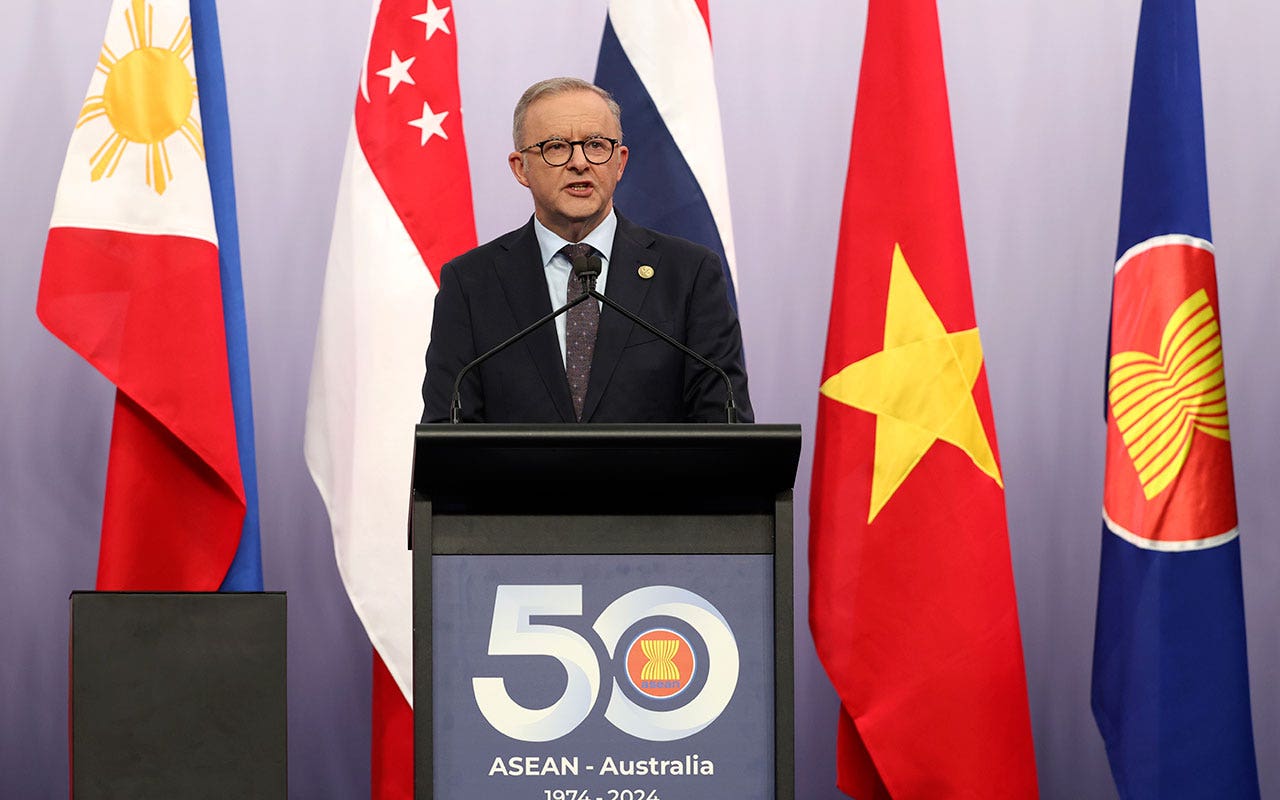
- Australia’s Prime Minister Anthony Albanese said he is concerned by “unsafe and destabilizing behavior” in the South China Sea.
- Chinese and Philippine coast guard vessels collided on Tuesday near a disputed shoal, leaving four crew members injured.
- Albanese’s remarks came as his country wrapped up a three-day summit of the Association of Southeast Asian Nations.
Australia’s prime minister expressed concerns Wednesday over “unsafe and destabilizing behavior” in the South China Sea, citing the collision between Chinese and Philippine ships the previous day.
Prime Minister Anthony Albanese’s remarks came as his country wrapped up a three-day summit of the Association of Southeast Asian Nations that failed to explicitly call China out over a series of incidents in the disputed waters.
Instead, ASEAN leaders urged for disputes to be resolved through dialogue rather than threats, a day after Chinese and Philippine coast guard vessels collided near a disputed shoal in the South China Sea and four Filipino crew members were injured in the confrontations.
AUSTRALIA AND LAOS ELEVATE BILATERAL RELATIONS AT SOUTHEAST ASIAN SUMMIT
Chinese and Philippines officials traded blame for the incident. The disputed area has been site of several tense skirmishes between Chinese and Philippine coast guard ships last year.
Australian Prime Minister Anthony Albanese speaks at a joint press conference with the Prime Minister of Lao, Sonexay Siphandone, at the conclusion of the ASEAN-Australia Special Summit on March 6, 2024, in Melbourne, Australia. (AP Photo/Hamish Blair)
Albanese, who co-chaired the summit with Laos Prime Minister Sonexay Siphandone, said Tuesday’s clash was concerning for Australia.
“It is dangerous and it creates risks of miscalculation, which can then lead to escalation,” he said.
Australia had backed the Philippines’ push to have the ASEAN declaration adopted at the end of summit cite a 2016 arbitration ruling in The Hague, Netherlands, that invalidated Beijing’s vast territorial claims in the South China Sea, which conflict with the claims of several ASEAN states. China did not accept the ruling.
The Melbourne Declaration, released late Wednesday, did not mention the 2016 ruling. The summit was held in the Australian city to mark 50 years since Australia became the first external ASEAN partner.
The declaration called for peaceful resolution of disputes through legal and diplomatic processes “without resorting to the threat or use of force” in accordance with international law, including the United Nations Convention on the Law of the Sea.
“We encourage all countries to avoid any unilateral actions that endanger peace, security and stability in the region,” it said.
Albanese said compromises had to made to find words that ASEAN leaders at the summit could agree on.
“There is a general recognition that we need to make sure that activity in the South China Sea alleviates any tension and doesn’t add to it,” Albanese said.
Deakin University Southeast Asia expert Damien Kingsbury said the declaration’s failure to explicitly mention China was a nod to countries that are close to Beijing — Cambodia, Laos and Myanmar — and also to Malaysia’s more conciliatory approach to the Chinese.
It’s “a veiled criticism of China, which is about as strong as consensus would allow,” Kingsbury said.
Leaders agreed at an ASEAN summit in Indonesia last September to accelerate a negotiation process with China with a goal of finalizing a South China Sea code of conduct within three years. Such a code would aim to prevent risky and provocative behavior.
That summit was joined by Vice President Kamala Harris, Chinese Prime Minister Li Qiang and Russian Foreign Minister Sergey Lavrov.
Singapore Prime Minister Lee Hsien Loong, the longest serving ASEAN leader after Sultan of Brunei Hassanal Bolkiah, said on Tuesday that finalizing that code would take some time with difficult issues relating yet to be resolved.
PHILIPPINES PRESIDENT AFFIRMS DEFENSE AGAINST CHINA IN THE SOUTH CHINA SEA TERRITORY
The ongoing violence and humanitarian crisis in Burma, an ASEAN state where a military junta seized control in 2021, have also loomed over the summit, with the declaration saying the leaders “strongly condemn the continued acts of violence.”
Burma was officially excluded from the Melbourne gathering. However, neither the Australian government nor the Burma Embassy in Australia would comment on reports that Burma was still represented at the summit by Australia-based diplomat Thet Tun.
Around 200 protesters had demonstrated outside the summit on Monday against any Burma representative being present.
East Timorese Prime Minister Xanana Gusmão also attended the summit as an official observer after ASEAN agreed in principle to admit Asia’s newest country.

The Tennessee Lottery offers several draw games for those aiming to win big.
Here’s a look at July 12, 2026, results for each game:
Winning Cash 3 numbers from July 12 drawing
Evening: 6-5-7, Wild: 0
Check Cash 3 payouts and previous drawings here.
Winning Cash 4 numbers from July 12 drawing
Evening: 1-1-4-7, Wild: 1
Check Cash 4 payouts and previous drawings here.
Winning Daily Tennessee Jackpot numbers from July 12 drawing
12-24-26-29-31
Check Daily Tennessee Jackpot payouts and previous drawings here.
Winning Millionaire for Life numbers from July 12 drawing
12-21-39-46-48, Bonus: 02
Check Millionaire for Life payouts and previous drawings here.
Feeling lucky? Explore the latest lottery news & results
Are you a winner? Here’s how to claim your lottery prize
All Tennessee Lottery retailers will redeem prizes up to $599.
For prizes over $599, winners can submit winning tickets through the mail or in person at Tennessee Lottery offices. By mail, send a winner claim form, winning lottery ticket, a copy of a government-issued ID and proof of social security number to P.O. Box 290636, Nashville, TN 37229. Prize claims less than $600 do not require a claim form. Please include contact information on prizes claimed by mail in the event we need to contact you.
To submit in person, sign the back of your ticket, fill out a winner claim form and deliver the form, along with the ticket and government-issued ID and proof of social security number to any of these locations:
Nashville Headquarters & Claim Center: 26 Century Blvd., Nashville, TN 37214, 615-254-4946 in the (615) and (629) area, 901-466-4946 in the (901) area, 865-512-4946 in the (865) area, 423-939-7529 in the (423) area or 1-877-786-7529 (all other areas in Tennessee). Outside Tennessee, dial 615-254-4946. Hours: 9 a.m. to 4 p.m. Monday through Friday. This office can cash prizes of any amount.
Knoxville District Office: Cedar Springs Shopping Center, 9298 Kingston Pike, Knoxville, TN 37922, (865) 251-1900. Hours: 9 a.m. to 4 p.m. Monday through Friday. This office can cash prizes up to $199,999.
Chattanooga District Office: 2020 Gunbarrel Rd., Suite 106, Chattanooga, TN 37421, (423) 308-3610. Hours: 9 a.m. to 4 p.m. Monday through Friday. This office can cash prizes up to $199,999.
Memphis District Office: Chiles Plaza, 7424 U.S. Highway 64, Suite 104, Memphis, TN 38133, (901) 322-8520. Hours: 9 a.m. to 4 p.m. Monday through Friday. This office can cash prizes up to $199,999.
Check previous winning numbers and payouts at https://tnlottery.com/.
When are the Tennessee Lottery drawings held?
- Powerball: 9:59 p.m. CT Monday, Wednesday, and Saturday.
- Mega Millions: 10:00 p.m. CT Tuesday and Friday.
- Cash 3, 4: Daily at 9:28 a.m. (Morning) and 12:28 p.m. CT (Midday), except for Sunday. Evening game daily, seven days a week, at 6:28 p.m. CT.
- Daily Tennessee Jackpot: 9:00 p.m. CT daily.
- Tennessee Cash: 10:34 p.m. CT Monday, Wednesday, and Friday.
- Powerball Double Play: 10:30 p.m. CT Monday, Wednesday and Saturday.
- Millionaire for Life: 10:15 p.m. CT daily.
This results page was generated automatically using information from TinBu and a template written and reviewed by a Tennessean editor. You can send feedback using this form.

Skip to content

Contact Us

Powerball, Mega Millions jackpots: What to know in case you win
Here’s what to know in case you win the Powerball or Mega Millions jackpot.
Just the FAQs, USA TODAY
The Virginia Lottery offers multiple draw games for those aiming to win big.
Here’s a look at July 12, 2026, results for each game:
Pick 3
DAY drawing at 1:59 p.m. NIGHT drawing at 11 p.m. each day.
Night: 5-4-0, FB: 7
Day: 9-9-3, FB: 7
Check Pick 3 payouts and previous drawings here.
Pick 4
DAY drawing at 1:59 p.m. NIGHT drawing at 11 p.m. each day.
Night: 5-5-6-7, FB: 8
Day: 1-2-8-1, FB: 5
Check Pick 4 payouts and previous drawings here.
Pick 5
DAY drawing at 1:59 p.m. NIGHT drawing at 11 p.m. each day.
Night: 0-4-1-7-3, FB: 9
Day: 6-8-2-8-6, FB: 1
Check Pick 5 payouts and previous drawings here.
Cash Pop
Drawing times: Coffee Break 9 a.m.; Lunch Break 12 p.m.; Rush Hour 5 p.m.; Prime Time 9 p.m.; After Hours 11:59 p.m.
Coffee Break: 11
After Hours: 04
Prime Time: 02
Rush Hour: 07
Lunch Break: 03
Check Cash Pop payouts and previous drawings here.
Cash 5
Drawing every day at 11 p.m.
01-12-26-39-43
Check Cash 5 payouts and previous drawings here.
Millionaire for Life
Drawing everyday at 11:15 p.m.
12-21-39-46-48, Bonus: 02
Check Millionaire for Life payouts and previous drawings here.
Feeling lucky? Explore the latest lottery news & results
This results page was generated automatically using information from TinBu and a template written and reviewed by a Center for Community Journalism (CCJ) editor. You can send feedback using this form.
-
Tennessee4 minutes ago
TN Lottery Cash 3 Evening, Cash 4 Evening winning numbers for July 12, 2026
-

 Texas10 minutes ago
Arrest made in death of North Texas teen Daniel Erving found in Lake Ray Hubbard
-
 Utah16 minutes ago
Families fight to stay cool as Salt Lake City reaches record-breaking temperatures
-
Vermont22 minutes ago
VT Lottery Pick 3, Pick 3 Evening results for July 12, 2026
-

 Virginia27 minutes ago
Virginia Lottery Pick 3 Night, Pick 3 Day results for July 12, 2026
-

 Wisconsin40 minutes ago
Wisconsin Lottery Pick 3, Pick 4 results for July 12, 2026
-

 West Virginia46 minutes ago
This week in West Virginia history: July 12 to 18
-

 Wyoming52 minutes ago
First Alert Weather Days through Sat. for excessive heat, possibly through Wednesday for fire danger

