Austin, TX
Texas’ mortality crisis isn’t random. These deaths reflect policy failures | Letters


Re: April 21 article, “People aren’t living as long as they did 4 years ago, data shows”
Your recent article on declining life expectancy in Texas points to a deeper crisis. As a public health researcher studying “deaths of despair” — from suicide, alcohol and drug overdoses — I’ve found these deaths have increased by 153% in Texas since 2000, especially among those of working-age in economically distressed counties.
In 2020 alone, the state lost nearly 372,000 years of potential life to preventable causes. These outcomes aren’t random. They reflect policy choices. Texas still refuses to expand Medicaid, ranks near the bottom in mental health funding, and has passed abortion bans contributing to a 56% rise in maternal mortality from 2019 to 2022.
We know what works: Access to care, housing and economic opportunity saves lives. What’s missing is the political will to act.
Camerino I. Salazar, doctoral candidate, University of Texas at San Antonio
When will we heed the urgent warnings on climate change?
Re: April 24 article, “Climate ‘tipping points’ are near”
When there is virtually unanimous consensus among the people who devote their entire careers to studying a given topic, who are the world’s foremost experts, we had best pay attention to what they say — especially when what they say is irrefutably backed up by evidence every one of us can see in our daily lives.
To date, we have not paid much attention to what the experts are saying about how we are disrupting, even destroying, Mother Nature’s harmony. American Indians and many other indigenous groups around the world lived without pillaging and destroying the environment that sustains us, but our society has not found a way to do so. We continue to ignore the warning signs screaming all around us — at our own peril.
Technological advances are not going to get us out of this mess. We must make social, political, economic, behavioral and attitudinal changes.
Mark Warren, Austin
State duplicates the agency focused on efficiency
Re: April 24 article, “Abbott signs DOGE bill, targets state bureaucracy”
So, by a fell swoop of pen and cooperation of the highly efficient Legislature, Gov. Greg Abbott has created the Texas Department of Government Efficiency (DOGE). Interesting, because I always thought that was the function of the Texas Sunset Commission. For some reason, it does not seem efficient to have two agencies performing the same task.
But what do I know. I’m just a tax-paying citizen.
John Williams, Austin
Texas DOGE can start by killing anti-renewables bill
Gov. Greg Abbott has signed a bill to establish a state agency to find and remove regulations that hamper Texas’ growth. Let’s start by killing the bill designed to hinder growth of renewable energy. About 30% of energy generated in Texas is from solar and wind — and it is cheaper than electricity from coal or natural gas.
Wealthy Republican donors are sitting on a reservoir of natural gas in west Texas that is threatened by the renewable sector, which is really what Senate Bill 819 is about. Kill it now.
Lawrence Ragan, Austin
Great. The bathroom police are back.
Re: April 22 article, “Texas Senate to hear bathroom bill”
So, will the state hire cops to check peoples’ privates before they enter a public restroom? I’m a 78-year-old woman who enters a restroom, hoping there is toilet paper in the stall before I lock the door. Who cares if the person in the next stall is gay, straight or trans? Do your business and wash your hands. Hopefully there are towels or a hand blower!
Aren’t there more important things to worry about?
Haven’t we moved on from the “whites only” days of discrimination? Things aren’t looking “great” if we continue down this path. Perhaps tattoos will be next, so we can quickly identify and judge one another.
Sue Kemp, Austin
Bills give Pornhub a pass without solving the problem
Texas legislators are considering Senate Bill 2420 and HB 4901. Both would implement app store verification mandates. While intended as an alternative to requiring age verification at the site level, this serves to help app developers dodge accountability for keeping children safe without solving the problem.
Worse, the bills mandate that app stores share user age information with every app developer regardless of the app’s nature or user consent, which creates severe privacy hazards for all users of the platform, regardless of whether they are trying to access apps with adult content.
The bills do nothing to address the many other ways children can access online platforms and sites with adult content. They only serve to exempt sites like Pornhub — which is supporting SB 2420 — from the responsibility of protecting children from the online harms on its platform.
Our legislators in Austin should scrap both bills.
Bill Peacock, Dripping Springs
An apt reminder of Austin Animal Center’s no-kill ethos
Re: April 20 commentary, “Austin can again become leader in animal services,” by Tawny Hammond
Thank you, Tawny Hammond, for reminding us of how Austin was once a no-kill leader. Our city animal shelter has recently failed to serve our community by refusing to even take in found animals. Now we have a chance to help people keep their pets through supportive programs and improve shelter life for the animals by making it easier to volunteer, foster and adopt.
I hope that City Manager T.C. Broadnax will show us that he wants to embrace what Austin is all about and find a new shelter director with the vision that Tawny Hammond brought during her too-short tenure.
Rona Distenfeld, Austin
Waiting for that voters’ remorse to kick in
Re: April 23 article, “Poll shows further dip in Trump’s approval rating”
How many more things need to go sideways before the folks who voted for President Trump finally admit they made a grievous error in judgment? I thought things were supposed to get better? He never said there would be a “period of adjustment.” He said it would be “immediate!”
Wake up and smell the coffee before that tariff hits the smell.
Tip Giles, Austin
Look at the damage done in just in a few months
I want to thank you all who voted for President Trump for all that is happening in this country.
I once was a Republican and believed that this was a country that always did the right thing. Now elected officials are working steadfastly to whitewash American history. DEI is a dirty word.
The Trump administration is attacking the freedom of speech and discussion in our universities. They are silencing scientific research in our health care system. They are invading our private lives and destroying our right to privacy. They are arresting people who have broken no laws. They have gotten rid of due process. They have destroyed America’s reputation so that no country will ever trust us to do what we promised to do.
Wealth has power. If only it was used for good.
Richard Chiarello, Austin
How to submit a letter to the editor
Send letters of no more than 150 words by using our online form at https://bit.ly/3Crmkcf or send an email to letters@statesman.com.
We welcome your letters on all topics. Include your name and city of residence; we do not publish anonymous letters.



FILE – LinkedIn logos are displayed on an iPhone and computer screen. (Photo by Carl Court/Getty Images)
AUSTIN, Texas – The Texas Attorney General’s office has opened an investigation into LinkedIn over allegations that the professional networking platform misleads consumers with advertising and profiting from misleading or fake job listings, otherwise known as “ghost jobs.”
LinkedIn investigation

In this photo illustration a Linkedin logo seen displayed on a mobile phone. (Photo Illustration by Stanislav Kogiku/SOPA Images/LightRocket via Getty Images)
What we know:
Texas announced on Tuesday it has issued a Civil Investigative Demand (CID) seeking documents, data and internal communications related to LinkedIn’s advertising, marketing, job listing verification practices and its Premium subscription services.
The investigation centers on whether LinkedIn violated Texas’ consumer protection laws by promoting paid subscription services while allegedly failing to disclose that some job listings on the platform may not actually be representative of hiring opportunities.
What is a ‘ghost job’?
An image of a woman holding a cell phone in front of a LinkedIn logo displayed on a computer screen. On Tuesday, January 12, 2021, in Edmonton, Alberta, Canada. (Photo by Artur Widak/NurPhoto via Getty Images)
Dig deeper:
LinkedIn is owned by Microsoft and the world’s largest professional networking platform, with more than 1 billion registered users worldwide.
A “ghost job” generally refers to a position advertised online that either is no longer available or that an employer has no immediate intention of filling. The attorney general’s office cited independent studies estimating that ghost jobs account for between one-fifth and one-third of online job postings.
Texas AG targets Premium Subscription Fees
Photographer: Mark Felix/Bloomberg via Getty Images
What they’re saying:
According to the office of the attorney general, LinkedIn does not independently verify the hiring status of most job listings on its platform. Ken Paxton’s office alleges that the company’s marketing for its Premium subscription services does not disclose that a significant number of postings could be inactive, unfilled or not reflect genuine employment opportunity.
“I will use every resource available to my office to help job-seeking Texans find and secure real employment opportunities,” Paxton said in a statement. “LinkedIn has a duty to provide the services it advertises and ensure that consumers paying for Premium subscriptions are receiving access to legitimate job postings.”
Texas officials said LinkedIn’s Premium Career and Premium Business subscriptions cost about $39.99 and $69.99 per month, respectively, and are marketed to jobseekers looking to improve their employment prospects.
What’s next:
The investigation does not include any formal allegations of wrongdoing, and no lawsuit has been filed.
The Source: Information in this article was provided by the Texas Attorney General’s Office.

Director Kristin Tièche says the seed for her new documentary, The Invisible Mammal, was planted back in 1999, when she was a film student in upstate New York.
“I was sitting at this pub on campus, and I looked up and the sky was just filled with bats,” said Tieche, a native Californian who had never seen a bat before.
“I just thought it was the coolest thing ever,” she said.
These days, such a sight is all but impossible to behold in New York and many other states. A deadly disease called white-nose syndrome is to blame.
The Invisible Mammal follows a team of researchers as they set out to protect bats from the disease, which has emptied entire caves and roosting spots once teaming with life. It’s being screened Tuesday night at AFS Cinema and will be followed by a Q&A.
White-nose syndrome is caused by an invasive fungus found in Europe, likely brought to America on the clothes of a visitor who came to see American bats up close. It kills by starving hibernating bats.
The disease causes bats to “wake up too often during winter and they burn up their fat reserves and die before spring,” said Winifred Frick, chief scientist at Bat Conservation International.
First detected in New York state in 2006, the disease steadily spread across the continent, inflicting catastrophic damage on bat colonies in the Northeast, mid-Atlantic and Midwest. In some parts of the U.S. and Canada, white-nose has wiped out over 90% of bat populations. While the disease exists in Texas, it has not proved as destructive so far.
When it appeared in California in 2019, Tièche thought back to that night decades before when she saw her first bat flight.
“I knew at that moment that it was time to launch this film project,” she said.
The result is a nonnarrated documentary that follows researchers and conservationists across the country, as they protect bats and study ways to battle white-nose syndrome.
Its primary focus is Frick and the team of scientists behind the Fat Bat Project, an initiative started in Michigan’s Upper Peninsula that aims to keep bats well fed around their winter hibernation.
“The idea was could we help bats get fat in the fall and also help them recover their body condition in the spring?” Frick said. “Because we had research that showed that the bats that were surviving tended to be fatter at the start of hibernation.”
Tièche said it was not until she arrived in Michigan to shoot that she realized the team of scientists working on the Fat Bat Project was comprised entirely of women.
“I knew at that point that I also was going to tell the story of women in science,” she said.
White-nose exists in Texas, but the colonies of Mexican free-tailed bats so celebrated in the Hill Country are at lower risk of death. That’s largely because they do not hibernate in the same way some other species do, and insect meals are available in Central Texas deeper into the winter months.
Still, Austin’s Congress Avenue bat bridge makes an appearance in the documentary. The film also opens and closes with immersive scenes — filmed by Austin wildlife cinematographer Skip Hobbie — of bats flying out of the Bracken Cave Preserve, home to the world’s largest bat colony.
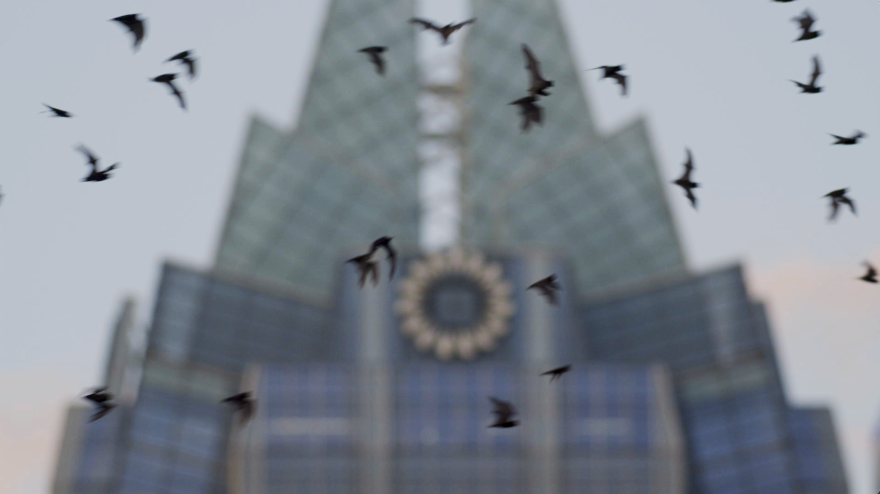
Courtesy of Kristin Tièchei
“I told him [Hobbie] I was hoping for people to fall in love with bats when they watch,” Tièche said. “You protect what you love.”
White-nose syndrome continues to decimate bats as it spreads, but there’s reason for cautious optimism. Some species that were nearly wiped out in the Northeastern states are beginning to show modest recovery, Frick said, though it is not fully clear why.
She said the Fat Bat Project, which has expanded across the Northeast and into Texas, is also showing promise as one tool of many that could stave off total population collapse in some areas.
The Invisible Mammal is screening at 6:30 p.m., Tuesday, July 14, at AFS Cinema. It will be followed by a Q&A with filmmaker Kristin Tièche, producer Matthew Podolsky, cinematographer Skip Hobbie and Winifred Frick of Bat Conservation International.

Brandywine Realty Trust sold 405 Colorado Street in Downtown Austin for $151 million.
Jerry Sweeney, Brandywine’s CEO, discussed how the company was looking to offload somewhere between $250 million and $300 million of its portfolio earlier this year, according to the Austin Business Journal. Earlier this year, the building was billed as 100 percent leased. Houston-based Hines announced that its real estate assets investment arm, Hines Global Income Trust, purchased the building in a statement published Monday. The sale price was disclosed in a Securities and Exchange Commission filing.
The Class-AA office property was completed in 2021, and features 206,000 square feet of office space across 25 stories. Hines paid around $733 per square foot for the building. Tenants at the building include JP Morgan Chase, Bain & Company and AllianceBernstein. Hines Global reports that as of May 2026, it controlled $6.4 billion in gross asset value. The statement from Hines is explicit in their reasoning for acquiring the property: Alfonso Mark, Hines’ global co-head of investment management said in the statement that the company believes that fully leased trophy office buildings are driving recovery in the United States’ office market.
Philadelphia-based Brandywine will still maintain a notable presence in Austin. The Uptown ATX development close to Austin’s second downtown, The Domain, is still receiving a $31 million facelift that’s expected to complete by the end of 2027. Last year, Brandywine stole headlines by snagging Nvidia as a tenant. The six-story, 172,000-square-foot building is getting a shiny new lobby to go with other new amenities. Last year, Brandywine sold Quarry Lake II and Four Barton Skyway, according to the outlet. Quarry Lake II’s 120,600 square feet of office space went to Brick Row Holdings, and Four Barton Skyway went to an unknown buyer.
In the same announcement, Hines confirmed that it had also purchased Wicker Park Commons in Chicago.
— Hunter Cooke
Nvidia takes the cake for Austin’s biggest office lease of 2025
Life after IBM: Brandywine tees up $31M in renovations for 66-acre Austin office campus
Private capital giant Apollo selects Austin as second HQ
Read more
-

 Politics14 seconds ago
Biden special counsel’s ‘runaway train’ scooped up sensitive lawmaker info: ‘Abuse of power’
-

 Health6 minutes ago
‘Miracle on the Hudson’ hero Captain ‘Sully’ Sullenberger reveals Alzheimer’s diagnosis
-

 Sports12 minutes ago
American League stars outshine National League in 96th MLB All-Star game
-

 Technology18 minutes ago
Before you connect another smart TV, tablet or phone, lock it down
-
 Business24 minutes ago
Commentary: Trump greenlights California’s dumbest water project
-
 Entertainment30 minutes ago
‘Hail Satan? Not me.’ Charley Crockett fires satanic duo Twin Temple, so Jack White hires them
-
 Lifestyle36 minutes ago
It’s time for the night trip to the beach — the grunion are running
-
 Politics42 minutes ago
After lawsuit, ICE pauses construction of Bay Area detention facility

