Austin, TX
Central Texas holiday events kicking off soon


Holiday season events happening in Central Texas
The holiday season is here with some events kicking off in Central Texas, and we’re getting a behind-the-scenes look at more that are set to roll out in the next couple of weeks.
AUSTIN, Texas – The holiday season is here with some events kicking off in Central Texas, and we’re getting a behind-the-scenes look at more that are set to roll out in the next couple of weeks.
“That’s generous and very kind of them, sweet of them to do it. God’s going to bless them for doing this,” says Maria, who attended the H-E-B Feast of Sharing dinner.
Thanksgiving came early with the 35th Annual H-E-B Feast of Sharing dinner at the Palmer Events Center. Free meals were passed out by volunteers, flu shots were made available, as well as free transportation to and from the event.
“We do 35 dinners across the state, and we serve over three. Over 300. Meals across the state and in Mexico. So today in Austin, we’re looking to serve 10,000,” says H-E-B Public Affairs Manager Tamara Jones.
While meals were being served, preparation started for the Christmas season in Austin.
This Friday, more lights are coming to the city with Mozart’s Lake Austin Festival of Lights. Celebrating four decades, the festival will operate for nearly six weeks.
The dazzling light displays last two and a half hours from 5-10 p.m., and it ends on January 4. Ticket prices are $5 for those ages 12 and up.
The countdown is also underway for the 60th year anniversary of the city of Austin’s Trail of Lights. Gates open on December 10 and close on December 23.
There are more than two million lights, 90 holiday trees and more than 70 holiday displays along the nearly one-mile stretch.
“We have got some new things this year as well for our opening night. We have got a drone show, that will happen four times on opening night. We have got a lot of new photo activations that are happening as well throughout the trail that you will be able to see,” says Executive Director of Trail of Lights Foundation James Russell.
The first seven nights are free, and the remaining seven nights will cost $8 per ticket. Those ages 11 and under are free. The trail opens from 7-10 p.m. with a line-up of live entertainment and activities.
“We have a ferris wheel, a carousel, and plenty to eat, so bring an appetite we have different vendors. You can buy Trail of Light merch,” says Trail of Lights Foundation Board member Enrique Duran.
This holiday season, the Kyle Police Department is warning residents to watch out for porch pirates with a popular Christmas character, the Grinch.
It’s the third year of the public service announcement, and the first year the department will host a Grinch on the Green event with live music, vendors, a Grinch movie screening and photos with the Grinch.
The Grinch on the Green event is free and will be held Saturday, Dec. 7, from 5:30-9 p.m. at La Verde Park.
The Source: Information from interviews conducted by FOX 7 Austin’s Tan Radford



Director Kristin Tièche says the seed for her new documentary, The Invisible Mammal, was planted back in 1999, when she was a film student in upstate New York.
“I was sitting at this pub on campus, and I looked up and the sky was just filled with bats,” said Tieche, a native Californian who had never seen a bat before.
“I just thought it was the coolest thing ever,” she said.
These days, such a sight is all but impossible to behold in New York and many other states. A deadly disease called white-nose syndrome is to blame.
The Invisible Mammal follows a team of researchers as they set out to protect bats from the disease, which has emptied entire caves and roosting spots once teaming with life. It’s being screened Tuesday night at AFS Cinema and will be followed by a Q&A.
White-nose syndrome is caused by an invasive fungus found in Europe, likely brought to America on the clothes of a visitor who came to see American bats up close. It kills by starving hibernating bats.
The disease causes bats to “wake up too often during winter and they burn up their fat reserves and die before spring,” said Winifred Frick, chief scientist at Bat Conservation International.
First detected in New York state in 2006, the disease steadily spread across the continent, inflicting catastrophic damage on bat colonies in the Northeast, mid-Atlantic and Midwest. In some parts of the U.S. and Canada, white-nose has wiped out over 90% of bat populations. While the disease exists in Texas, it has not proved as destructive so far.
When it appeared in California in 2019, Tièche thought back to that night decades before when she saw her first bat flight.
“I knew at that moment that it was time to launch this film project,” she said.
The result is a nonnarrated documentary that follows researchers and conservationists across the country, as they protect bats and study ways to battle white-nose syndrome.
Its primary focus is Frick and the team of scientists behind the Fat Bat Project, an initiative started in Michigan’s Upper Peninsula that aims to keep bats well fed around their winter hibernation.
“The idea was could we help bats get fat in the fall and also help them recover their body condition in the spring?” Frick said. “Because we had research that showed that the bats that were surviving tended to be fatter at the start of hibernation.”
Tièche said it was not until she arrived in Michigan to shoot that she realized the team of scientists working on the Fat Bat Project was comprised entirely of women.
“I knew at that point that I also was going to tell the story of women in science,” she said.
White-nose exists in Texas, but the colonies of Mexican free-tailed bats so celebrated in the Hill Country are at lower risk of death. That’s largely because they do not hibernate in the same way some other species do, and insect meals are available in Central Texas deeper into the winter months.
Still, Austin’s Congress Avenue bat bridge makes an appearance in the documentary. The film also opens and closes with immersive scenes — filmed by Austin wildlife cinematographer Skip Hobbie — of bats flying out of the Bracken Cave Preserve, home to the world’s largest bat colony.
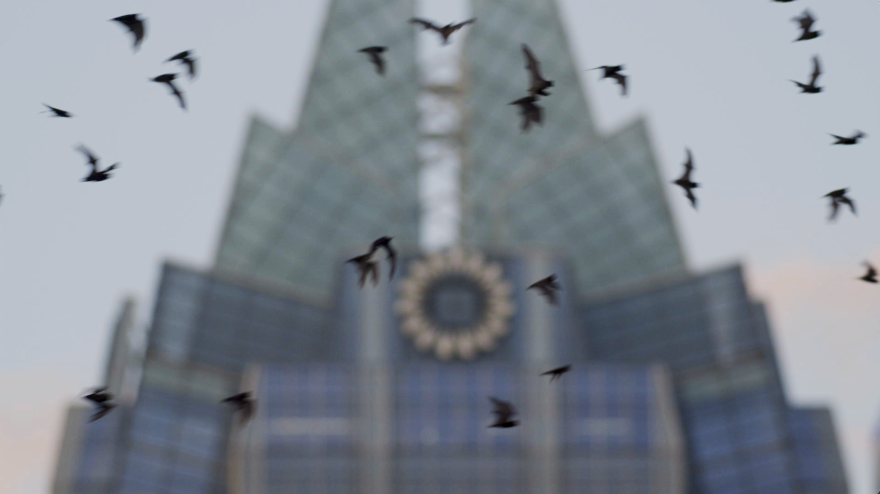
Courtesy of Kristin Tièchei
“I told him [Hobbie] I was hoping for people to fall in love with bats when they watch,” Tièche said. “You protect what you love.”
White-nose syndrome continues to decimate bats as it spreads, but there’s reason for cautious optimism. Some species that were nearly wiped out in the Northeastern states are beginning to show modest recovery, Frick said, though it is not fully clear why.
She said the Fat Bat Project, which has expanded across the Northeast and into Texas, is also showing promise as one tool of many that could stave off total population collapse in some areas.
The Invisible Mammal is screening at 6:30 p.m., Tuesday, July 14, at AFS Cinema. It will be followed by a Q&A with filmmaker Kristin Tièche, producer Matthew Podolsky, cinematographer Skip Hobbie and Winifred Frick of Bat Conservation International.

Brandywine Realty Trust sold 405 Colorado Street in Downtown Austin for $151 million.
Jerry Sweeney, Brandywine’s CEO, discussed how the company was looking to offload somewhere between $250 million and $300 million of its portfolio earlier this year, according to the Austin Business Journal. Earlier this year, the building was billed as 100 percent leased. Houston-based Hines announced that its real estate assets investment arm, Hines Global Income Trust, purchased the building in a statement published Monday. The sale price was disclosed in a Securities and Exchange Commission filing.
The Class-AA office property was completed in 2021, and features 206,000 square feet of office space across 25 stories. Hines paid around $733 per square foot for the building. Tenants at the building include JP Morgan Chase, Bain & Company and AllianceBernstein. Hines Global reports that as of May 2026, it controlled $6.4 billion in gross asset value. The statement from Hines is explicit in their reasoning for acquiring the property: Alfonso Mark, Hines’ global co-head of investment management said in the statement that the company believes that fully leased trophy office buildings are driving recovery in the United States’ office market.
Philadelphia-based Brandywine will still maintain a notable presence in Austin. The Uptown ATX development close to Austin’s second downtown, The Domain, is still receiving a $31 million facelift that’s expected to complete by the end of 2027. Last year, Brandywine stole headlines by snagging Nvidia as a tenant. The six-story, 172,000-square-foot building is getting a shiny new lobby to go with other new amenities. Last year, Brandywine sold Quarry Lake II and Four Barton Skyway, according to the outlet. Quarry Lake II’s 120,600 square feet of office space went to Brick Row Holdings, and Four Barton Skyway went to an unknown buyer.
In the same announcement, Hines confirmed that it had also purchased Wicker Park Commons in Chicago.
— Hunter Cooke
Nvidia takes the cake for Austin’s biggest office lease of 2025
Life after IBM: Brandywine tees up $31M in renovations for 66-acre Austin office campus
Private capital giant Apollo selects Austin as second HQ
Read more


They came for the red-light therapy room and the yoga studio overlooking downtown Austin’s Lady Bird Lake. They came for the in-house pilates, the concierge, the cold plunges, the swanky lounges and coworking spaces, and the first floor coffee shop that sells $14 bottles of organic juice.
They came to rub shoulders with TikTok-famous fitness influencers, finance bros, and University of Texas football players living large on the kind of name, image, and likeness (NIL) money that turns nineteen-year-olds into millionaires. But mostly, they came for the bragging rights, the chance to proclaim residence inside Austin’s first influencer building, a glassy, 48-story sky palace that provides significant rental discounts to influencers in exchange for social media promotion. Paseo––which opened in November––is not merely a residential building on Rainey Street, surrounded by bars and drunken bachelorette parties, with a $45,000-a-month penthouse on top. It’s also a branded experience, with its own hashtags and a steady stream of lifestyle videos from influencers who live there—one of whom recently went viral on X for touting his “sober Saturday”—as well as many of their followers who aspire to move in. As the building’s website puts it: “This is where life flows your way.”
But at the luxury building’s eleventh-floor indoor dog park, the only thing flowing in recent months has been an excrement-laced stream of urine, one that has become a sanitation nightmare and a social media fiasco. The foul-smelling river begins beneath a turfed dog area covered in feces and poop bags before making its way into the parking garage and eventually an elevator bank, where it forms a slippery mustard-colored pool that, residents say, poses a danger to humans and dogs alike. To make matters worse, the dog park lacked barriers separating animals from vehicles driving through the garage (barriers are currently being built). The park is also set against a concrete wall with openings more than a hundred feet off the ground. In a building nearly devoid of children but packed full of dogs (Paseo allows two pets per unit), it isn’t hard to imagine an exuberant pup jumping to its death while its owner watches in horror.
The situation worsened when images and first-person accounts of the disaster spread on TikTok, leading many to begin referring to the building as “the Piss-eo.” Almost overnight, the high-rise’s proximity to digital virality, the thing that had bolstered its reputation over many months, threatened to destroy it even faster. “There’s only one thing that can come from a bunch of divas with a camera and collective millions of eyeballs on them, and that is drama,” as one woman, a TikTok user who manages influencers for a living, put it. “And the lowest-hanging fruit for that drama is your building. Welcome to bad PR.”
The “bad PR” already has real-world implications. Since April, the City of Austin has received three complaints about conditions at Paseo and has an open code-compliance case related to the sanitation concerns, according to Stephanie Sanchez, a spokeswoman for Austin Development Services. “In order to issue a notice of violation, inspectors must visually confirm unsanitary conditions, and our team has reached out to the property to arrange access for an inspection and is continuing to follow up,” Sanchez said.
I was curious about the reality behind Paseo’s glossy digital facade and what it revealed about our growing inability to distinguish reality from social media’s “fun house mirror” effect, the algorithmic warping of our sense of what is normative.
Until recently, “collab houses,” group living spaces where aspiring influencers (usually teenagers) amass to create social media content, were relegated to residential mansions in cities like Los Angeles, Las Vegas, and Miami. The idea of turning a residential building full of adults thousands of miles from Los Angeles into some variation of a collab house struck me as another bizarre example of the real world bending, ever more theatrically, to the will of the digital one. Or maybe, I thought, I was just getting old.
Traditionally, real estate developers marketing to high-end customers treat things like square footage, location, and luxury finishes as a building’s primary selling points. But from the start, LV Collective, the Austin-based real estate development firm behind Paseo’s creation, sold the idea that a renter is granted access to an exclusive, preexisting community experience, one measured by “energy per square foot,” according to a “case study” provided by LV Collective. More Silicon Valley–themed blueprint than case study, the document breaks down how the Austin tower became a socially engineered “proof of concept” and “one of the most talked-about buildings in the U.S.” It’s not about “how much space a building has,” the document notes, “but how much life it holds.”
Unlike with other ready-made communities, such as storied fraternities or country clubs with existing legacies, Paseo’s developers realized they’d need to create their select community from scratch, using what might best be described as the science of vibes. The vibe-optimization quest began with the recruitment of several dozen lifestyle, wellness, and fitness creators. Their job was to live inside Paseo and turn their daily lives inside the building––from coffee runs to gym sessions to cold plunges––into content not only designed to look authentic but also accentuated by the building’s rich, textured sensory environments, all of which were designed to be Instagrammable.
The content was meant to look organic, and, not surprisingly, the building’s small army of promoters do not disclose that their posts are, at their core, a form of paid marketing. “This isn’t a traditional influencer campaign,” the case study says. “Creators like Ken Eurich are brought into the community early to showcase it forming in real time, giving Paseo a first-person authenticity that advertising can’t manufacture.” The influencer content was further bolstered by “#PaseoTok,” an endless stream of social media posts that form, in the somewhat totalitarian language of LV Collective’s case study, a kind of “cultural programming.”
The result: Since October, Paseo has received over 123 million views across Instagram and TikTok and $7 million in creator-driven media value, according to LV Collective. The firm credits the influencer-themed strategy with ensuring that just under half of the building was leased in the first ninety days since opening and up to 70 percent within six months.

At the same time renters were rushing to move into the building and influencers were touting its glamour on TikTok, Paseo’s management was already struggling to contain the pet waste on the eleventh floor. In February, the building’s management sent an email to residents promising to remodel the dog park the next month. Delays followed, and more “drainage improvements” were required over the following months, according to subsequent communications obtained by Texas Monthly. “We truly understand how important amenities are and sincerely appreciate your patience as we work to complete them with quality and care,” the building’s management wrote in a March 19 missive.
The dog park’s viral moment arrived in mid-May and can be traced back to a temporary resident named Elizabeth Swenson, who was apartment sitting for a friend when she encountered the eleventh-floor mess. Until then, Swenson said she’d largely enjoyed her stay in the building, both because of the friendly encounters with other residents and the access to the coffee shop on the first floor. Though she doesn’t consider herself an influencer (she doesn’t get paid for her posts), Swenson, a stylish 31-year-old who routinely posts about mental health, wellness, and preparing for law school, has an online presence that suggests she could be one. Her TikTok has more than 31,000 followers, and her candid first-person takes routinely rack up thousands of views.
She decided to post about the Paseo sanitation issue on TikTok because she couldn’t believe what she was encountering each time she set foot on the eleventh floor. Her first video about the “Austin influencer tower,” a close-up freeze-frame of her disturbed face with text describing the “yellow river” in the building, was viewed more than two million times. Her next, which included video evidence to back up her claims, was viewed more than half a million times. Weeks later, Swenson was still in shock. “The second I opened the door onto the eleventh floor and stepped onto the little mat for wiping your feet, it was soaked in pee,” she said, noting that the waste was frequently tracked into elevators by people and dogs alike. “I kept thinking, ‘If they’re dealing with fecal matter and urine in this manner, what else do you do with the rest of the building in terms of hygiene? If there was mold, would they care?’ ”
From a public health standpoint, an unsanitary dog park can have serious repercussions. Dog parks with contaminated soil or turf can become breeding grounds for parasites (like giardia, roundworm, and hookworm) and bacteria (like those that cause leptospirosis, which is transmissible to humans and pets).
In the world of social media, extreme exposure is, of course, a double-edged sword. When the dog park first went viral, TikTok users began tagging Eurich and other well-known Paseo influencers, accusing some of covering up the sordid truth about their residence. David Kanne, the founder and CEO of LV Collective, admitted during a phone interview that the building’s social media narrative has “taken on a life of its own.” Faced with the online backlash and a growing number of frustrated residents, Kanne said LV Collective has decided to assume day-to-day management of the building from Greystar, one of the nation’s largest property development and management companies. But the entire episode, he maintains, is little more than a sewage-themed growing pain. “Every building has challenges,” Kanne said. “Ours has such a large microphone that you hear about it more often. And the cool thing is, we now hear those criticisms and we just go, ‘Okay, how do we fix it? How do we make it better?’ ”
But for Swenson, and for some women who live in the building, the dog park also raised a safety issue—one, they said, that was lost on many online male commenters who dismissively asked why dog owners don’t just take their pets outside to relieve themselves. Swenson, who works in the service industry as she prepares for law school, said she often comes home after 2 a.m. Sometimes Rainey Street is packed with rowdy groups of drunk men; other times it’s a ghost town. Either way, trekking in the dark to find a suitable place for her pooch to pee, behind a building or closer to the dimly lit trails around Lady Bird Lake, felt risky. “This area is known for having a bunch of murders and disappearances,” she said, referring to the alleged Rainey Street Ripper. “God forbid it’s just you and your Chihuahua out there in the middle of the night.”
In the wake of the dog-park debacle, it wasn’t hard to find someone to sneak me into the ivory tower. Plenty of Paseo’s residents were frustrated by the urine issue, among others, and a few of them were willing to talk, as long as I didn’t use their names. The rumor in the building in recent months was that the residence’s management had begun monitoring an internal message board accessible via the building’s app, where residents could voice complaints about issues inside Paseo.
When critical comments began being deleted by management, some residents began to feel like the building’s culture had turned oppressive and they no longer had an outlet to voice complaints. LV Collective told Texas Monthly the issue had been addressed and the building manager in question, a Greystar employee, had been removed. Meanwhile, residents had become alarmed by reports that––due to high concierge turnover and security lapses––an unhoused man had been able to waltz into the building, allegedly penetrating the twelfth-floor “wellness area” with saunas and cold plunges, the closest thing the residential temple has to an innermost sacred chamber.
To avoid suspicion, my Paseo deep throat met me not in a shadowy parking garage but at a grassy roundabout where his dog could relieve itself several blocks from the building. He looked the part: an exceptionally fit man, mildly tattooed but clean-cut, in his mid-thirties who’d moved to Austin to work in tech. He’d been drawn to Paseo because of the notion that with all of the tower’s amenities, which include a Mediterranean restaurant on the twelfth floor and the ability to have his groceries delivered by the concierge, he’d never really need to leave the building. But here he was, he grumbled, forced to walk several blocks away to find a patch of grass. This inconvenience was due to urinegate, he said, which was not only disgusting but also reflective of a series of problems that were at odds with the promotional videos being produced by the building’s influencers.
Almost as soon as he and his partner moved into Paseo, where they pay around $4,500 in rent each month, they met residents whose glass shower doors shattered when they closed them. In their own shower, along with those of other neighbors, water leaked through the glass door and onto the bathroom floor, leaving slippery puddles on the tile floor (it was later fixed). Perhaps more dangerously, the couple said, their balcony door has no mechanism for holding it in place once it’s been opened, which allows the door to be slammed against the building and shattered by a strong gust of wind (something that has happened to other residents). “And there have been multiple occasions of the high-rise windows just randomly cracking,” the tech worker said. “I saw a residence where the window to access the balcony was made up entirely of cracked glass, like it was about to fall off the building.”
Inside, he continued, many residents have been disturbed by the so-called cardboard rooms, designated for residents to discard boxes, filling instead with rotting trash and food waste that remains for weeks at a time. Images shared with Texas Monthly showed trash bags dumped on the ground alongside orange peels, old running shoes, empty toothpaste dispensers, and hair-removal waxing strips. So pungent was the trash odor, he said, that the smell was discernible from inside the couple’s apartment. In another building, bad smells might be overlooked, but Paseo was supposed to be different. “Everyone here expects perfection,” the tech worker said, noting that he and his partner pay several hundred dollars in amenity and other fees each month. “We’re in a super luxury building. It’s been advertised as ‘Hey, we’re going to be a hundred percent perfect,’ so now you got to deliver.”
Despite the amenity fee, the tech worker said, many residents have reported finding hairs in the cold plunges. When I visited the cold-plunge room, I witnessed water flecked with mysterious residue and floating clumps of matted hair. I wasn’t the only one unwilling to take a dip. At one point, a resident told me she blamed one of the building’s hot tubs for turning her hair and swimsuit green, a potential result of excess copper in the chlorinated water. “What if my bathing suit was $1,500?” said the woman, who asked not to be identified for fear of retaliation from the building’s management. “People have expensive stuff in their hair, and women, when they get their hair done, it’s sometimes $600 or even more.”
My tour culminated on the eleventh floor, where the dog-park disorder was still unfolding despite having been highlighted on TikTok weeks earlier. The dog park sat on an elevated platform, and multiple streams of urine, some of them three or four feet wide, seeped from underneath. Gravity carried them downhill, covering large portions of the garage with a hazardous sheen. Despite fans twirling overhead, the pungent odor was as unavoidable as the stickiness beneath my feet. Photos taken over the previous months showed an even more formidable biohazard, with waste streaked across the ground and poop bags spilling out of a trash can. “It’s so disgusting that dog owners aren’t even taking their dogs there,” my guide said. “And by the way, the residents have been telling management this over and over again. You would think that a building pulling in this much money each month would take the problem more seriously.”
Real estate developers are fond of talking about bringing “community” to Rainey Street. It’s discussed like a precious commodity being imported into the neighborhood for the first time. What they often fail to acknowledge is that before Rainey Street became synonymous with wealthy transplants, barhopping partiers, and an alleged serial killer run amok, it was for decades one of Austin’s most tightly knit communities. That was still true in 1995, when Brigid Shea and her husband moved into a cramped, one-bedroom, one-bath home on the street, lined with charming historic homes dating back to the late nineteenth century, and started a family.
It felt even more true after her son got a little older and was unofficially adopted by the Solis family down the street, the same one that had thirteen kids and turned their backyard into a “pachanga for the whole neighborhood,” as Shea put it, every weekend. “It felt like we were living in Cannery Row,” Shea said, referring to the John Steinbeck novel about the gritty charm of a Depression-era Monterey, California, neighborhood lined with sardine canneries. “It was just a really rich, interesting mix of working-class people and musicians and artists and Hispanic families with deep ties to the area.”
The local residents eventually decided to allow the city to rezone Rainey Street, giving many families a chance to cash out as the area urbanized. But they did so after years of discussions and with a unanimous stipulation, Shea said: that any change in zoning include requirements for new high-rises to set aside a percentage of the units for affordable housing. Eventually, she said, that was rescinded. “Eveybody was in agreement about this,” said Shea, whose local activism would eventually propel her to her current role as a Travis County commissioner. “We didn’t want Rainey to become another neighborhood for wealthy people.”
-

 Milwaukee, WI12 minutes ago
Milwaukee cooling centers, heat advisory tips; what to know
-

 Atlanta, GA18 minutes ago
Warnock, Dickens talk about new housing legislation
-

 Indianapolis, IN30 minutes ago
Indiana heat index to hit 100 as hot, dry pattern holds | July 14, 2026
-

 Pittsburg, PA36 minutes ago
Another stretch of high temperatures in the 90s hitting the Pittsburgh area this week
-

 Augusta, GA42 minutes ago
Flash flooding impacts multiple areas across Columbia County
-

 Washington, D.C48 minutes ago
ARCO Design/Build Deepens Its Presence in Washington, D.C. Market
-

 Cleveland, OH54 minutes ago
LeBron James Could Give the Cavaliers the Mentality They’re Missing
-
Austin, TX60 minutes ago
Documentary on the fight against a bat-killing plague flies into Austin

