Austin, TX
6 things to know about Texas weather and the grid this August


Check out some of Community Impact’s recent coverage of energy and the environment below.
Low wind, high demand could trigger Texas power grid emergency in August
High temperatures, rapid population growth, and an influx of cryptocurrency and artificial intelligence companies will continue to squeeze Texas’ power grid, energy officials reported in June.
- There is a 12% chance of rotating power outages on August nights with little wind, according to the Electric Reliability Council of Texas.
- During the summer, the strain on the power grid is typically highest from 8-9 p.m., when more people are using electricity and less solar power is available.
- If wind power production is also low, ERCOT may ask Texans to reduce their energy use. The grid operator called for energy conservation 11 times last summer.
What to know about Texas’ power grid ahead of another hot summer
Energy leaders face continued skepticism from Texans in the three-plus years after the deadly power outages during Winter Storm Uri, the dayslong freeze in February 2021. Community Impact sat down with ERCOT leaders in May to discuss how the grid has evolved to meet the needs of Texas’ rapidly growing population and more.
- ERCOT relies partially on solar power to meet high demand during the summer, resulting in a “rapidly declining energy source” as the sun sets, CEO Pablo Vegas said.
- Power plants and transmission facilities across the state have been upgraded to ensure they can withstand extreme temperatures, said Venkat Tirupati, ERCOT’s vice president of DevOps and Grid Transformation. ERCOT did not confirm how many plants had been upgraded but said officials have inspected 2,117 “weatherized” facilities since December 2021.
Report: Texas summers will keep getting hotter, drier
Texans can expect more 100-degree days and longer wildfire seasons in the coming years, according to a recent report from the state climatologist at Texas A&M University.
- 2023 was Texas’ hottest year on record, according to the National Oceanic and Atmospheric Administration. By 2036, the year Texas turns 200, triple-digit days will likely be four times more common than they were in the 1970s and ‘80s.
- Rising temperatures and varying rainfall can cause drier conditions, leading to an increased risk of wildfires. With higher temperatures occurring earlier in the year, researchers expect the spring and summer wildfire seasons will last longer.
Texas’ first statewide flood plan finds over 5 million people live, work in flood-prone areas
Over 5 million Texans live or work in areas vulnerable to flooding, according to a draft of the state’s first flood plan.
State lawmakers tasked the Texas Water Development Board with creating the plan in 2019, in the aftermath of Hurricane Harvey. The 267-page draft, published in early May, recommends over $54.5 billion in funding to reduce flood risks.
- Nearly 1.3 million homes and over 12 million acres of agricultural land are in flood-prone areas, the plan estimates. Each of Texas’ 254 counties has experienced at least one federally declared flood disaster.
- The plan asked the Texas Legislature to expand early warning systems for floods; create minimum building and infrastructure standards to reduce fatalities and property damage; improve low-water crossing safety; and enhance dam and levee safety programs.
‘Profits over people’: Lawmakers, residents demand change from CenterPoint after Hurricane Beryl
CenterPoint Energy faced another day of reckoning over its response to Hurricane Beryl on July 31. Around two dozen Texas House members grilled CenterPoint CEO Jason Wells on how the utility prepared for the storm, what changes it was making and why power restoration took so long.
- “We keep hearing the same thing: we’ll do better, we’ll do better,” Rep. Ana Hernandez, D-Houston, told Wells. “It’s an excuse. That’s not enough. People want to know that this will not happen again and that we will make changes.”
- CenterPoint has proposed raising customers’ electricity bills by 2% for the next 15 years to cover the nearly $1.8 billion in recovery costs associated with the May derecho and Hurricane Beryl.
Gov. Abbott orders CenterPoint to speed up action plan for future storms
CenterPoint Energy will speed up its plans to trim trees, replace utility poles and increase communication with its customers ahead of future storms in Southeast Texas, Gov. Greg Abbott announced Aug. 1. Abbott said he met with CenterPoint executives for over two hours Aug. 1 and ordered them to complete the bulk of their proposal by the end of the month.
- CenterPoint will clear tree branches and other vegetation from 2,000 miles of “higher risk” power lines by Aug. 31, according to the proposal. The company originally planned to complete this project by the end of the year.
- About 1,000 utility poles will be replaced by the end of August, which was also originally scheduled for the end of the year.
- Abbott also directed CenterPoint to improve its communication with Houston-area residents after Hurricane Beryl. The utility has held five community listening sessions to get customer feedback since July 17 and will hold large open houses in each of the counties it serves before Sept. 30.



AUSTIN (KXAN) — Governor Greg Abbott and the Texas Society Sons of the American Revolution unveiled a new monument at the Texas State Cemetery on Saturday, dedicated to Texas Revolutionary War soldiers.
“We must educate every generation about why it is that America grew from a tenuous 13 colonies into the most powerful country in the history of the world,” said Governor Abbott. “This monument here is an enduring testament to the heroes who fought for the freedom that is unique to America.”
The monument was dedicated to 69 soldiers who fought in the American Revolutionary War and later settled in Texas, according to a press release.
Among those that were honored, Abbott recognized:
- José Santiago Seguín, grandfather of Texas Revolutionary hero Juan Seguín.
- Peter Sides, who fought in the 2nd Battalion of the North Carolina Regiment of the Colonial Army, and was later killed in the 1813 Battle of Medina, fighting for Mexican independence against Spain.
- Antonio Gil Y’Barbo, the founder of Nacogdoches.
- William Sparks, who fought as a mounted rifleman in the American Revolution and later settled in Texas. He had two sons and two grandsons who fought in the Texas Revolution.
“This year marks the 250th anniversary of the American Revolution, which not only gave freedom to the British colonies of North America, but inspired movements for freedom and liberty all over the world,” said TSSAR President Mel Oller. “Texans played a role in the war too, and it’s important to recognize them, and the sacrifices they made for our freedom.”
At the monument unveiling, Abbott was also inducted into the Sons of the American Revolution and received its Silver Good Citizenship Medal.
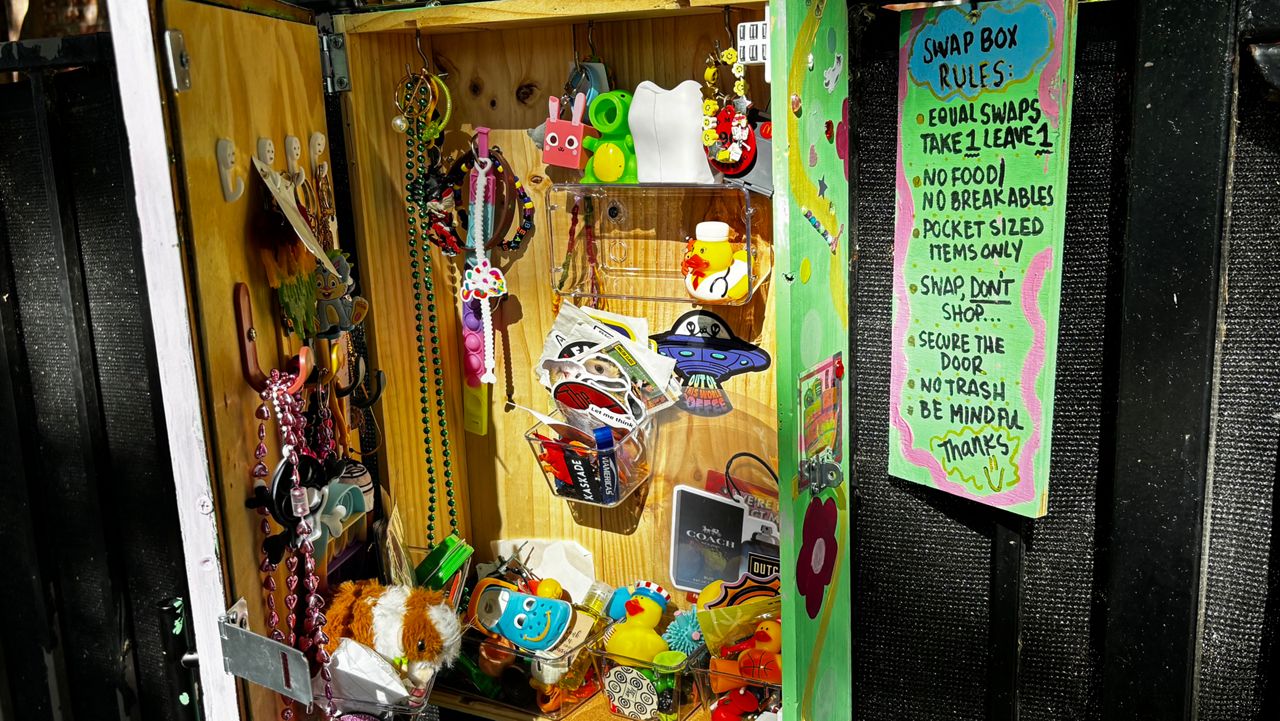
AUSTIN, Texas — Inside a green wooden box mounted to a steel fence, a treasure trove of trinkets awaits. Just a few miles north is another goodie box, this time covered in leopard print and inside a craft studio. Farther east, a simple white trinket box sits mounted on a wooden pole, decorated with stars and a crow saying, “Thanks for visiting!”
These boxes, filled to the brim with stickers, keychains, jewelry, collectibles and more, are known as trinket trade boxes. Austin has seen a sudden surge in these boxes over the last few months, and despite their varying locations, one sentiment ties them all together: trinket trading is a fun way to bring a bit of joy to the community.
“Little things that bring people joy is so important right now, which I think a lot of us can agree with, and I’ve seen all sorts of people use the box so far,” said Anna Arocha, whose trinket box is in The Triangle neighborhood downtown. “Little kids and all the way up to people in their 50s and 60s, I’ve seen stop by.”
Trinket trading operates on a simple system of take something, leave something. People can swap a toy car for a lanyard, a bracelet for a Sonny Angel, or a Pokémon card for a rubber duck.
“There was somebody who was just walking by with their kid in the stroller, and there was a finger puppet inside of the box, and I saw her swap something out and walk away with the little finger puppet,” Arocha said. “And it was just such a cute moment to see a mom and a kid enjoy something like that.”
Arocha put her crafting skills to work and made her green wooden box in just one day using craft wood and a wine crate last month. Amy Elms opted for a small, white junction box to ensure it could withstand harsh Texas weather. Ani’s Day & Night on East Riverside, which has a large outdoor space for picnic tables and food trucks, gave Elms permission to place her trinket box on their property in January.
Ally Chavez used her own property, Create! Studio ATX on West Anderson Lane, for her leopard-print box that opened in March.
“There wasn’t a ton up here in the north area, so we just kind of wanted to put it together and put it up for the studio just as a way to connect with the community in a way that no one has to spend money,” Chavez said.
Since their debuts, all three trinket boxes have garnered thousands of interactions on social media. When Arocha posted about the opening of her box in March, she racked up 100,000 views on TikTok. But with the excited comments came a bit of negative attention, and her cameras caught a thief trying to take all the trinkets. Arocha now locks the box at night.
“If somebody wants to do that, so be it,” Arocha said. “We can start over, and if the joy that it brings outweighs that every time, I think it’s worth doing.”
Arocha, Elms and Chavez’s boxes are now registered on a website called Worldwide Sidewalk Joy, alongside all the others in Austin and across the globe, as trinket trading grows to become a kind of new, modern geocaching.
“Honestly, it’s been I think even better than I expected so far,” Elms said. “I’ve had people… visiting Austin from out of town, and they’re making it a stop during their visit. I’ve also had multiple people reach out to me to ask how they can start their own trinket trade box, too, which I really love.”

AUSTIN (KXAN) — Forbes on Friday released its annual list of ‘New Ivies,’ and the University of Texas at Austin made it. This is not UT’s first time on the list; it was included in 2024 and 2025.
It’s important to note the Forbes designation does not make UT an Ivy League School. Schools currently designated as Ivy League are Brown University, Columbia University, Cornell University, Dartmouth College, Harvard University, Princeton University, the University of Pennsylvania, and Yale University.
Forbes argued its list was created because a growing number of employers have said they are less likely to hire an Ivy League grad today compared to five years ago. The list is curated by surveying over 100 C-Suite and hiring executives, as well as using data from the 2024 National Center for Education Statistics to gauge if a school fulfilled the criteria to be on the list.
One respondent said instead of prestige, employers are looking for graduates who have “complex emotional intelligence, radical adaptability and visionary creativity to orchestrate AI tools rather than compete with them.”
Forbes said colleges had to meet three criteria to be considered, which included:
- Size: Private schools must enroll at least 3,000 students, and public colleges must have at least 4,000 students enrolled.
- Selectivity: All but one private college had an admission rate of less than 15%; public college admission rates were 50% or less.
- Testing Requirements: At least half the entrants must have submitted either the SAT or the ACT scores
Forbes argued testing requirements indicated academic rigor, as a result. Schools such as the University of California and California State schools were not considered.
When it came to UT meeting the requirements for the list, UT had an undergrad enrollment of 44,663 students with a 27% acceptance rate. When it came to test scores, it had a median SAT score of 1390 and a median ACT score of 31.
For a full list of the public and private schools included in the Forbes 2026 New Ivies list, click here.
-

 Connecticut1 minute ago
Overnight Forecast for April 19
-

 Delaware7 minutes ago
State Police Arrest Dover Man for Assault and Aggravated Menacing in Dover – Delaware State Police – State of Delaware
-

 Florida13 minutes ago
SNAP benefits will be changing in Florida starting Monday
-

 Georgia19 minutes ago
Georgia on nobody’s mind: The Dawgs are under the radar, and that’s a compliment
-

 Hawaii25 minutes ago
Large section of Aloha Stadium demolished as project proceeds – West Hawaii Today
-
Idaho31 minutes ago
Idaho Lottery results: See winning numbers for Powerball, Pick 3 on April 18, 2026
-

 Illinois37 minutes ago
5 tornadoes confirmed in Illinois from Friday’s storms
-

 Indiana43 minutes ago
An Indiana district turned to voters to fund more preschool seats. Here’s what happened next.