Arkansas
Gymbacks Place Seventh at NCAA Championships, Four Earn All-America Honors

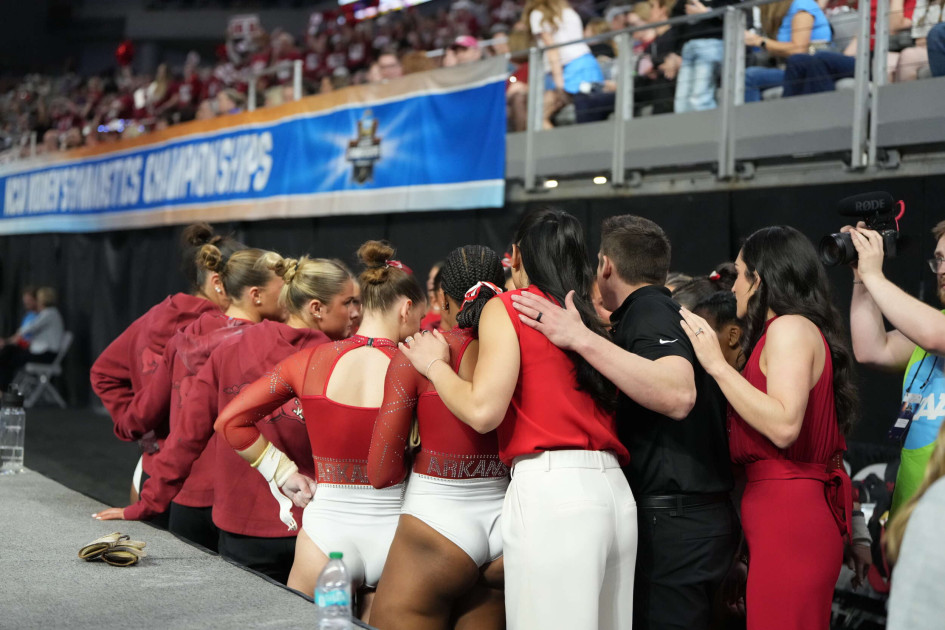
The No. 9 Gymbacks saw their season come to an end on Thursday night as they placed fourth in the NCAA Gymnastics Championships evening semifinal and seventh overall with a score of 196.9625.
Arkansas finished behind No. 1 Oklahoma (198.300), No. 13 Minnesota (197.4625) and No. 4 UCLA (197.275) in its session, with the Sooners and Golden Gophers advancing to Saturday’s national championship. In the afternoon session, No. 3 Florida (197.7875) and No. 2 LSU (197.4375) advanced, while No. 6 Georgia placed sixth overall (197.2625) and No. 7 Stanford placed eighth (196.9375).
The Gymbacks’ team score of 196.9625 is the second highest in program history at NCAAs for Arkansas, and highest since 2009. The team got out to a strong start on floor, in which the Razorbacks scored 49.300, a new NCAA championships record for Arkansas on the event.
The day was highlighted by a great all-around performance by senior Morgan Price. She scored 39.4625, which was good for fifth in the session and tied for ninth overall, good for Second Team All-America honors. She also tied for eighth on vault (9.900) and fifth on bars (9.9125) to bring her All-America total to three, the most by a Gymback at a single nationals since Kennedy Hambrick in 2021.
Fifth year Leah Smith sent her Arkansas career out with a bang as she notched a pair of 9.900s on vault and bars, both of which tied for the session for All-America nods. Smith is now a three-time All-American with two on vault.
Freshman Allison Cucci had a fantastic first NCAA Championships with Arkansas’ highest individual score of the day, 9.9375 on vault. She tied for fourth in the session to earn First Team All-America honors and tied for sixth overall. Her score is the third highest ever by a Gymback on vault at NCAAs, and the best for Arkansas since 2014.
Sophomore Joscelyn Roberson closed out her second season with her first All-American honor on floor. She scored 9.9125 and placed eighth in the evening semifinal. Roberson has now earned two All-America nods in as many seasons at Arkansas.
Floor
After an uncharacteristic start from Hailey Klein on floor, Smith got the Gymbacks on track again in the two spot with a 9.8375. The Price duo of Morgan and Frankie earned matching 9.825 marks back-to-back, and Lauren Williams broke through for the first 9.900 of the night for Arkansas in the fifth spot. Roberson anchored the Gymbacks with a 9.9125, which brought the floor total to 49.300.
Vault
After a 9.7875 from Cami Weaver in the lead-off position, Smith stuck her Yurchenko full up second and earned a 9.900. The sticks were contagious as Cucci delivered one of her own midway through the lineup on her Yurchenko 1.5 for a 9.9375. Klein and Williams scored 9.8125 and 9.825, respectively. Morgan Price finished the rotation with a 9.900, and Arkansas posted 49.375 on vault.
Bars
Roberson led off with a 9.7875 for Arkansas, and the scores built from there with a 9.800 from Klein and a 9.900 for Smith to pace the Gymbacks halfway through the rotation. The freshman duo of Avalon Campbell and Cucci scored 9.800 and 9.775 next, which brought up Morgan Price to anchor. She put down her typical solid routine on the event and went 9.9125. The Gymbacks’ total on bars was 49.200.
Beam
Arkansas went to one of its best events of the season for the last rotation, beam. Priscilla Park kicked it off with a 9.8125, followed by a 9.7875 by Klein up second. Weaver and Cucci then scored 9.750 and 9.775. Morgan Price and Joscelyn Roberson both posted good scores of 9.825 and 9.8875, but neither were enough to move Arkansas into a spot to contend for a national finals berth.
More Information
Visit ArkansasRazorbacks.com for the latest information on all things Arkansas Gymnastics. You can also find the Razorbacks on social media by liking us on Facebook (Arkansas Razorback Gymnastics) and following us on Twitter and Instagram (@RazorbackGym).



Arkansas
Northwest Arkansas waste district merger talks make progress with agreement on executive committee size | Northwest Arkansas Democrat-Gazette

Copyright © 2026, Northwest Arkansas Newspapers LLC. (NWA Media)
All rights reserved.
This document may not be reprinted without the express written permission of Northwest Arkansas Newspapers LLC
Material from the Associated Press is Copyright © 2026, Associated Press and may not be published, broadcast, rewritten, or redistributed. Associated Press text, photo, graphic, audio and/or video material shall not be published, broadcast, rewritten for broadcast or publication or redistributed directly or indirectly in any medium. Neither these AP materials nor any portion thereof may be stored in a computer except for personal and noncommercial use. The AP will not be held liable for any delays, inaccuracies, errors or omissions therefrom or in the transmission or delivery of all or any part thereof or for any damages arising from any of the foregoing. All rights reserved.
The Arkansas Lottery offers several draw games for those aiming to win big.
Here’s a look at Sunday, July 12, 2026 results for each game:
Winning Cash 3 numbers from July 12 drawing
Evening: 7-0-6
Check Cash 3 payouts and previous drawings here.
Winning Cash 4 numbers from July 12 drawing
Evening: 5-3-0-9
Check Cash 4 payouts and previous drawings here.
Winning Natural State Jackpot numbers from July 12 drawing
07-12-15-26-35
Check Natural State Jackpot payouts and previous drawings here.
Winning Millionaire for Life numbers from July 12 drawing
12-21-39-46-48, Bonus: 02
Check Millionaire for Life payouts and previous drawings here.
Feeling lucky? Explore the latest lottery news & results
When are the Arkansas Lottery drawings held?
- Powerball: 9:59 p.m. CT on Monday, Wednesday, and Saturday.
- Mega Millions: 10 p.m. CT on Tuesday and Friday.
- Cash 3 Midday: 12:59 p.m. CT daily except Sunday.
- Cash 3 Evening: 6:59 p.m. CT daily.
- Cash 4 Midday: 12:59 p.m. CT daily except Sunday.
- Cash 4 Evening: 6:59 p.m. CT daily.
- Lucky For Life: 9:30 p.m. CT daily.
- Natural State Jackpot: 8 p.m. CT daily except Sunday.
- LOTTO: 9 p.m. CT on Wednesday and Saturday.
- Millionaire for Life: 10:15 p.m. CT daily.
This results page was generated automatically using information from TinBu and a template written and reviewed by an Arkansas editor. You can send feedback using this form.

JONESBORO, Ark. (KAIT) – Sen. Lindsey Graham of South Carolina has died after a “brief and sudden illness,” his office said. He was 71.
Hours later, another statement from Graham’s office said the Medical Examiner of the District of Columbia’s preliminary findings are the senator died of aortic dissection due to arteriosclerotic cardiovascular disease. That is an aorta rupture stemming from hardening of Graham’s arteries.
Arkansas officials released statements following the death of Graham.
Gov. Sarah Huckabee Sanders released the following statement:
“Bryan and I are sending our deepest sympathies to the people of South Carolina as they mourn the passing of Senator Lindsey Graham. He was a veteran, a longtime public servant, and a leading voice on foreign relations, but I remember him most for his partnership during the fight to get Supreme Court Justice Kavanaugh confirmed by the U.S. Senate. Working on the White House team, we needed allies like Senator Graham who would fight hard for what they knew was right, and it was thanks to his forcefulness that we were able to get Justice Kavanaugh’s confirmation over the finish line. America has lost one of its finest Senators, and my prayers are with Senator Graham’s family, staff, colleagues in the U.S. Senate, and everyone who had the privilege of knowing him.”
Attorney General Tim Griffin posted on Facebook:
“Lindsey Graham will long be remembered as a stalwart of the U.S. Senate. His legacy is that of a problem solver and a passionate advocate for our national security. He understood America’s leadership role in the world and helped craft policies that supported that role. In addition to his 23 years in the U.S. Senate, he also served his country with distinction as a JAG officer in the United States Air Force for 33 years. Rest in peace, Senator Graham. A grateful nation thanks you for your service.”
Fellow Sen. John Boozman posted on X:
“The sudden passing of my friend and colleague Lindsey Graham is an incredible loss for the Senate, his beloved South Carolina and our country. Public service, whether in the Air Force or in Congress, was his life’s work. We were fortunate to serve with such a fierce advocate for American leadership through both diplomacy and a strong military. Cathy and I are heartbroken and join all those praying for his family, friends and staff as we mourn a dear friend and patriot.”
Sen. Tom Cotton also posted on X:
“Lindsey Graham was an American original. A truly self-made man, he lost his parents at an early age and cared for his younger sister. That same sense of responsibility and duty took him into the Air Force and the Congress. Lindsey was a great champion for our military, our troops, and our national security. A lover of liberty and a true patriot, Lindsey never stopped working on behalf of South Carolina and America. His premature death is a tragedy for all those who knew him. Anna and I join all Arkansans in extending our deepest condolences to Lindsey’s family and friends.”
To report a typo or correction, please click here.
Copyright 2026 KAIT. All rights reserved.
-
Missouri4 minutes ago
Missouri Lottery Powerball, Pick 3 winning numbers for July 13, 2026
-

 Montana10 minutes ago
Missoula and Western Montana neighbors: Obituaries for July 14
-

 Nebraska16 minutes ago
Cyclospora outbreak reaches Nebraska as health officials investigate source
-

 New Hampshire28 minutes ago
Thousands Of Sunflowers Hit Peak Bloom For Limited Time At Coppal House Farm In Lee
-

 New Jersey34 minutes ago
NJ fines Sen. Wimberly $24K after use of donations for hotels, airfare
-

 New Mexico40 minutes ago
New Mexico wants to get orphaned wells plugged — but did contractors get the word?
-

 North Carolina46 minutes ago
North Carolina attempted murder suspect arrested in Myrtle Beach
-

 North Dakota52 minutes ago
Families allege babies were switched at Grafton hospital

