Arkansas
Arkansas agency’s rule change on state IDs and gender prompts safety debate and pushback


The emergency rule leaves only a narrow way to change sex on documents, which could itself soon be closed.
An emergency rule mandating that all Arkansas driver’s licenses and state ID cards show the bearer’s sex as it’s recorded on a birth certificate went into effect on Thursday after approval by the Arkansas Legislative Council.
Top officials at the Department of Finance and Administration, which issued the rule, say it accounts for a need for the police to know the sex of people they encounter. They invoked public safety as a core rationale for the policy change.
Transgender rights activists and the ACLU of Arkansas, however, are pushing back. They say the policy would likely lead to sex-based discrimination and threatens the safety and wellbeing of trans and gender non-conforming people in the state.
A driver’s license, DFA Secretary Jim Hudson told the Arkansas Legislative Council on Thursday, “is a document that law enforcement relies upon, and if law enforcement cannot have confidence [in] information about the person they’re encountering, I do believe that is a public safety issue.”
“There is potential for confusion under the existing policy that we rescinded.”
State Sen. Clarke Tucker, D-Little Rock, disagreed.
“What you all are telling me is ‘we want law enforcement to have the most accurate information possible when they’re presented with a person,’ and to me, there’s no distinction between gender, height and weight on that, which are obviously also objectively verifiable.”
Height and weight on a state ID are self-reported, the same as gender was under the previous policy.
Hudson and Assistant Commissioner Paul Gehring did not city specific problems with the then-current policy over the 14 years it had been in place, saying that the emergency rule change is proactive.
A ‘dangerous proposition’
Sarah Everett, director of policy at the ACLU of Arkansas, took issue with the idea of requiring IDs to show sex assigned at birth.
“They’re implying a couple of things,” Everett said in a Monday interview. “One is that law enforcement treats people differently based on sex, which is illegal, and that trans people are somehow inherently dangerous.”
U.S. Supreme Court precedent, she said, holds that discrimination based on gender expression is, legally speaking, sex-based discrimination.
“Obviously there’s no basis,” Everett said, for the idea that police must know a person’s sex assigned at birth.
“It’s just it’s kind of a scary and dangerous proposition that trans people should be required to out themselves to law enforcement and anyone else who needs to see their identification,” she said.
“No officer is going to be confused when a woman hands him a driver’s license that says ‘F.’ But he may be confused and may react questionably at best if a woman hands him a driver’s license that says ‘male.’”
‘Going forward’
Since 2010, Arkansas has allowed ID holders to change the gender shown, without any questions asked, and to use the gender-neutral designation “X” in addition to “male” and female.”
Across the nation, 21 other states and the District of Columbia continue to allow state IDs to be marked “M,” “F” or “X.” The practice is also allowed on U.S. passports.
From now on, people in Arkansas with a gender marker of “X” on their passport must choose between male or female on their state ID, Gehring said before the Legislative Council on Thursday.
All current licenses and IDs will remain valid until their printed expiration date regardless of the sex marker shown on them.
In Arkansas, there is no option to designate a newborn as intersex on a birth certificate or to later change one’s sex to anything besides male or female.
Gehring said that the previous policy of “no questions asked” changes to sex markers was based on a departmental memo, which was not codified in state law or agency rules.
The change, he said, seeks to ensure that everything on a state ID is based on existing documentation.
The agency’s primary concern with the rule change was the X designation on a state ID, rather than male or female markers which differ from other documentation. This is because a marker of “X” is not “verifiable,” said Scott Hardin, a representative from the DFA.
But any sex markers that might differ from those on a person’s birth certificate, he said, are inherently unreliable and perhaps even inherently fraudulent.
Hardin said that the agency sees the issue of sex markers on state IDs as a pressing concern but that their emergency rule change was not made in response to existing problems on the ground or calls to action from the public or law enforcement.
The emergency rule, Hardin said, has “a sense of urgency” meant “to ensure nothing does happen going forward… [because] there’s a real possibility that something could happen if we’re not to address this.”
Wide-ranging consequences.
Max Calabotta, the Northwest Arkansas Coordinator at the trans rights advocacy group Intransitive, said that the consequences of a mismatch between a person’s outward appearance and the sex shown on their ID are wide-ranging.
These can include “being misgendered and denied housing, being misgendered and then being mistreated in the hospital when you’re in crisis, being misgendered by a police officer who has a gun and potentially the power to kill you.”
“I have a beard and I have a deep voice,” he said. “You don’t need to know anything else, none of the rest of how my body works.”
The new rule, he said, means that the only option for people to change the gender marker on their ID would likely cost many thousands of dollars in a complex and difficult process.
Under the new rules, Arkansas state IDs can only show male or female and that must match the sex on the holder’s birth certificate. It isn’t impossible for a transitioning person to change the sex on their birth certificate, but the bar to do so is set very high.
It can be changed by court order only after sex reassignment surgery. “Normally an attorney is needed for this type of action,” notes an explanation on the Arkansas Department of Health’s website.
The combination of medical bills and legal fees that are pre-requisites for obtaining a driver’s license with a different name or sex means a heavy burden for a bureaucratic process that’s practically free in other places.
Adding to this, transgender and gender non-conforming people are far more likely than the general population to be living below the poverty line, according to data from the University of California-Los Angeles, putting transition therapy, let alone legal counsel, far out of reach.
By contrast, for Calabotta, who was born in New York State and moved to Arkansas as a young child, there were no such hoops for them to jump through when changing the sex on their birth certificate.
“I just had to fill out a form and send them I didn’t have to provide a bunch of proof.”
Everett said that even this less attainable loophole could itself be in danger of further restrictions or even elimination.
“The only reason we haven’t seen an attack on that yet is because we’re not in a regular legislative session,” she said, noting that there are legislative bills in other states seeking to restrict that process.
Everett said that the ACLU of Arkansas’ policy is not to announce any potential legal action they might take until after filing a complaint, but that they are “looking at our options when it comes to litigation.”
An emergency rule like this only stays in effect for three months. Hardin said the DFA is already in the process of drafting a permanent rule change which will allow for a 30-day public comment period.



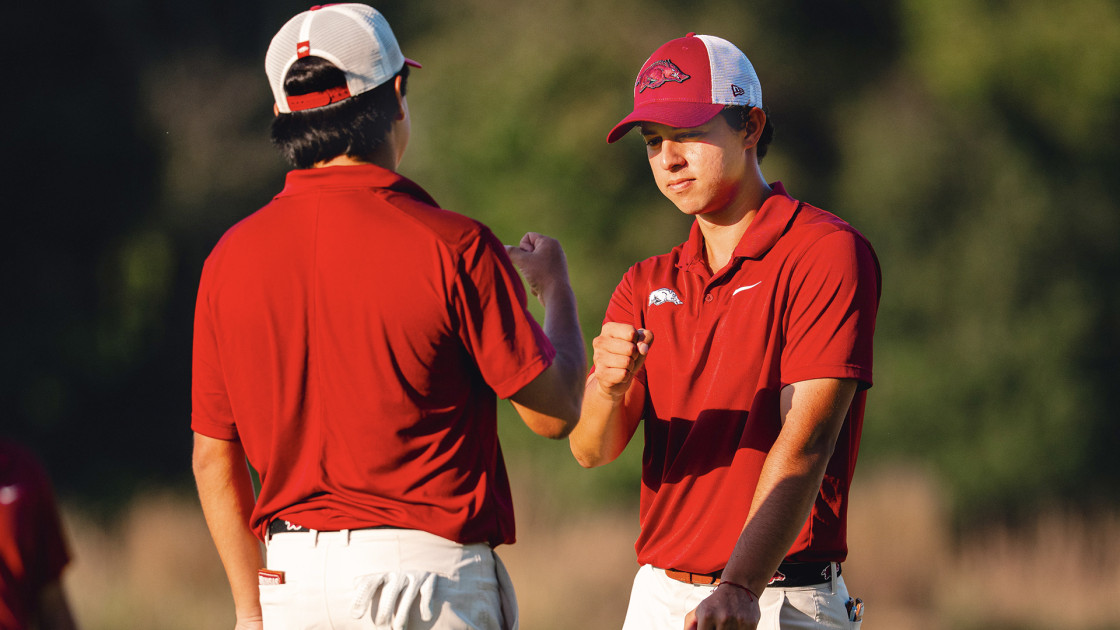
PALM CITY, Fla. – #7 Arkansas sits in fifth place after two rounds Monday in the stacked 16-team Valspar Collegiate Invitational with a 36-hole, 18-under-par score of 550 (270-280), played at the Floridian National Golf Club (par 71).
Top-ranked Auburn leads the way at 538 (-30), followed by #10 Texas Tech (-28), #6 Texas (-20), #30 Florida State (-19) and Arkansas.
Of the 10 rounds played by the Razorbacks on Monday, eight were under par.
Erich Fortlage and Gerardo Gomez are tied for 10th at -6 (136).
Fortlage shot a career-best, bogey-free 65 (-6) in the morning sessions, posting three birdies on each nine, and he was in second place. Fortlage had an even-par round in the afternoon session with three birdies, a bogey and a double.
Gomez had four birdies and a bogey for an opening-round 67, matching his best total for 18 holes for the third time this season. In round two, Gomez turned in a 3-under 69 and moved up two spots into a nine-way tie for 10th.
John Daly II offset a double bogey on the par-5 7th with an eagle on the par-5 15th to finish with a 68 after 18 holes. In round two, Daly was 1-under and is tied for 25th (138 / -4).
Niilo Maki-Petaja carded two rounds of 70 and is tied for 38th (140) while Thomas Curry is tied for 54th (143) with rounds of 70-73.
The Valspar concludes with 18 holes on Tuesday.
VALSPAR COLLEGIATE INVITATIONAL
Host: Houston
Floridian National Golf Club
Palm City, Fla.
Par: 71 • 7,088 yards
Format: 5 count 4 ||36 holes Monday / 18 Holes Tuesday
RESULTS THRU RD2:
1 #1 Auburn 264-274=538 / -30
2 #10 Texas Tech 273-267=540 / -28
3 #6 Texas 268-280=548 / -20
4 #30 Florida State 269-280=550 / -19
5 #7 Arkansas 270-280=550 / -18
6 Houston 271-282=553 / -15
7 #23 Duke 280-274=554 / -14
T8 #14 Oklahoma 274-282=556 / -12
T8 #32 Texas A&M 277-279=556 / -12
10 #24 Southern Cal 277-281=558 / -10
T11 #13 Pepperdine 279-281=560 / -8
T11 #29 Wake Forest 286-274=560 / -8
13 #8 Arizona State 278-283=561 / -7
14 #17 North Carolina 282-280=562 / -6
15 Rice 282-291=571 / +5
16 Augusta 286-294=580 / +12
For more information on Arkansas Men’s Golf, X and Instagram.

The Sweet 16 matchup between No. 1 Arizona and No. 4 Arkansas is set for Thursday at 6:45 p.m. MST in San Jose.
The game will be televised on CBS during the first day of NCAA Tournament regional semifinal play.
The most recent Arizona-Arkansas meeting occurred in 1995, making this a rare date. For what it’s worth, Arkansas leads the all-time series 6-2 and five of the eight matchups took place in the 1990s.
The other Sweet 16 contest in the West Region will see No. 2 Purdue take on No. 11 Texas, which was a First Four winner. That game will tip at 4:10 p.m. Thursday, also on CBS.
Arizona last qualified for the Elite 8 in the 2014-15 season under the leadership of Sean Miller, who has the chance to face his former school as the head coach of Texas.
Arizona defeated the No. 9 Utah State Aggies in the Round of 32 Sunday, 78-66. Brayden Burries and Koa Peat were the catalysts in holding off the Aggies, despite battling foul trouble as they finished with 16 and 14 points, respectively.
Arkansas punched its ticket into the third round of the national tournament by holding off No. 12 High Point, 94-88, on Saturday. The Razorbacks needed 36 points and eight assists from SEC Player of the Year Darius Acuff Jr. and a couple of late missed 3s from the Panthers’ sharpshooting Chase Johnston to emerge victorious.
The John Calipari-led Razorbacks easily defeated No. 13 Hawaii in the Round of 64.
Tommy Lloyd has not coached the Wildcats past the Sweet 16 in four previous NCAA Tournaments, losing each of his three times in the round (2022, 2024, 2025). His team is poised to do so as a unanimous No. 1 in The Associated Press’ Top 25 rankings this season and with a 16-2 record against Quad 1 programs.
Arkansas ended as SEC Tournament champion, defeating Vanderbilt for its first title in 26 years. It finished tied for second with Alabama in the SEC regular-season standings. The Razorbacks, through conference tournament play, were No. 15 in the NCAA net rankings with an 8-8 Quad 1 record and perfect 18-0 mark against Quads 2-4.
Calipari, who is in his second season at Arkansas, led the Razorbacks to the Sweet 16 last season, where they narrowly lost to Texas Tech.
Arkansas most recently made the Elite 8 in 2022, which was its second of two consecutive trips.
Each basketball program possesses a national championship, the Wildcats being victors in 1997 and the Razorbacks in 1994.


TORUŃ, POLAND – Arkansas alums collected six medals on the final day of the World Indoor Championships, four medals in the 4 x 400m relay along with individual medals in the 1,500m and pole vault.
Rosey Effiong and Paris Peoples ran the second and third legs of the United States 4 x 400m relay that won the race in 3:25.81. It’s the sixth time for the Americans to claim World Indoor gold in the event.
Bailey Lear ran the opening leg in 51.47. Effiong split 50.83 as she moved USA from third to first on her carry. Peoples maintained the lead with a 52.02 carry. Then Shamier Little closed out the victory with a 51.49 anchor leg.
Finishing behind the Americans were the Netherlands (3:26.00) and Spain (3:26.04) with host Poland (3:26.17) fourth.
Arkansas’ winning time of 3:23.63 to win the NCAA Indoor title a week ago remains the world-leading time for 2026 and would better the World Indoor meet record of 3:23.85 set by USA in 2018.
Effiong produced the second fastest split in the final as her 50.83 only trailed the anchor leg of 50.10 generated by Great Britain’s Keely Hodgkinson, who won the 800m in a championship record of 1:55.30 on the same day. The British placed fifth in 3:28.09.
In the men’s 4 x 400m relay, the United States broke the championship record with a 3:01.52 victory. That bettered the previous mark of 3:01.77 set by Poland in 2018. It’s the 12th World Indoor relay title for the American men.
TJ Tomlyanovich ran the anchor leg for USA during the prelims, splitting 45.98 as the Americans ran 3:04.85 for third place in their heat, advancing to the final on time.
Tyrice Taylor ran third leg for Jamaica in the final, splitting 46.11 as they earned a bronze medal with a time of 3:05.99. In the prelims, Taylor ran second leg (46.14) as the Jamaicans advanced on time with a 3:05.68.
For the second consecutive World Indoor Championships, Tina Šutej earned a silver medals in the pole vault. She cleared 15-9 (4.80) to equal her season’s best and placed second to a 15-11 (4.85) clearance by Molly Caudrey of Great Britain. Three vaulters tied for bronze at 15-5 (4.70).
“Gosh, it’s my fourth medal from World Championships but I still have not got the gold one,” stated the 37-year-old Šutej, who collected indoor bronze in 2022 and outdoor bronze in 2025. “Today, I was so close to upgrading my collection. All season I have had jumps and great feelings. I came to Toruń like a leader but something went wrong at 4.85m. Maybe we had been waiting too long but something was broken. The longer the competition goes, the more troubles I have.
“It’s not easy for me to compete with girls who are younger 10 or 15 years than me but I’m proud I’m still very competitive. Let’s see what happens in the summer. Everyone says about my age. I know that I’m the oldest in the field but I feel good, I jump high and I’m going to continue at this level as long as I enjoy the competitions. I want to keep going and get my mark closer to five meters.”
Nikki Hiltz set a career best of 3:59.68 in finishing with a bronze medal in the 1,500m. The time ranks No. 3 on the U.S. all-time list. The previous best by Hiltz in the 1,500m was 4:02.32 to claim silver at the 2024 World Indoor.
Georgia Hunter Bell established a world-leading time of 3:58.53 for the victory while Australia’s Jessica Hull produced an Area record of 3:59.45 as the runner-up. Agathe Guillemot of France (3:59.71) was edged out of a medal by Hiltz in the final step to the finish line.
“It was fast,” noted Hiltz, who moved from fifth to third over the final lap (29.96 seconds). “I’ve been in a lot of tactical races this season and never broken four minutes so this was different for me. Sometimes you just have to trust your instincts. I think I was in fourth place until the very last step. It just shows you always have to run to the line. You never know what can happen.”
Representing Jamaica in the long jump, Nia Robinson placed fifth with a mark of 22-1.75 (6.75), which left her two inches from the bronze medal distance. It’s the highest finish for an Arkansas alum in the women’s long jump at a World Championship meet. Robinson improved her career best to 22-4.5 (6.82) this indoor season.
In the men’s long jump, Carey McLeod placed ninth with a leap of 26-2.25 (7.98) and was the second Jamaican in the field behind Tajay Gayle, who placed seventh at 26-7.75 (8.12).

Video: Passenger Jet and Fire Truck Crash at LaGuardia Airport, Leaving 2 Dead

Here’s what Metro Detroit homebuyers face heading into spring season

Preparations for SMART expansion to Healdsburg set to begin

Construction underway on Harold Simmons Park’s first attraction

‘Confident’ Bencic takes out Anisimova, eyes Gauff next in Miami

Florida High School Football Rankings: Top 25 teams – Oct. 21

How old is Bo Nix? What to know about Oregon quarterback ahead of 2024 NFL Draft

Cleary's 21 help Le Moyne down Central Connecticut State 69-64 in OT

99th annual Pony Swim held in Virginia

Indiana Members Credit Union announced as new anchor tenant at Bottleworks District

See TSA Wait Times at Major U.S. Airports

Senate hopeful with deep Dem ties slapped with scathing complaint targeting alleged family payout ‘scheme’

How the Iran war is about to hit your wallet

Suspect in slaying of Loyola University student was in the country illegally, officials say

Video: Plane Collides With Vehicle at LaGuardia Airport
-

 Detroit, MI5 days ago
Drummer Brian Pastoria, longtime Detroit music advocate, dies at 68
-

 Oklahoma1 week ago
Family rallies around Oklahoma father after head-on crash
-

 Georgia1 week ago
How ICE plans for a detention warehouse pushed a Georgia town to fight back | CNN Politics
-
 Science1 week ago
Federal EPA moves to roll back recent limits on ethylene oxide, a carcinogen
-

 Alaska1 week ago
Police looking for man considered ‘armed and dangerous’
-

 Movie Reviews5 days ago
‘Youth’ Twitter review: Ken Karunaas impresses audiences; Suraj Venjaramoodu adds charm; music wins praise | – The Times of India
-
 Science1 week ago
Long COVID leaves thousands of L.A. county residents sick, broke and ignored
-

 Education1 week ago
Video: Turning Point USA Clubs Expand to High Schools Across America