Alabama
James Spann: Warm weekend ahead for Alabama; cooler air arrives Tuesday – Alabama News Center


RADAR CHECK: Light rain is fairly widespread across southwest Alabama this afternoon; showers are widely spaced over the northern half of the state. Temperatures are in the 70s over south Alabama with clouds and rain. The northern counties, where the sun is out in spots, are in the low to mid 80s. Showers will fade quickly after dark, and the sky becomes mostly fair tonight with a low in the 60s.THE ALABAMA WEEKEND: Highs remain in the 80s Saturday and Sunday with a partly to mostly sunny sky both days. We will keep some risk of showers in the forecast for far southern Alabama, but nothing too widespread or heavy.
COOL CHANGE: While Monday will be another warm day, a dry cold front will bring a cool change to the Deep South beginning Tuesday. Highs drop into the 70s over north and central Alabama, with lows in the 50s. The high will be close to 80 over south Alabama, and the week will be dry with sunny days and fair nights. We see no significant rain for Alabama for the next 10-15 days. This is common for October, the driest month of the year here based on climatology.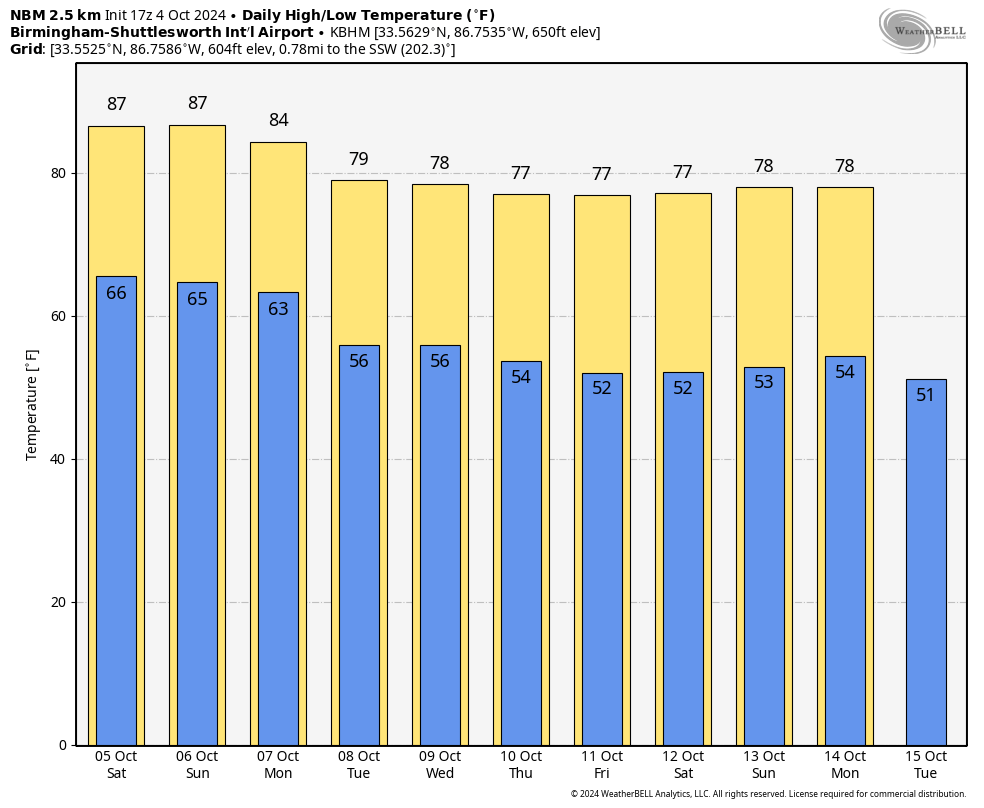 TROPICS: Kirk remains a major hurricane with winds of 140 mph, but it is in the middle of the Atlantic, far from land. It turns north, then northeast well east of the U.S. Behind Kirk is Tropical Storm Leslie with winds of 65 mph. It should become a hurricane over the next 24 hours, but, like Kirk, it will remain far from land.
A trough of low pressure over the western Gulf of Mexico is producing widespread showers and thunderstorms. A broad area of low pressure is expected to develop from this system over the southwestern or south-central Gulf of Mexico during the next day or two, and additional subsequent development is possible while the low moves slowly eastward or northeastward. A tropical or subtropical depression or storm could form during the early to middle part of next week if the low remains separate from a frontal boundary that is forecast to extend across the Gulf of Mexico.
Regardless of tropical or subtropical development, locally heavy rains could occur over portions of Mexico during the next few days and over portions of the Florida Peninsula late this weekend into next week. The latest global models move the tropical low into south Florida Wednesday.
The National Hurricane Center gives this feature a 50% chance of development. We see no risk of a tropical storm or hurricane for the central Gulf Coast (Gulf Shores to Panama City Beach) for at least the next seven days.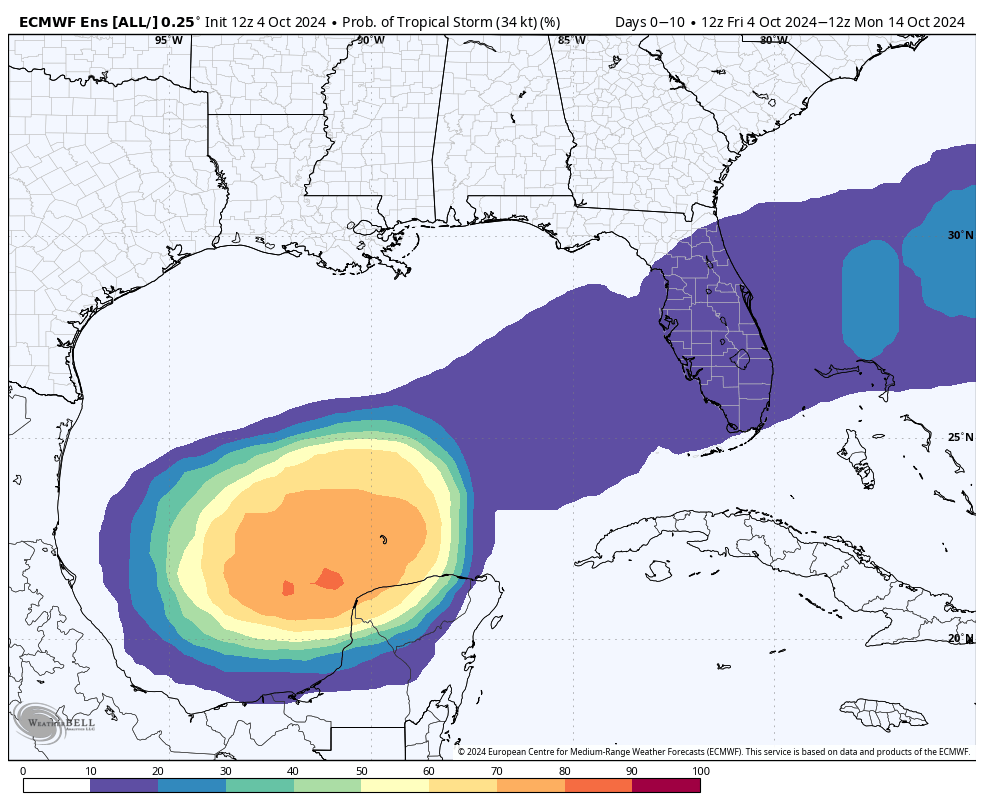 FOOTBALL WEATHER: There’s just a small risk of a shower during the first quarter for the high school games tonight. Otherwise, it will be mostly fair and pleasant; temperatures will fall through the 70s.
Saturday, UAB will host Tulane at Protective Stadium in downtown Birmingham (noon kickoff). The sky will be mostly sunny with temperatures in the low to mid 80s.
Auburn will be on the road at Georgia (2:30 p.m. CT kickoff). The sky will be sunny with temperatures in the low 80s through most of the game.
Alabama travels to Nashville to take on Vanderbilt (3:15 p.m. CT kickoff). Expect a sunny sky with temperatures falling from near 85 degrees at kickoff to near 80 by the final whistle.
RACE WEEKEND: There’s just an outside risk of a shower today at Talladega; otherwise, it will be warm and dry through the weekend with highs in the mid 80s. Lows will be in the 60s.
ON THIS DATE IN 1995: Opal made landfall at Pensacola Beach as a Category 3 hurricane with top sustained winds of 115 mph. Opal at that time was the first major hurricane to strike the Florida Panhandle since Eloise in 1975.
Opal’s legacy will always be the devastating storm surge that occurred across the coastal areas of the western Florida Panhandle. Storm surge of 10-15 feet was recorded from Navarre Beach east to Destin, with 6-8 feet observed in the inland bays from Pensacola to Choctawhatchee Bay. Opal destroyed most of the homes that were facing the Gulf of Mexico from Navarre Beach to east of Destin.
Opal was a high-impact event for most of inland Alabama. Rainfall measured at the Birmingham Airport reached 6.94 inches for the day, with major flooding in parts of the city. There were two storm-related deaths in Gadsden, in Etowah County, when high wind toppled a massive oak tree onto their mobile home.
For more weather news and information from James Spann and his team, visit AlabamaWx.



Alabama
Small Plane Makes Emergency Landing In Peanut Field Near Florida-Alabama Line : NorthEscambia.com

A single-engine plane made an emergency landing in an Alabama peanut field near the Florida state line on Friday afternoon.
The pilot and a student made the landing in the field after experiencing engine trouble, approximately 0.7 miles south-southwest of the runway at the Atmore Municipal Airport. There were no injuries.
The 2023 Diamond DA 40 NG plane belonging to Skywarrior Flight Training of Pensacola did not sustain any apparent damage.
For more photos, click here.
The incident occurred just north of Old Bratt Road, which is also known as State Line Road in Florida. The Florida-Alabama state line is generally considered to be along the middle of the roadway.
NorthEscambia.com photos, click to enlarge.


The 2026 Major League Baseball Draft begins Saturday, and Alabama Crimson Tide shortstop Justin Lebron has consistently been touted as one of the first 10-20 overall picks among analysts’ various mock drafts.
On Friday, CBS Sports released its final mock ahead of this weekend’s festivities in Philadelphia. Analyst Mike Axisa sees Lebron going to the Texas Rangers with the 16th overall selection.
Among college players, Lebron lands between Arkansas catcher Ryder Helfrick at No. 14 and one spot above Texas A&M second baseman Chris Hacopian in CBS Sports’ final analysis.
Axisa said of the possible Rangers-Lebron fit:
“The Rangers have a thing for ‘famous’ prospects in the draft (think Jack Leiter and Kumar Rocker), and Lebron is one of the most famous prospects available this summer. About 18 months ago, he was the favorite to go No. 1 overall, but some uneven performances (and Cholowsky’s breakout) cooled that talk. Lebron has some of the loudest tools in the draft class. We’re talking speed, power, athleticism, the works. Approach and plate discipline concerns have held him back, though.”
ESPN sees Alabama’s Justin Lebron among top 12 MLB draft picks
In the final MLB mock draft by ESPN’s Kiley McDaniel on Friday, Lebron goes 12th overall to the Los Angeles Angels. LSU outfielder Derek Curiel is taken one pick above Lebron by the Washington Nationals in McDaniel’s draft forecast.
“With a new interim head of baseball operations in John Mozeliak, who is mostly hands-off with the draft, the belief is that the scouts will get to make this pick. That doesn’t mean all prep upside because that’s not really what the board is giving them, but I could see the Angels selecting a college hitter with less polish and more upside, such as Lebron, who is a nice value here.” –Kiley McDaniel, ESPN.com.
Could Justin Lebron be a top-10 pick in 2026 MLB draft?
For The Win, part of the USA TODAY Sports Media Group, unveiled its 2026 mock draft on Friday. Wajih AlBaroudi has Lebron going as high as No. 8 overall to the Athletics and said:
“Lebron is a dynamic athlete whose only glaring flaw is his patience at the plate. If he can clean that up, he’ll be a fixture atop the A’s lineup.”
Keith Law’s final mock draft for The Athletic (subscription required for full access) has Lebron taken with the 15th overall pick by the Arizona Diamondbacks.
Justin Lebron career stats at Alabama
Lebron batted .313 with a .414 on base percentage, 45 home runs, 39 doubles and 158 RBIs in three seasons for the Crimson Tide. He stole 69 bases in his collegiate career. This past season, Lebron hit .277 with 16 homers and 13 doubles as Alabama won 42 games and reached the College World Series for the first time since 1999.
Where to watch the 2026 MLB draft: time, TV channel, streaming
The 2026 Major League Baseball Draft begins Saturday in Philadelphia. Per Major League Baseball, rounds 1-4 start at noon CT. The first 10 picks will be televised on NBC and will stream on Peacock. Picks 11-40 can be seen on MLB Network beginning at 1:30 p.m. Saturday.
Rounds 5-20 begin Sunday at 10:30 a.m. CT and can be seen on MLB.com.
Follow us at @RollTideWire on X, and like our page on Facebook, for ongoing coverage of Alabama Crimson Tide news, notes and opinions.
Alabama
University of Alabama police officer's family leans on law enforcement community after his death

-

 New York22 minutes ago
How ‘The Wire’ Star Jamie Hector Spends a Hot Day in Brooklyn
-

 Los Angeles, Ca25 minutes ago
Burglars ransack Sherman Oaks condo building during fumigation
-

 Detroit, MI45 minutes ago
Metro Detroit weather forecast, July 10, 2026 — 11 p.m. Update
-

 San Francisco, CA55 minutes ago
Classical music series helps reconnect downtown San Francisco community
-

 Dallas, TX60 minutes ago
Dallas police officers, paramedics recall saving woman stuck in a ravine for days;
-

 Boston, MA1 hour ago
Red Sox win 7th straight game just hours after landing in New York
-
 Denver, CO1 hour ago
One tree at a time: Denver nonprofit works to close shade gap as heat dome threatens neighborhoods
-

 Seattle, WA1 hour ago
VIDEO: West Seattle Summer Fest 2026 day 1, evening report

