Science
Trump's pick for surgeon general quit medical residency due to stress, former department chair says

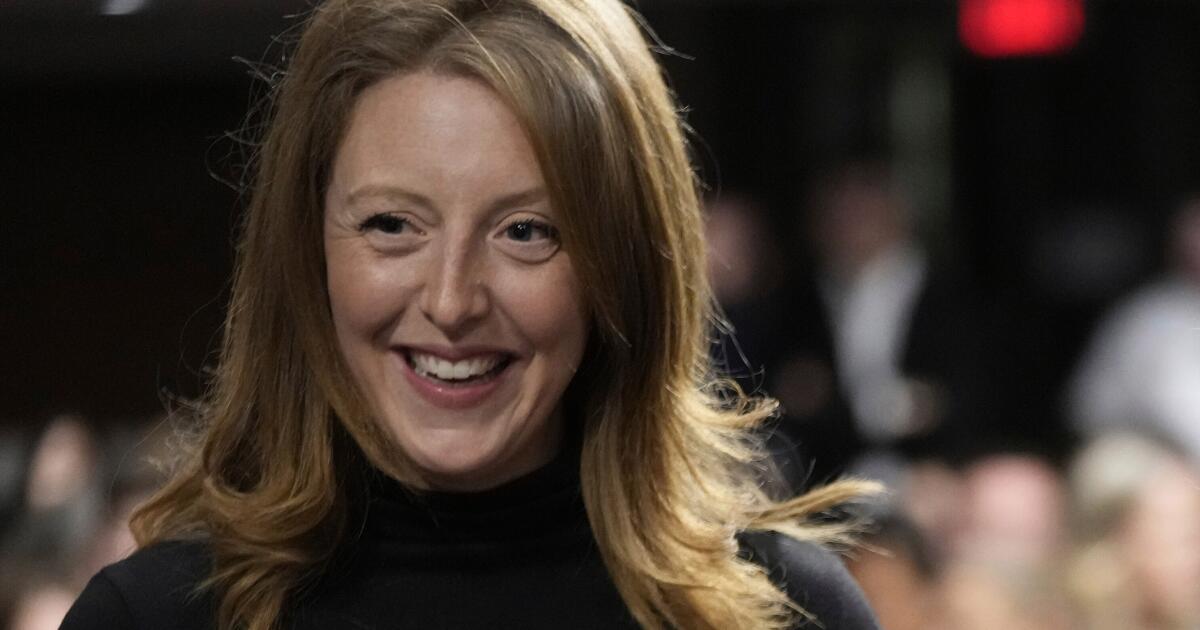
President Trump’s choice of Dr. Casey Means, a Los Angeles holistic medicine doctor and wellness influencer, as his nominee for surgeon general appears to mark another attempt to defy establishment medicine and longstanding federal policy.
Trump portrayed Means — a 37-year-old Stanford medical school graduate and author who describes herself on LinkedIn as a “former surgeon turned metabolic health evangelist” — in his announcement as fully in sync with Robert F. Kennedy Jr.’s mission to “Make America Healthy Again.”
“Casey has impeccable ‘MAHA’ credentials, and will work closely with our wonderful Secretary of Health and Human Services, Robert F. Kennedy, Jr., to ensure a successful implementation of our Agenda in order to reverse the Chronic Disease Epidemic, and ensure Great Health, in the future, for ALL Americans,” Trump said in a statement on Truth Social.
Some have raised questions about Means’ credentials. Although she graduated from medical school, she is not an active doctor licensed to practice medicine.
After graduating from Stanford, Means was nearly 4½ years into a five-year physician residency to be a head and neck surgeon at Oregon Health & Science University when she dropped out.
“During my training as a surgeon, I saw how broken and exploitative the healthcare system is and left to focus on how to keep people out of the operating room,” she says on her website.
Dr. Paul Flint, a former chair of Otolaryngology/Head and Neck Surgery at Oregon Health and Science University, said Means resigned from the residency because of anxiety.
After four years of training, Means came to him and Dr. Mark Wax, the residency program director, and said she wasn’t sure it was the right job for her.
“She wasn’t even sure she wanted to be in medicine,” Flint said. “She wanted to do something different. She wanted to resign.”
Flint and Wax urged Means to think about it more and offered her three months paid time off.
“She was under so much stress,” he said. “She did that, came back and decided she wanted to leave the program. She did not like that level of stress.”
Flint said Means was competent, a good resident. “But there was a lot of anxiety around this,” he said of the role of the surgeon. “You become much more responsible the more senior you get.”
Did he think Means would make an effective surgeon general?
“I don’t know,” Flint said. “Time will tell.”
According to public records from the Oregon Medical Board, Means’ medical postgraduate license was granted in 2014 and shifted to inactive status in 2019.
Some who know Means question whether she is completely aligned with Kennedy.
Robert Lustig, professor emeritus of pediatrics in the division of endocrinology at UC San Francisco, who is a friend of Means, told The Times he was shocked and surprised.
“What’s surprising to me is that she wanted the job, because she had difficulties adopting RFK’s full portfolio,” Lustig said, citing Kennedy’s controversial pronouncements on vaccines and fluoride in public water supplies. “She didn’t want to be part of the administration, in part because she couldn’t accede to those views. So what has changed is not clear.”
Means did not respond to requests for comment. Still, she attended a January confirmation hearing at the U.S. Capitol for Kennedy and celebrated in February when he was sworn in, saying on an X post that “his vision of the future aligns with what I want for my family, future children, and the world.”
Over the last year, she has raised public concerns about some vaccines. In August, she spoke out on X against CDC guidelines that all infants should receive a dose of hepatitis B vaccine at birth.
“There is growing evidence that the total burden of the current extreme and growing vaccine schedule is causing health declines in vulnerable children,” she wrote in an October newsletter, linking to a blog about vaccines and autism. “This needs to be investigated.”
“I have said innumerable times publicly I think vaccine mandates are criminal,” she said on X in November.
But when Lustig spoke to Means four weeks ago, he told The Times, Means had left her home in Pacific Palisades, worried about toxic air and water after the L.A.-area wildfires, and had moved to Hawaii. He said she wanted to start a family and did not express interest in working with Kennedy at the time.
“I know that her views are not his — that’s why she didn’t accept it earlier,” Lustig said. “If you’re an employee, you have to take the whole portfolio. You don’t get to choose parts of it, and she was uncomfortable.”
The president announced Means as his pick a day before his initial choice for the position, New York family physician and Fox News contributor Janette Nesheiwat, was scheduled to have a hearing with senators Thursday.
Trump has yet to explain why Nesheiwat was replaced as his nominee, but he said she would work at the Department of Health and Human Services in “another capacity.”
Asked by a reporter Thursday why he picked a nominee for surgeon general who never finished her residency and is not a practicing physician, Trump said: “Because Bobby thought she was fantastic. She’s a brilliant woman who went through Stanford. … I don’t know her.”
The U.S. surgeon general is known as “the nation’s doctor.” According to the Department of Health and Human Services, the role is to provide Americans with “the best advice on how to improve their health, by issuing advisories, reports and calls to action to offer the best available scientific information on crucial issues.”
Lustig said he had no doubt Means — whom he got to know by advising Levels Health, a digital metabolic health company she co-founded — would bring a different perspective to the U.S. government.
“Here’s the problem: We have an epidemic of chronic disease and there are no medicines that fix any of these diseases,” Lustig said. “They’re not fixable by drugs. They’re fixable by food. And the reason is because all of these diseases are mitochondrial diseases, and we don’t have drugs that get to the mitochondria.
“We have to change the food supply,” he added. “There is no option. Casey knows that. So as surgeon general, she would be able to make that case.”
In that sense, Lustig agreed with Trump, who said, “Dr. Casey Means has the potential to be one of the finest Surgeon Generals in United States History.”
“I think she’s a terrific person,” Lustig said. “She will bring a very different mindset to the office.”
But Lustig said he believed Kennedy was flat-out wrong on vaccines.
“I know why he’s wrong on vaccines,” he said. “I understand where his brain is, because I got a half-hour with him on the phone, one on one. But I cannot alter my integrity to match that — and I thought that Casey couldn’t either.”
Means is an unorthodox pick for a president famed for his diet of Big Macs and Diet Cokes.
Her website features pictures of broccoli and almonds. Her Instagram page shows bright bowls of tofu scrambles with heirloom tomatoes, avocado and beet sauerkraut.
Her newsletter recounts how, at the age of 35, after she moved to L.A., she embraced the “woo woo (aka, the mystery),” set up a meditation shrine in her home and sought relationship advice from trees.
Means was raised in Washington, D.C., the daughter of mildly religious, Republican parents. Her Californian-born father, Grady Means, a retired American business executive and government official, served in the White House as assistant to Vice President Nelson Rockefeller, led the Food and Nutrition Task Force to reform the food stamp program and provided oversight to the National Health Insurance Experiment.
Casey Means earned a bachelor’s degree in human biology with honors at Stanford and went on to graduate with a doctor of medicine degree in 2014. But Lustig said she dropped out of her residency in Oregon, disillusioned.
“The reason she quit was because she saw that the same patients were coming back with the same problems, and her mentors, the faculty at Stanford, when she would ask, ‘Why is this happening?’ would say, ‘Shut up and operate,’” Lustig said.
“She had a crisis of confidence that she was actually not helping the problem, or was actually part of the system that was actually making the problems.”
But that’s not how some people who knew Means when she was a resident surgeon in Oregon remember it.
“She didn’t mention metabolic health, she didn’t mention any of that,” said one person with whom she discussed her work regularly at that time and who declined to be named for fear of retaliation. “She was scared of accidentally hurting someone in surgery. She just didn’t want to mess up. She genuinely cared about her patients — she wanted them to be healthy and well — and I think her heart in that is genuine. But she was not talking about what she’s talking about now.”
Means’ recent rhetoric about the medical profession, they said, was disappointing.
“She’s claiming doctors are just trying to cut and make money, but she’s making money too,” they said. “Surgeons, they’re trained to be the last resort and actually help with solving after something’s gone wrong. If she wanted to help preventatively, she was in the wrong field, so I’m glad she went elsewhere. … But to be upset with a system that is trying to help when it does get down the line is very strange.”
In 2019, Means co-founded Levels Health, which works to “empower individuals to radically optimize their health and well-being by providing real-time continuous glucose biofeedback.”
Two years later, her break with establishment medicine became more intense — and more personal — when her mother was diagnosed with Stage 4 pancreatic cancer.
“What put her over the edge was when her mother passed away of pancreatic cancer, and it was missed,” Lustig said. “She had all the symptoms and signs of metabolic syndrome in her and none of her doctors addressed any of them.”
Means served as Levels Health’s chief medical officer until last year, when she and her brother, Calley, published a 400-page diet and self-help book titled “Good Energy: The Surprising Connection Between Metabolism and Limitless Health.”
In August, she catapulted to mainstream fame — particularly on the right — when Tucker Carlson featured her and her brother on his podcast for a show titled “How Big Pharma Keeps You Sick, and the Dark Truth About Ozempic and the Pill.”
“The system is rigged against the American patient to create diseases and then profit off of them,” Means told Carlson.
Over the last few months, Means and her brother, who now serves as a White House health advisor, made public appearances at “Make America Healthy Again” events.
In September, she addressed a U.S. Senate roundtable on chronic disease, listing all the things she didn’t learn in medical school: “For each additional serving of ultra-processed food we eat,” she said, “early mortality increases by 18%.”
Critics were quick to take to X to mock her statistics.
“I’ve easily had 1000 bags of chips in my life,” said Brad Stulberg, adjunct clinical assistant professor of health management and policy at the University of Michigan’s School of Health. “If this is true, it means my mortality risk has increased by 18,000 percent. That seems unlikely.”


new video loaded: NASA Announces Artemis III Crew
transcript
transcript
NASA Announces Artemis III Crew
NASA announced the crew of Artemis III mission, which will fly to low-Earth orbit to test rendezvous and docking maneuvers with one or two lunar landers.
-
“I am excited to welcome you as the next crew in the Artemis journey to successfully return to the moon — this time to stay.” “I’m honored by the role that I’ve been given. I’m also very humbled by the task in front of us. But first and foremost, I’m grateful.” “So with that, the Artemis II crew, comrade, hands you the baton. You got the controls.” “As you know, we had a significant anomaly at our Launch Complex 36A on May 28. We’ve redoubled our efforts and are moving forward.”
By Alisa Shodiyev Kaff
June 9, 2026
Science
Santa Monica Mountains’ last steelhead trout survived the Palisades fire — and even had babies

Scientists feared the Santa Monica Mountains’ last remaining steelhead trout were dead, smothered by debris flows unleashed by the Palisades fire.
But the endangered fish surprised them: A team of biologists recently spotted 30 of the rare trout — and 21 babies — in Topanga Creek.
“There was a lot of happy dancing in the creek,” said Rosi Dagit, principal conservation biologist for the Resource Conservation District of the Santa Monica Mountains, which works with public and private landowners to conserve natural resources.
That’s because the steelhead here are endangered, at both the state and federal levels. Once, they swam in most streams of the Santa Monicas, but their numbers plummeted amid overfishing and coastal development. Increasingly frequent wildfire has further stressed their habitat. Topanga Creek, a biodiversity hot spot, is home to their last known population in the mountains that stretch from the Hollywood Hills to Point Mugu in Ventura County.
The trout that were spotted, including this one, are part of a distinct Southern California population that’s listed as endangered at the state and federal levels.
(RCDSMM Stream Team)
The California Department of Fish and Wildlife spearheaded a complex mission to rescue trout threatened by the Palisades fire that sparked in January 2025.
Time was of the essence. The fire hadn’t yet been fully contained. But rain was on the way, which would sweep massive amounts of sediment from the denuded hillsides into the water. Fish are often killed this way.
Crews stunned the fish with electricity, scooped them up in buckets, trucked them to a hatchery and ultimately moved them to Arroyo Hondo Creek in Santa Barbara County.
Within days, Topanga Creek was choked with mud. Some assumed the fish left behind were goners.
But in March, the conservation district’s team found four. The following month, when water conditions were clearer, they saw more.
“These fish continue to amaze me,” said Kyle Evans, environmental program manager for the state Department of Fish and Wildlife, who had seen the damage to the creek. “I had seen populations get wiped out in similar situations. So when I heard, I was thrilled.”
Evans surmises the fish that survived were in an area of the creek where less charred material and sediment were swept in.
“These fish likely hunkered down, were hiding under some rocks or places to try to get away from the main concentration of flow,” he said. “And luckily they weren’t buried.”
The ones that were spotted were fairly small, around 6 to 14 inches. Rainbow trout and steelhead trout are the same species, but with different lifestyles. If the fish remain in freshwater, they’ll be considered rainbows. However, they can migrate to the ocean and become steelhead, where they typically grow larger before returning to their natal waters to spawn.
Topanga Creek hasn’t fully recovered from the damage it sustained, but scientists say it’s looking better. Surveys last year were “so depressing,” Dagit said, with very few animals, and stretches that were essentially transformed into flat roads from all the sediment buildup. Some of the riparian canopy burned right down to the creek.
Then came 32 inches of rain over the last nine months, scouring out and moving sediment, creating deeper pools. Dagit said they recently found newt egg masses for the first time in years, as well as a few adult newts and many frogs. Plants that provide cover are starting to recover.
She provided photos comparing certain pools last year and this year, some dramatically transformed. In September 2025, the Shrine Pool could have been an overgrown hiking trail. This April, it was filled with shallow water.

The Shrine Pool in September 2025, left, and the same location in April 2026, right, with RCDSMM’s Isaac Yelchin donning a wetsuit.
(RCDSMM Stream Team)
Topanga Creek is home to another endangered fish, the small but hardy northern tidewater goby, often described as cute. Not long before the trout operation, Dagit led a rescue of hundreds of these fish too. Many were repatriated to the lagoon at the mouth of the creek in a moving ceremony last June.
There’s still the matter of what to do with the trout that were moved to Santa Barbara County last year. Evans would like to bring them home to the Santa Monicas at some point, but isn’t sure if it will happen. On one hand, they could bolster the small, genetically isolated surviving population. On the other, they might inadvertently bring in a disease or bacteria. There is some time to decide. Evans estimates the creek still needs to recover for two to three more years.
For now, the fish are functioning fine in their adopted creek. Experts worried the trauma wrought by the move would disrupt their spawning process, but they had babies that spring. This year, they spawned again.

The Pacifica Municipal Pier was shut down and taped off Thursday after city workers noticed cracks running through the landmark structure and concrete chunks falling into the ocean.
It’s just one of many coastal California structures that have recently crumbled under pressure from a rising and relentless ocean.
Officials from the small, beach city south of San Francisco said the pier was closed due to “cracking, separation, and displacement of the concrete walkway and structural elements.”
It will stay closed while structural engineers asses its safety.
Photos taken by city employees show a wide crack that runs from top to bottom and across the structure as well. Other photos show a large horizontal crack under the foundation of a small restaurant on the pier, the Chit Chat Cafe.
The cafe was also shut down.
This is not the first time the 53-year-old pier has shown signs of stress. In 2021, part of it was shut down after handrails along the edge collapsed. And in 2023, after a series of storms pummeled the Central California coast, damaging parts of the pier, the structure was partially closed for more than year.
Those same storms caused extensive damage in Aptos and Capitola, 70 miles south, where piers and waterfront infrastructure were swept away or damaged.
In 2024, a 150- to 180- foot section of the Santa Cruz wharf was ripped off by powerful waves.
At least 10 of the state’s dozens of coastal public piers were closed for part or all of 2024 due to structural damage sustained in winter storms since 2022. At least five others have longer-term upgrades planned to address structural issues.
“These things are costly to maintain,” said Zach Plopper, senior environmental director at Surfrider. “They are a part of our California coastal culture in many ways, but we’re going to need to reckon with, one, the state that they’re in, and two, the continuous and worsening threats they’re going to experience,”
He said most of the piers were constructed in the early 1900s, and they weren’t built to withstand decades of rough seas, storms and rising sea level.
“With this incoming El Niño, which is forecasted to be significant, and this marine heat wave we’re in the midst of, we’re kind of in uncharted waters as far as what this winter could bring in terms of storms and swells to the California coast, and we’re likely going to see a lot more damage,” he said. “Not just piers, but roads and other coastal infrastructure up and down the state.”
There was no storm in Pacifica earlier this week, so no single event could be blamed for the destruction.
However, a 2025 report from an outside engineering firm, GHD, found that several sections of the pier were in “poor” or “serious” condition, and they recommended closure before anticipated storms or events that could “subject the piles to high winds, swells and large waves.”
The firm found several areas of the pier where concrete was missing and rebar was exposed and corroding.
“The pier has continued to experience high winds and large waves in a harsh marine environment,” the engineers wrote in the report, noting that continuous exposure to seawater or marine spray was “detrimental” to the structure.
A 2023 city report estimated it would cost $19 million to repair.
That same year, a state law was enacted to require local governments along the California coast to plan for sea level rise in the coming decades.
Sea level has risen some 8 inches, on average, along the coast in the past 150 years, Plopper said, and researchers anticipate another foot in the next 25 years.
“We’re going to see profound shifts on our coastline, none that we have ever experienced before, and building static structures on the coast just doesn’t work all that well,” he said. “We’re going to have to make some really hard decisions.”
-
 Sports1 minute ago
World Cup referee, denied entry to U.S. because of suspected ties to terrorists, hailed in return to Somalia
-

 World9 minutes ago
US military chief Hegseth warns Cuba against acquiring military arms
-
 News34 minutes ago
July 1 brings big student loan changes. Here’s what you need to know
-

 Los Angeles, Ca2 hours ago
Los Angeles High School locked down as police search for armed juvenile
-

 Detroit, MI2 hours ago
‘Diarra From Detroit’ sets date for second season on Paramount+
-

 San Francisco, CA3 hours ago
San Francisco police release video of shootout that critically wounded officer
-

 Dallas, TX3 hours ago
3 Dallas educators among FIFA World Cup volunteers
-

 Miami, FL3 hours ago
Miami Gardens man arrested after fleeing Florida Keys deputies at 125 mph, sheriff says

