Science
The spinning of Earth's inner core is slowing down. Is this how it all ends?

Geophysicist John Vidale noticed something striking while tracking the way seismic waves move from Earth’s crust through its core.
The very center of the planet, a solid ball of iron and nickel floating in a sea of molten rock, appears to be slowing down in relation to the movement of Earth itself. The inner core has slowed so much that it has essentially kicked into reverse.
The fluctuations happening 3,000 miles underground won’t affect life on the planet’s surface in any noticeable way — at least not for now, USC geophysicist John Vidale said.
(Christina House / Los Angeles Times)
The finding by Vidale and his counterpart Wei Wang of the Chinese Academy of Sciences, published recently in the journal Nature, offers the most convincing evidence yet that the core seems to operate with a mind of its own.
“It might be cycling back and forth but it might also be on a random walk,” Vidale said. “It went one way for a while, then it’s going back the other way. Who knows what it’s going to do next?”
The fluctuations happening 3,000 miles beneath us won’t affect life on the planet’s surface in any noticeable way — at least not for now, Vidale said.
“There’s essentially no effect on people, from what we’ve seen,” said Vidale, who is Dean’s Professor of Earth Sciences at the USC Dornsife College of Letters, Arts and Sciences. “It’s a part of basically understanding the evolution of the planet. What we’d also like to know in more detail is what are the forces that are moving the inner core.”
Scientists first had a hunch that the inner core was moving in the 1990s, he said. It has taken years to back up that theory with hard evidence, mainly because of the difficulty of studying a mass located so far out of reach — and suspended inside a hellish sea of liquid iron that’s between 8,000 and 10,000 degrees.
Instead, Vidale, who was director of the Southern California Earthquake Center at USC from 2017 to 2018, peered into the planet by tracking seismic waves from quakes occurring off the lower tip of South America. As the waves passed through the heart of the planet, they were recorded on 400 seismometers positioned at the other end of the globe in Alaska and Northern Canada. The sensors were the same kind used to measure ground vibrations during nuclear tests.
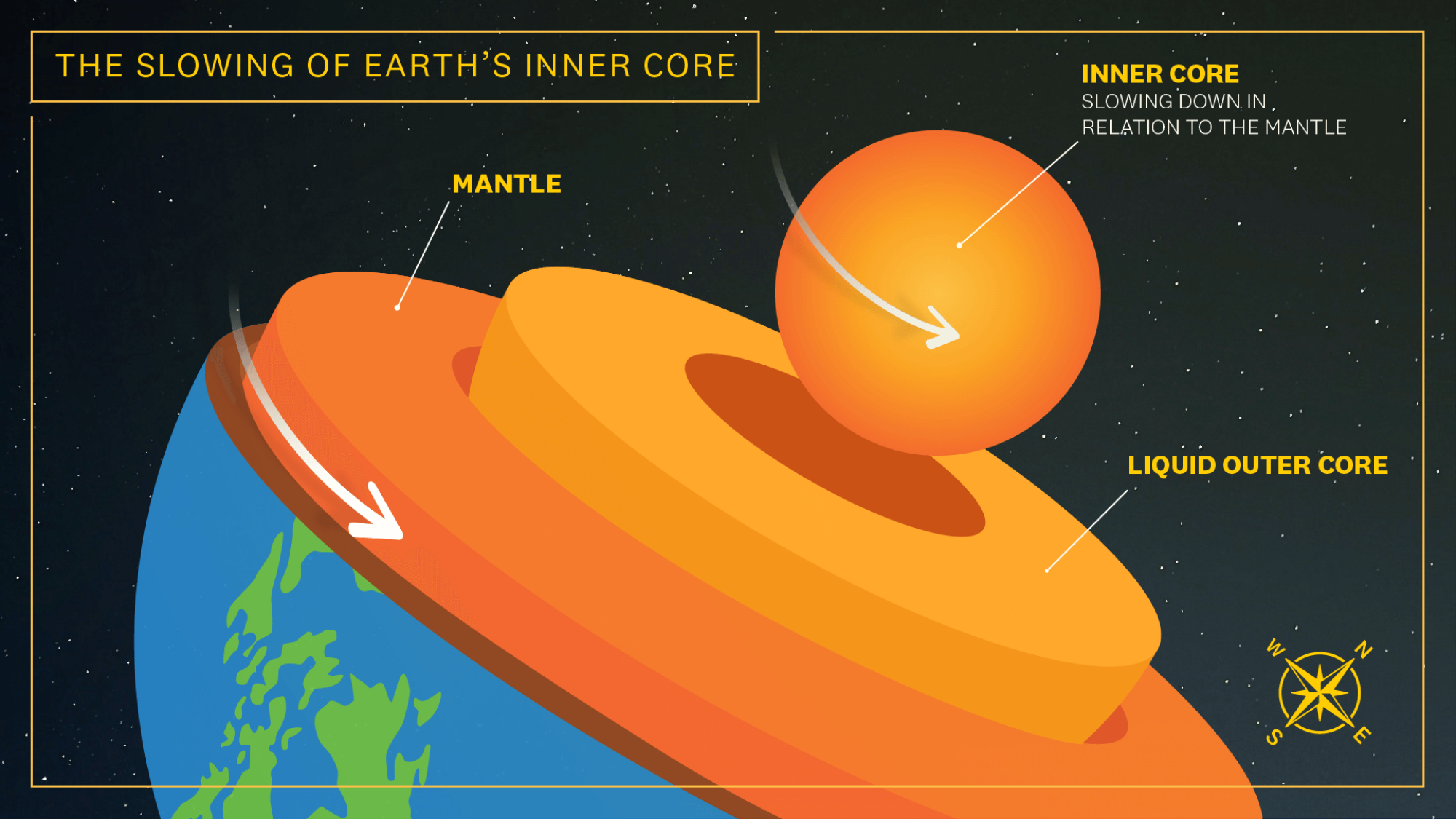
He compared those refined readings to quake signals recorded in past years to see where they matched. That’s how he determined that the rotation has been decreasing since 2010. Prior to that, the core’s spin had been accelerating.
The findings add to the mystique of the most inscrutable part of our world, Vidale said. Literature and lore involving Earth’s core have filled the knowledge void with all sorts of fanciful ideas.
“I’m not such a philosopher but we’ve all had nightmares of what’s going on down in the planet,” Vidale said. “Just a couple hundred years ago, people thought the planet was hollow and that there were people living down there. It’s pretty exotic — exotic like Jupiter, but it’s just right under our feet.”
In Jules Verne’s 1864 science-fiction classic “Journey to the Center of the Earth,” a German professor, his nephew and their guide descend into the planet through a volcano in Iceland — along the way encountering caverns, a subterranean ocean, living dinosaurs, strange sea creatures and even a prehistoric giant herding mastodons — and are finally spat out through a volcano off the coast of Sicily.
The 2003 disaster film “The Core” imagines that the rotation of Earth’s center has stalled, damaging the magnetic field that envelops the planet — and triggering a violent lightning storm that destroys Rome and “invisible microwaves” that melt the Golden Gate Bridge. A hotshot crew of scientists burrows down through Earth’s layers to jump-start the core with a nuclear bomb.
In the real world, no human could survive the unimaginable heat and bone-crushing pressure, even if there were a vehicle capable of tunneling to the core, Vidale said.
It is true that the outer core generates electrical currents that sustain the planet’s magnetic field, but Vidale says shifts in the Texas-size inner core are too minuscule to have an impact.
While the planet’s subterranean reality is less fantastical than novels and Hollywood movies make it out to be, it is still fascinating to those like Vidale whose job is to counter conjecture with facts.
What is increasingly clear is that the inner core is susceptible in different ways to activity in the layers of Earth that encircle it.
“The mechanics are that the outer core is circulating and making a magnetic field, and so it’s kind of pulling the inner core back and forth,” Vidale said.

The latest discoveries about the inner core have fueled vigorous disagreements among the world’s top Earth scientists, USC’s John Vidale says. Some don’t believe the core turns at all.
(Christina House/Los Angeles Times)
Another player in the endless tug-of-war taking place inside the planet is the lower level of the planet’s mantle, whose mix of hard and less-dense matter results in its own peculiar magnetic pull, Vidale said.
“We sort of think the outer core is stirring up the inner core, but the mantle’s trying to keep it aligned — maybe that’s why it’s oscillating,” he said.
The latest discoveries about the inner core have fueled vigorous disagreements among the world’s top Earth scientists and given rise to competing theories of varying credibility, Vidale says. Some don’t believe the core turns at all. Some insist that forces on the surface, such as quakes, briefly alter the rotation.
Over the phone, Vidale reads a review from a scientist in Australia who greeted Vidale’s recent findings with much skepticism. The Australian proclaims that the analysis will lead to “the erosion of seismology as a credible branch of science and the destruction of seismologists as credible researchers.”
“I think he’s just frustrated — he knows he’s lost,” Vidale said, gently ribbing his peer.
“It’s exciting because the core is pretty big, it’s moving by measurable amounts and it’s a mystery,” Vidale said. “We’re making progress and seeing more things, arguing with people around the world and trying to get more data … What our paper’s done is it’s convinced most of the community.”


new video loaded: NASA Announces Artemis III Crew
transcript
transcript
NASA Announces Artemis III Crew
NASA announced the crew of Artemis III mission, which will fly to low-Earth orbit to test rendezvous and docking maneuvers with one or two lunar landers.
-
“I am excited to welcome you as the next crew in the Artemis journey to successfully return to the moon — this time to stay.” “I’m honored by the role that I’ve been given. I’m also very humbled by the task in front of us. But first and foremost, I’m grateful.” “So with that, the Artemis II crew, comrade, hands you the baton. You got the controls.” “As you know, we had a significant anomaly at our Launch Complex 36A on May 28. We’ve redoubled our efforts and are moving forward.”
By Alisa Shodiyev Kaff
June 9, 2026
Science
Santa Monica Mountains’ last steelhead trout survived the Palisades fire — and even had babies

Scientists feared the Santa Monica Mountains’ last remaining steelhead trout were dead, smothered by debris flows unleashed by the Palisades fire.
But the endangered fish surprised them: A team of biologists recently spotted 30 of the rare trout — and 21 babies — in Topanga Creek.
“There was a lot of happy dancing in the creek,” said Rosi Dagit, principal conservation biologist for the Resource Conservation District of the Santa Monica Mountains, which works with public and private landowners to conserve natural resources.
That’s because the steelhead here are endangered, at both the state and federal levels. Once, they swam in most streams of the Santa Monicas, but their numbers plummeted amid overfishing and coastal development. Increasingly frequent wildfire has further stressed their habitat. Topanga Creek, a biodiversity hot spot, is home to their last known population in the mountains that stretch from the Hollywood Hills to Point Mugu in Ventura County.
The trout that were spotted, including this one, are part of a distinct Southern California population that’s listed as endangered at the state and federal levels.
(RCDSMM Stream Team)
The California Department of Fish and Wildlife spearheaded a complex mission to rescue trout threatened by the Palisades fire that sparked in January 2025.
Time was of the essence. The fire hadn’t yet been fully contained. But rain was on the way, which would sweep massive amounts of sediment from the denuded hillsides into the water. Fish are often killed this way.
Crews stunned the fish with electricity, scooped them up in buckets, trucked them to a hatchery and ultimately moved them to Arroyo Hondo Creek in Santa Barbara County.
Within days, Topanga Creek was choked with mud. Some assumed the fish left behind were goners.
But in March, the conservation district’s team found four. The following month, when water conditions were clearer, they saw more.
“These fish continue to amaze me,” said Kyle Evans, environmental program manager for the state Department of Fish and Wildlife, who had seen the damage to the creek. “I had seen populations get wiped out in similar situations. So when I heard, I was thrilled.”
Evans surmises the fish that survived were in an area of the creek where less charred material and sediment were swept in.
“These fish likely hunkered down, were hiding under some rocks or places to try to get away from the main concentration of flow,” he said. “And luckily they weren’t buried.”
The ones that were spotted were fairly small, around 6 to 14 inches. Rainbow trout and steelhead trout are the same species, but with different lifestyles. If the fish remain in freshwater, they’ll be considered rainbows. However, they can migrate to the ocean and become steelhead, where they typically grow larger before returning to their natal waters to spawn.
Topanga Creek hasn’t fully recovered from the damage it sustained, but scientists say it’s looking better. Surveys last year were “so depressing,” Dagit said, with very few animals, and stretches that were essentially transformed into flat roads from all the sediment buildup. Some of the riparian canopy burned right down to the creek.
Then came 32 inches of rain over the last nine months, scouring out and moving sediment, creating deeper pools. Dagit said they recently found newt egg masses for the first time in years, as well as a few adult newts and many frogs. Plants that provide cover are starting to recover.
She provided photos comparing certain pools last year and this year, some dramatically transformed. In September 2025, the Shrine Pool could have been an overgrown hiking trail. This April, it was filled with shallow water.

The Shrine Pool in September 2025, left, and the same location in April 2026, right, with RCDSMM’s Isaac Yelchin donning a wetsuit.
(RCDSMM Stream Team)
Topanga Creek is home to another endangered fish, the small but hardy northern tidewater goby, often described as cute. Not long before the trout operation, Dagit led a rescue of hundreds of these fish too. Many were repatriated to the lagoon at the mouth of the creek in a moving ceremony last June.
There’s still the matter of what to do with the trout that were moved to Santa Barbara County last year. Evans would like to bring them home to the Santa Monicas at some point, but isn’t sure if it will happen. On one hand, they could bolster the small, genetically isolated surviving population. On the other, they might inadvertently bring in a disease or bacteria. There is some time to decide. Evans estimates the creek still needs to recover for two to three more years.
For now, the fish are functioning fine in their adopted creek. Experts worried the trauma wrought by the move would disrupt their spawning process, but they had babies that spring. This year, they spawned again.

The Pacifica Municipal Pier was shut down and taped off Thursday after city workers noticed cracks running through the landmark structure and concrete chunks falling into the ocean.
It’s just one of many coastal California structures that have recently crumbled under pressure from a rising and relentless ocean.
Officials from the small, beach city south of San Francisco said the pier was closed due to “cracking, separation, and displacement of the concrete walkway and structural elements.”
It will stay closed while structural engineers asses its safety.
Photos taken by city employees show a wide crack that runs from top to bottom and across the structure as well. Other photos show a large horizontal crack under the foundation of a small restaurant on the pier, the Chit Chat Cafe.
The cafe was also shut down.
This is not the first time the 53-year-old pier has shown signs of stress. In 2021, part of it was shut down after handrails along the edge collapsed. And in 2023, after a series of storms pummeled the Central California coast, damaging parts of the pier, the structure was partially closed for more than year.
Those same storms caused extensive damage in Aptos and Capitola, 70 miles south, where piers and waterfront infrastructure were swept away or damaged.
In 2024, a 150- to 180- foot section of the Santa Cruz wharf was ripped off by powerful waves.
At least 10 of the state’s dozens of coastal public piers were closed for part or all of 2024 due to structural damage sustained in winter storms since 2022. At least five others have longer-term upgrades planned to address structural issues.
“These things are costly to maintain,” said Zach Plopper, senior environmental director at Surfrider. “They are a part of our California coastal culture in many ways, but we’re going to need to reckon with, one, the state that they’re in, and two, the continuous and worsening threats they’re going to experience,”
He said most of the piers were constructed in the early 1900s, and they weren’t built to withstand decades of rough seas, storms and rising sea level.
“With this incoming El Niño, which is forecasted to be significant, and this marine heat wave we’re in the midst of, we’re kind of in uncharted waters as far as what this winter could bring in terms of storms and swells to the California coast, and we’re likely going to see a lot more damage,” he said. “Not just piers, but roads and other coastal infrastructure up and down the state.”
There was no storm in Pacifica earlier this week, so no single event could be blamed for the destruction.
However, a 2025 report from an outside engineering firm, GHD, found that several sections of the pier were in “poor” or “serious” condition, and they recommended closure before anticipated storms or events that could “subject the piles to high winds, swells and large waves.”
The firm found several areas of the pier where concrete was missing and rebar was exposed and corroding.
“The pier has continued to experience high winds and large waves in a harsh marine environment,” the engineers wrote in the report, noting that continuous exposure to seawater or marine spray was “detrimental” to the structure.
A 2023 city report estimated it would cost $19 million to repair.
That same year, a state law was enacted to require local governments along the California coast to plan for sea level rise in the coming decades.
Sea level has risen some 8 inches, on average, along the coast in the past 150 years, Plopper said, and researchers anticipate another foot in the next 25 years.
“We’re going to see profound shifts on our coastline, none that we have ever experienced before, and building static structures on the coast just doesn’t work all that well,” he said. “We’re going to have to make some really hard decisions.”
-

 Iowa2 minutes ago
Here’s what to know as another year brings another watering ban
-

 Kansas5 minutes ago
Kansas boy discovers 15-foot marine reptile fossil from 85 million years ago during geology field trip
-

 Kentucky10 minutes ago
What states spend the most on fast food? Kentucky ranks among the top
-

 Louisiana17 minutes ago
Winnsboro woman dies in single-vehicle crash on LA Highway 867
-

 Maine19 minutes ago
Live updates: Midterms take shape in California, Maine, S.C. and Nevada; Trump to sign ICE bill
-

 Maryland25 minutes ago
Alert Days Wednesday through Friday for severe weather risk, intense heat in Maryland
-

 Michigan32 minutes ago
Trieu: For Michigan State targets, visits, in-state decisions loom
-

 Massachusetts34 minutes ago
Make Father’s Day memorable with these 10 activities in Massachusetts

