Science
Space shuttle Endeavour's giant orange external tank begins final journey

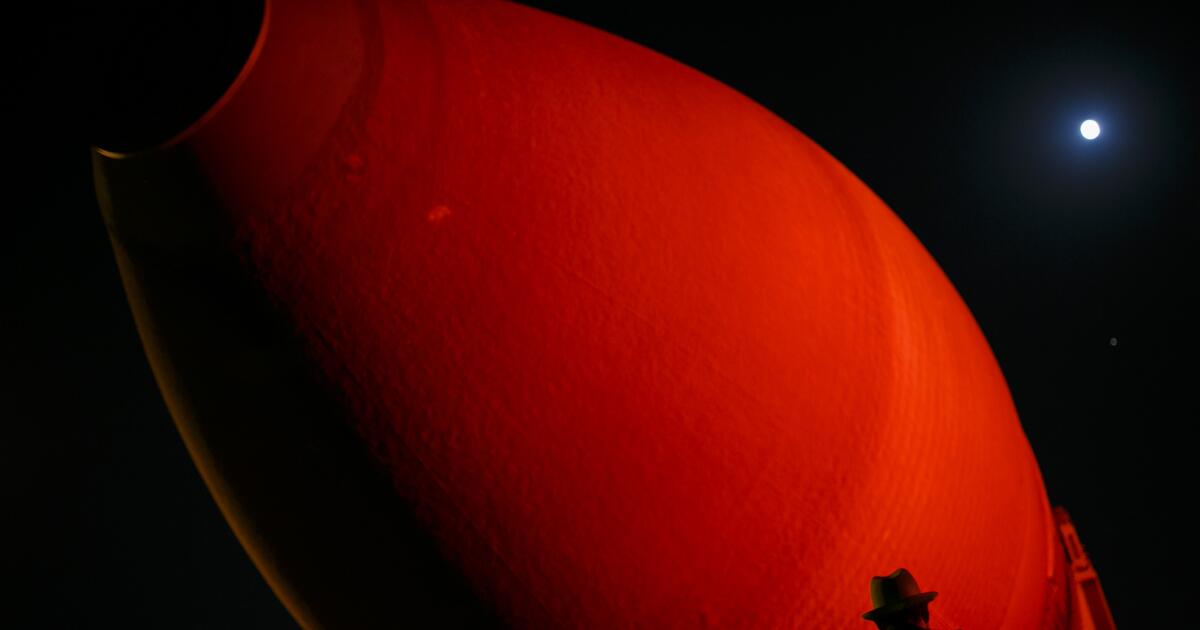
At long last, the final journey of the last space shuttle ever built, Endeavour, and its giant orange external tank are expected to begin this month — the capstone to a historic journey to an ambitious museum exhibit in Los Angeles.
It’ll be a momentous occasion for the California Science Center, the state-run museum just south of downtown L.A., which is building the 20-story Samuel Oschin Air and Space Center to house Endeavour. Anticipation has been building for more than a decade for the new museum wing, after NASA’s decision in 2011 to send Endeavour to L.A. and the orbiter’s cross-country journey in 2012, flying over the Hollywood sign before undertaking a three-day journey through city streets to its new home.
Unlike any other exhibit showcasing a retired space shuttle, Endeavour in L.A. will be configured in a full-stack arrangement, pointing to the stars, as if ready for launch.
Barring any weather delays, starting next week, the 65,000-pound, 154-foot-long giant orange external tank is expected to be moved and then lifted up from its current horizontal position into a vertical orientation, where it’ll be attached to the solid rocket boosters that have already been installed.
Then, no earlier than the end of the month, the space shuttle orbiter itself, Endeavour, will then be lifted from its horizontal position to its vertical position, and be attached to the external tank. It’ll be the first time a shuttle designed for space has been assembled vertically outside of a NASA or Air Force facility.
Jeffrey Rudolph, president of the California Science Center, at the groundbreaking of the Samuel Oschin Air and Space Center in 2022.
(Irfan Khan / Los Angeles Times)
The operation will be a sight to see, and the key moments of the lift of the external tank and Endeavour will be streamed online by the California Science Center. The cranes that will lift the spacecraft are quite tall — the tallest of which will be about the height of City Hall.
“Show time!” said Jeffrey Rudolph, president of the California Science Center.
The prelude to the external tank’s big lift is scheduled for Jan. 10, when the it will be moved by self-propelled modular transporters — similar to the ones used to move Endeavour through city streets in 2012 — down State Drive to the new museum wing’s construction site. The journey will take about two hours, past the science center and the Exposition Park Rose Garden.
Then, on the evening of Jan. 11 and into the next morning, the external tank is to be lifted, starting sometime after 10 p.m. Because the move is taking place outdoors, any significant winds could lead to delays in the big move, and the museum doesn’t want a very big thing swinging off a crane in significant winds.
“The trend, at least in December, was for the winds to die down about 10 p.m. and pick back up about 4 a.m. Assuming that holds into early January, we’ll try taking advantage of that six-hour window to lift the tank and get it in to the pit,” said Dennis Jenkins, project director for the Samuel Oschin Air and Space Center.
The orange external tank will be attached to the twin solid rocket boosters, already installed, at the Samuel Oschin Air and Space Center construction site at the California Science Center.
(Luis Sinco / Los Angeles Times)
Two cranes will be used initially to lift up the external tank from its horizontal position. Then, the external tank will be slowly turned upright to a vertical orientation, and one of the cranes will be disconnected. The other crane will then lift the tank into its final position.
The external tank will then be attached to components that were installed in recent months — the twin solid rocket boosters, which began to be installed in a months-long process that started over the summer. At liftoff, the white rocket boosters were set underneath the shuttle’s wings and produced more than 80% of the lift.
The 15-story orange external tank, the last of its kind in existence, arrived in Los Angeles in 2016, on a journey by sea through the Panama Canal and into Marina del Rey, before also lumbering through the streets to the Science Center. During launches, the external tank carried propellants — liquid oxygen and liquid hydrogen — that powered the space shuttle’s three main engines to help bring the shuttle into orbit.
After the external tank is put into position, work will begin to move Endeavour out of its existing exhibit space, the temporary hangar known as the Samuel Oschin Space Shuttle Endeavour Pavilion, where the orbiter had been on display for about 11 years, until it closed on New Year’s Eve.
The hangar is being dismantled to make way for Endeavour’s move. Later this month, Endeavour will begin to be moved out of the hangar, on the western edge of the science center, Rudolph said.
It’ll first be rolled onto the lawn just north of the Los Angeles Memorial Coliseum and south of the Natural History Museum of Los Angeles County.
Then, the orbiter will move down State Drive. The move will be tricky: At one point, Endeavour will need to be jacked up — to avoid striking a building — moved and then jacked back down for the rest of the journey.
An architectural drawing showing the design of the future California Science Center’s Samuel Oschin Air and Space Center, which will house the space shuttle Endeavour, just next to the Los Angeles Memorial Coliseum.
(ZGF via the California Science Center)
Weather permitting, before the end of the month, Endeavour will undertake its own lift into place. Hopefully, that lift will also be a one-night operation.
Once Endeavour is in place, the rest of the museum will be built around it, followed by the time it will take to install exhibits. It could be a few years before the new museum is open to the public.
The shuttle project, estimated to cost $400 million, will reshape the skyline around the California Science Center, whose roots stem from 110 years ago as a site for exhibiting agricultural and industrial projects. The site became the California Museum of Science and Industry in 1951, and reopened as the California Science Center in 1998.
The new aerospace museum wing is named for Samuel Oschin, the late Los Angeles businessman and philanthropist, whose name is also on the Griffith Observatory planetarium and the Cedars-Sinai Medical Center cancer institute. Financial contributions that came from the Mr. and Mrs. Samuel Oschin Family Foundation have been transformational to building the new museum wing, which broke ground in mid-2022.
The space shuttle’s arrival in California was a homecoming for Endeavour, which rolled off Rockwell International’s production line in Palmdale in 1991, replacing Challenger, which exploded shortly after launch in 1986, killing the seven aboard. Southern California played a crucial role in the shuttles’ development, which pumped hundreds of millions of dollars into the economy and became a source of pride for the region’s aerospace industry.
Endeavour flew 25 missions in space before its final flight in 2011, eight years after another shuttle, Columbia, disintegrated on reentry in 2003, and the shuttle fleet was set for retirement.
Among Endeavour’s most notable missions was successfully repairing the Hubble Space Telescope and helping complete construction of the International Space Station.



new video loaded: Watch Live: Artemis II Mission

April 6, 2026
Trump Escalates Threats to Devastate Iran
1:55

Artemis II Crew Names Crater After Mission Commander’s Late Wife
1:10
Search and Rescue Underway After Iran Downs U.S. Fighter Jet
1:09
How the Artemis Astronauts Plan to Live in Space for 10 Days
2:05
NASA Launches Artemis Astronauts on Journey to the Moon
1:39
For the First Time, a Toilet Heads Into Deep Space
1:17
Today’s Videos
U.S.
Politics
Immigration
NY Region
Science
Business
Culture
Books
Wellness
World
Africa
Americas
Asia
South Asia
Donald Trump
Middle East Crisis
Russia-Ukraine Crisis
Visual Investigations
Opinion Video
Advertisement
SKIP ADVERTISEMENT

NASA’s Artemis II crew, farther from Earth than any humans before them, are preparing for their event-filled six-hour flyby of the moon after five days traveling through space.
At approximately 11 a.m. Pacific time, the crew reached another milestone: At more than 248,655 miles from our pale blue dot, no humans have ever traveled farther from our home planet.
“We do so in honoring the extraordinary efforts and feats of our predecessors in human space exploration,” said Canadian astronaut and Artemis II mission specialist Jeremy Hansen. “We will continue our journey even further into space before Mother Earth succeeds in pulling us back to everything that we hold dear. But we most importantly choose this moment to challenge this generation and the next to make sure this record is not long lived.”
The previous record holders were the Apollo 13 astronauts, who accidentally set the mark after an oxygen tank on their spacecraft exploded shortly after they reached space, forcing them to slingshot around the moon and back without landing on it.
Over the next few hours, the crew will begin making observations of the far side of the moon. With the near side of our natural satellite permanently locked facing Earth in an eternal staring contest, the far side has been viewed many times with space-based telescopes and sensors, but seldom with the naked human eye.
At approximately 3:45 p.m. Pacific time, NASA expects the spacecraft to lose communication with Earth for roughly 40 minutes as it passes behind the moon. During this eclipse of Earth, the crew members will reach their closest point to the moon at about 4,070 miles, with the moon appearing about the size of a basketball held at arm’s length. Shortly after, the crew members will reach their farthest point from Earth at roughly 252,760 miles.
The crew will then experience an Earthrise — the sight of our home planet rising above the moon’s horizon, memorialized in a famous photo from the Apollo 8 crew — as it regains a signal from Mission Control at approximately 4:25 p.m. Pacific time.
At about 5:35 p.m. Pacific time, it will be the sun’s turn to get eclipsed by the moon, with the spacecraft plunging into the darkness of the moon’s shadow for an hour.
NASA is livestreaming the flyby across the internet, including on YouTube, X, Netflix and HBO Max.
The Artemis II mission is one in a series of international efforts spearheaded by NASA to return humans to the lunar surface for the first time in over a half-century.
Artemis I in 2022 was an uncrewed flyby of the moon to test out the vehicle. Artemis II is primarily focused on assessing the life support systems. Artemis III, in Earth’s orbit, aims to test docking procedures with SpaceX’s and Blue Origin’s lunar landers next year, and Artemis IV, slated for 2028, hopes to put boots on the dusty lunar surface.
After a powerful liftoff Wednesday, Artemis II’s journey to the moon has been about as mundane as a deep space mission can get.
The crew spent some time troubleshooting the toilet, with NASA astronaut and Artemis II mission specialist Christina Koch proudly embracing the title of “space plumber.” The team suspected that a vent had frozen over, so they gently turned the ship so that the vent faced the sun, warming it up.
At another point, NASA astronaut and Artemis II commander Reid Wiseman called down to Earth to NASA’s IT specialists on the ground to report that both versions of Microsoft’s email program Outlook installed on his computer were not working.
The crew’s back and forth with Mission Control also included a complaint that, after playing Chappell Roan’s “Pink Pony Club” to wake up the crew, Mission Control annoyingly cut off the song right before the chorus. The crew also called Mission Control to ask whether they could see the spacecraft wiggling as Wiseman rocked the ship while exercising on the flywheel (which both agreed was not an issue).
After the lunar flyby, the crew has another four days of (hopefully) mundane travel before a high-energy reentry and splashdown off the coast of San Diego on Friday.

new video loaded: NASA’s Artemis II Crew Prepares for Lunar Flyby on Monday
transcript
transcript
NASA’s Artemis II Crew Prepares for Lunar Flyby on Monday
The Artemis II crew sent an Easter message as they readied to travel around the moon.
-
“Happy Easter to everyone down there on Earth.” “We did want to send a special Easter message on this day.” “We did hide a few eggs around the cabin. They were the dehydrated scrambled egg variety, but we’re all pretty happy with them.” “We’re going to pass the Apollo 13 distance record by humans, and that record is 248,655 statute miles. That’s when we break the record.” “And in space, you really just eat all of your food out of bags of some kind. This is actually shrimp cocktail. And those are green beans. So we do have to eat our vegetables even in space. But don’t worry, they do give us mac and cheese.”

By Nailah Morgan
April 6, 2026

Report: ICE arrests decline in Tennessee

No. 18 Baseball Faces Texas State in San Marcos – Texas A&M Athletics – 12thMan.com

Drought relief offered as Utah farmers brace for one of the worst years on record

Magnificent 7: Must-See, Must-Do Events in and Around Vermont, April 8-15 | Seven Days

Denver police arrest man suspected in fatal shooting on E. Virginia Avenue

Florida High School Football Rankings: Top 25 teams – Oct. 21

How old is Bo Nix? What to know about Oregon quarterback ahead of 2024 NFL Draft

Cleary's 21 help Le Moyne down Central Connecticut State 69-64 in OT

99th annual Pony Swim held in Virginia

Indiana Members Credit Union announced as new anchor tenant at Bottleworks District

Map: Minor Earthquake Strikes Near San Diego

Trump claims he’d win as the president of Venezuela — just needs to ‘quickly’ learn Spanish

US Supreme Court clears path for Steve Bannon criminal case dismissal

Trump reiterates threats to bomb Iran’s power plants and bridges

Trump threatens Iranian infrastructure over Strait of Hormuz | BBC News
-

 Atlanta, GA2 days ago
1 teenage girl killed, another injured in shooting at Piedmont Park, police say
-

 South-Carolina1 week ago
South Carolina vs TCU predictions for Elite Eight game in March Madness
-

 Vermont1 week ago
Skier dies after fall at Sugarbush Resort
-

 Movie Reviews5 days ago
Vaazha 2 first half review: Hashir anchors a lively, chaos-filled teen tale
-

 Politics1 week ago
Trump’s Ballroom Design Has Barely Been Scrutinized
-

 Politics1 week ago
JD Vance says he was ‘obsessed’ with UFOs, believes aliens are actually ‘demons’
-

 Atlanta, GA1 week ago
Fetishist ‘No Kings’ protester in mask drags ‘Trump’ and ‘JD Vance’ behind her wheelchair
-
 Entertainment5 days ago
Inside Ye’s first comeback show at SoFi Stadium