Science
Q&A: Noma chef René Redzepi wants to make insects delicious. In 'Omnivore,' he explains why


Earning three Michelin stars and having your restaurant named the best in the world five times might be enough for most chefs, but René Redzepi has set his sights on something bigger: changing the way we eat.
The fare we take for granted today is at risk on multiple fronts. Climate change threatens all kinds of crops, including the most popular food in the world. Mass production by agribusinesses is marring the environment, while monoculture farming practices are giving deadly pathogens a biological edge. Underlying all these challenges is the persistent pressure to feed an ever-growing global population.
None of this was on Redzepi’s mind when he followed his best friend to culinary school at age 15. He quickly found his purpose, cooking in multiple Michelin-starred restaurants before opening Noma in his native Copenhagen 2003.
In the 21 years since, one thing has become abundantly clear.
“There’s something happening with our environment,” Redzepi said, “and how we produce and grow our food has a huge impact.”
Matt Goulding, left, and René Redzepi created “Omnivore,” a documentary series on Apple TV+.
(Courtesy of Apple TV+)
That’s the starting point for “Omnivore,” which debuts on AppleTV+ on Friday. Created with his “old pal” Matt Goulding, a food writer and three-time James Beard Award winner, the documentary series raises big questions about the future of food by going deep on eight ingredients: chiles, bluefin tuna, salt, bananas, pork, rice, coffee and corn.
Redzepi and Goulding spoke with The Times about their new show and what they learned about sustainability while making it.
How did “Omnivore” come about?
René Redzepi: Noma was exploding, and I was being offered all sorts of opportunities. I never had the desire to be on TV unless we were informing the world about how magical and important and delicious food is in a way that would be more like “Planet Earth” than a cooking show or travel show.
It was always on the back burner. Then COVID happens.

Matt Goulding: When René called, it all fell into place. His voice always had that kind of David Attenborough echo to it.
Of course we want to make food delicious and enjoyable, but we also want to understand what it means — not just political or cultural but also the natural world, the biological. All of those elements felt like they could be connected through the vessel of the ingredient.
How did you pick the ingredients?
MG: We thought about this like a recipe. What are some of the fundamental ingredients you would put at the heart of a recipe — the protein or the carb — and what are the seasonings? That’s why we have an episode on chile peppers. They don’t have an essential role in our survival, but they have an essential role in explaining the human psyche.
RR: For me, we need wheat to stay alive, but we need chile to feel alive.
You highlight traditional milpa farmers in the Yucatan and organic rice growers in India. If techniques like theirs were widely adopted, would we be able to feed everyone?
RR: We need large-scale agriculture to be inspired by traditional ways that have been used for thousands of years. At the same time, you need those ancient ways to adopt some technology that can actually help things move forward.
MG: It’s a question at the heart of the series, and the episode on corn is where we address this most directly. It’s built around the idea of a tale of two corns. One is a giant monoculture Iowa farm, and the other is the milpa, this polyculture system that was the way corn was grown during its rise in Mesoamerica.
What attracted us to the milpa was not just this romantic ideal of ancient wisdom. When you look at studies, you’ll find that polycultures can produce more calories per acre than a monoculture can.
Monocultures work on a one-dimensional plane — they just use surface area. With polyculture, you’re using using a three-dimensional space to create more food. There’s the crawling vines of the beans, the cover crop of the squash grown below, and the shade being produced by the cornstalks.
The peril of climate change is seen most acutely in the episode about rice. Farmers are so dependent on monsoons, and they’re not behaving as they were in the past.
MG: This single ingredient represents about 20% of the human diet. Figuring out how to continue to grow rice amid this incredible change in our climate is one of the most confounding problems of the 21st century.
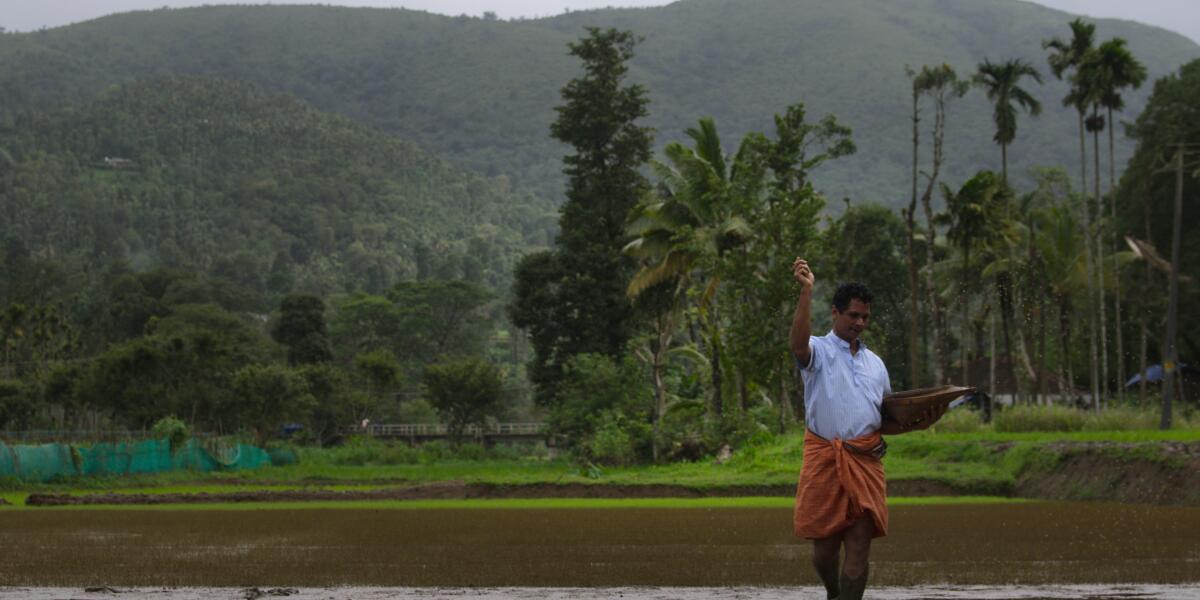
Organic farmer Jayakrishnan Thazhathuveetil sows Kuruva rice seeds in Kerala, India, in the documentary series “Omnivore” on Apple TV +.
(Courtesy of Apple TV+)
We found JK, a southern Indian rice farmer who was just trying to grow rice for his community. He discovered that all these incredible varieties of rice that he grew up with were disappearing, so he took it upon himself to look for them. Maybe one of them will adapt better to the changing climate.
RR: Perhaps if we ate more different things, that would also be something that could help. Could we eat more seaweed? Could we eat more mushrooms? Could we eat more legumes? What about bugs? These things have the potential to be mini-staples.
Could we eat more seaweed? Could we eat more mushrooms? Could we eat more legumes? What about bugs?
— René Redzepi, founder and head chef of Noma
Throughout the series, you show how much humans have literally changed the landscape in pursuit of a good bite to eat. Is this necessarily bad?
MG: Food has always been at the sharp end of the globalization spear. It’s been driving a globalized world since the Age of Discovery, looking for spices, trading salts along the Silk Road.
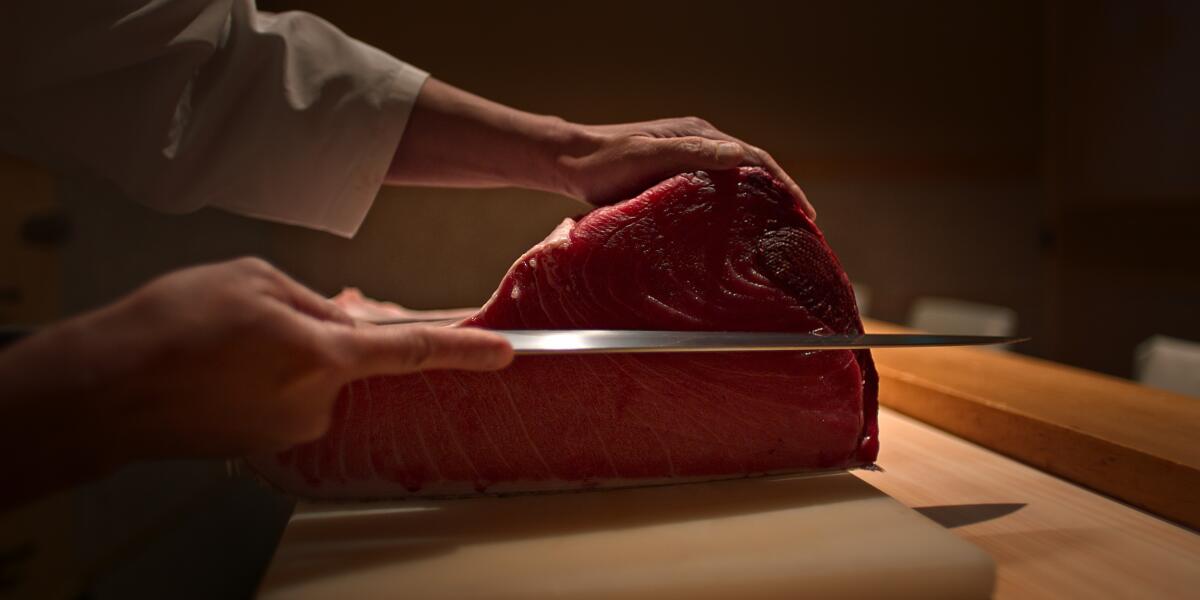
Master sushi chef Takashi Saito prepares bluefin tuna at his Tokyo restaurant in a scene from the documentary series “Omnivore” on Apple TV+.
(Apple TV+)
Bluefin tuna is a very potent example. What had been a trash fish for the better part of the 20th century could suddenly transform into one of the most sought-after ingredients through the innovation of this one individual at Japan Airlines.
Is this necessarily bad? I don’t think it has to be. There are good ways to do it and there are bad ways to do it. It’s a tough thing to draw a line in the sand.
You seem to have a love/hate relationship with global markets. They make it possible for premium coffee growers in Rwanda to be paid fairly for their labor-intensive work, but they also allow the United Fruit Company to take over big chunks of Latin America to grow bananas.
MG: The United Fruit Company is the classic example of a system that controls all means of production so you can maximize efficiency and profit and get a product around the world. The only thing they didn’t factor in is that you can’t control nature in the long run. This is what we’re seeing with Panama disease and bananas.
That a banana costs one-fifth of the cost of an apple grown right down the road from you is one of the most confounding things about our food system. But the true cost of that banana — to the workforce, the consumer, and the planet — is definitely much greater.
RR: If we can just make people aware that this is how food works, and make you think about what sort of systems you tap into, that will be powerful. Most people probably have no clue.
MG: When we eat, when we drink, we are voting for some world we want to live in. It’s an incredibly empowering thing to be able to do three times a day.
Did you learn anything while making “Omnivore” that changed the way you do things at Noma?
RR: When we go into Noma 3.0 next year, we will cease to operate as a 12-months-of-the-year restaurant and focus a lot of our attention and skills and team on tackling bigger questions in the food space. One of the projects I’m looking into is this thing that we call Future Staples of Food, which was inspired by a lot of the research we’ve done. I mentioned some of them before — the seaweeds, the mushrooms, legumes, and so on.
What about insects?
RR: For sure. It’s definitely a superfood. It’s unbelievable the amount of calories and nutrition you get. It’s mind-blowing.
But to change habits and have more things in our diet, we need to make them utterly delicious so that people choose them. Deliciousness is the change factor.
This interview has been edited for length and clarity.


new video loaded: NASA Announces Artemis III Crew
transcript
transcript
NASA Announces Artemis III Crew
NASA announced the crew of Artemis III mission, which will fly to low-Earth orbit to test rendezvous and docking maneuvers with one or two lunar landers.
-
“I am excited to welcome you as the next crew in the Artemis journey to successfully return to the moon — this time to stay.” “I’m honored by the role that I’ve been given. I’m also very humbled by the task in front of us. But first and foremost, I’m grateful.” “So with that, the Artemis II crew, comrade, hands you the baton. You got the controls.” “As you know, we had a significant anomaly at our Launch Complex 36A on May 28. We’ve redoubled our efforts and are moving forward.”
By Alisa Shodiyev Kaff
June 9, 2026
Science
Santa Monica Mountains’ last steelhead trout survived the Palisades fire — and even had babies

Scientists feared the Santa Monica Mountains’ last remaining steelhead trout were dead, smothered by debris flows unleashed by the Palisades fire.
But the endangered fish surprised them: A team of biologists recently spotted 30 of the rare trout — and 21 babies — in Topanga Creek.
“There was a lot of happy dancing in the creek,” said Rosi Dagit, principal conservation biologist for the Resource Conservation District of the Santa Monica Mountains, which works with public and private landowners to conserve natural resources.
That’s because the steelhead here are endangered, at both the state and federal levels. Once, they swam in most streams of the Santa Monicas, but their numbers plummeted amid overfishing and coastal development. Increasingly frequent wildfire has further stressed their habitat. Topanga Creek, a biodiversity hot spot, is home to their last known population in the mountains that stretch from the Hollywood Hills to Point Mugu in Ventura County.
The trout that were spotted, including this one, are part of a distinct Southern California population that’s listed as endangered at the state and federal levels.
(RCDSMM Stream Team)
The California Department of Fish and Wildlife spearheaded a complex mission to rescue trout threatened by the Palisades fire that sparked in January 2025.
Time was of the essence. The fire hadn’t yet been fully contained. But rain was on the way, which would sweep massive amounts of sediment from the denuded hillsides into the water. Fish are often killed this way.
Crews stunned the fish with electricity, scooped them up in buckets, trucked them to a hatchery and ultimately moved them to Arroyo Hondo Creek in Santa Barbara County.
Within days, Topanga Creek was choked with mud. Some assumed the fish left behind were goners.
But in March, the conservation district’s team found four. The following month, when water conditions were clearer, they saw more.
“These fish continue to amaze me,” said Kyle Evans, environmental program manager for the state Department of Fish and Wildlife, who had seen the damage to the creek. “I had seen populations get wiped out in similar situations. So when I heard, I was thrilled.”
Evans surmises the fish that survived were in an area of the creek where less charred material and sediment were swept in.
“These fish likely hunkered down, were hiding under some rocks or places to try to get away from the main concentration of flow,” he said. “And luckily they weren’t buried.”
The ones that were spotted were fairly small, around 6 to 14 inches. Rainbow trout and steelhead trout are the same species, but with different lifestyles. If the fish remain in freshwater, they’ll be considered rainbows. However, they can migrate to the ocean and become steelhead, where they typically grow larger before returning to their natal waters to spawn.
Topanga Creek hasn’t fully recovered from the damage it sustained, but scientists say it’s looking better. Surveys last year were “so depressing,” Dagit said, with very few animals, and stretches that were essentially transformed into flat roads from all the sediment buildup. Some of the riparian canopy burned right down to the creek.
Then came 32 inches of rain over the last nine months, scouring out and moving sediment, creating deeper pools. Dagit said they recently found newt egg masses for the first time in years, as well as a few adult newts and many frogs. Plants that provide cover are starting to recover.
She provided photos comparing certain pools last year and this year, some dramatically transformed. In September 2025, the Shrine Pool could have been an overgrown hiking trail. This April, it was filled with shallow water.

The Shrine Pool in September 2025, left, and the same location in April 2026, right, with RCDSMM’s Isaac Yelchin donning a wetsuit.
(RCDSMM Stream Team)
Topanga Creek is home to another endangered fish, the small but hardy northern tidewater goby, often described as cute. Not long before the trout operation, Dagit led a rescue of hundreds of these fish too. Many were repatriated to the lagoon at the mouth of the creek in a moving ceremony last June.
There’s still the matter of what to do with the trout that were moved to Santa Barbara County last year. Evans would like to bring them home to the Santa Monicas at some point, but isn’t sure if it will happen. On one hand, they could bolster the small, genetically isolated surviving population. On the other, they might inadvertently bring in a disease or bacteria. There is some time to decide. Evans estimates the creek still needs to recover for two to three more years.
For now, the fish are functioning fine in their adopted creek. Experts worried the trauma wrought by the move would disrupt their spawning process, but they had babies that spring. This year, they spawned again.

The Pacifica Municipal Pier was shut down and taped off Thursday after city workers noticed cracks running through the landmark structure and concrete chunks falling into the ocean.
It’s just one of many coastal California structures that have recently crumbled under pressure from a rising and relentless ocean.
Officials from the small, beach city south of San Francisco said the pier was closed due to “cracking, separation, and displacement of the concrete walkway and structural elements.”
It will stay closed while structural engineers asses its safety.
Photos taken by city employees show a wide crack that runs from top to bottom and across the structure as well. Other photos show a large horizontal crack under the foundation of a small restaurant on the pier, the Chit Chat Cafe.
The cafe was also shut down.
This is not the first time the 53-year-old pier has shown signs of stress. In 2021, part of it was shut down after handrails along the edge collapsed. And in 2023, after a series of storms pummeled the Central California coast, damaging parts of the pier, the structure was partially closed for more than year.
Those same storms caused extensive damage in Aptos and Capitola, 70 miles south, where piers and waterfront infrastructure were swept away or damaged.
In 2024, a 150- to 180- foot section of the Santa Cruz wharf was ripped off by powerful waves.
At least 10 of the state’s dozens of coastal public piers were closed for part or all of 2024 due to structural damage sustained in winter storms since 2022. At least five others have longer-term upgrades planned to address structural issues.
“These things are costly to maintain,” said Zach Plopper, senior environmental director at Surfrider. “They are a part of our California coastal culture in many ways, but we’re going to need to reckon with, one, the state that they’re in, and two, the continuous and worsening threats they’re going to experience,”
He said most of the piers were constructed in the early 1900s, and they weren’t built to withstand decades of rough seas, storms and rising sea level.
“With this incoming El Niño, which is forecasted to be significant, and this marine heat wave we’re in the midst of, we’re kind of in uncharted waters as far as what this winter could bring in terms of storms and swells to the California coast, and we’re likely going to see a lot more damage,” he said. “Not just piers, but roads and other coastal infrastructure up and down the state.”
There was no storm in Pacifica earlier this week, so no single event could be blamed for the destruction.
However, a 2025 report from an outside engineering firm, GHD, found that several sections of the pier were in “poor” or “serious” condition, and they recommended closure before anticipated storms or events that could “subject the piles to high winds, swells and large waves.”
The firm found several areas of the pier where concrete was missing and rebar was exposed and corroding.
“The pier has continued to experience high winds and large waves in a harsh marine environment,” the engineers wrote in the report, noting that continuous exposure to seawater or marine spray was “detrimental” to the structure.
A 2023 city report estimated it would cost $19 million to repair.
That same year, a state law was enacted to require local governments along the California coast to plan for sea level rise in the coming decades.
Sea level has risen some 8 inches, on average, along the coast in the past 150 years, Plopper said, and researchers anticipate another foot in the next 25 years.
“We’re going to see profound shifts on our coastline, none that we have ever experienced before, and building static structures on the coast just doesn’t work all that well,” he said. “We’re going to have to make some really hard decisions.”
-

 Nebraska5 minutes ago
Nebraska pitcher enters transfer portal
-

 Nevada8 minutes ago
VOTE: Now that Nevada’s primary election is over, what best describes your experience?
-
 New Hampshire13 minutes ago
New England Wagyu: Raising Japanese delicacy in New Hampshire – Monadnock Ledger-Transcript
-

 New Jersey20 minutes ago
New Jersey Food Council kicks off nationwide search for new CEO
-

 North Carolina23 minutes ago
4 charged after massive party in Alamance County ends with gunfire, stabbing, fights
-

 New Mexico23 minutes ago
The Battle of Socorro, New Mexico and the Uprising Against AI Data Centers
-

 North Dakota35 minutes ago
North Dakota election results: Latest on US House primary race
-

 Ohio38 minutes ago
$150,000 funding to be voted on for the Lisbon pool

