Science
Only a fraction of fire cleanup workers are protecting themselves against toxic debris. One community center is fighting to change that


A crew of 10, many sporting bright orange National Day Laborer Organizing Network T-shirts, funneled out of a Mexican restaurant on the edge of the Eaton burn scar.
Four months — to the day — after winds smashed a tree into a car next to NDLON’s Pasadena Community Job Center and soot blanketed the neighborhood, a University of Illinois Chicago professor, NDLON staff and volunteers sorted into cars under the midday sun and began discreetly traveling every road in fire-stricken Altadena.
-
Share via
They watched nearly 250 crews — working long hours (for good pay), many under contract with the U.S. Army Corps of Engineers — remove the toxic debris covering the landscape in the wake of the fire.
Of the over 1,000 workers they surveyed in the burn area on May 7 and 9, only a quarter wore gloves, a fifth wore a protective mask, and a mere tenth donned full Tyvek suits, as required by California’s fire cleanup safety regulations, the group’s report, released Thursday, found.
For Pablo Alvarado, co-executive director and co-founder of NDLON, the results aren’t surprising.
NDLON — a Pasadena-based, national network of day laborer organizations, focused on improving the lives of day laborers, migrant and low-wage workers — has been responding to post-disaster worker safety issues for decades. Alvarado couldn’t help but remember the laborers he and NDLON supported during the cleanup following 9/11 over 20 years ago.
“Those workers are no longer alive. They died of cancer,” he said. “These are workers I’d known for decades — their sons, their cousins.”

Smoke rises from the burning twin towers of the World Trade Center after hijacked planes crashed into the towers, Sept. 11, 2001, in New York.
(Richard Drew / Associated Press)
As Alvarado watches a new generation of laborers get to work in the aftermath of the L.A. fires, his call to action is simple: “I just don’t want to see people dying.”
“We are committed to protecting all workers, regardless of immigration status,” a California Department of Industrial Relations spokesperson said in a statement to The Times.
The Department of Industrial Relations houses the Cal/OSHA program, which is responsible for enforcing worker safety requirements.
“Our outreach services participated in numerous events to ensure safety information is clear, accessible, and widely shared across impacted communities,” the spokesperson said. “Our enforcement team has also been actively providing compliance assistance. To date this team has provided nearly 500 site visits to educate both employers and employees.”
In a statement to The Times, the Army Corps said it mandates every corps employee and contractor to wear proper PPE.
“USACE’s number one priority is public health and safety — of our employees and contractors, and of the survivors and the community,” the corps said. “No workers are ever allowed on USACE sites without proper PPE.”
Yet NDLON has seen lax PPE use time and time again following disasters. Since 2001, NDLON has dispatched to countless hurricanes, floods and fires to support what the organization calls the “second responders” — the workers who wade through the rubble and rebuild communities after the devastation. Eaton was no different.
“We always respond around the country to floods, fires, no matter where it is,” said Cal Soto, workers’ rights director for NDLON, who helped survey workers in the burn area. For the Eaton fire, “we just happen to be literally in the shadow of it.”
When wildfires push into developed areas like Altadena, they chew through not just trees but also residents’ cars, plastics, batteries and household goods such as detergents and paint thinners, releasing hosts of toxic chemicals.
They include heavy metals such as lead and mercury, capable of damaging the nervous system and kidneys, as well as arsenic and nickel, known carcinogens. Organic materials like wood and oil that don’t fully burn can leave polycyclic aromatic hydrocarbons — or PAHs — which can harm the immune system and cause sickness in the short term and cancer in the long term.
Their primary opportunities to enter the body are through the inhalation of toxic air or through ingestion, after collecting on the hands of a person who then touches their face or uses their hands to eat. They can also, to a lesser extent, absorb directly through the skin.
Masks and disposable head-to-toe coverall suits act as a barrier against the dangerous contaminants.
The responsibility to ensure workers are using those protective barriers on the job ultimately falls on the employer, said Soto.
However, the breakdown of the safety standards can happen anywhere in the chain: The state’s OSHA division can fail to communicate rules to companies and enforce them. Employers can fail to educate their employees or provide the correct PPE. Workers themselves — despite it all — can choose to remove their PPE on long, hot days where a plastic suit and heavy duty mask feel suffocating.
“Sometimes it’s uncomfortable to wear all of that crap — particularly when it’s hot,” said Alvarado, who was a day laborer before founding NDLON. “Sometimes you feel like you’re suffocated.”
NDLON and its Pasadena Community Job Center, within hours of the Eaton fire, became a hub for the community’s response. Its volunteers handed out PPE, food and donations to workers and community members. By the end of January, it had hundreds of helping hands clearing Pasadena’s parks and streets of debris to assist overwhelmed city employees.
At the same time, day labor, construction and environmental remediation workers quickly rushed into the burn zone along with the donations, media attention and celebrities. Like clockwork, so did the labor safety violations.
How to keep a worker safe
In a dimly lit Pasadena church in late January, dozens of day laborers watched as Carlos Castillo played the role of an impatient boss, barking directions at three workers standing before them.
“Hurry up,” Castillo told them in Spanish, handing out boxes of protective suits and masks. One woman, standing in front of the room, fumbled with the straps of a respirator.
Debora Gonzalez, health and safety director NDLON, eyed the day laborer’s efforts before asking the crowd: “What is our friend missing?”
“Gloves!” someone called out.
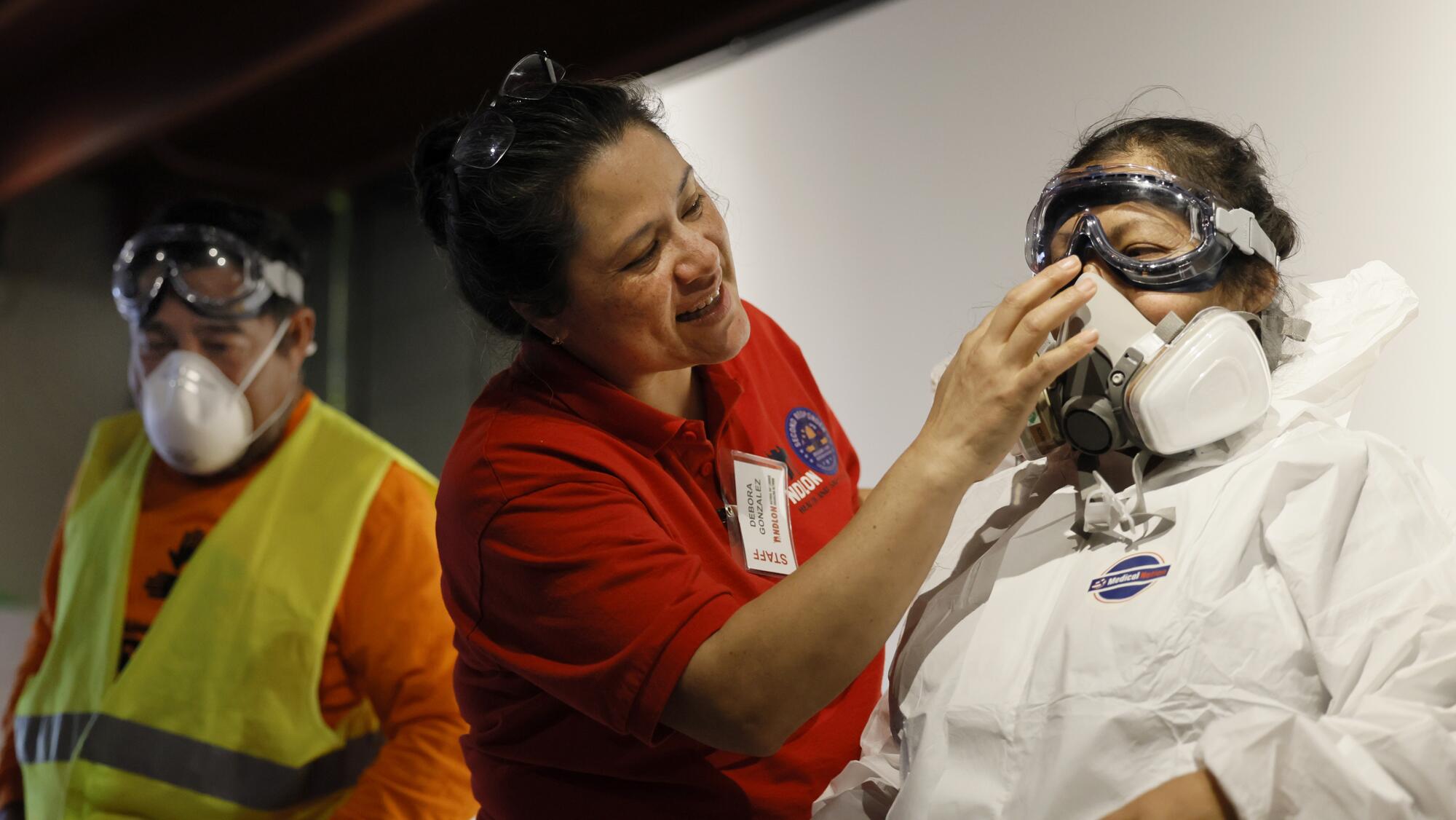
Debora Gonzalez, middle, teaches fire cleanup workers safety training such as proper fitting and use of a respirator and proper wearing of protective clothing for cleaning disaster sites through the National Day Laborer Organizing Network in Pasadena on Jan. 31.
(Allen J. Schaben / Los Angeles Times)
Gonzalez and other volunteers called on the crowd, who quickly pointed out more problems with the equipment that the three workers had hastily donned. One had a mask that wasn’t sufficient for toxic cleanup; Gonzalez also pointed out that his beard would allow dust to infiltrate.
Castillo, a volunteer trainer and president of the D.C.-based immigrant worker-support nonprofit Trabajadores Unidos de Washington D.C., reminded them that when they are cleaning up an area after a wildfire, there could be a range of noxious chemicals in the ash. Gonzalez said she wanted them to be prepared.
“Tomorrow we’ll practice again,” she told them.
NDLON set up the free trainings for any day laborers interested in supporting fire recovery after some laborers began picking up work cleaning homes contaminated with smoke and ash near the fire zones.
Employers are supposed to provide protective equipment to workers and train them on how to use it, but “many times employers want to move quickly. They just want to get the job done and get the job done as quickly as possible,” said Nadia Marin-Molina, NDLON co-executive director. “Unfortunately, workers’ health goes by the wayside.”
As NDLON worked to educate day laborers, another group of workers moved in: The Army Corps of Engineers’ contractors and private debris removal crews. Alvarado quickly noticed that many of the corps’ workers were not wearing the required PPE.
Never one to let the “Day Laborer” in NDLON’s name limit his compassion, Alvarado reached out to a longtime collaborator, Nik Theodore, a University of Illinois Chicago professor who studies labor standards enforcement, to do something about it.
Neglected in the burn zone
A week later, Juan Pablo Orjuela, a labor justice organizer with NDLON, made sure the air was recirculating in the car as the team drove through the burn zone, surveying workers for the NDLON and University of Illinois Chicago report in early May. He watched an AllTrails map documenting their progress — they’d drive until they had traced every street in northeast Altadena.
Orjuela spotted an Army Corps crew working on a home and pulled the car to the curb. “Eight workers — no gloves, no Tyvek suit,” he said.
Nestor Alvarenga, a day laborer and volunteer with NDLON, sat in the back, tediously recording the number of workers, how many were wearing protective equipment and the site’s address into a spreadsheet on an iPad with a beefy black case.
The Army Corps said it requires all workers on-site to wear a hard hat, safety glasses and reflective vests. Workers in the ash footprint must also wear Tyvek suits, gloves and a respirator, the corps said.
One worker walked up to the car; Orjuela slowly lowered the window.
“Do you guys need anything?” the worker asked.
“No, we’re OK,” Orjuela said, “we’ll get out of your way.”

Debora Gonzalez, left, teaches fire cleanup workers safety training such as proper fitting and use of a respirator and proper wearing of protective clothing for cleaning disaster sites through the National Day Laborer Organizing Network in Pasadena on Jan. 31.
(Allen J. Schaben / Los Angeles Times)
Orjuela rolled up the window and pulled away. “I don’t really have to tell anybody what I’m doing,” he said. “I’m not being antagonistic, but you know … I’m just not saying anything to anybody.”
Theodore and NDLON hope the window survey, spanning 240 job sites with more than 1,000 total workers, can raise awareness for safety and health concerns in the burn areas, help educate workers, and put pressure on the government to more strictly enforce compliance.
“This was no small sample by any means,” Theodore said. “This was an attempt to be as comprehensive as possible and the patterns were clear.”
For Soto, the results are a clear sign that, first and foremost, employers are not upholding their responsibility to ensure their workers’ safety.
“It’s the responsibility of the employer,” he said. “I want to be clear that we have that expectation — that demand — always.”
Yet the window survey found even job sites where the PPE requirements are explicitly listed by the employer on a poster at the site, usage was still low. The reality, NDLON organizers said, is that the state must step in to help enforce the rules.
“I understand that the disaster was colossal, and I never expected the government to have the infrastructure to respond immediately,” said Alvarado, “but at this point, making sure workers have PPE, that’s a basic thing that the government should be doing.”
Former Times staff writer Emily Alpert Reyes contributed to this report.


new video loaded: NASA Announces Artemis III Crew
transcript
transcript
NASA Announces Artemis III Crew
NASA announced the crew of Artemis III mission, which will fly to low-Earth orbit to test rendezvous and docking maneuvers with one or two lunar landers.
-
“I am excited to welcome you as the next crew in the Artemis journey to successfully return to the moon — this time to stay.” “I’m honored by the role that I’ve been given. I’m also very humbled by the task in front of us. But first and foremost, I’m grateful.” “So with that, the Artemis II crew, comrade, hands you the baton. You got the controls.” “As you know, we had a significant anomaly at our Launch Complex 36A on May 28. We’ve redoubled our efforts and are moving forward.”
By Alisa Shodiyev Kaff
June 9, 2026
Science
Santa Monica Mountains’ last steelhead trout survived the Palisades fire — and even had babies

Scientists feared the Santa Monica Mountains’ last remaining steelhead trout were dead, smothered by debris flows unleashed by the Palisades fire.
But the endangered fish surprised them: A team of biologists recently spotted 30 of the rare trout — and 21 babies — in Topanga Creek.
“There was a lot of happy dancing in the creek,” said Rosi Dagit, principal conservation biologist for the Resource Conservation District of the Santa Monica Mountains, which works with public and private landowners to conserve natural resources.
That’s because the steelhead here are endangered, at both the state and federal levels. Once, they swam in most streams of the Santa Monicas, but their numbers plummeted amid overfishing and coastal development. Increasingly frequent wildfire has further stressed their habitat. Topanga Creek, a biodiversity hot spot, is home to their last known population in the mountains that stretch from the Hollywood Hills to Point Mugu in Ventura County.
The trout that were spotted, including this one, are part of a distinct Southern California population that’s listed as endangered at the state and federal levels.
(RCDSMM Stream Team)
The California Department of Fish and Wildlife spearheaded a complex mission to rescue trout threatened by the Palisades fire that sparked in January 2025.
Time was of the essence. The fire hadn’t yet been fully contained. But rain was on the way, which would sweep massive amounts of sediment from the denuded hillsides into the water. Fish are often killed this way.
Crews stunned the fish with electricity, scooped them up in buckets, trucked them to a hatchery and ultimately moved them to Arroyo Hondo Creek in Santa Barbara County.
Within days, Topanga Creek was choked with mud. Some assumed the fish left behind were goners.
But in March, the conservation district’s team found four. The following month, when water conditions were clearer, they saw more.
“These fish continue to amaze me,” said Kyle Evans, environmental program manager for the state Department of Fish and Wildlife, who had seen the damage to the creek. “I had seen populations get wiped out in similar situations. So when I heard, I was thrilled.”
Evans surmises the fish that survived were in an area of the creek where less charred material and sediment were swept in.
“These fish likely hunkered down, were hiding under some rocks or places to try to get away from the main concentration of flow,” he said. “And luckily they weren’t buried.”
The ones that were spotted were fairly small, around 6 to 14 inches. Rainbow trout and steelhead trout are the same species, but with different lifestyles. If the fish remain in freshwater, they’ll be considered rainbows. However, they can migrate to the ocean and become steelhead, where they typically grow larger before returning to their natal waters to spawn.
Topanga Creek hasn’t fully recovered from the damage it sustained, but scientists say it’s looking better. Surveys last year were “so depressing,” Dagit said, with very few animals, and stretches that were essentially transformed into flat roads from all the sediment buildup. Some of the riparian canopy burned right down to the creek.
Then came 32 inches of rain over the last nine months, scouring out and moving sediment, creating deeper pools. Dagit said they recently found newt egg masses for the first time in years, as well as a few adult newts and many frogs. Plants that provide cover are starting to recover.
She provided photos comparing certain pools last year and this year, some dramatically transformed. In September 2025, the Shrine Pool could have been an overgrown hiking trail. This April, it was filled with shallow water.

The Shrine Pool in September 2025, left, and the same location in April 2026, right, with RCDSMM’s Isaac Yelchin donning a wetsuit.
(RCDSMM Stream Team)
Topanga Creek is home to another endangered fish, the small but hardy northern tidewater goby, often described as cute. Not long before the trout operation, Dagit led a rescue of hundreds of these fish too. Many were repatriated to the lagoon at the mouth of the creek in a moving ceremony last June.
There’s still the matter of what to do with the trout that were moved to Santa Barbara County last year. Evans would like to bring them home to the Santa Monicas at some point, but isn’t sure if it will happen. On one hand, they could bolster the small, genetically isolated surviving population. On the other, they might inadvertently bring in a disease or bacteria. There is some time to decide. Evans estimates the creek still needs to recover for two to three more years.
For now, the fish are functioning fine in their adopted creek. Experts worried the trauma wrought by the move would disrupt their spawning process, but they had babies that spring. This year, they spawned again.

The Pacifica Municipal Pier was shut down and taped off Thursday after city workers noticed cracks running through the landmark structure and concrete chunks falling into the ocean.
It’s just one of many coastal California structures that have recently crumbled under pressure from a rising and relentless ocean.
Officials from the small, beach city south of San Francisco said the pier was closed due to “cracking, separation, and displacement of the concrete walkway and structural elements.”
It will stay closed while structural engineers asses its safety.
Photos taken by city employees show a wide crack that runs from top to bottom and across the structure as well. Other photos show a large horizontal crack under the foundation of a small restaurant on the pier, the Chit Chat Cafe.
The cafe was also shut down.
This is not the first time the 53-year-old pier has shown signs of stress. In 2021, part of it was shut down after handrails along the edge collapsed. And in 2023, after a series of storms pummeled the Central California coast, damaging parts of the pier, the structure was partially closed for more than year.
Those same storms caused extensive damage in Aptos and Capitola, 70 miles south, where piers and waterfront infrastructure were swept away or damaged.
In 2024, a 150- to 180- foot section of the Santa Cruz wharf was ripped off by powerful waves.
At least 10 of the state’s dozens of coastal public piers were closed for part or all of 2024 due to structural damage sustained in winter storms since 2022. At least five others have longer-term upgrades planned to address structural issues.
“These things are costly to maintain,” said Zach Plopper, senior environmental director at Surfrider. “They are a part of our California coastal culture in many ways, but we’re going to need to reckon with, one, the state that they’re in, and two, the continuous and worsening threats they’re going to experience,”
He said most of the piers were constructed in the early 1900s, and they weren’t built to withstand decades of rough seas, storms and rising sea level.
“With this incoming El Niño, which is forecasted to be significant, and this marine heat wave we’re in the midst of, we’re kind of in uncharted waters as far as what this winter could bring in terms of storms and swells to the California coast, and we’re likely going to see a lot more damage,” he said. “Not just piers, but roads and other coastal infrastructure up and down the state.”
There was no storm in Pacifica earlier this week, so no single event could be blamed for the destruction.
However, a 2025 report from an outside engineering firm, GHD, found that several sections of the pier were in “poor” or “serious” condition, and they recommended closure before anticipated storms or events that could “subject the piles to high winds, swells and large waves.”
The firm found several areas of the pier where concrete was missing and rebar was exposed and corroding.
“The pier has continued to experience high winds and large waves in a harsh marine environment,” the engineers wrote in the report, noting that continuous exposure to seawater or marine spray was “detrimental” to the structure.
A 2023 city report estimated it would cost $19 million to repair.
That same year, a state law was enacted to require local governments along the California coast to plan for sea level rise in the coming decades.
Sea level has risen some 8 inches, on average, along the coast in the past 150 years, Plopper said, and researchers anticipate another foot in the next 25 years.
“We’re going to see profound shifts on our coastline, none that we have ever experienced before, and building static structures on the coast just doesn’t work all that well,” he said. “We’re going to have to make some really hard decisions.”
-

 Los Angeles, Ca43 minutes ago
Los Angeles High School locked down as police search for armed juvenile
-

 Detroit, MI1 hour ago
‘Diarra From Detroit’ sets date for second season on Paramount+
-

 San Francisco, CA1 hour ago
San Francisco police release video of shootout that critically wounded officer
-

 Dallas, TX1 hour ago
3 Dallas educators among FIFA World Cup volunteers
-

 Miami, FL1 hour ago
Miami Gardens man arrested after fleeing Florida Keys deputies at 125 mph, sheriff says
-

 Boston, MA1 hour ago
Boston gives update on plans for 3 a.m. last call at bars, outdoor drinking areas during World Cup
-

 Denver, CO2 hours ago
One Invitation Can Change a Life: Called By Name Campaign Inspires Future Priests For a Second Year in Denver
-

 Seattle, WA2 hours ago
Survey: What’s the toughest game to start the Seahawks’ season?

