Science
Jeremiah Ostriker, Who Plumbed Dark Forces That Shape Universe, Dies at 86


Jeremiah Ostriker, an astrophysicist who helped set off a revolution in humankind’s view of the universe, revealing it to be a vaster, darker realm than the one we can see, ruled by invisible forms of matter and energy we still don’t understand, died on Sunday at his home on the Upper West Side of Manhattan. He was 87.
His daughter Rebecca Ostriker said the cause was end-stage renal disease.
Over more than four decades, mostly at Princeton University, Dr. Ostriker’s work altered our understanding of how galaxies form and evolve as he explored the nature of pulsars, the role of black holes in the evolution of the cosmos and what the universe is made of.
Before the 1970s, most astronomers believed that galaxies were made up mostly of stars.
“Ostriker was arguably the most important single figure in convincing the astronomical community that this natural and seductive assumption is wrong,” David Spergel, the president of the Simons Foundation, which supports scientific research, wrote in 2022, nominating Dr. Ostriker, his mentor, for the Crafoord Prize, the astronomical equivalent of a Nobel. He cited Dr. Ostriker’s “eloquent advocacy for the then-radical new model in which the visible stars in galaxies were only a minor pollutant at the center of a much larger halo of dark matter of unknown composition.”
Dr. Ostriker’s work, he said, was “the grandest revision in our understanding of galaxies” in half a century.
Jerry Ostriker, as he was known to friends and colleagues, a man with a prickly sense of humor and a soft but commanding voice, was willing to go wherever the data and scientific calculations led him, and was not shy about questioning assumptions — or having fun. Prominently displayed in his home was a youthful photo of himself, taken in Cambridge, Mass., driving a motor scooter as his wife, Alicia Ostriker, seated behind him, lifts a bottle of wine to her lips. (A close look shows the cork still in the bottle.)
“He had the quickest wit of any scientist I have encountered,” said James Peebles, a Nobel physics laureate and a colleague of Dr. Ostriker’s at Princeton. “And I don’t remember ever matching him in a spontaneous debate” on any issue.
Asked in a 1988 oral history interview for the American Institute of Physics if he had favored any of the models of the universe being batted about in the 1970s, when he entered the field — whether the universe was finite or infinite, whether it had a beginning or was somehow always here, whether it would expand forever or crash back down in a big crunch — he said he had not.
“Scientists have followed their own biases, and my principle bias at the time was being contemptuous and intolerant of all of these people who had specific models,” he answered. “How could they be so certain when the evidence was as confusing and inconclusive?”
A ‘Classic Nerd Child’
Jeremiah Paul Ostriker was born on April 13, 1937, on the Upper West Side, the second of four siblings. His father, Martin Ostriker, ran a clothing company, and his mother, Jeanne (Sumpf) Ostriker, was a public-school teacher. Babe Ruth lived around the corner, and the children used to chase his car for autographs.
“I must have been the classic nerd child,” Dr. Ostriker wrote in a memoir published in the Annual Review of Astronomy and Astrophysics in 2016. He first became interested in science when he was 4: His mother started reading science books aloud to get him to sit still for an oil portrait, and the readings stuck.
After graduating from the Ethical Culture Fieldston School in the Bronx, Jerry Ostriker went to Harvard University, where he planned to study chemistry. Instead, he switched to physics, which appealed to what he called his “cosmic perspective.”
“I probably spent more time on literature than I spent on science,” he said in the oral history interview.
He soon began commuting to Brandeis University to visit Alicia Suskin, a former Fieldston classmate who was an aspiring artist and poet. They were married in 1958, while they were still undergraduates.
Ms. Ostriker, a professor emerita of English at Rutgers University, became an award-winning poet and has often written her husband into her work. In turn, he found poetry in astrophysics. “As an astrophysicist, you get a perspective on humankind,” he said, describing it as “sweating on this little grain of spinning sand.”
In addition to his wife and his daughter Rebecca, an editor for the opinion section of The Boston Globe, Dr. Ostriker is survived by two other children, Eve Ostriker, an astrophysicist at Princeton, and Gabriel Ostriker, a data engineer; a sister, Naomi Seligman; two brothers, Jon and David; and three grandchildren.
After graduating from Harvard in 1959, Dr. Ostriker worked at the United States Naval Research Laboratory for a year before enrolling in graduate school at the University of Chicago, splitting his time between the university’s Yerkes Observatory and the physics department, where he worked under the future Nobel laureate Subrahmanyan Chandrasekhar.
He earned his Ph.D. in 1964. After a postdoctoral year at the University of Cambridge in England, where he rubbed elbows with future black hole eminences like Stephen Hawking and Martin Rees, Dr. Ostriker joined Princeton as a research scientist. He remained there for 47 years, rising through the ranks to become chairman of the astronomy department and provost of the university.
The Dark Side of the Universe
At Princeton, Dr. Ostriker wrote a series of papers that would lead astronomy to the dark side.
He wondered whether galaxies, like stars, could break apart if they rotated too fast. The question was particularly relevant to so-called disc galaxies like the Milky Way, which are shaped sort of like a fried egg, with a fat, yolky center surrounded by a thin, white flat of stars.
Working with Dr. Peebles, he constructed a computer simulation and found that disc galaxies were indeed unstable. They would fall apart unless there was something we couldn’t see, a halo of some additional invisible mass, lending gravitational support.
Whatever this stuff called dark matter was — dim stars, black holes, rocks, exotic subatomic particles left over from the Big Bang — there could be a lot of it, as much as 10 times the mass of ordinary atomic matter.
It was one of the first theoretical arguments that there must be more to galaxies than could be seen in starlight. In the 1930s, the astronomer Fritz Zwicky had suggested that most of the mass in galaxies was “dark.” His idea was largely ignored until Dr. Ostriker and Dr. Peebles published their paper in 1973.
The reaction from the scientific community was predominantly hostile, Dr. Ostriker said. “I couldn’t see particularly why,” he said in the oral history. “It was just a fact.”
A year later, incorporating more data from galaxy clusters and other star systems, he and his colleagues argued that, in fact, most of the mass in the universe was invisible.
By the early 1980s, the idea of dark matter had become an accepted part of cosmology, but there remained conundrums, including calculations that suggested that stars were older than the universe in which they lived.
The missing ingredient, Dr. Ostriker and the theoretical physicist Paul Steinhardt, then at the University of Pennsylvania, suggested in 1995, was a fudge factor known as the cosmological constant. Einstein had come up with this concept in 1917, but had later abandoned it, considering it a blunder.
As Dr. Steinhardt recalled, he and Dr. Ostriker were “convinced that a universe with only dark and ordinary matter could not explain the existing observations.” But once they added the cosmological constant, everything came out right.
They were not the only ones with this idea. The cosmologists Michael Turner, now retired from the University of Chicago, and Lawrence Krauss, now retired from Arizona State University, also argued in favor of bringing back the constant. “To say Jerry was a giant in the field is an understatement,” Dr. Turner wrote in an email, adding, “Sparring with Jerry over science was a privilege and often a learning experience.”
Three years later, two competing teams of astronomers discovered that the expansion of the universe was being accelerated by a “dark energy” acting as the cosmological constant, pushing galaxies apart. The cosmological constant then became part of a standard model of the universe, as Dr. Ostriker and others had predicted.
In another series of papers, he and various collaborators transformed astronomers’ view of what was going on in the space between stars.
Dr. Ostriker and Renyue Cen, also of Princeton, concluded in 1999 that most ordinary atomic matter in the nearby universe was invisible, taking the form of intergalactic gas heated to millions of degrees by shock waves and explosions.
A Passion That Never Waned
At Princeton, Dr. Ostriker helped set up the Sloan Digital Sky Survey, a collaboration — initially of Princeton, the University of Chicago and the Institute for Advanced Study in Princeton, N.J. — aimed at remapping the entire sky in digital form with a dedicated telescope at Apache Point Observatory in Sunspot, N.M.
“The survey is going to increase our knowledge and our understanding of the universe a hundredfold,” he told The New York Times in 1991. “The map is not going to show us how the universe began, but it will show us the nature and origin of large-scale structure, the most interesting problem in astrophysics today. With an answer to this problem, we will be able to better approach the question of how it all began.”
The survey, started in 1998, is now in its fifth iteration and has generated some 10,000 research papers and archived measurements of a half-billion stars and galaxies, all free to any astronomer in the world.
As provost, Dr. Ostriker led the effort to vastly expand the university’s financial aid program, changing many loans to grants that would not need to be repaid, making a Princeton education more egalitarian. In 2000, he was awarded the National Medal of Science by President Bill Clinton.
Dr. Ostriker retired from Princeton in 2012, just as his daughter Eve was joining the astronomy faculty there. He took a part-time position at Columbia University, returning to his childhood neighborhood.
“Growing up in New York City, I couldn’t see the stars,” he once told The Times. He found them anyway, and a whole lot more that we can’t see with or without the glare of streetlights.
It was a passion that never waned. Encountered recently by a reporter on the sidewalk in front of Columbia, Dr. Ostriker launched into an enthusiastic description of a promising new theory of dark matter.
Early in 2023, by then ailing, he took to his bed at home. But he kept up with his research by email and had regular pizza lunches with colleagues.
Apprised recently of results from the James Webb Space Telescope that seemed to reinforce his ideas about dark matter, he wrote in an email to his colleagues, “Keep up the good work.”
The dark universe he helped conjure half a century ago has developed a few small cracks, leading to new ideas about the nature of that dark matter.
“It’s a very, very, very specific and clear theory. So therefore, God bless it, it can be wrong,” Dr. Ostriker said in a recent interview. “That’s the way science proceeds. And what we know about it is that it is a little bit wrong, not a lot wrong.”
Dr. Rees, a cosmologist at the University of Cambridge and the Astronomer Royal, summed up Dr. Ostriker’s life this way: “Some scientists come up with pioneering ideas on novel themes; others write definitive ‘last words’ on already-established topics. Jerry was in the first category.”
“He wrote among the earliest papers — now classics — on the nature of pulsars, the evidence for dark matter and on galaxy formation and cosmology. His flow of papers continued into his 80s,” Dr. Rees added. “He enthusiastically engaged in new data and in computational techniques. He inspired younger colleagues and collaborators, not just at Princeton but around the world.”



Few substances are as deeply woven into everyday life as alcohol. It is a fixture at holiday celebrations, work-related social gatherings, sporting events, airports, and brunch or dinner tables. All demonstrate how deeply alcohol has become embedded in social customs and cultural traditions.
Yet alcohol contributes to millions of deaths globally each year and is linked to cancer, liver disease, unintentional accidents, violence and, importantly, dependence and addiction. Despite this, the disconnect between alcohol’s cultural role and its serious health burden is striking. An estimated 2.3 billion people worldwide consume alcohol.
As a physician working in addiction medicine, I regularly care for patients whose alcohol use affects nearly every organ system. It is often not until these patients end up admitted to the hospital that they learn the effects of alcohol on various parts of their body besides their liver.
Newer evidence challenges assumptions about what was long considered “safe drinking.” Even moderate drinking carries risk and is not as harmless as people, including experts, once thought.
Many people associate alcohol risk primarily with addiction or dangerous behaviors such as driving while intoxicated. However, its effects extend far beyond this, into nearly every aspect of a person’s well-being.
While alcohol may transiently improve mood and ease social anxiety, long-term alcohol use can lead to a worsening of mood, cognition and sleep, which can further compound use.
A 2021 literature review found that consuming approximately two standard drinks roughly doubles the odds of sustaining injuries — with or without a vehicle involved. The review also found that heavy episodic (binge) drinking can increase the risk of injury by 50-fold, depending on the amount of alcohol consumed and the type of injury. While alcohol’s effects on the liver are well known, it can also lead to gastrointestinal complications and heart disease
The World Health Organization estimates that 2.6 million deaths each year are attributable to alcohol, accounting for nearly 1 in every 20 deaths worldwide.
While many people recognize the risks of alcohol addiction, people are generally much less aware of the links between alcohol use and cancer risk.
The World Health Organization classifies alcohol as a Group 1 carcinogen — the same category as tobacco and asbestos. In 2025, the U.S. surgeon general emphasized that alcohol increases the risk of at least seven cancers, including cancers of the breast, colorectal, liver, oral, esophagus and larynx. An advisory called for updated warning labels.
Yet fewer than half of Americans recognize alcohol as a risk factor for cancer, particularly for cancers such as breast cancer that are not commonly associated with alcohol use.
Throughout the 1990s and early 2000s, observational studies suggested that moderate alcohol consumption might offer cardiovascular benefits. Over the past decade, however, higher-quality studies have challenged these findings, suggesting that much of the apparent benefit may have reflected differences in the health and lifestyles of moderate drinkers rather than a protective effect of alcohol itself.
Current evidence increasingly suggests that even low levels of alcohol may increase cancer risk.
Federal guidelines acknowledge that adults should “consume less alcohol for better overall health.” However, the most recent version of the “Dietary Guidelines for Americans,” updated in January, removed the previous recommendation to limit intake to no more than one drink per day for women and two for men. It also omitted explicit discussion of alcohol’s links to cancer.
These changes have drawn criticism from public health experts, who argue that the revised language plays down the growing evidence of alcohol-related harms and provides less specific guidance to consumers. The current administrator of the Centers for Medicare & Medicaid Services characterized alcohol as a “social lubricant” that brings people together, rather than emphasizing its well-established health risks.
This may be true physiologically, at least temporarily, but obscures the fact that relying on it as a social lubricant can lead to chemical and psychological dependency. In my view, statements to that effect are shortsighted, prioritizing short-term social effects over more insidious and long-term issues, including addiction.
While many dangerous mind-altering substances are hidden from public perception, alcohol is often placed at the center of it – a trend that shows no sign of changing imminently.
Further, large companies often profit from ads that appeal to young people.
Looking back at the history of tobacco smoking provides some helpful insights. In 1965, 42.4% of the U.S. population smoked. By 2022, that figure had dropped to 11.6%.
This steep decline did not happen because of a single intervention, but through decades of accumulating scientific evidence, public education campaigns, warning labels, restrictions on advertising, smoke-free policies, higher tobacco taxes and shifts in social norms. Together, these efforts transformed smoking from a widely accepted social behavior into one broadly recognized as a major health risk and correspondingly, less socially accepted.
Although alcohol consumption has modestly declined in recent years, it remains deeply embedded in social life in ways cigarette smoking no longer is.
People often assume that if a substance is legal, common and widely socially accepted — even encouraged — it must also be safe. But public health history suggests those assumptions can and should change.
Emma Fenske is an addiction medicine fellow and internal medicine physician at Oregon Health & Science University. This article was produced in partnership with the Conversation.
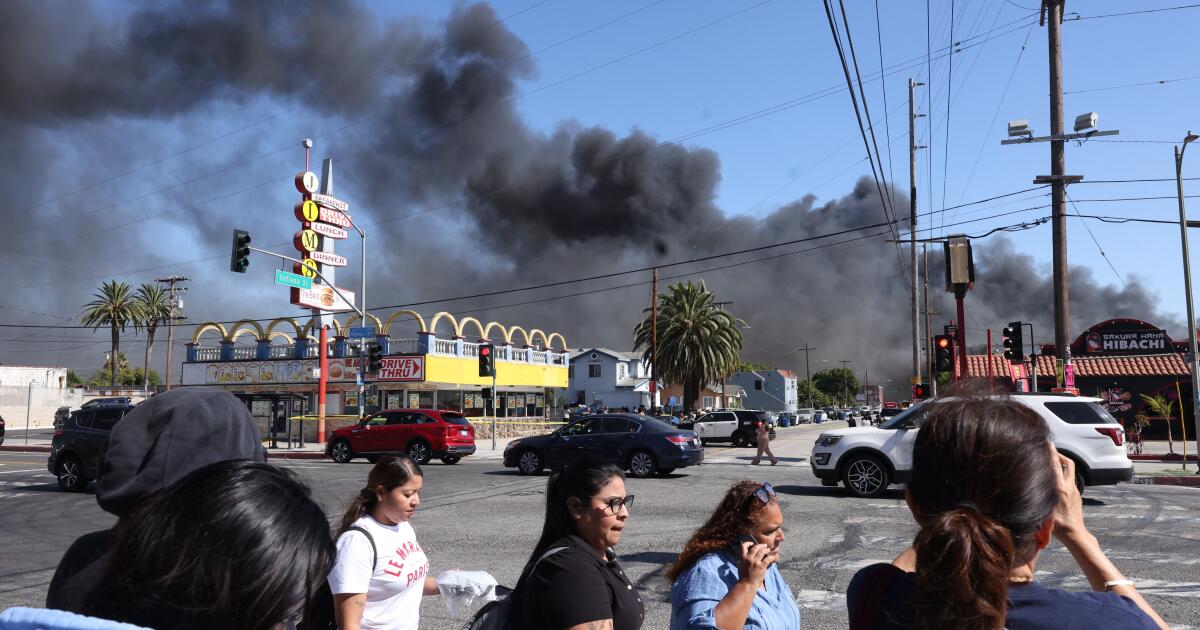
The air near the Lineage refrigerated warehouse fire in Boyle Heights carried astronomically high levels of smoke and soot, surpassing some of the worst air pollution during the Los Angeles County fires in January 2025, according to preliminary data from air officials.
The fire spewed thick black smoke for days. From downtown Los Angeles to the San Gabriel Valley, tens of thousands were enveloped in unhealthful levels of smoke, even as some local officials told residents that the air posed no danger.
As the days wore on, worst off were communities nearest the blaze. On June 19, three days after the facility ignited, a temporary air quality monitoring station at Eastman Elementary in unincorporated East Los Angeles measured an extremely hazardous 755 micrograms per cubic meter of fine particles for more than an hour, according to the South Coast Air Quality Management District.
For comparison, a Caltech air monitor in Pasadena recorded about 650 micrograms per cubic meter during the Eaton fire.
These high levels of fine particles, known as PM 2.5, probably resulted in the surge of residents into local emergency rooms during the fire, according to local health officials. But even now with the smoke gone, people still have not been told what chemicals they were breathing in during the weeklong ordeal.
Michael Jerrett, an environmental health professor at the UCLA Fielding School of Public Health, said his concern is the composition of materials emitted when the building burned.
“These contain many particularly toxic components,” Jerrett said, “and we know little about how these mixtures affect health.”
There is no completely safe level of fine particulate pollution, he noted, meaning higher concentrations are always worse.
During the 2025 L.A. County fires, local air officials announced that several monitors downwind had detected elevated levels of brain-damaging lead and cancer-causing arsenic from toxic paint and construction materials used in older homes.
The Lineage warehouse, built in 2018, is likely to contain different materials of concern. Thick insulation foam required for a massive refrigeration operation, solar panels and refrigerants were burned, leaving many residents on edge.
Even though three public agencies conducted air monitoring, the picture is still murky.
“[Public officials] are speaking with a lot of confidence but not a lot of information,” said mark! Lopez, a community organizer with East Yard Communities for Environmental Justice. “We’ve gotten in the room with folks to discuss where the gaps lie and where assumptions are being made. And I think they are realizing these agencies supposed to protect our air and our health aren’t as reliable as they thought they were.”
In response to the Boyle Heights fire, the South Coast air district deployed a mobile monitoring vehicle to screen for toxic substances in the community near the fire, according to Nahal Mogharabi, a spokesperson for the air district. It found increased levels of bromine, a chemical commonly found in fire retardant, and chlorine, often released from burning plastic. Both were below short-term health-based exposure thresholds.
Toxic metals, including lead and arsenic, were not elevated, according to air district data.
“That was the reassuring piece, that they were not picking up any of the metals,” said Dr. Nichole Quick, chief medical advisor for the Los Angeles County Department of Public Health. “But … that smoke is unhealthy. “You don’t want to be breathing it, regardless.”
The U.S. Environmental Protection Agency set up air monitors around the perimeter of the facility to test for toxic air contaminants, has the results and has not made them public. Julia Giarmoleo, an EPA spokesperson, said the monitors did not detect elevated metals, but would not provide a copy of the data without a federal records request.
The Los Angeles Fire Department’s hazardous material team also tested for ammonia, which is used in refrigeration, and hydrogen fluoride, a toxic chemical that could be released by burning lithium-ion batteries and solar panels.
Fire officials previously said they measured low levels of hydrogen fluoride on the second day of the fire. But the department would not answer questions about its air monitoring. It also told a reporter to submit a public records request.
It remains unclear whether any agency has tested for hydrogen cyanide or isocyanates, highly toxic gases that could be released from burning chemical-laden insulating foam inside the building.
“The real issue is what monitoring has not been done to protect the fence-line community from the air toxics,” said Jane Williams, executive director of California Communities Against Toxics.
Without the EPA or LAFD data, what is known of the smoke’s toxicity rests on the air district’s mobile monitoring.
Jerrett, the UCLA researcher, said that is not ideal for understanding the kind of plume released by the Boyle Heights fire, which rapidly changed direction with the wind.
“This can in some instances lead to levels that look low, but they are resulting from a mismatch between the location of the vehicle and the plume,” he said.
The Boyle Heights blaze, similar to the Eaton and Palisades fires, has revealed the region’s air monitoring can’t always tell people what they’ve been exposed to in a disaster.
“We do need a better monitoring system in place,” he said.
Local officials are now shifting their focus to the rancid odors from millions of pounds of rotting food in the ruined wing of the warehouse. Decomposing food can release hydrogen sulfide, a toxic gas synonymous with landfills and garbage. Lineage hired contractors who are measuring this noxious gas and other pollution. Their data indicate they have not detected hydrogen sulfide.
As Lineage workers haul the rotting food to local landfills, they are using deodorizing mist and have discussed using shrink wrapping to suppress the stench and minimize issues for nearby homes.
At this point, the odors are believed to be an inconvenience rather than a public health threat, according to Quick, the county medical advisor. She said running air purifiers may help to reduce odors indoors.
“It’s very important for folks to understand that the odors themselves do not indicate any dangerous levels of toxins, mold, bacteria, and so forth,” Quick said. “But the odors are a public nuisance.”
The air district is still encouraging residents to report odors to its online complaint system or by calling (800) 288-7664.

Federal employees who were axed during waves of cuts by the Trump administration have fought back against the dismantling of a key climate science website, Climate.gov, and put up a new site, Climate.us, that can now do everything the original did.
The site, with millions of users each year, was known for colorful charts that anyone could freely download and that simplified giant sets of data, such as temperature readings. Now it refers to another page and is no longer being updated.
Daniel Swain, a UC Agriculture & Natural Resources climate scientist, called the resources available at Climate.gov “the most efficacious dollars spent by NOAA on public-facing science, possibly ever.” He has used graphics from the former website on his popular weather blog.
“I am a terrible artist or illustrator. It would be very bad if I had to create those on my own.” Swain said. The website didn’t just make graphics that were beautiful, he said, they were accurate and reliable because of the network of researchers who fact-checked them.
Rebecca Lindsey was the editorial lead and program manager for Climate.gov until February 2025, when her position at the National Oceanic and Atmospheric Administration was eliminated by the Elon Musk-led Department of Government Efficiency, or DOGE. She explained that the online resource was “a bridge between scientists, data and the public.”
Lindsey and her team have now rebuilt the bridge piece by piece, if just a bit further downstream.
The team is made of the same editorial and technical staff that ran Climate.gov. It’s paid for through a crowdfunding campaign and one large, anonymous donation.
The group has raised some $380,000, about $100,000 of which came in the last week. They also have recruited 80 scientists who are willing to volunteer as subject matter experts and fact checkers. It’s enough to keep the work going through February while they seek more long-term funding.
The first iteration of Climate.us went online in 2025 to keep the last 15 years of work from the government website available. The newest version restores the full function of the previous website.
For Californians, the timing could be important.
“We’re headed for a very strong El Niño event that will have significant implications for Southern California,” Swain said. “Climate.gov and the scientists behind it did a great job walking people through the last one, and I would expect that’s the case this time as well.”
Climate.gov excelled at tapping into a pool of academic experts to explain what was happening in nearly real time. This allowed the public to see how events such as wildfire, drought or large weather patterns such as El Niño were shaping their lives when they needed the information most. Research from academic institutions, by contrast, can take years to publish results from major natural disasters.
Swain emphasized that cuts to resources that give context to hard-to-interpret data is not just a loss for the research community.
“It’s getting more and more difficult for the American public to access the science and the scientists that their tax dollars have supported for over half a century,” he said.
With the revival of Climate.us, Swain said he plans to directly use the site and its graphics to keep Californians connected to the world of climate science.
-

 Health9 minutes ago
She Ate High-Protein Ice Cream Daily and Lost 193 Lbs—Her Keys to Success
-
 Lifestyle24 minutes ago
House Democrats accuse Trump of ‘hijacking’ America’s 250th birthday for his own gain
-

 Technology36 minutes ago
Tesla driver faces manslaughter charges over Texas crash that killed a woman inside her home
-

 World39 minutes ago
Six Kurdish fighters killed in IRGC ambush as clashes spread across western Iran
-

 Politics44 minutes ago
Sanctuary county refused 615 ICE transfer requests, turned over just 11 illegal immigrants, records show
-

 Health50 minutes ago
Mystery parasite leaves Americans battling ‘explosive’ illness as CDC investigates
-

 Sports54 minutes ago
2026 World Cup Round Of 16 Odds: Who’s Favored To Advance?
-

 Technology1 hour ago
Fox News AI Newsletter: American manufacturer says AI is creating jobs, not replacing them

