Science
'It's pretty bleak': A warming planet is poised to get even hotter, forecasters warn

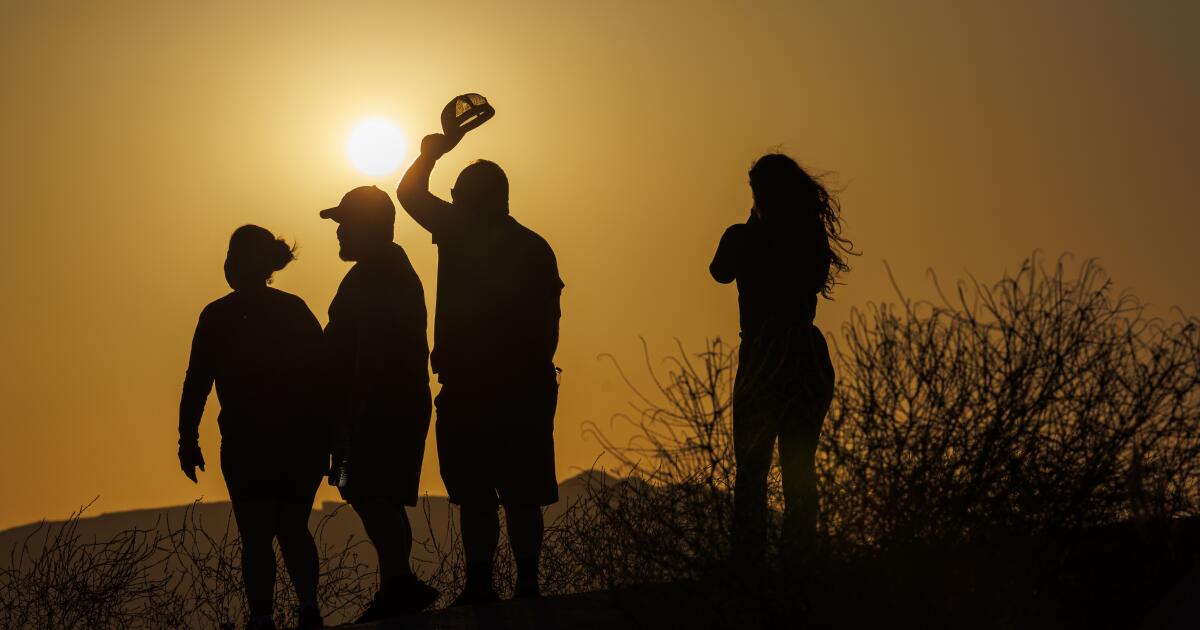
As hot, dry and disastrous as the last few years have been, it appears that the chaos caused by a warming planet is just getting started.
Though the hottest year in nearly two centuries was recorded only last year, the world will probably shatter that record yet again by 2029, according to a new report from the World Meteorological Organization, the climate and weather arm of the United Nations.
There is a very good chance that average warming over the next five years will be more than 2.7 degrees Fahrenheit, or 1.5 degrees Celsius, above preindustrial levels, the cap established by the Paris Agreement to ward off the worst consequences of climate change. There’s an even better chance that at least one of those years will be more than 2.7 degrees above the 1850 to 1900 average.
That means we can expect many more days when the weather feels freakish and far more natural disasters that cost people their homes, health or lives.
“It’s pretty bleak,” said Mike Flannigan, a fire scientist at Thompson Rivers University in British Columbia. “My fear is that [the coming years] will be even warmer than they suggest, and the impacts will continue to catch us by surprise and be more severe than we expect across the world, including the American West.”
In the western U.S. states, including California, those effects most probably include drought, heat waves and longer fire seasons with more intense wildfires, climate scientists said.
“As the globe has warmed thus far, the western U.S. has warmed as well, but without increases in precipitation that compensate for the drought- and wildfire-promoting effects of warming,” UCLA professor Park Williams said.
Last year, Williams examined 1,200 years of geological records and found that the previous 25 years were probably
the driest quarter of a century since the year 800. He sees no reason why that trend won’t continue.
“Given that there is not even a whiff of a hint that our global greenhouse gas emissions are going to slow in the next few years, then it appears virtually certain that the globally averaged temperature will continue to set new records every few years or so, just as it’s done over the past four to five decades,” Williams said.
The projections in the U.N. report are based on more than 200 forecasting models run by scientists at 14 research institutes around the globe, including two managed by the U.S. National Oceanic and Atmospheric Administration.
The report found an 80% chance that at least one year in the 2025 to 2029 period will surpass 2024 as the warmest year on record, and an 86% chance that at least one of those years will exceed the 2.7 degrees warming target.
It estimated a 70% likelihood that average warming over that period will be more than 2.7 degrees, though total warming averaged over 20 years — the Paris Agreement standard — will probably remain below that threshold.
“Unfortunately, this WMO report provides no sign of respite over the coming years, and this means that there will be a growing negative impact on our economies, our daily lives, our ecosystems and our planet,” Ko Barrett, deputy secretary-general of the World Meteorological Organization, said in a statement.
The consequences of warming will probably vary widely across the world, the report found: rapid thawing of Arctic sea ice, drier seasons in the Amazon, excess rain in places such as Alaska, northern Europe and the Sahel in north-central Africa.
Hotter temperatures are more effective at evaporating water out of plants and soil, leading to droughts and failed crop seasons. At the same time, a warmer atmosphere holds more moisture, which increases the chance of flood-inducing downpours and hurricanes.
Episodes of climate “whiplash” — rapid swings between wet-to-dry and dry-to-wet conditions — are also growing more frequent and intense because of rising global temperatures.
The devastating Palisades and Eaton wildfires in January erupted after such a period. Unusually heavy rains in 2023 led to an explosion of new vegetation, which dried out and turned into kindling during an exceptionally dry 2024.
The same week that the fires began, government agencies in the U.S. and around the world confirmed that 2024 was the planet’s hottest year since recordkeeping began in 1880. It was the 11th consecutive year the record had been set.
The U.S. will likely head into this period of climate chaos with a drastically reduced ability to forecast disasters and head off their worst consequences.
Rounds of firings have reduced staffing at NOAA, including in the agency’s National Weather Service. The Trump administration has proposed a $1.5-billion cut to NOAA’s budget in 2026, a 25% reduction from the previous year’s spending.
Those budget cuts are part of a wider turn away from climate mitigation efforts.
The U.S. already had a messy relationship with the Paris Agreement. It withdrew from the international accord just days before President Trump lost his reelection bid in November 2020. The U.S. rejoined when Joe Biden entered the White House in January 2021, but pulled out again when Trump began his second term in January.
Trump has gone even further to roll back U.S. climate science this time.
The phrases “climate crisis,” “clean energy” and “climate science” are among the prohibited terms that federal funding recipients and employees must reportedly strike from websites, reports, regulations and other communications.
In April, the administration dismissed more than 400 scientists and other experts who started writing the latest National Climate Assessment report, a congressionally mandated assessment of the latest climate change science and mitigation progress.
Meanwhile, the warming trend continues. And there’s no withdrawing from the planetary consequences.
“It’s scary. It really is,” Flannigan said. “A lot of people are ignoring this, or [saying] ‘it won’t be in my backyard.’ But it’s going to be in just about everyone’s backyard soon.”



Science
Cancer survival rates soar nationwide, but L.A. doctors warn cultural and educational barriers leave some behind

The American Cancer Society’s 2026 Cancer Statistics report, released Tuesday, marks a major milestone for U.S. cancer survival rates. For the first time, the annual report shows that 70% of Americans diagnosed with cancer can expect to live at least five years, compared with just 49% in the mid-1970s.
The new findings, based on data from national cancer records and death statistics from 2015 to 2021, also show promising progress in survival rates for people with the deadliest, most advanced and hardest-to-treat cancers when compared with rates from the mid-1990s. The five-year survival rate for myeloma, for example, nearly doubled (from 32% to 62%). The survival rate for liver cancer tripled (from 7% to 22%), for late-stage lung cancer nearly doubled (from 20% to 37%), and for both melanoma and rectal cancer more than doubled (from 16% to 35% and from 8% to 18%, respectively).
For all cancers, the five-year survival rate more than doubled since the mid-1990s, rising from 17% to 35%.
This also signals a 34% drop in cancer mortality since 1991, translating to an estimated 4.8 million fewer cancer deaths between 1991 and 2023. These significant public health advances result from years of public investment in research, early detection and prevention, and improved cancer treatment, according to the report.
“This stunning victory is largely the result of decades of cancer research that provided clinicians with the tools to treat the disease more effectively, turning many cancers from a death sentence into a chronic disease,” said Rebecca Siegel, senior scientific director at the American Cancer Society and lead author of the report.
As more people survive cancer, there is also a growing focus on the quality of life after treatment. Patients, families and caregivers face physical, financial and emotional challenges. Dr. William Dahut, the American Cancer Society’s chief scientific officer, said that ongoing innovation must go hand in hand with better support services and policies, so all survivors — not just the privileged — can have “not only more days, but better days.”
Indeed, the report also shows that not everyone has benefited equally from the advances of the last few decades. American Indian and Alaska Native people now have the highest cancer death rates in the country, with deaths from kidney, liver, stomach and cervical cancers about double that of white Americans.
Additionally, Black women are more likely to die from breast and uterine cancers than non-Black women — and Black men have the highest cancer rates of any American demographic. The report connects these disparities in survival to long-standing issues such as income inequity and the effects of past discrimination, such as redlining, affecting where people live — forcing historically marginalized populations to be disproportionately exposed to environmental carcinogens.
Dr. René Javier Sotelo, a urologic oncologist at Keck Medicine of USC, notes that the fight against cancer in Southern California, amid long-standing disparities facing vulnerable communities, is very much about overcoming educational, cultural and socioeconomic barriers.
While access to care and insurance options in Los Angeles are relatively robust, many disparities persist because community members often lack crucial information about risk factors, screening and early warning signs. “We need to insist on the importance of education and screening,” Sotelo said. He emphasized that making resources, helplines and culturally tailored materials readily available to everyone is crucial.
He cites penile cancer as a stark example: rates are higher among Latino men in L.A., not necessarily due to lack of access, but because of gaps in awareness and education around HPV vaccination and hygiene.
Despite these persisting inequities, the dramatic nationwide improvement in cancer survival is unquestionably good news, bringing renewed hope to many individuals and families. However, the report also gives a clear warning: Proposed federal cuts to cancer research and health insurance could stop or even undo these important gains.
“We can’t stop now,” warned Shane Jacobson, the American Cancer Society’s chief executive.
“We need to understand that we are not yet there,” Sotelo concurred. ”Cancer is still an issue.”

As the state continues multiyear marathon discussions on rules for what residents in wildfire hazard zones must do to make the first five feet from their houses — an area dubbed “Zone Zero” — ember-resistant, the Los Angeles City Council voted Tuesday to start creating its own version of the regulations that is more lenient than most proposals currently favored in Sacramento.
Critics of Zone Zero, who are worried about the financial burden and labor required to comply as well as the detrimental impacts to urban ecosystems, have been particularly vocal in Los Angeles. However, wildfire safety advocates worry the measures endorsed by L.A.’s City Council will do little to prevent homes from burning.
“My motion is to get advice from local experts, from the Fire Department, to actually put something in place that makes sense, that’s rooted in science,” said City Councilmember John Lee, who put forth the motion. “Sacramento, unfortunately, doesn’t consult with the largest city in the state — the largest area that deals with wildfires — and so, this is our way of sending a message.”
Tony Andersen — executive officer of the state’s Board of Forestry and Fire Protection, which is in charge of creating the regulations — has repeatedly stressed the board’s commitment to incorporating L.A.’s feedback. Over the last year, the board hosted a contentious public meeting in Pasadena, walking tours with L.A. residents and numerous virtual workshops and hearings.
-
Share via
Some L.A. residents are championing a proposed fire-safety rule, referred to as “Zone Zero,” requiring the clearance of flammable material within the first five feet of homes. Others are skeptical of its value.
With the state long past its original Jan. 1, 2023, deadline to complete the regulations, several cities around the state have taken the matter into their own hands and adopted regulations ahead of the state, including Berkeley and San Diego.
“With the lack of guidance from the State Board of Forestry and Fire Protection, the City is left in a precarious position as it strives to protect residents, property, and the landscape that creates the City of Los Angeles,” the L.A. City Council motion states.
However, unlike San Diego and Berkeley, whose regulations more or less match the strictest options the state Board of Forestry is considering, Los Angeles is pushing for a more lenient approach.
The statewide regulations, once adopted, are expected to override any local versions that are significantly more lenient.
The Zone Zero regulations apply only to rural areas where the California Department of Forestry and Fire Protection responds to fires and urban areas that Cal Fire has determined have “very high” fire hazard. In L.A., that includes significant portions of Silver Lake, Echo Park, Brentwood and Pacific Palisades.
Fire experts and L.A. residents are generally fine with many of the measures within the state’s Zone Zero draft regulations, such as the requirement that there be no wooden or combustible fences or outbuildings within the first five feet of a home. Then there are some measures already required under previous wildfire regulations — such as removing dead vegetation like twigs and leaves, from the ground, roof and gutters — that are not under debate.
However, other new measures introduced by the state have generated controversy, especially in Los Angeles. The disputes have mainly centered around what to do about trees and other living vegetation, like shrubs and grass.
The state is considering two options for trees: One would require residents to trim branches within five feet of a house’s walls and roof; the other does not. Both require keeping trees well-maintained and at least 10 feet from chimneys.
On vegetation, the state is considering options for Zone Zero ranging from banning virtually all vegetation beyond small potted plants to just maintaining the regulations already on the books, which allow nearly all healthy vegetation.
Lee’s motion instructs the Los Angeles Fire Department to create regulations in line with the most lenient options that allow healthy vegetation and do not require the removal of tree limbs within five feet of a house. It is unclear whether LAFD will complete the process before the Board of Forestry considers finalized statewide regulations, which it expects to do midyear.
The motion follows a pointed report from LAFD and the city’s Community Forest Advisory Committee that argued the Board of Forestry’s draft regulations stepped beyond the intentions of the 2020 law creating Zone Zero, would undermine the city’s biodiversity goals and could result in the loss of up to 18% of the urban tree canopy in some neighborhoods.
The board has not decided which approach it will adopt statewide, but fire safety advocates worry that the lenient options championed by L.A. do little to protect vulnerable homes from wildfire.
Recent studies into fire mechanics have generally found that the intense heat from wildfire can quickly dry out these plants, making them susceptible to ignition from embers, flames and radiant heat. And anything next to a house that can burn risks taking the house with it.
Another recent study that looked at five major wildfires in California from the last decade, not including the 2025 Eaton and Palisades fires, found that 20% of homes with significant vegetation in Zone Zero survived, compared to 37% of homes that had cleared the vegetation.
Science
At 89, he’s heard six decades of L.A.’s secrets and is ready to talk about what he’s learned

Dr. Arnold Gilberg’s sunny consultation room sits just off Wilshire Boulevard. Natural light spills onto a wooden floor, his houndstooth-upholstered armchair, the low-slung couch draped with a colorful Guatemalan blanket.
The Beverly Hills psychiatrist has been seeing patients for more than 60 years, both in rooms like this and at Cedars-Sinai Medical Center, where he has been an attending physician since the 1960s.
He treats wildly famous celebrities and people with no fame at all. He sees patients without much money and some who could probably buy his whole office building and not miss the cash.
Gilberg, 89, has treated enough people in Hollywood, and advised so many directors and actors on character psychology, that his likeness shows up in films the way people float through one another’s dreams.
The Nancy Meyers film “It’s Complicated” briefly features a psychiatrist character with an Airedale terrier — a doppelganger of Belle, Gilberg’s dog who sat in on sessions until her death in 2018, looking back and forth between doctor and patient like a Wimbledon spectator.
“If you were making a movie, he would be central casting for a Philip Roth‑esque kind of psychiatrist,” said John Burnham, a longtime Hollywood talent agent who was Gilberg’s patient for decades starting in his 20s. “He’s always curious and interested. He gave good advice.”
Since Gilberg opened his practice in 1965, psychiatry and psychotherapy have gone from highly stigmatized secrets to something people acknowledge in award show acceptance speeches. His longtime prescriptions of fresh food, sunshine, regular exercise and meditation are now widely accepted building blocks of health, and are no longer the sole province of ditzy L.A. hippies.
Beverly Hills psychiatrist Dr. Arnold Gilberg, 89, is the last living person to have trained under Franz Alexander, a disciple of Sigmund Freud.
(Robert Gauthier / Los Angeles Times)
He’s watched people, himself included, grow wiser and more accepting of the many ways there are to live. He’s also watched people grow lonelier and more rigid in their political beliefs.
On a recent afternoon, Gilbert sat for a conversation with The Times at the glass-topped desk in his consultation room, framed by a wall full of degrees. At his elbow was a stack of copies of his first book, “The Myth of Aging: A Prescription for Emotional and Physical Well-Being,” which comes out Tuesday.
In just more than 200 pages, the book contains everything Gilberg wishes he could tell the many people who will never make it into his office. After a lifetime of listening, the doctor is ready to talk.
Gilberg moved to Los Angeles in 1961 for an internship at what is now Los Angeles General Medical Center. He did his residency at Mount Sinai Hospital (later Cedars-Sinai) with the famed Hungarian American psychoanalyst Dr. Franz Alexander.
Among his fellow disciples of Sigmund Freud, Alexander was a bit of an outlier. He balked at Freud’s insistence that patients needed years of near-daily sessions on an analyst’s couch, arguing that an hour or two a week in a comfortable chair could do just as much good. He believed patients’ psychological problems stemmed more often from difficulties in their current personal relationships than from dark twists in their sexual development.
Not all of Alexander’s theories have aged well, Gilberg said — repressed emotions do not cause asthma, to name one since-debunked idea. But Gilberg is the last living person to have trained with Alexander directly and has retained some of his mentor’s willingness to go against the herd.
If you walk into Gilberg’s office demanding an antidepressant prescription, for example, he will suggest you go elsewhere. Psychiatric medication is appropriate for some mental conditions, he said, but he prefers that patients first try to fix any depressing situations in their lives.
He has counseled patients to care for their bodies long before “wellness” was a cultural buzzword. It’s not that he forces them to adopt regimens of exercise and healthy eating, exactly, but if they don’t, they’re going to hear about it.
“They know how I feel about all this stuff,” he said.
He tells many new patients to start with a 10-session limit. If they haven’t made any progress after 10 visits, he reasons, there’s a good chance he’s not the right doctor for them. If he is, he’ll see them as long as they need.
One patient first came to see him at 19 and returned regularly until her death a few years ago at the age of 79.
“He’s had patients that he’s taken care of over the span, and families that have come back to him over time,” said Dr. Itai Danovitch, who chairs the psychiatry department at Cedars-Sinai. “It’s one of the benefits of being an incredibly thoughtful clinician.”
Not long after opening his private practice in 1965, Gilberg was contacted by a prominent Beverly Hills couple seeking care for their son. The treatment went well, Gilberg said, and the satisfied family passed his name to several well-connected friends.
As a result, over the years his practice has included many names you’d recognize right away (no, he will not tell you who) alongside people who live quite regular lives.
They all have the same concerns, Gilberg says: Their relationships. Their children. Their purpose in life and their place in the world. Whatever you achieve in life, it appears, your worries remain largely the same.
When it’s appropriate, Gilberg is willing to share that his own life has had bumps and detours.
He was born in Chicago in 1936, the middle of three boys. His mother was a homemaker and his father worked in scrap metal. Money was always tight. Gilberg spent a lot of time with his paternal grandparents, who lived nearby with their adult daughter, Belle.
The house was a formative place for Gilberg. He was especially close to his grandfather — a rabbi in Poland who built a successful career in waste management after immigrating to the U.S. — and to his Aunt Belle.
Disabled after a childhood accident, Belle spent most of her time indoors, radiating a sadness that even at the age of 4 made Gilberg worry for her safety.
“It’s one of the things that brought me into medicine, and then ultimately psychiatry,” Gilberg said. “I felt very, very close to her.”
He and his first wife raised two children in Beverly Hills. Jay Gilberg is now a real estate developer and Dr. Susanne Gilberg-Lenz is an obstetrician-gynecologist (and the other half of the only father-daughter pair of physicians at Cedars-Sinai).
The marriage ended when he was in his 40s, and though the split was painful, he said, it helped him better understand the kind of losses his patients experienced.
He found love again in his 70s with Gloria Lushing-Gilberg. The couple share 16 grandchildren and seven great-grandchildren. They married four years ago, after nearly two decades together.
“As a psychoanalyst or psychiatrist ages, we have the ability, through our own life experiences, to be more understanding and more aware,” he said.
It’s part of what keeps him going. Though he has reduced his hours considerably, he isn’t ready to retire. He has stayed as active as he advises his patients to be, both personally (he was ordained as a rabbi several years ago) and professionally.
For all the strides society has made during the course of his career toward acceptance and inclusivity, he also sees that patients are lonelier than they used to be. They spend less time with friends and family, have a harder time finding partners.
We’re isolated and suffering for it, he said, as individuals and as a society. People still need care.
Unlike a lot of titles on the self-help shelves, Gilberg’s book promises no sly little hack to happiness, no “you’ve-been-thinking-about-this-all-wrong” twist.

After 60 years working with Hollywood stars and regular Angelenos, Gilberg is ready to share what he’s learned with the world.
(Robert Gauthier / Los Angeles Times)
His prescriptions run along deceptively simple lines: Care for your health. Say thank you. Choose to let go of harmless slights and petty conflicts. Find people you belong with, and stop holding yourself and others to impossibly high standards.
“People have the capacity to self-heal, and I have become a firm believer in that. Not everyone needs to be in therapy for 10 years to figure it out,” he said. “A lot of this is inside yourself. You have an opportunity to overcome the things and obstacles that are in you, and you can do it.”
So what is “it”? What does it mean to live a good life?
Gilberg considered the question, hands clasped beneath his chin, the traffic outside humming expectantly.
“It means that the person has been able to look at themselves,” he said, “and feel somewhat happy about their existence.”
The best any of us can hope for is to be … somewhat happy?
Correct, Gilberg said. “A somewhat happy existence, off and on, which is normal. And hopefully, if the person wants to pursue that, some kind of a personal relationship.”
As it turns out, there is no housing in happiness. You can visit, but nobody really lives there. The happiest people know that. They live in OK neighborhoods that are not perfect but could be worse. They try to be nice to the neighbors. The house is a mess a lot of the time. They still let people in.
Somewhat happy, sometimes, with someone else to talk to.
It is that simple. It is that hard.

MLK concert held annually at the Kennedy Center for 23 years is relocating

BMW says electric M3 will be a ‘new level’ of performance

Nigeria named epicenter of global killings of Christians over faith in 2025, report says

Republicans light cigars, cigarettes on burning photos of Khamenei to show support for Iranian protesters

Space experiments reveal new way to fight drug-resistant superbugs, scientists say

Florida High School Football Rankings: Top 25 teams – Oct. 21

Cleary's 21 help Le Moyne down Central Connecticut State 69-64 in OT

How old is Bo Nix? What to know about Oregon quarterback ahead of 2024 NFL Draft

99th annual Pony Swim held in Virginia

Video: ‘It Didn’t Have to Happen This Way:’ U.Va. Faculty Call for Review of Police Response to Protests
Republicans light cigars, cigarettes on burning photos of Khamenei to show support for Iranian protesters

EU Parliament questions defence loan’s ‘€17 billion gift’ to Hungary
Trump administration sends letter wiping out addiction, mental health grants

Video: Clashes With Federal Agents in Minneapolis Escalate

Venezuela releases multiple American citizens from prison following military operation
-

 Montana4 days ago
Service door of Crans-Montana bar where 40 died in fire was locked from inside, owner says
-

 Technology1 week ago
Power bank feature creep is out of control
-

 Delaware5 days ago
MERR responds to dead humpback whale washed up near Bethany Beach
-

 Dallas, TX6 days ago
Anti-ICE protest outside Dallas City Hall follows deadly shooting in Minneapolis
-

 Dallas, TX1 week ago
Defensive coordinator candidates who could improve Cowboys’ brutal secondary in 2026
-

 Virginia4 days ago
Virginia Tech gains commitment from ACC transfer QB
-

 Iowa1 week ago
Pat McAfee praises Audi Crooks, plays hype song for Iowa State star
-

 Education1 week ago
Video: This Organizer Reclaims Counter Space