Science
Government Science Data May Soon Be Hidden. They’re Racing to Copy It.


Amid the torrent of executive orders signed by President Trump were directives that affect the language on government web pages and the public’s access to government data touching on climate change, the environment, energy and public health.
In the past two months, hundreds of terabytes of digital resources analyzing data have been taken off government websites, and more are feared to be at risk of deletion. While in many cases the underlying data still exists, the tools that make it possible for the public and researchers to use that data have been removed.
But now, hundreds of volunteers are working to collect and download as much government data as possible and to recreate the digital tools that allow the public to access that information.
So far, volunteers working on a project called Public Environmental Data Partners have retrieved more than 100 data sets that were removed from government sites, and they have a growing list of 300 more they hope to preserve.
It echoes efforts that began in 2017, during Mr. Trump’s first term, when volunteers downloaded as much climate, environmental, energy and public health data as possible because they feared its fate under a president who has called climate change a hoax.
Little federal information disappeared then. But this time is different. And so, too, is the response.
“We should not be in this position where the Trump administration can literally take down every government website if it wants to,” said Gretchen Gehrke, an environmental scientist who helped found the Environmental Data and Governance Initiative in 2017 to conserve federal data. “We’re not prepared for having resilient public information in the digital age and we need to be.”
While a lot of data generated by agencies, like climate measurements collected by the National Oceanic and Atmospheric Administration, is required by Congress, the digital tools that allow the public to view that data are not.
“This is a campaign to remove public access,” said Jessie Mahr, the director of technology at the Environmental Policy Innovation Center, a member group of the data partnership. “And at the end of the day, American taxpayers paid for these tools.”
The Public Environmental Data Partners coalition has received frequent requests for two data tools: the Climate and Economic Justice Screening Tool, or CEJST, and the Environmental Justice Screening Tool, or EJScreen.
The first was developed under a Biden administration initiative to make sure that 40 percent of federal climate and infrastructure investments to go to disadvantaged communities. It was taken offline in January. EJScreen, developed under the Obama administration and once available through the E.P.A, was removed in early February.
“The very first thing across the executive branch was to remove references to equity and environmental justice and to remove equity tools from all agencies,” Dr. Gehrke said. “It really impairs the public’s ability to demonstrate structural racism and its disproportionate impacts on communities of color.”
Just a dozen years ago, the E.P.A. defined environmental justice as “the fair treatment and meaningful involvement of all people regardless of race, color, national origin, or income.” The E.P.A.’s new administrator, Lee Zeldin, recently equated environmental justice to “forced discrimination.”
Nonprofit organizations used both screening tools to apply for federal grants related to environmental justice and climate change. But the E.P.A. closed all of its environmental justice offices last week, ending three decades of work to mitigate the effects on poor and minority communities often disproportionately burdened by industrial pollution. It also canceled hundreds of grants already promised to nonprofit groups trying to improve conditions in those communities.
“You can’t possibly solve a problem until you can articulate it, so it was an important source of data for articulating the problem,” said Harriet Festing, executive director of the nonprofit group Anthropocene Alliance.
Christina Gosnell, co-founder and president of Catalyst Cooperative, a member of the environmental data cooperative, said her main concern was not that the data won’t be archived before it disappears, but that it won’t be updated.
Preserving the current data sets is the first step, but they could become irrelevant if data collection stops, she said.
More than 100 tribal nations, cities, and nonprofits used CEJST to show where and why their communities needed trees, which can reduce urban heat, and then applied for funds from the Arbor Day Foundation, a nonprofit organization that received a $75 million grant from the Inflation Reduction Action. The Arbor Day Foundation was on track to plant over a quarter of a million new trees before its grant was terminated in February.
How hard it is to reproduce complex tools depends on how the data was created and maintained. CEJST was “open source,” meaning the raw data and information that backed it up were already publicly accessible for coders and researchers. It was put back together by three people within 24 hours, according to Ms. Mahr.
But EJScreen was not an open source tool, and recreating it was more complicated.
“We put a lot of pressure on the last weeks of the Biden administration to make EJScreen open source, so they released as much code and documentation as they could,” Dr. Gehrke said.
It took at least seven people more than three weeks to make a version of EJScreen that was close to its original functionality, and Ms. Mahr said they’re still tinkering with it. It’s akin to recreating a recipe with an ingredient list but no assembly instructions. Software engineers have to try and remember how the “dish” tasted last time, and then use trial and error to reassemble it from memory.
Now, the coalition is working to conserve even more complicated data sets, like climate data from NOAA, which hosts many petabytes — think a thousand terabytes, or more than a million gigabytes — of weather observations and climate models in its archives.
“People may not understand just how much data that is,” Dr. Gehrke said in an email. It could cost hundreds of thousands of dollars per month just in storage fees, she said, without including the cost of any sort of access. She said they were talking to NOAA personnel to prioritize the most vulnerable and highest impact data to preserve as soon as possible.
So far, the data they’ve collected is largely stored in the cloud and backed up using servers around the globe; they’ve worked out pro bono agreements to avoid having to pay to back it up.
Some data have, so far, been left alone, like statistics from the Energy Information Administration, among other agencies. Zane Selvans, a fellow co-founder of Catalyst Cooperative said the group had worked for the past eight years to aggregate U.S. energy system data and research in the form of open source tools. The goal is to increase access to federal data that is technically available but not necessarily easy to use.
“So far we’ve been lucky,” Mr. Selvans said. “Folks working on environmental justice haven’t been as lucky.”



Video released by Chinese state media shows a state-owned aerospace company launching a rocket and recovering part of it on Friday. The successful launch of a reusable rocket was a major step for China toward challenging SpaceX’s satellite internet dominance.
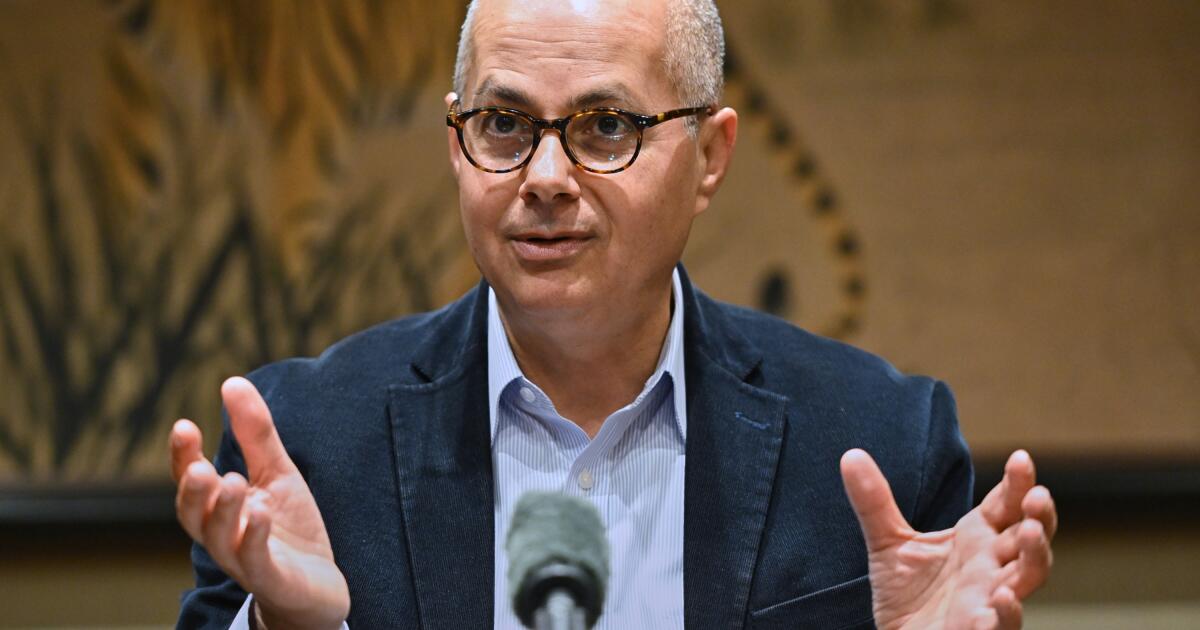
Nobel Prize recipient Omar Yaghi is leaving his role at UC Berkeley to lead the development of a new artificial intelligence institute at Tsinghua University in Beijing, the Chinese university announced.
Yaghi will head the AI Chemistry and Materials Research Institute at Tsinghua, where he was appointed an honorary professor in 2022. Known as AIMATRY (AI × Materials × Chemistry), the new center will focus on material design and synthesis through artificial intelligence, according to a statement from the university.
In 2025, Yaghi shared the Nobel Prize in chemistry with Susumu Kitagawa of Kyoto University and Richard Robson of the University of Melbourne for their development of metal-organic frameworks, a type of super-porous material in which metal ions and carbon-based molecules combine to form crystals with exceptionally large surface areas.
The material has the potential to combat climate change by capturing and storing carbon or other pollutants, and by extracting water from the atmosphere in water-scarce areas. Upon awarding the prize, a member of the Nobel committee likened the technology’s ability to store enormous amounts of stuff in seemingly compact spaces to Hermione Granger’s enchanted handbag in the Harry Potter series.
Yaghi’s Irvine-based company, Atoco, has said it will start taking orders later this year for its technology that harvests water from the air.
A representative for Yaghi said he was not yet available to respond to questions.
China is one of several countries that has been actively recruiting scientists from the U.S., where the Trump administration has slashed science funding, suspended research grants, fired science advisors and tightened immigration restrictions.
“For many, many years, our funding was very competitive; if you worked hard and you were doing good research, you would get funding,” Yaghi said of the U.S. in an interview with Scientific American earlier this year. “The current state is not so encouraging because of the cutting back on grants and support of science by the very agencies that many university researchers rely on.”
Yaghi was born in Jordan to Palestinian refugees, and immigrated to the U.S. when he was 15 to study.
“We’ve learned over and over in human civilization that scholars can move across borders,” Yaghi told the New York Times last year. “This is how knowledge spread and how vast regions of the world lifted themselves out of poverty.”
Science
Trump administration seeks to limit federal funding that doesn’t ‘advance’ presidential policies

A new rule proposed by the White House Office of Management and Budget would fundamentally overhaul the way federal grants are awarded and overseen — a sweeping change that one scientific society said “would all but end the use of scientific merit in the selection of grants and programs across the government.”
Proposed in late May, the rule would give political appointees unprecedented control over federal grants for research, education and infrastructure, and specifies that government funds can only be spent on projects “aligned with administration policies and priorities,” according to a copy of the proposed rule.
The rule would also restrict research topics, limit U.S. scientists’ ability to collaborate with colleagues in other countries and make it easier for the government to suspend or cancel grants at any time.
The changes are intended to improve “transparency, accountability, and oversight for Federal awards” while “ensuring that American tax dollars are not wasted or misused,” according to the White House office.
But critics say that if the rule is implemented, the final sign-off for grants will no longer be in the hands of subject-matter experts within individual agencies, but in those of political appointees.
“This touches all parts of American life,” said Dr. Eric Rafla-Yuan, a psychiatrist who practices at the Veterans Administration and San Diego County’s psychiatric hospital.
“Control of how all of the federal grants and programs are funded will fall under a small group of highly partisan individuals who would have very few limits on how they spend these billions of taxpayer dollars,” said Rafla-Yuan, who also chairs the Committee to Protect Public Mental Health advocacy group. “This touches everyone’s life, even if they don’t realize it.”
OMB published the proposed rule May 29, opening a 45-day comment period that closes July 13.
Opposition to the proposed rule has mobilized multiple sectors of society. Professional groups representing cancer researchers, civil engineers, county governments, medical schools, housing agencies, city and municipal governments, nonprofits and others have publicly expressed concerns about potential consequences.
By midday Thursday, the Federal Register logged nearly 100,000 comments about the proposal, many of them expressing concern.
“I understand the need for oversight, fiscal responsibility, and accountability. That is not the issue,” wrote Jack Feldman, a neuroscientist who holds the David Geffen School of Medicine Chair in Neuroscience at UCLA. “The issue is whether scientific research is to be judged by scientific merit, or whether it can be approved, denied, or terminated according to broad political criteria that may change from one administration to the next.”
Crucially, the rule converts policies governing federal grants from “guidance” into binding regulations that all agencies would be required to follow. It would give political appointees power to override federal agencies’ merit-based reviews and mandate that a political appointee review decisions to ensure that all awards “demonstrably advance the President’s policy priorities.”
The elevation of political appointees in what were previously merit-based decisions has alarmed many scientists.
“The proposed rule changes would all but end the use of scientific merit in the selection of grants and programs across the government,” read a statement from the Planetary Society, a nonprofit dedicated to space research.
Researchers and science groups have also expressed concern about a section of the rule prohibiting the promotion of “theories of disparate-impact liability” — a legal concept that refers to policies that appear neutral but cause disproportionate harm to certain groups.
The section’s vague language and many loopholes could have a chilling effect on any research that studies the effects of a disease, policy or public health intervention on any specific group of people, Rafla-Yuan said.
As an example, he said, “if there’s a specific age range that is at higher risk for suicide, and we want to figure out, well, what’s going on with people that are aged 14 to 19 … we can’t do that under the wording in this rule.”
New restrictions on collaborations with scientists in other countries would hinder opportunities for U.S. researchers and limit innovation, said Joanne Padrón Carney, chief government relations officer for the American Assn. for the Advancement of Science.
“Science is a global enterprise. Especially in biomedical and public health fields, diseases don’t care about borders or government policies,” she said.
California’s congressional delegation sent a letter Wednesday asking OMB to rescind the proposal, outlining concerns about its impact on scientific innovation, U.S. competitiveness and the fiscal stability of local governments, many of which rely on federal grants for local services.
The proposed rule grants the federal government broad powers to suspend or cancel grants for any reason, introducing “unprecedented unpredictability into local governance,” the lawmakers wrote, “leaving vital infrastructure projects unfinished and abandoning vulnerable populations who rely on these services.”
Republican Sen. Susan Collins has also asked the White House to withdraw certain parts of the letter and extend the public comment period, saying the proposed rule as written would “harm small and rural communities, undermine scientific and biomedical research, and conflict with Congress’ control over the federal funding process.”
-

 New York20 minutes ago
How ‘The Wire’ Star Jamie Hector Spends a Hot Day in Brooklyn
-

 Los Angeles, Ca23 minutes ago
Burglars ransack Sherman Oaks condo building during fumigation
-

 Detroit, MI43 minutes ago
Metro Detroit weather forecast, July 10, 2026 — 11 p.m. Update
-

 San Francisco, CA53 minutes ago
Classical music series helps reconnect downtown San Francisco community
-

 Dallas, TX58 minutes ago
Dallas police officers, paramedics recall saving woman stuck in a ravine for days;
-

 Boston, MA1 hour ago
Red Sox win 7th straight game just hours after landing in New York
-
 Denver, CO1 hour ago
One tree at a time: Denver nonprofit works to close shade gap as heat dome threatens neighborhoods
-

 Seattle, WA1 hour ago
VIDEO: West Seattle Summer Fest 2026 day 1, evening report

