Science
Explosion of power-hungry data centers could derail California clean energy goals

Near the Salton Sea, a company plans to build a data center to support artificial intelligence that would cover land the size of 15 football fields and require power that could support 425,000 homes.
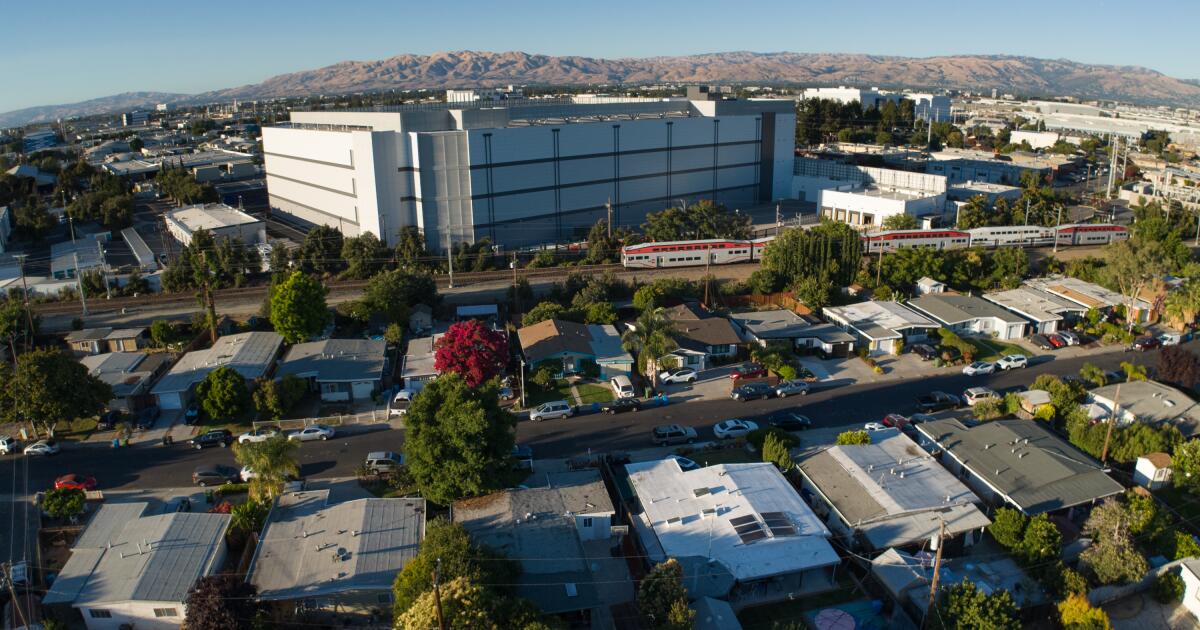
In Santa Clara — the heart of Silicon Valley — electric rates are rising as the municipal utility spends heavily on transmission lines and other infrastructure to accommodate the voracious power demand from more than 50 data centers, which now consume 60% of the city’s electricity.
And earlier this year, Pacific Gas & Electric told investors that its customers have proposed more than two dozen data centers, requiring 3.5 gigawatts of power — the output of three new nuclear reactors.
Vantage Data Center in Santa Clara is equipped with its own electrical substations.
(Paul Kuroda / For The Times)
While the benefits and risks of AI continue to be debated, one thing is clear: The technology is rapacious for power. Experts warn that the frenzy of data center construction could delay California’s transition away from fossil fuels and raise electric bills for everyone else. The data centers’ insatiable appetite for electricity, they say, also increases the risk of blackouts.
Even now, California is at the verge of not having enough power. An analysis of public data by the nonprofit GridClue ranks California 49th of the 50 states in resilience — or the ability to avoid blackouts by having more electricity available than homes and businesses need at peak hours.
“California is working itself into a precarious position,” said Thomas Popik, president of the Foundation for Resilient Societies, which created GridClue to educate the public on threats posed by increasing power use.
The state has already extended the lives of Pacific Gas & Electric Co.’s Diablo Canyon nuclear plant as well as some natural gas-fueled plants in an attempt to avoid blackouts on sweltering days when power use surges.
Worried that California could no longer predict its need for power because of fast-rising use, an association of locally run electricity providers called on state officials in May to immediately analyze how quickly demand was increasing.
The California Community Choice Assn. sent its letter to the state energy commission after officials had to revise their annual forecast of power demand upward because of skyrocketing use by Santa Clara’s dozens of data centers.
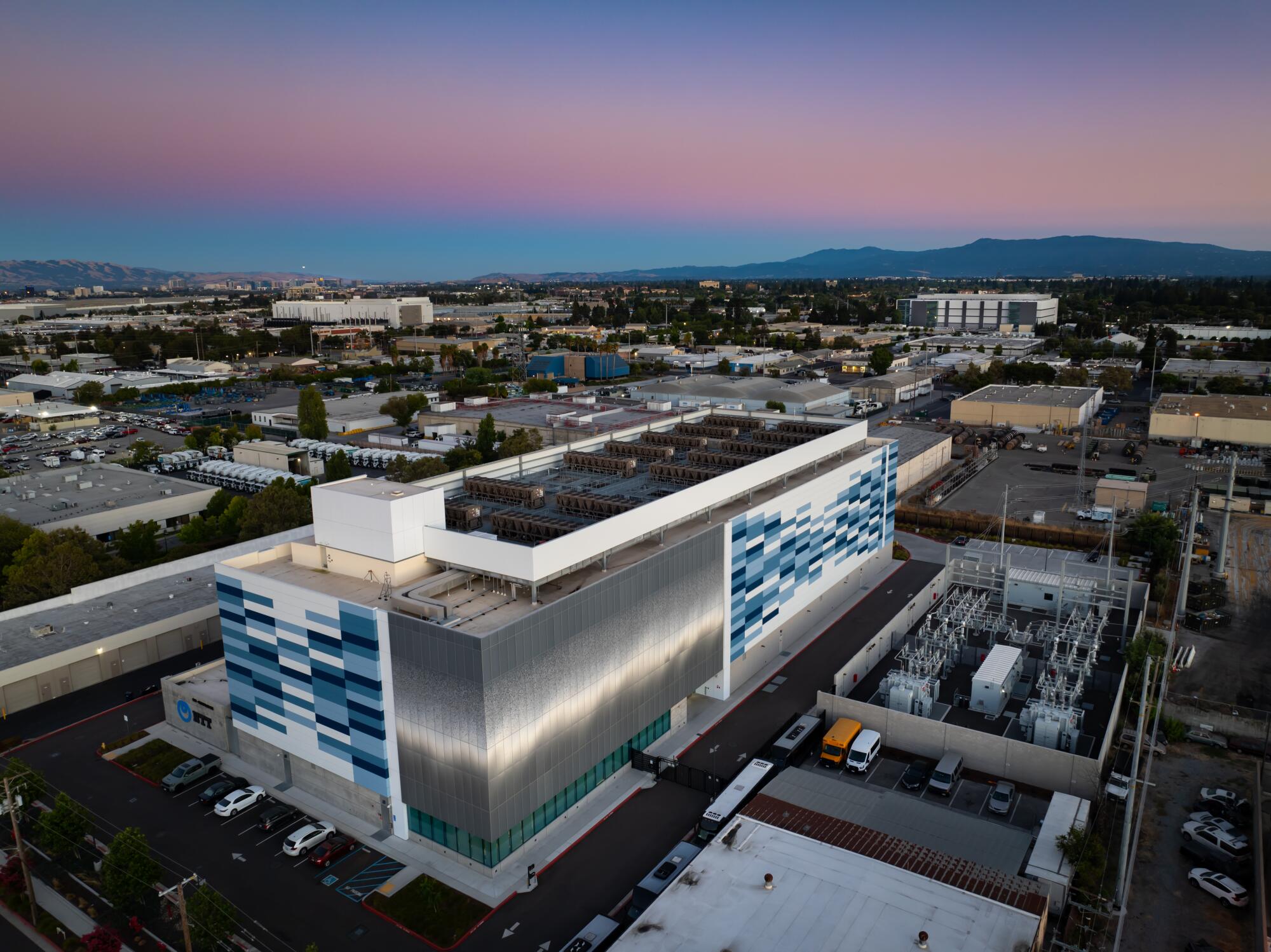
A large NTT data center rises in a Santa Clara neighborhood.
(Paul Kuroda / For The Times)
The facilities, giant warehouses of computer servers, have long been big power users. They support all that Americans do on the internet — from online shopping to streaming Netflix to watching influencers on TikTok.
But the specialized chips required for generative AI use far more electricity — and water — than those that support the typical internet search because they are designed to read through vast amounts of data.
A ChatGPT-powered search, according to the International Energy Agency, consumes 10 times the power as a search on Google without AI.
And because those new chips generate so much heat, more power and water is required to keep them cool.
“I’m just surprised that the state isn’t tracking this, with so much attention on power and water use here in California,” said Shaolei Ren, associate professor of electrical and computer engineering at UC Riverside.
Ren and his colleagues calculated that the global use of AI could require as much fresh water in 2027 as that now used by four to six countries the size of Denmark.
Driving the data center construction is money. Today’s stock market rewards companies that say they are investing in AI. Electric utilities profit as power use rises. And local governments benefit from the property taxes paid by data centers.
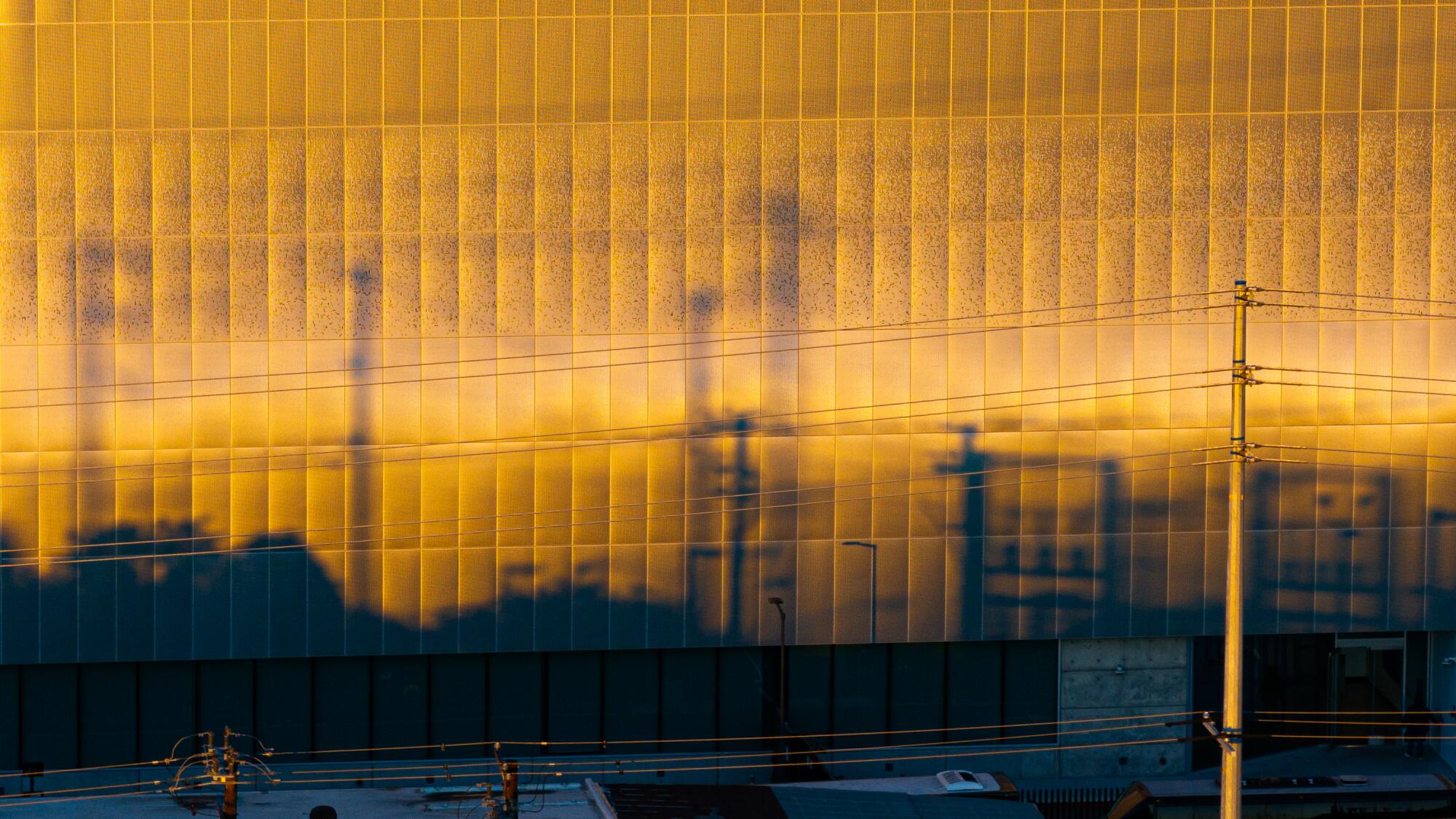
Transmission lines are reflected on the side of the NTT data center in Santa Clara.
(Paul Kuroda / For The Times)
Silicon Valley is the world’s epicenter of AI, with some of the biggest developers headquartered there, including Alphabet, Apple and Meta. OpenAI, the creator of ChatGPT, is based in San Francisco. Nvidia, the maker of chips needed for AI, operates from Santa Clara.
The big tech companies leading in AI, which also include Microsoft and Amazon, are spending billions to build new data centers around the world. They are also paying to rent space for their servers in so-called co-location data centers built by other companies.
In a Chicago suburb, a developer recently bought 55 homes so they could be razed to build a sprawling data center campus.
Energy officials in northern Virginia, which has more data centers than any other region in the world, have proposed a transmission line to shore up the grid that would depend on coal plants that had been expected to be shuttered.
In Oregon, Google and the city of The Dalles fought for 13 months to prevent the Oregonian from getting records of how much water the company’s data centers were consuming. The newspaper won the court case, learning the facilities drank up 29% of the city’s water.
By 2030, data centers could account for as much as 11% of U.S. power demand — up from 3% now, according to analysts at Goldman Sachs.
“We must demand more efficient data centers or else their continued growth will place an unsustainable strain on energy resources, impact new home building, and increase both carbon emissions and California residents’ cost of electricity,” wrote Charles Giancarlo, chief executive of the Santa Clara IT firm Pure Storage.
Santa Clara a top market for data centers
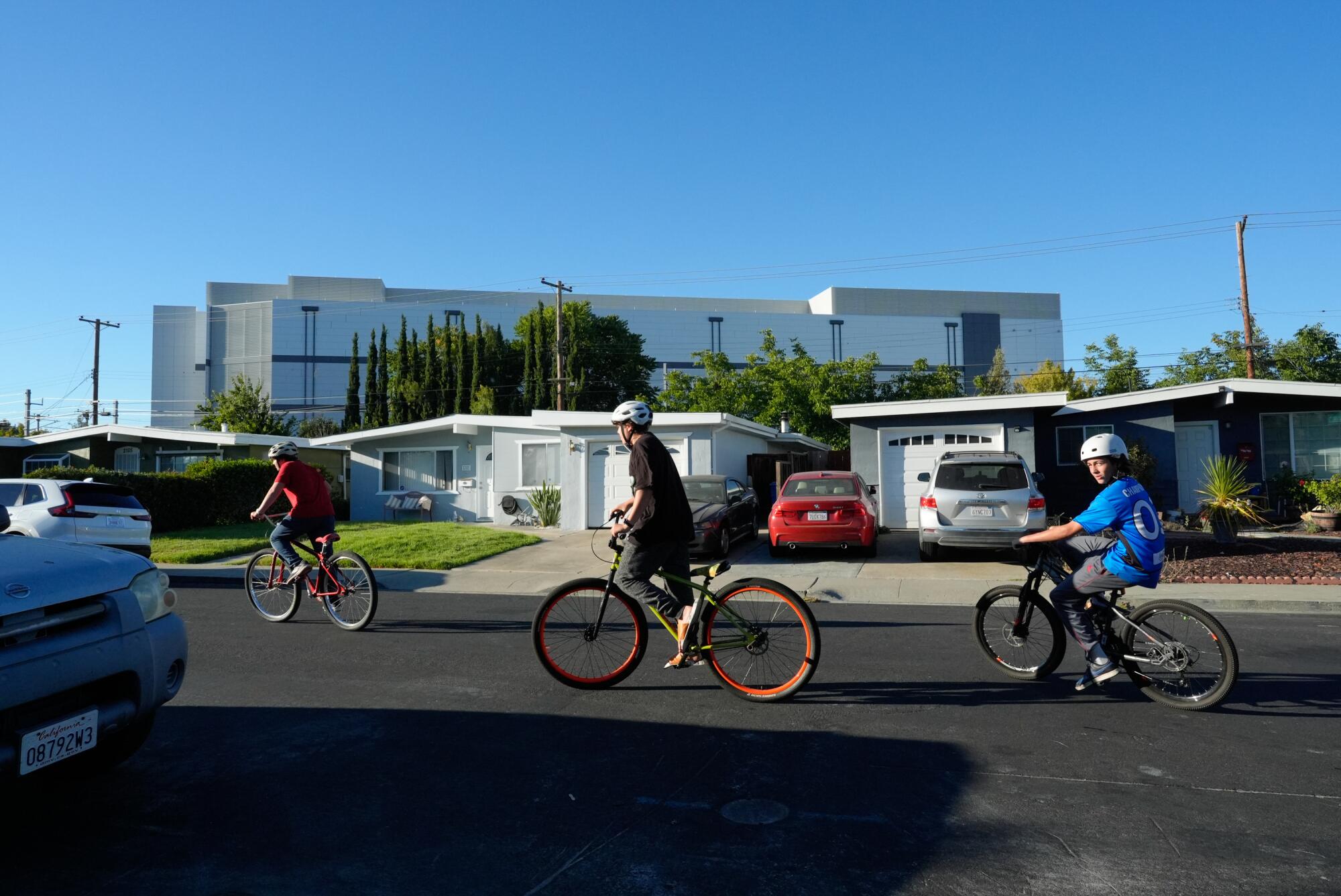
Boys ride their bikes on Main Street near a large data center in Santa Clara.
(Paul Kuroda / For The Times)
California has more than 270 data centers, with the biggest concentration in Santa Clara. The city is an attractive location because its electric rates are 40% lower than those charged by PG&E.
But the lower rates come with a higher cost to the climate. The city’s utility, Silicon Valley Power, emits more greenhouse gas than the average California electric utility because 23% of its power for commercial customers comes from gas-fired plants. Another 35% is purchased on the open market where the electricity’s origin can’t be traced.
The utility also gives data centers and other big industrial customers a discount on electric rates.
While Santa Clara households pay more for each kilowatt hour beyond a certain threshold, the rate for data centers declines as they use more power.
The city receives millions of dollars of property taxes from the data centers. And 5% of the utility’s revenue goes to the city’s general fund, where it pays for services such as road maintenance and police.
An analysis last year by the Silicon Valley Voice newspaper questioned the lower rates data centers pay compared with residents.
“What impetus do Santa Clarans have to foot the bill for these environmentally unfriendly behemoth buildings?” wrote managing editor Erika Towne.
In October, Manuel Pineda, the utility’s top official, told the City Council that his team was working to double power delivery over the next 10 years. “We prioritize growth as a strategic opportunity,” he said.
He said usage by data centers was continuing to escalate, but the utility was nearing its power limit. He said 13 new data centers were under construction and 12 more were moving forward with plans.
“We cannot currently serve all data centers that would like to be in Santa Clara,” he said.
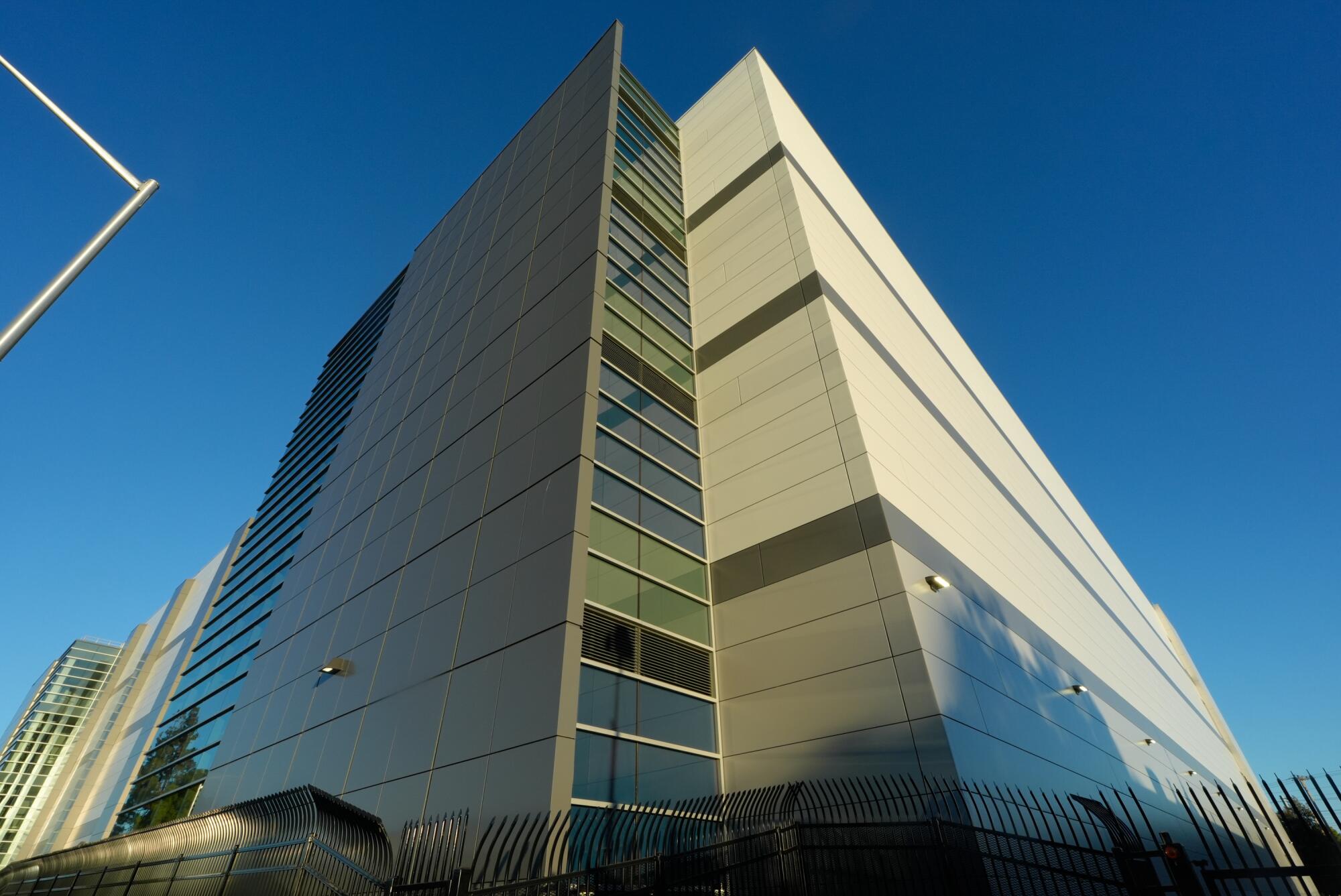
Dozens of data centers have been built for artificial intelligence and the internet in Santa Clara.
(Paul Kuroda / For The Times)
To accommodate increasing power use, the city is now spending heavily on transmission lines, substations and other infrastructure. At the same time, electric rates are rising. Rates had been increasing by 2% to 3% a year, but they jumped by 8% in January 2023, another 5% in July 2023 and 10% last January.
Pineda told The Times that it wasn’t just the new infrastructure that pushed rates up. The biggest factor, he said, was a spike in natural gas prices in 2022, which increased power costs.
He said residential customers pay higher rates because the distribution system to homes requires more poles, wires and transformers than the system serving data centers, which increases maintenance costs.
Pineda said the city’s decisions to approve new data centers “are generally based on land use factors, not on revenue generation.”
Loretta Lynch, former chair of the state’s public utilities commission, noted that big commercial customers such as data centers pay lower rates for electricity across the state. That means when transmission lines and other infrastructure must be built to handle the increasing power needs, residential customers pick up more of the bill.
“Why aren’t data centers paying their fair share for infrastructure? That’s my question,” she said.
PG&E eyes profits from boom
The grid’s limited capacity has not stopped PG&E from wooing companies that want to build data centers.
“I think we will definitely be one of the big ancillary winners of the demand growth for data centers,” Patricia Poppe, PG&E’s chief executive, told Wall Street analysts on an April conference call.
Poppe said she recently invited the company’s tech customers to an event at a San José substation.
“When I got there, I was pleasantly surprised to see AWS, Microsoft, Apple, Google, Equinix, Cisco, Western Digital Semiconductors, Tesla, all in attendance. These are our customers that we serve who want us to serve more,” she said on the call. “They were very clear: they would build … if we can provide.”
In June, PG&E revealed it had received 26 applications for new data centers, including three that need at least 500 megawatts of power, 24 hours a day. In all, the proposed data centers would use 3.5 gigawatts. That amount of power could support nearly 5 million homes, based on the average usage of a California household of 6,174 kilowatts a year.
In the June presentation, PG&E said the new data centers would require it to spend billions of dollars on new infrastructure.
Already PG&E can’t keep up with connecting customers to the grid. It has fallen so far behind on connecting new housing developments that last year legislators passed a law to try to shorten the delays. At that time, the company told Politico that the delays stemmed from rising electricity demand, including from data centers.
In a statement to The Times, PG&E said its system was “ready for data centers.”
The company said its analysis showed that adding the data centers would not increase bills for other customers.
Most of the year, excluding extreme hot weather, its grid “is only 45% utilized on average,” the company said.
“Data centers’ baseload will enable us to utilize more of this percentage and deliver more per customer dollar,” the company said. “For every 1,000 MW load from data centers we anticipate our customers could expect 1-2% saving on their monthly electricity bill.”
The company added that it was “developing tools to ensure that every customer can cost-effectively connect new loads to the system with minimal delay.”
Lynch questioned the company’s analysis that adding data centers could reduce bills for other customers. She pointed out that utilities earn profits by investing in new infrastructure. That’s because they get to recover that cost — plus an annual rate of return — through rates billed to all customers.
“The more they spend, the more they make,” she said.
In the desert, cheap land and green energy
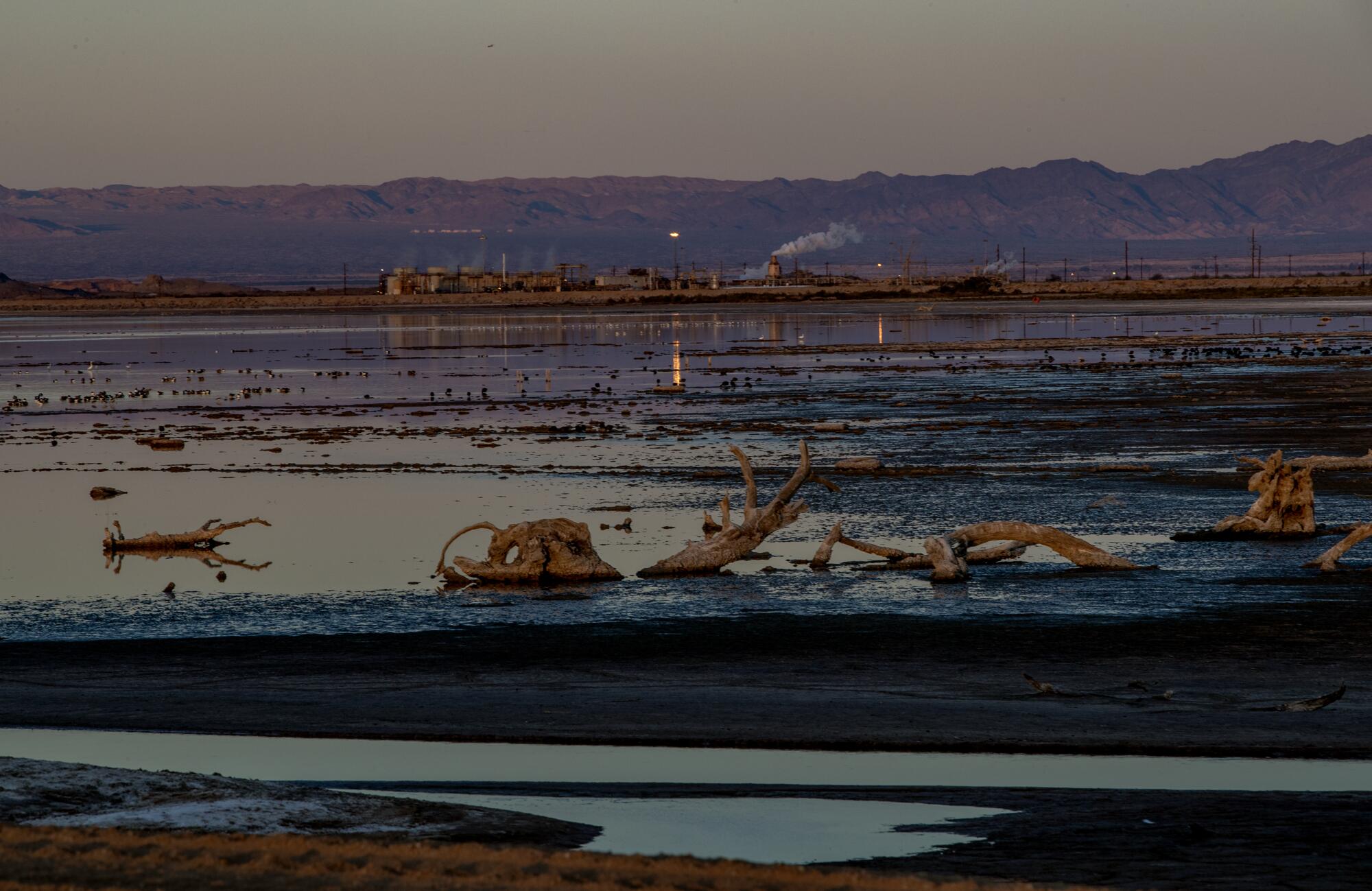
A geothermal plant viewed from across the Salton Sea in December 2022.
(Gina Ferazzi / Los Angeles Times)
The power and land constraints in Santa Clara and other cities have data center developers looking for new frontiers.
“On the edge of the Southern California desert in Imperial County sits an abundance of land,” begins the sales brochure for the data center that a company called CalEthos is building near the south shore of the Salton Sea.
Electricity for the data center’s servers would come from the geothermal and solar plants built near the site in an area that has become known as Lithium Valley.
The company is negotiating to purchase as much as 500 megawatts of power, the brochure said.
Water for the project would come from the state’s much fought over allotment from the Colorado River.
Imperial County is one of California’s poorest counties. More than 80% of its population are Latino. Many residents are farmworkers.
Executives from Tustin-based CalEthos told The Times that by using power from the nearby geothermal plants it would help the local community.
“By creating demand for local energy, CalEthos will help accelerate the development of Lithium Valley and its associated economic benefits,” Joel Stone, the company’s president, wrote in an email.
“We recognize the importance of responsible energy and water use in California,” Stone said. “Our data centers will be designed to be as efficient as possible.”
For example, Stone said that in order to minimize water use, CalEthos plans a cooling system where water is recirculated and “requires minimal replenishment due to evaporation.”
Already, a local community group, Comite Civico del Valle, has raised concerns about the environmental and health risks of one of the nearby geothermal plants that plans to produce lithium from the brine brought up in the energy production process.
One of the group’s concerns about the geothermal plant is that its water use will leave less to replenish the Salton Sea. The lake has been decreasing in size, creating a larger dry shoreline that is laden with bacteria and chemicals left from decades of agricultural runoff. Scientists have tied the high rate of childhood asthma in the area to dust from the shrinking lake’s shores.
James Blair, associate professor of geography and anthropology at Cal Poly Pomona, questioned whether the area was the right place for a mammoth data center.
“Data centers drain massive volumes of energy and water for chillers and cooling towers to prevent servers from overheating,” he said.
Blair said that while the company can tell customers its data center is supported by environmentally friendly solar and geothermal power, it will take that renewable energy away from the rest of California’s grid, making it harder for the state to meet its climate goals.


new video loaded: NASA Announces Artemis III Crew
transcript
transcript
NASA Announces Artemis III Crew
NASA announced the crew of Artemis III mission, which will fly to low-Earth orbit to test rendezvous and docking maneuvers with one or two lunar landers.
-
“I am excited to welcome you as the next crew in the Artemis journey to successfully return to the moon — this time to stay.” “I’m honored by the role that I’ve been given. I’m also very humbled by the task in front of us. But first and foremost, I’m grateful.” “So with that, the Artemis II crew, comrade, hands you the baton. You got the controls.” “As you know, we had a significant anomaly at our Launch Complex 36A on May 28. We’ve redoubled our efforts and are moving forward.”
By Alisa Shodiyev Kaff
June 9, 2026
Science
Santa Monica Mountains’ last steelhead trout survived the Palisades fire — and even had babies

Scientists feared the Santa Monica Mountains’ last remaining steelhead trout were dead, smothered by debris flows unleashed by the Palisades fire.
But the endangered fish surprised them: A team of biologists recently spotted 30 of the rare trout — and 21 babies — in Topanga Creek.
“There was a lot of happy dancing in the creek,” said Rosi Dagit, principal conservation biologist for the Resource Conservation District of the Santa Monica Mountains, which works with public and private landowners to conserve natural resources.
That’s because the steelhead here are endangered, at both the state and federal levels. Once, they swam in most streams of the Santa Monicas, but their numbers plummeted amid overfishing and coastal development. Increasingly frequent wildfire has further stressed their habitat. Topanga Creek, a biodiversity hot spot, is home to their last known population in the mountains that stretch from the Hollywood Hills to Point Mugu in Ventura County.
The trout that were spotted, including this one, are part of a distinct Southern California population that’s listed as endangered at the state and federal levels.
(RCDSMM Stream Team)
The California Department of Fish and Wildlife spearheaded a complex mission to rescue trout threatened by the Palisades fire that sparked in January 2025.
Time was of the essence. The fire hadn’t yet been fully contained. But rain was on the way, which would sweep massive amounts of sediment from the denuded hillsides into the water. Fish are often killed this way.
Crews stunned the fish with electricity, scooped them up in buckets, trucked them to a hatchery and ultimately moved them to Arroyo Hondo Creek in Santa Barbara County.
Within days, Topanga Creek was choked with mud. Some assumed the fish left behind were goners.
But in March, the conservation district’s team found four. The following month, when water conditions were clearer, they saw more.
“These fish continue to amaze me,” said Kyle Evans, environmental program manager for the state Department of Fish and Wildlife, who had seen the damage to the creek. “I had seen populations get wiped out in similar situations. So when I heard, I was thrilled.”
Evans surmises the fish that survived were in an area of the creek where less charred material and sediment were swept in.
“These fish likely hunkered down, were hiding under some rocks or places to try to get away from the main concentration of flow,” he said. “And luckily they weren’t buried.”
The ones that were spotted were fairly small, around 6 to 14 inches. Rainbow trout and steelhead trout are the same species, but with different lifestyles. If the fish remain in freshwater, they’ll be considered rainbows. However, they can migrate to the ocean and become steelhead, where they typically grow larger before returning to their natal waters to spawn.
Topanga Creek hasn’t fully recovered from the damage it sustained, but scientists say it’s looking better. Surveys last year were “so depressing,” Dagit said, with very few animals, and stretches that were essentially transformed into flat roads from all the sediment buildup. Some of the riparian canopy burned right down to the creek.
Then came 32 inches of rain over the last nine months, scouring out and moving sediment, creating deeper pools. Dagit said they recently found newt egg masses for the first time in years, as well as a few adult newts and many frogs. Plants that provide cover are starting to recover.
She provided photos comparing certain pools last year and this year, some dramatically transformed. In September 2025, the Shrine Pool could have been an overgrown hiking trail. This April, it was filled with shallow water.

The Shrine Pool in September 2025, left, and the same location in April 2026, right, with RCDSMM’s Isaac Yelchin donning a wetsuit.
(RCDSMM Stream Team)
Topanga Creek is home to another endangered fish, the small but hardy northern tidewater goby, often described as cute. Not long before the trout operation, Dagit led a rescue of hundreds of these fish too. Many were repatriated to the lagoon at the mouth of the creek in a moving ceremony last June.
There’s still the matter of what to do with the trout that were moved to Santa Barbara County last year. Evans would like to bring them home to the Santa Monicas at some point, but isn’t sure if it will happen. On one hand, they could bolster the small, genetically isolated surviving population. On the other, they might inadvertently bring in a disease or bacteria. There is some time to decide. Evans estimates the creek still needs to recover for two to three more years.
For now, the fish are functioning fine in their adopted creek. Experts worried the trauma wrought by the move would disrupt their spawning process, but they had babies that spring. This year, they spawned again.

The Pacifica Municipal Pier was shut down and taped off Thursday after city workers noticed cracks running through the landmark structure and concrete chunks falling into the ocean.
It’s just one of many coastal California structures that have recently crumbled under pressure from a rising and relentless ocean.
Officials from the small, beach city south of San Francisco said the pier was closed due to “cracking, separation, and displacement of the concrete walkway and structural elements.”
It will stay closed while structural engineers asses its safety.
Photos taken by city employees show a wide crack that runs from top to bottom and across the structure as well. Other photos show a large horizontal crack under the foundation of a small restaurant on the pier, the Chit Chat Cafe.
The cafe was also shut down.
This is not the first time the 53-year-old pier has shown signs of stress. In 2021, part of it was shut down after handrails along the edge collapsed. And in 2023, after a series of storms pummeled the Central California coast, damaging parts of the pier, the structure was partially closed for more than year.
Those same storms caused extensive damage in Aptos and Capitola, 70 miles south, where piers and waterfront infrastructure were swept away or damaged.
In 2024, a 150- to 180- foot section of the Santa Cruz wharf was ripped off by powerful waves.
At least 10 of the state’s dozens of coastal public piers were closed for part or all of 2024 due to structural damage sustained in winter storms since 2022. At least five others have longer-term upgrades planned to address structural issues.
“These things are costly to maintain,” said Zach Plopper, senior environmental director at Surfrider. “They are a part of our California coastal culture in many ways, but we’re going to need to reckon with, one, the state that they’re in, and two, the continuous and worsening threats they’re going to experience,”
He said most of the piers were constructed in the early 1900s, and they weren’t built to withstand decades of rough seas, storms and rising sea level.
“With this incoming El Niño, which is forecasted to be significant, and this marine heat wave we’re in the midst of, we’re kind of in uncharted waters as far as what this winter could bring in terms of storms and swells to the California coast, and we’re likely going to see a lot more damage,” he said. “Not just piers, but roads and other coastal infrastructure up and down the state.”
There was no storm in Pacifica earlier this week, so no single event could be blamed for the destruction.
However, a 2025 report from an outside engineering firm, GHD, found that several sections of the pier were in “poor” or “serious” condition, and they recommended closure before anticipated storms or events that could “subject the piles to high winds, swells and large waves.”
The firm found several areas of the pier where concrete was missing and rebar was exposed and corroding.
“The pier has continued to experience high winds and large waves in a harsh marine environment,” the engineers wrote in the report, noting that continuous exposure to seawater or marine spray was “detrimental” to the structure.
A 2023 city report estimated it would cost $19 million to repair.
That same year, a state law was enacted to require local governments along the California coast to plan for sea level rise in the coming decades.
Sea level has risen some 8 inches, on average, along the coast in the past 150 years, Plopper said, and researchers anticipate another foot in the next 25 years.
“We’re going to see profound shifts on our coastline, none that we have ever experienced before, and building static structures on the coast just doesn’t work all that well,” he said. “We’re going to have to make some really hard decisions.”
-

 Iowa2 minutes ago
Here’s what to know as another year brings another watering ban
-

 Kansas5 minutes ago
Kansas boy discovers 15-foot marine reptile fossil from 85 million years ago during geology field trip
-

 Kentucky10 minutes ago
What states spend the most on fast food? Kentucky ranks among the top
-

 Louisiana17 minutes ago
Winnsboro woman dies in single-vehicle crash on LA Highway 867
-

 Maine20 minutes ago
Live updates: Midterms take shape in California, Maine, S.C. and Nevada; Trump to sign ICE bill
-

 Maryland25 minutes ago
Alert Days Wednesday through Friday for severe weather risk, intense heat in Maryland
-

 Michigan32 minutes ago
Trieu: For Michigan State targets, visits, in-state decisions loom
-

 Massachusetts35 minutes ago
Make Father’s Day memorable with these 10 activities in Massachusetts

