Science
Despite warnings from bird flu experts, it's business as usual in California dairy country

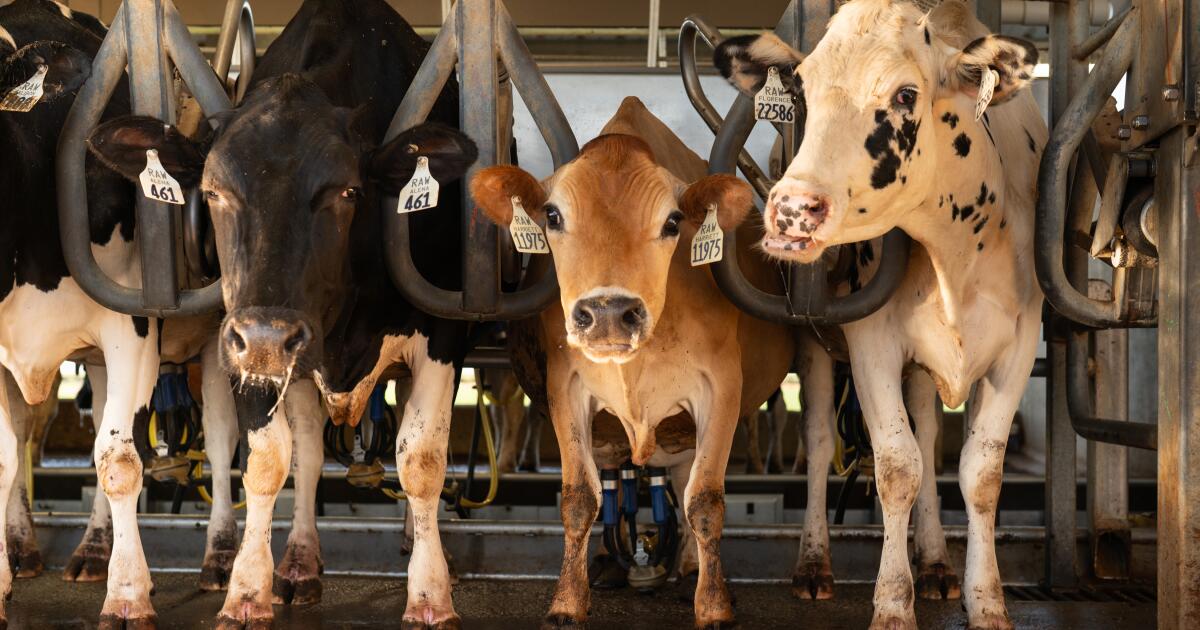
TIPTON, Calif. — It was a late fall morning and hundreds of cows — black and white splattered Holsteins and cappuccino-colored Jerseys — milled about a San Joaquin Valley dairy farm in the largest milk-producing state in the nation.
Nearby, workers herded some of the animals onto a rotating platform within the farm’s milking parlor and quickly attached pumping equipment. The machines buzzed and whirred as the cows were carried in a lazy arc to the parlor’s exit, where they were detached from milk hoses and sent on their way.
The scene seemed utterly unremarkable — except for the fact that five days earlier, the H5N1 bird flu virus that has ravaged California’s dairy herds for the last three months, had been confirmed on the farm. Although dozens of cows were sick, and their owner expected that number to climb, none of the farm’s workers wore personal protective equipment and vehicles from off site were let in and out with nary a hint of concern.
As H5N1 bird flu infects a growing number of California dairy farms, dead cows are becoming an increasingly common site in some areas of the Central Valley.
(Tomas Ovalle / For The Times)
The farm was just one of more than 400 California operations that have been confirmed to have suffered outbreaks of H5N1, but interviews with Central Valley dairy farmers, dairy workers and a recent study by the U.S. Centers for Disease Control and Prevention suggests the virus may be more widespread in people than the CDC’s official numbers suggest. Although authorities have been urging dairy farms and workers to take precautions against spreading infection, there is little evidence their cautions are being heeded.
No expert will say that H5N1 bird flu is going to become the next global pandemic, and government health officers say the virus poses a low risk to the public. However, some experts warn that nearly all the conditions needed for the virus to develop a threatening mutation are now present in many dairy farms: Lax testing protocols; close, unprotected contact between humans and animals; a general failure to take the threat seriously enough; and the approach of human flu season.
Since this particular clade of H5N1 virus (2.3.4.4b) first appeared in North America at the end of 2021, it has infected more than 600 dairy herds across 15 states, hundreds of millions of wild and domesticated birds, and at least 48 mammal species — such as dolphins, seals, cats and dogs.
“We are in a soup of virus. I mean, there’s virus everywhere around us at this point,” said Dr. Marcela Uhart, a wildlife veterinarian with UC Davis’ One Health institute, who is based in Argentina, speaking at symposium held by the O’Neill Institute at Georgetown Law recently. (11/15) “This virus is circulating left and right in mammals and in birds, as far as we can tell, some of them are not showing any signs of disease.”
In October, The Times visited Tipton, a dairy town in Tulare County, and spoke with several residents, including Elodia Ibañez, who said the number of reported human cases in California — which in mid-October was 16, and is now 23 — sounded too low. She said her husband, a dairy worker, told her that two of his co-workers had red, swollen eyes, but they had continued working despite displaying bird flu symptoms.
“It’s an illness that they know the cows have, and many cows have died. But the boss cared about the cows, not the workers,” Ibañez told The Times. “They never told them they have to go to the doctor to get a check-up.”
People often continue to work because they feel they have no other choice, she said. “Even though they say there are laws that protect them, there are still a lot of people who are fearful … They’re scared of losing their jobs.”
Anthony, also a Tipton resident, said he would talk, but did not want to share his last name; he has family members who work in dairies, and he feared impacting their employment by speaking out.
“My dad and uncle have told me there’s a bunch of dairies that have had outbreaks,” Anthony said. He said his dad and uncle take steps to stay safe, but many workers likely are not reporting getting sick because they don’t want to get in trouble.
“Some of them are here not legally. They’re relying on that job, they don’t want to jeopardize that,” he said.
In early November, the CDC published a study that looked for H5N1 antibodies in the blood of dairy workers in Michigan and Colorado. The agency sampled blood from 115 people; eight — or 7% — had antibodies. Only three dairy workers in those two states — one in Colorado, two in Michigan — have been positively identified as having the disease.
It’s this blindness to — and ignorance of — the virus’ reach that has infectious disease and health experts concerned.
And as human flu season approaches, and infected wild birds continue their southward migration down the North American flyways — stopping to rest in lakes, ponds, farms and backyards throughout the United States — experts worry conditions are becomingly increasingly ripe for a large “spillover” event.
If a virus — whether it’s a bird flu, a human influenza virus or a coronavirus — is given the opportunity to spread within and between organisms, the virus will evolve, adapt and mutate. Sometimes these mutations have little effect on its ability to transmit between organisms or cause severe disease. But sometimes, they do.
Then there’s the concern that the bird flu virus will find another flu virus that’s circulating — a human, swine or even other bird flu — and swap genetic material with it, potentially creating a new “super flu” that can spread easily between people, make its hosts very sick, or carry immunity to the antiviral medications used to treat infected patients.
In the 1970s, when the understanding of flu viruses was still being developed, Robert Webster, a researcher at St. Jude’s Hospital in Memphis, Tenn., conducted an experiment at the U.S. Department of Agriculture’s Plum Island Research Station, off the coast of Long Island.
He put a human flu virus — H3N2 — into one pig, and a swine flu virus — H1N1 — into another. He then put the two pigs in a pen with four other pigs. Seven days later, he and his team detected reassorted viruses — H3N1 and H1N2 — in one of the other pigs.
The viruses had swapped genes and created new combinations.

Jersey cows drink water at sunrise.
(Tomas Ovalle / For The Times)
The work of Webster and others led to the discovery that several of the nastier historical flu pandemics have been the result of this kind of reassortment. For instance, the 1918 flu outbreak — which killed approximately 50 million people worldwide — is believed to have been a recombined version of a bird and human flu.
It happened again in 2009, when a human and swine flu switched genes, unleashing the H1N1 swine flu outbreak that killed roughly 500,000 people.
Already there is evidence this virus is swapping genes. The birds currently traveling south from the Arctic are carrying a slightly different variant of H5N1 — called D1.1 or D1.2 — that has an altered take on the several of the flu’s viral segments.
It’s this strain that has put a Canadian teenager into critical condition at a British Columbia hospital. Health authorities don’t know where or how the child picked it up, except to note it wasn’t from cows or poultry. And they don’t know yet whether it has acquired the ability to move easily between people — although early and initial testing suggests it may have acquired some new and ominous traits, including changes that would make it easier to infect people.
Even so, as of this moment, there is no evidence that the H5N1 bird flu circulating among dairy cows and workers — known as B3.13 — has achieved the ability to move efficiently from human to human, or to cause severe illness. But with human flu season approaching — and the possibility that retail customers were drinking infected raw milk — the chances increase.
In an effort to spread awareness among dairy farms and potentially lure workers in for testing and decrease the chances for this virus to acquire mutations that could make it widespread and deadly in people, state health, agriculture and workers safety experts held a workshop at the Tulare Expo Center in late October, with help from the dairy trade group, Western United Dairies.
About 20 dairy workers and farmers sat through the two-hour session, which included English and Spanish presentations from the different state agenciess and dozens of slides
Dr. Erica Pan, California’s State Epidemiologist, told the audience her agency recommended personal protective equipment at work, and urged people to protect their eyes. She also told the audience to stay up to date on their recommended vaccines and refrain from consuming raw milk and undercooked beef, “especially ground beef.”
Eric Berg, Deputy Chief of Health and Research and Standards at CalOSHA said that farms under quarantine needed to establish restricted areas for infected animals. Workers, he said, should wear protective clothing, including coveralls, gloves and “and very important … eye protection and also respirators indoors.”
Eduardo Mondragon sat near the front of a conference room, nodding along as experts discussed safety protocols for dairy workers. As a manager of multiple dairy farms, Mondragon had watched the bird flu rip through the farms he oversaw in Tulare County and the cows he and his colleagues were tasked with caring for as they became sick.
Milk production fell as hundreds of cows became sick and about a dozen died, he said, but the dairy’s owner provided protective gear, including gloves and goggles, which workers were used to wearing daily.
At the dairy farm, Mondragon said they worked quickly when cows started getting sick over the summer to try and stop the spread. His boss sent him to the seminar in Tulare to learn more about the bird flu.
“For weeks, we never stopped,” he said, with many workers working weekend shifts to care for the cows. “We had a good handle on the flu, and because of that we didn’t suffer that many losses. Milk production yes, but animals, no.”
Mondragon knows that while his dairy farm saw the worst of the bird flu hit over the summer, none of the workers reported getting sick. He said friends in the industry in other countries were not yet affected like dairies in Tulare County.
After the seminar, Mondragon loaded up his white pickup truck with boxes of N95 masks, face shields and goggles to take back to his job site and share with the other workers.


new video loaded: NASA Announces Artemis III Crew
transcript
transcript
NASA Announces Artemis III Crew
NASA announced the crew of Artemis III mission, which will fly to low-Earth orbit to test rendezvous and docking maneuvers with one or two lunar landers.
-
“I am excited to welcome you as the next crew in the Artemis journey to successfully return to the moon — this time to stay.” “I’m honored by the role that I’ve been given. I’m also very humbled by the task in front of us. But first and foremost, I’m grateful.” “So with that, the Artemis II crew, comrade, hands you the baton. You got the controls.” “As you know, we had a significant anomaly at our Launch Complex 36A on May 28. We’ve redoubled our efforts and are moving forward.”
By Alisa Shodiyev Kaff
June 9, 2026
Science
Santa Monica Mountains’ last steelhead trout survived the Palisades fire — and even had babies

Scientists feared the Santa Monica Mountains’ last remaining steelhead trout were dead, smothered by debris flows unleashed by the Palisades fire.
But the endangered fish surprised them: A team of biologists recently spotted 30 of the rare trout — and 21 babies — in Topanga Creek.
“There was a lot of happy dancing in the creek,” said Rosi Dagit, principal conservation biologist for the Resource Conservation District of the Santa Monica Mountains, which works with public and private landowners to conserve natural resources.
That’s because the steelhead here are endangered, at both the state and federal levels. Once, they swam in most streams of the Santa Monicas, but their numbers plummeted amid overfishing and coastal development. Increasingly frequent wildfire has further stressed their habitat. Topanga Creek, a biodiversity hot spot, is home to their last known population in the mountains that stretch from the Hollywood Hills to Point Mugu in Ventura County.
The trout that were spotted, including this one, are part of a distinct Southern California population that’s listed as endangered at the state and federal levels.
(RCDSMM Stream Team)
The California Department of Fish and Wildlife spearheaded a complex mission to rescue trout threatened by the Palisades fire that sparked in January 2025.
Time was of the essence. The fire hadn’t yet been fully contained. But rain was on the way, which would sweep massive amounts of sediment from the denuded hillsides into the water. Fish are often killed this way.
Crews stunned the fish with electricity, scooped them up in buckets, trucked them to a hatchery and ultimately moved them to Arroyo Hondo Creek in Santa Barbara County.
Within days, Topanga Creek was choked with mud. Some assumed the fish left behind were goners.
But in March, the conservation district’s team found four. The following month, when water conditions were clearer, they saw more.
“These fish continue to amaze me,” said Kyle Evans, environmental program manager for the state Department of Fish and Wildlife, who had seen the damage to the creek. “I had seen populations get wiped out in similar situations. So when I heard, I was thrilled.”
Evans surmises the fish that survived were in an area of the creek where less charred material and sediment were swept in.
“These fish likely hunkered down, were hiding under some rocks or places to try to get away from the main concentration of flow,” he said. “And luckily they weren’t buried.”
The ones that were spotted were fairly small, around 6 to 14 inches. Rainbow trout and steelhead trout are the same species, but with different lifestyles. If the fish remain in freshwater, they’ll be considered rainbows. However, they can migrate to the ocean and become steelhead, where they typically grow larger before returning to their natal waters to spawn.
Topanga Creek hasn’t fully recovered from the damage it sustained, but scientists say it’s looking better. Surveys last year were “so depressing,” Dagit said, with very few animals, and stretches that were essentially transformed into flat roads from all the sediment buildup. Some of the riparian canopy burned right down to the creek.
Then came 32 inches of rain over the last nine months, scouring out and moving sediment, creating deeper pools. Dagit said they recently found newt egg masses for the first time in years, as well as a few adult newts and many frogs. Plants that provide cover are starting to recover.
She provided photos comparing certain pools last year and this year, some dramatically transformed. In September 2025, the Shrine Pool could have been an overgrown hiking trail. This April, it was filled with shallow water.

The Shrine Pool in September 2025, left, and the same location in April 2026, right, with RCDSMM’s Isaac Yelchin donning a wetsuit.
(RCDSMM Stream Team)
Topanga Creek is home to another endangered fish, the small but hardy northern tidewater goby, often described as cute. Not long before the trout operation, Dagit led a rescue of hundreds of these fish too. Many were repatriated to the lagoon at the mouth of the creek in a moving ceremony last June.
There’s still the matter of what to do with the trout that were moved to Santa Barbara County last year. Evans would like to bring them home to the Santa Monicas at some point, but isn’t sure if it will happen. On one hand, they could bolster the small, genetically isolated surviving population. On the other, they might inadvertently bring in a disease or bacteria. There is some time to decide. Evans estimates the creek still needs to recover for two to three more years.
For now, the fish are functioning fine in their adopted creek. Experts worried the trauma wrought by the move would disrupt their spawning process, but they had babies that spring. This year, they spawned again.

The Pacifica Municipal Pier was shut down and taped off Thursday after city workers noticed cracks running through the landmark structure and concrete chunks falling into the ocean.
It’s just one of many coastal California structures that have recently crumbled under pressure from a rising and relentless ocean.
Officials from the small, beach city south of San Francisco said the pier was closed due to “cracking, separation, and displacement of the concrete walkway and structural elements.”
It will stay closed while structural engineers asses its safety.
Photos taken by city employees show a wide crack that runs from top to bottom and across the structure as well. Other photos show a large horizontal crack under the foundation of a small restaurant on the pier, the Chit Chat Cafe.
The cafe was also shut down.
This is not the first time the 53-year-old pier has shown signs of stress. In 2021, part of it was shut down after handrails along the edge collapsed. And in 2023, after a series of storms pummeled the Central California coast, damaging parts of the pier, the structure was partially closed for more than year.
Those same storms caused extensive damage in Aptos and Capitola, 70 miles south, where piers and waterfront infrastructure were swept away or damaged.
In 2024, a 150- to 180- foot section of the Santa Cruz wharf was ripped off by powerful waves.
At least 10 of the state’s dozens of coastal public piers were closed for part or all of 2024 due to structural damage sustained in winter storms since 2022. At least five others have longer-term upgrades planned to address structural issues.
“These things are costly to maintain,” said Zach Plopper, senior environmental director at Surfrider. “They are a part of our California coastal culture in many ways, but we’re going to need to reckon with, one, the state that they’re in, and two, the continuous and worsening threats they’re going to experience,”
He said most of the piers were constructed in the early 1900s, and they weren’t built to withstand decades of rough seas, storms and rising sea level.
“With this incoming El Niño, which is forecasted to be significant, and this marine heat wave we’re in the midst of, we’re kind of in uncharted waters as far as what this winter could bring in terms of storms and swells to the California coast, and we’re likely going to see a lot more damage,” he said. “Not just piers, but roads and other coastal infrastructure up and down the state.”
There was no storm in Pacifica earlier this week, so no single event could be blamed for the destruction.
However, a 2025 report from an outside engineering firm, GHD, found that several sections of the pier were in “poor” or “serious” condition, and they recommended closure before anticipated storms or events that could “subject the piles to high winds, swells and large waves.”
The firm found several areas of the pier where concrete was missing and rebar was exposed and corroding.
“The pier has continued to experience high winds and large waves in a harsh marine environment,” the engineers wrote in the report, noting that continuous exposure to seawater or marine spray was “detrimental” to the structure.
A 2023 city report estimated it would cost $19 million to repair.
That same year, a state law was enacted to require local governments along the California coast to plan for sea level rise in the coming decades.
Sea level has risen some 8 inches, on average, along the coast in the past 150 years, Plopper said, and researchers anticipate another foot in the next 25 years.
“We’re going to see profound shifts on our coastline, none that we have ever experienced before, and building static structures on the coast just doesn’t work all that well,” he said. “We’re going to have to make some really hard decisions.”
-

 Los Angeles, Ca1 hour ago
Los Angeles High School locked down as police search for armed juvenile
-

 Detroit, MI2 hours ago
‘Diarra From Detroit’ sets date for second season on Paramount+
-

 San Francisco, CA2 hours ago
San Francisco police release video of shootout that critically wounded officer
-

 Dallas, TX2 hours ago
3 Dallas educators among FIFA World Cup volunteers
-

 Miami, FL2 hours ago
Miami Gardens man arrested after fleeing Florida Keys deputies at 125 mph, sheriff says
-

 Boston, MA2 hours ago
Boston gives update on plans for 3 a.m. last call at bars, outdoor drinking areas during World Cup
-

 Denver, CO2 hours ago
One Invitation Can Change a Life: Called By Name Campaign Inspires Future Priests For a Second Year in Denver
-

 Seattle, WA2 hours ago
Survey: What’s the toughest game to start the Seahawks’ season?

