Science
Column: UnitedHealthcare's chief executive was shot dead. Why did thousands react with glee?


The apparent assassination of UnitedHealthcare Chief Executive Brian Thompson on a Midtown Manhattan sidewalk Wednesday has unleashed an extraordinary outpouring of emotion. But it’s not all horror or sadness over a 50-year-old father of two being shot dead in public by a man in a mask.
Thompson’s death has inspired a torrent of fury about the way his insurance company and others treat — or mistreat — people in their moments of greatest need. Some of the reactions, particularly on social media, have been downright gleeful about the killing.
What a stunning illustration of the hatred so many Americans feel toward for-profit health insurance companies, which too often make money for stockholders by withholding care from sick people.
UnitedHealthcare is a particularly awful exemplar. It is infamous for high denial rates and low reimbursement levels.
According to an investigation by the medical news site Stat and a federal lawsuit recently filed in Minnesota, UnitedHealthcare has been using a deeply flawed artificial intelligence algorithm to wrongfully deny healthcare to elderly and disabled patients. Stat reported that the company “pressured its medical staff to cut off payments for seriously ill patients … denying rehabilitation care for older and disabled Americans as profits soared.”
ProPublica reported last month that the company was using algorithms to identify people it deemed guilty of “therapy overuse” and deny mental health treatment. Both California and Massachusetts determined that the company was breaking the federal law that requires insurers to cover mental health issues the same way they cover physical ailments. UnitedHealthcare denied claims for more than 34,000 therapy sessions from 2013 to 2020 in New York alone, saving the company about $8 million.
Adding to this unsavory picture, four of its top executives, including Thompson, have been under scrutiny for $101.5 million in stock trades they made after the company was informed that it was the target of a federal antitrust investigation but before the news became public and the stock price dropped.
Perhaps all this helps explain why, as of Friday morning, more than 85,000 people had reacted to UnitedHealthcare’s solemn Facebook statement about Thompson’s death with a laugh emoji.
People on other social media platforms also piled on.
“All human life is sacred, so it’s not proper to laugh when serious harm befalls someone,” wrote one Bluesky user. “The moral thing to do is instead charge them hundreds of thousands of dollars.”
“UnitedHealth CEO meets the same fate as many of his clients,” posted another Bluesky user above photos of the shooter pointing his gun at Thompson’s back before he reportedly rode off on an e-bike.
Stories of terrible interactions with the largest health insurer in the country also poured forth.
Elizabeth Austin, a single mother who lives in Bucks County, Pa., told me she had a miserable experience with UnitedHealthcare after her young daughter, Carolyn, was diagnosed with leukemia during the COVID-19 pandemic. Her chemotherapy caused nausea, so Carolyn’s doctor ordered a nighttime feeding tube to supplement what little she was able to eat while awake. She said United Healthcare wouldn’t pay for the feeding tube unless Carolyn ate no solid food at all.
“I was like, ‘She’s 9! She wants to eat food!’” Austin told me. Unmoved, the insurer forced Austin to pay $900 a month out of pocket for the device.
Later, when Carolyn developed a sensitivity to a sedative used during her monthly lumbar punctures, her doctors switched to another medicine, and the company again denied payment, Austin said. She paid for that herself too.
Austin said she eventually developed a stress-related heart condition that required ablation surgery. She and her daughter are healthy now, but the scars remain. She said she was saddened but not shocked to learn about Thompson’s death.
“These things are happening because people are really struggling,” she told me. “I don’t think the CEO was responsible for my daughter’s caregiving issues, but it’s smart to ask, ‘Why did this happen?’ Could it be a systemic issue?’ People are buckling under the pressure.”
At this point, the motive for Thompson’s killing is a matter of speculation. But ammunition recovered from the scene was inscribed with words often used to describe insurance companies’ anti-patient strategies, including “deny” and “defend,” the Associated Press and others reported.
In the 2010 book “Delay, Deny, Defend: Why Insurance Companies Don’t Pay Claims and What You Can Do About It,” Jay M. Feinman, a Rutgers law professor, traces the evolution of insurance companies from generally helpful organizations where adjusters — that is, human beings — were responsible for reimbursements into the antagonistic, algorithm-driven behemoths they are today.
In the 1990s, he writes, insurance companies such as Allstate turned to the consulting firm McKinsey & Co. to develop new strategies.
“McKinsey,” Feinman writes, “saw claims as a ‘zero-sum game,’ with the policyholder and the company competing for the same dollars. No longer would each claim be treated on its merits.” Computers would determine reimbursements, and settlements would be offered on a “take-it-or-litigate basis.” Feinman writes that McKinsey urged Allstate to move “from ‘Good Hands’ to ‘Boxing Gloves.’”
Earlier this year, the insurance giant Anthem Blue Cross Blue Shield announced that it would start limiting reimbursements for anesthesia based on its own time limits for surgeries. The idea, Anthem said, was to prevent overbilling. Doctors, predictably, were outraged.
“This is just the latest in a long line of appalling behavior by commercial health insurers looking to drive their profits up at the expense of patients and physicians providing essential care,” Donald Arnold, the president of the American Society of Anesthesiologists, told NPR.
On Thursday, after the outpouring of rage against health insurers sparked by Thompson’s killing, Anthem reversed course, blaming “significant widespread misinformation” about its proposed policy for the about-face.
No wonder there is so little empathy for Brian Thompson, who was by many accounts a lovely human being. In death, he has become an unwitting symbol of the terrible things health insurance companies do to people for money.
Bluesky: @rabcarian.bsky.social. Threads: @rabcarian



SACRAMENTO — California and its state-funded programs are heading into a period of volatile fiscal uncertainty, driven largely by events in Washington and on Wall Street.
Gov. Gavin Newsom’s budget chief warned Friday that surging revenues tied to the artificial intelligence boom are being offset by rising costs and federal funding cuts. The result: a projected $3-billion state deficit for the next fiscal year despite no major new spending initiatives.
The Newsom administration on Friday released its proposed $348.9-billion budget for the fiscal year that begins July 1, formally launching negotiations with the Legislature over spending priorities and policy goals.
“This budget reflects both confidence and caution,” Newsom said in a statement. “California’s economy is strong, revenues are outperforming expectations, and our fiscal position is stable because of years of prudent fiscal management — but we remain disciplined and focused on sustaining progress, not overextending it.”
Newsom’s proposed budget did not include funding to backfill the massive cuts to Medicaid and other public assistance programs by President Trump and the Republican-led Congress, changes expected to lead to millions of low-income Californians losing healthcare coverage and other benefits.
“If the state doesn’t step up, communities across California will crumble,” California State Assn. of Counties Chief Executive Graham Knaus said in a statement.
The governor is expected to revise the plan in May using updated revenue projections after the income tax filing deadline, with lawmakers required to approve a final budget by June 15.
Newsom did not attend the budget presentation Friday, which was out of the ordinary, instead opting to have California Director of Finance Joe Stephenshaw field questions about the governor’s spending plan.
“Without having significant increases of spending, there also are no significant reductions or cuts to programs in the budget,” Stephenshaw said, noting that the proposal is a work in progress.
California has an unusually volatile revenue system — one that relies heavily on personal income taxes from high-earning residents whose capital gains rise and fall sharply with the stock market.
Entering state budget negotiations, many expected to see significant belt tightening after the nonpartisan Legislative Analyst’s Office warned in November that California faces a nearly $18-billion budget shortfall. The governor’s office and Department of Finance do not always agree, or use the LAO’s estimates.
On Friday, the Newsom administration said it is projecting a much smaller deficit — about $3 billion — after assuming higher revenues over the next three fiscal years than were forecast last year. The gap between the governor’s estimate and the LAO’s projection largely reflects differing assumptions about risk: The LAO factored in the possibility of a major stock market downturn.
“We do not do that,” Stephenshaw said.
Among the key areas in the budget:
Science
California confirms first measles case for 2026 in San Mateo County as vaccination debates continue

Barely more than a week into the new year, the California Department of Public Health confirmed its first measles case of 2026.
The diagnosis came from San Mateo County, where an unvaccinated adult likely contracted the virus from recent international travel, according to Preston Merchant, a San Mateo County Health spokesperson.
Measles is one of the most infectious viruses in the world, and can remain in the air for two hours after an infected person leaves, according to the CDPH. Although the U.S. announced it had eliminated measles in 2000, meaning there had been no reported infections of the disease in 12 months, measles have since returned.
Last year, the U.S. reported about 2,000 cases, the highest reported count since 1992, according to CDC data.
“Right now, our best strategy to avoid spread is contact tracing, so reaching out to everybody that came in contact with this person,” Merchant said. “So far, they have no reported symptoms. We’re assuming that this is the first [California] measles case of the year.”
San Mateo County also reported an unvaccinated child’s death from influenza this week.
Across the country, measles outbreaks are spreading. Today, the South Carolina State Department of Public Health confirmed the state’s outbreak had reached 310 cases. The number has been steadily rising since an initial infection in July spread across the state and is now reported to be connected with infections in North Carolina and Washington.
Similarly to San Mateo’s case, the first reported infection in South Carolina came from an unvaccinated person who was exposed to measles while traveling internationally.
At the border of Utah and Arizona, a separate measles outbreak has reached 390 cases, stemming from schools and pediatric centers, according to the Utah Department of Health and Human Services.
Canada, another long-standing “measles-free” nation, lost ground in its battle with measles in November. The Public Health Agency of Canada announced that the nation is battling a “large, multi-jurisdictional” measles outbreak that began in October 2024.
If American measles cases follow last year’s pattern, the United States is facing losing its measles elimination status next.
For a country to lose measles-free status, reported outbreaks must be of the same locally spread strain, as was the case in Canada. As many cases in the United States were initially connected to international travel, the U.S. has been able to hold on to the status. However, as outbreaks with American-origin cases continue, this pattern could lead the Pan American Health Organization to change the country’s status.
In the first year of the Trump administration, officials led by Health Secretary Robert F. Kennedy Jr. have promoted lowering vaccine mandates and reducing funding for health research.
In December, Trump’s presidential memorandum led to this week’s reduced recommended childhood vaccines; in June, Kennedy fired an entire CDC vaccine advisory committee, replacing members with multiple vaccine skeptics.
Experts are concerned that recent debates over vaccine mandates in the White House will shake the public’s confidence in the effectiveness of vaccines.
“Viruses and bacteria that were under control are being set free on our most vulnerable,” Dr. James Alwine, a virologist and member of the nonprofit advocacy group Defend Public Health, said to The Times.
According to the CDPH, the measles vaccine provides 97% protection against measles in two doses.
Common symptoms of measles include cough, runny nose, pink eye and rash. The virus is spread through breathing, coughing or talking, according to the CDPH.
Measles often leads to hospitalization and, for some, can be fatal.
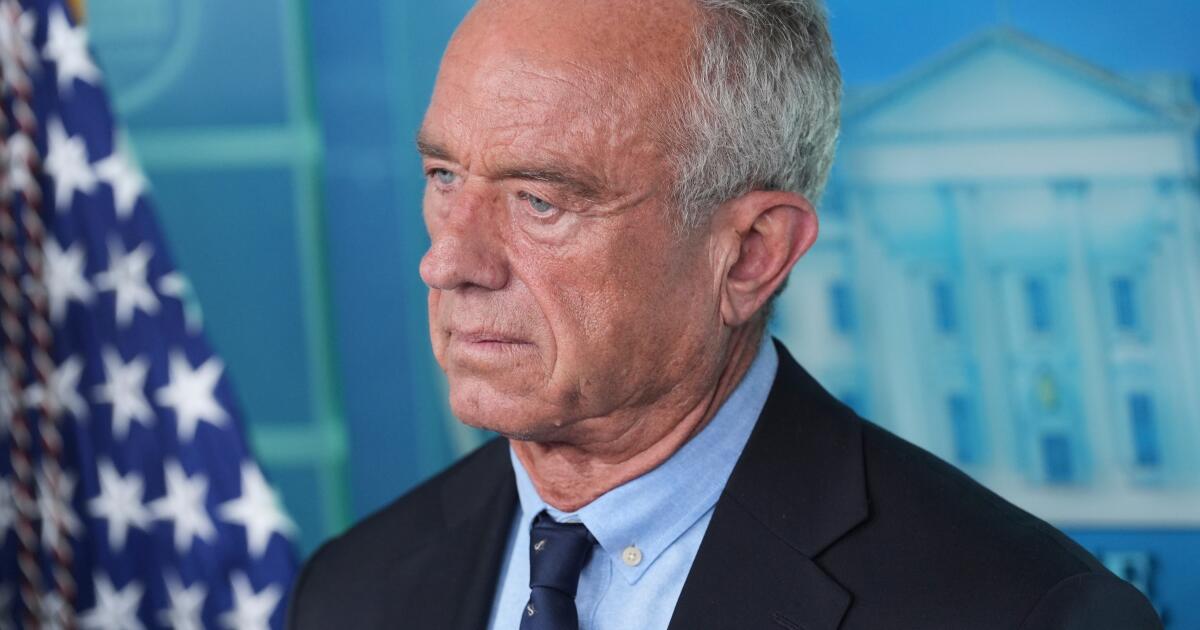
The Trump administration announced a major overhaul of American nutrition guidelines Wednesday, replacing the old, carbohydrate-heavy food pyramid with one that prioritizes protein, healthy fats and whole grains.
“Our government declares war on added sugar,” Health and Human Services Secretary Robert F. Kennedy Jr. said in a White House press conference announcing the changes. “We are ending the war on saturated fats.”
“If a foreign adversary sought to destroy the health of our children, to cripple our economy, to weaken our national security, there would be no better strategy than to addict us to ultra-processed foods,” Kennedy said.
Improving U.S. eating habits and the availability of nutritious foods is an issue with broad bipartisan support, and has been a long-standing goal of Kennedy’s Make America Healthy Again movement.
During the press conference, he acknowledged both the American Medical Association and the American Assn. of Pediatrics for partnering on the new guidelines — two organizations that earlier this week condemned the administration’s decision to slash the number of diseases that U.S. children are vaccinated against.
“The American Medical Association applauds the administration’s new Dietary Guidelines for spotlighting the highly processed foods, sugar-sweetened beverages, and excess sodium that fuel heart disease, diabetes, obesity, and other chronic illnesses,” AMA president Bobby Mukkamala said in a statement.

When will the big nor’easters return? Boston in midst of second-longest streak without hefty snowfalls. – The Boston Globe

Broncos healthy compared to Bills

UPDATE: Another incident reported near ‘the curve’ toward southwest end of westbound West Seattle Bridge

Morning Report: Newsom Pumps the Brakes on Homelessness Funding

Milwaukee County gets $25M federal grant for 67 road safety projects

Florida High School Football Rankings: Top 25 teams – Oct. 21

Cleary's 21 help Le Moyne down Central Connecticut State 69-64 in OT

How old is Bo Nix? What to know about Oregon quarterback ahead of 2024 NFL Draft

99th annual Pony Swim held in Virginia

Video: ‘It Didn’t Have to Happen This Way:’ U.Va. Faculty Call for Review of Police Response to Protests

San Antonio ends its abortion travel fund after new state law, legal action

UN top court set to open Myanmar Rohingya genocide case

Arson engulfs Mississippi synagogue, a congregation once bombed by Ku Klux Klan

Federal judge blocks Trump administration from enforcing mail-in voting rules in executive order

Four killed, 20 injured in overnight Russian strikes across Ukraine
-

 Detroit, MI1 week ago
2 hospitalized after shooting on Lodge Freeway in Detroit
-

 Technology6 days ago
Power bank feature creep is out of control
-

 Dallas, TX4 days ago
Anti-ICE protest outside Dallas City Hall follows deadly shooting in Minneapolis
-

 Delaware3 days ago
MERR responds to dead humpback whale washed up near Bethany Beach
-

 Dallas, TX1 week ago
Defensive coordinator candidates who could improve Cowboys’ brutal secondary in 2026
-

 Iowa6 days ago
Pat McAfee praises Audi Crooks, plays hype song for Iowa State star
-

 Montana2 days ago
Service door of Crans-Montana bar where 40 died in fire was locked from inside, owner says
-

 Health1 week ago
Viral New Year reset routine is helping people adopt healthier habits