Science
Climate warriors fighting some of the 'greatest crises humanity has ever seen'


Aru Shiney-Ajay’s awakening to the climate crisis began in her late teens. On visits to family in India, she watched in horror as loved ones endured one disaster after another: deadly floods in her parents’ home state of Kerala and record-shattering air pollution in Delhi among them.
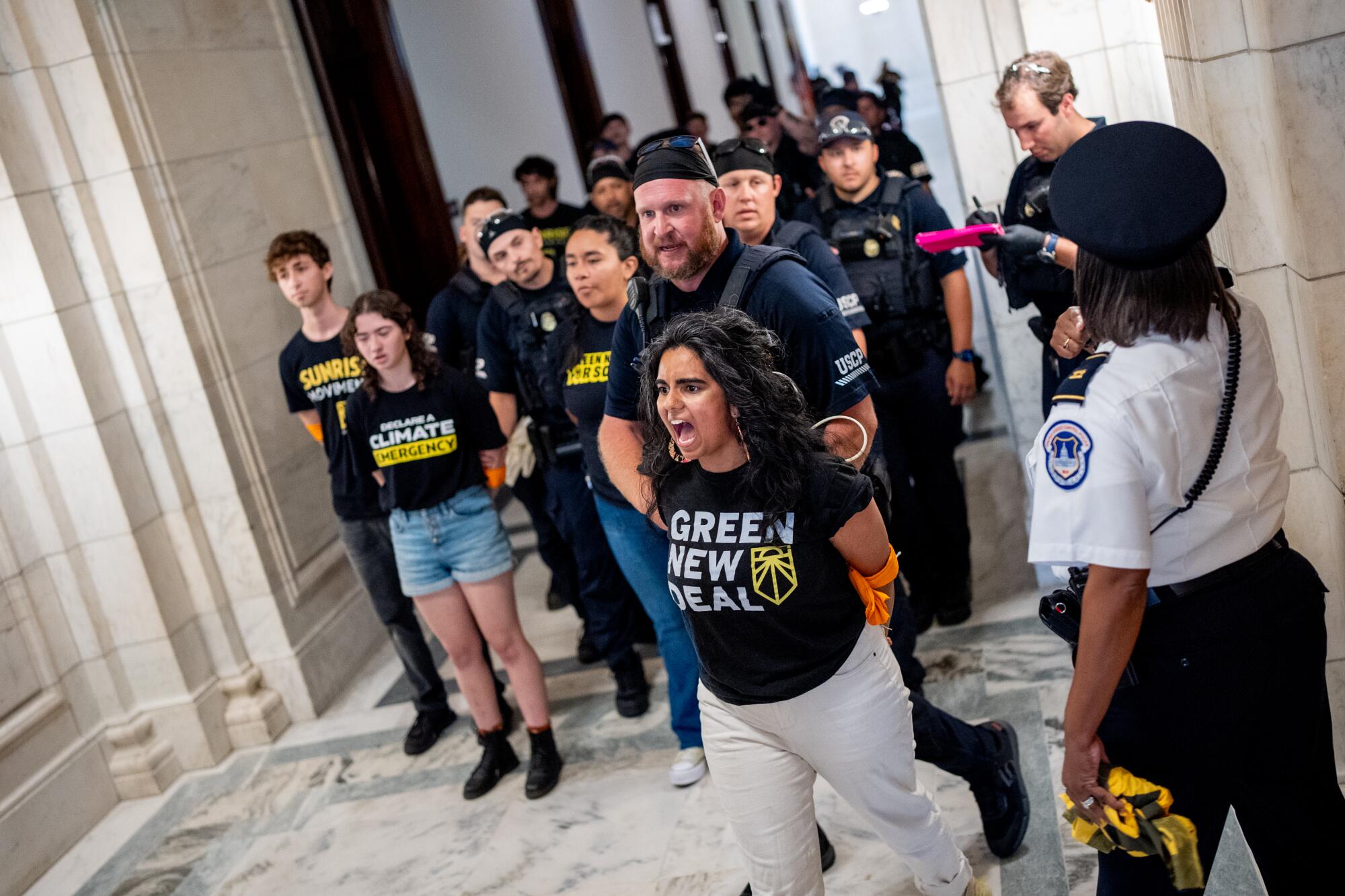
Aru Shiney-Ajay is arrested along with other Sunrise Movement members as they protest in July outside the Washington office of Sen. JD Vance of Ohio, who has since become the Republican vice presidential nominee.
(Andrew Harnik / Getty Images)
“The climate crisis was not just something in the background, but something that was already here,” she said. “That’s really what drove me to get involved in Sunrise.”
The Sunrise Movement was founded in 2017 by young climate activists frustrated by the mismatch between an accelerating global disaster and the staid pace of existing environmental organizations.
Theirs would be different: a movement organized for and by young people that would be unafraid of confronting powerful figures directly and dramatically.
They broke onto the national stage just a year later, when some 150 members staged a sit-in at the office of incoming Speaker Nancy Pelosi (D-San Francisco) to demand that the newly elected Democratic majority commit to a Green New Deal.
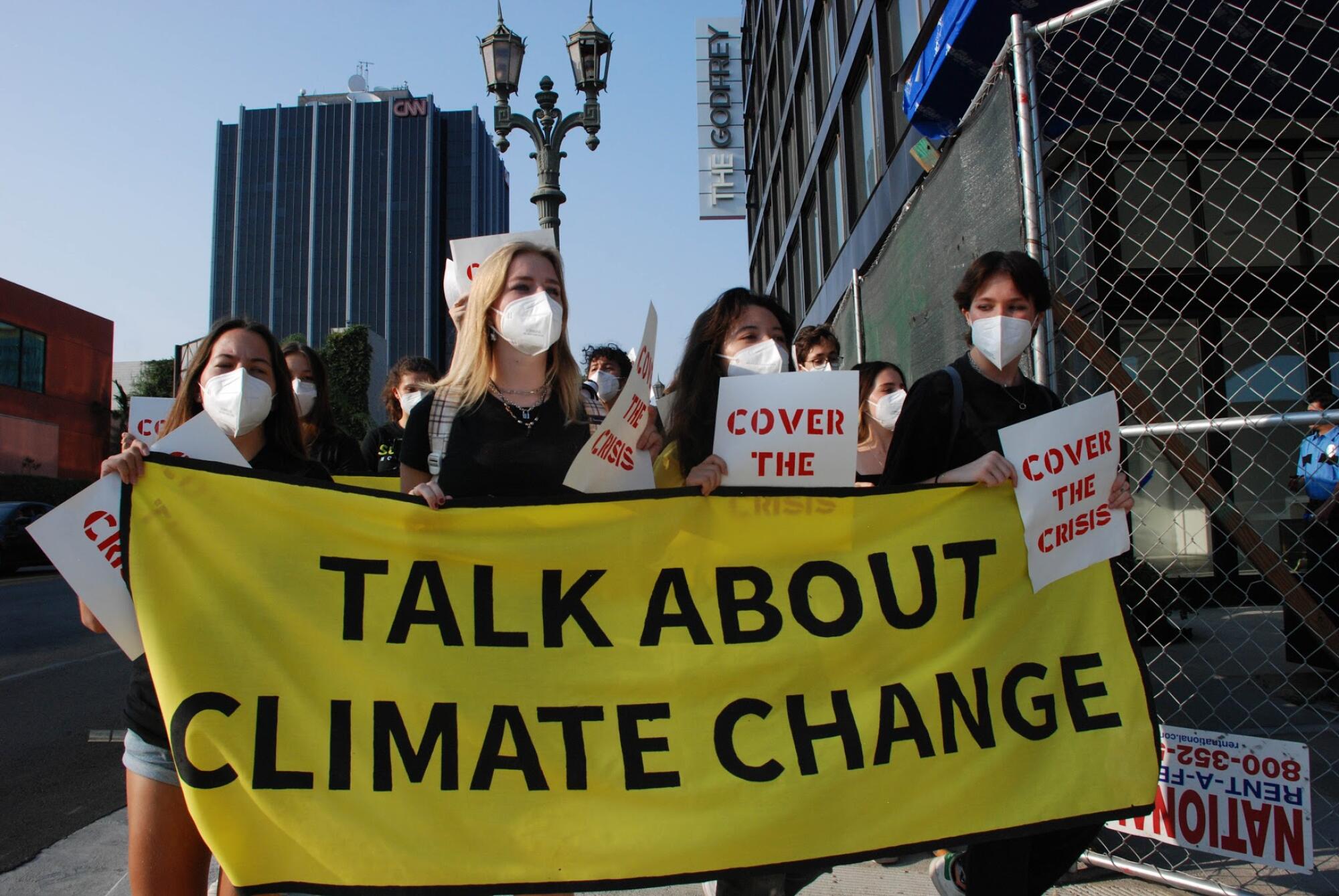
In September 2020, members of Sunrise L.A. Youth protested at CNN’s L.A. office to “demand that they connect the climate crisis with the wildfires, with the hurricanes.”
(Sunrise Movement)
Then a Swarthmore College student and volunteer trainer, Shiney-Ajay had helped coordinate the highly publicized action on Capitol Hill. After its success, she made the decision to leave college and work for Sunrise full time.
Last October, after a months-long search and a 95% confirmation vote from Sunrise’s volunteer delegates, Shiney-Ajay was named the organization’s executive director.
She is only the second person to lead the organization, which is based in Washington, D.C., and has thousands of members in 118 hubs in cities, towns and campuses across the U.S. There are 15 hubs in California alone.
“She is one of the sharpest and most compassionate leaders I have ever met,” founding director Varshini Prakash said in a statement last year. “I’m confident that under her leadership, Sunrise will reach new heights.”
Shiney-Ajay, 26, assumed leadership at a highly charged moment in U.S. politics. While the Democratic ticket of Vice President Kamala Harris and Minnesota Gov. Tim Walz has energized young progressive voters who were deeply skeptical of both President Biden and former President Trump, the outcome of November’s election remains a toss-up. Protests over the violence in Gaza and Israel have electrified university campuses. All the while, temperatures soar and acres burn, and the time left to save a sweltering planet seems to tick closer to zero.
The Times spoke with Shiney-Ajay this summer. The conversation has been edited for length and clarity.

What does it feel like to lead Sunrise after having come up as a volunteer?
I feel like I get to live out my purpose in life. It’s given me a lot of meaning and energy to face down some of the greatest crises that humanity has ever seen, and do it with hope and determination, with people who I trust at my side. Sunrise gave me that when I was a member, and it feels like a privilege to be able to give that back to thousands more people.
What appealed to you about Sunrise as a new member?
I’d never seen an organization that had so much vision for what is needed to stop the climate crisis, and also so much seriousness about the power it took to get there.
They were like, “OK, the way that we’re going to do it is we’re going to push the Democratic Party to see the urgency of the climate crisis. We’re going to expose the corrupting influence of fossil fuel billionaires on our politics. We’re going to tie the issue of good, green, union jobs to climate change, to make it clear that it’s not a choice between jobs and climate.”
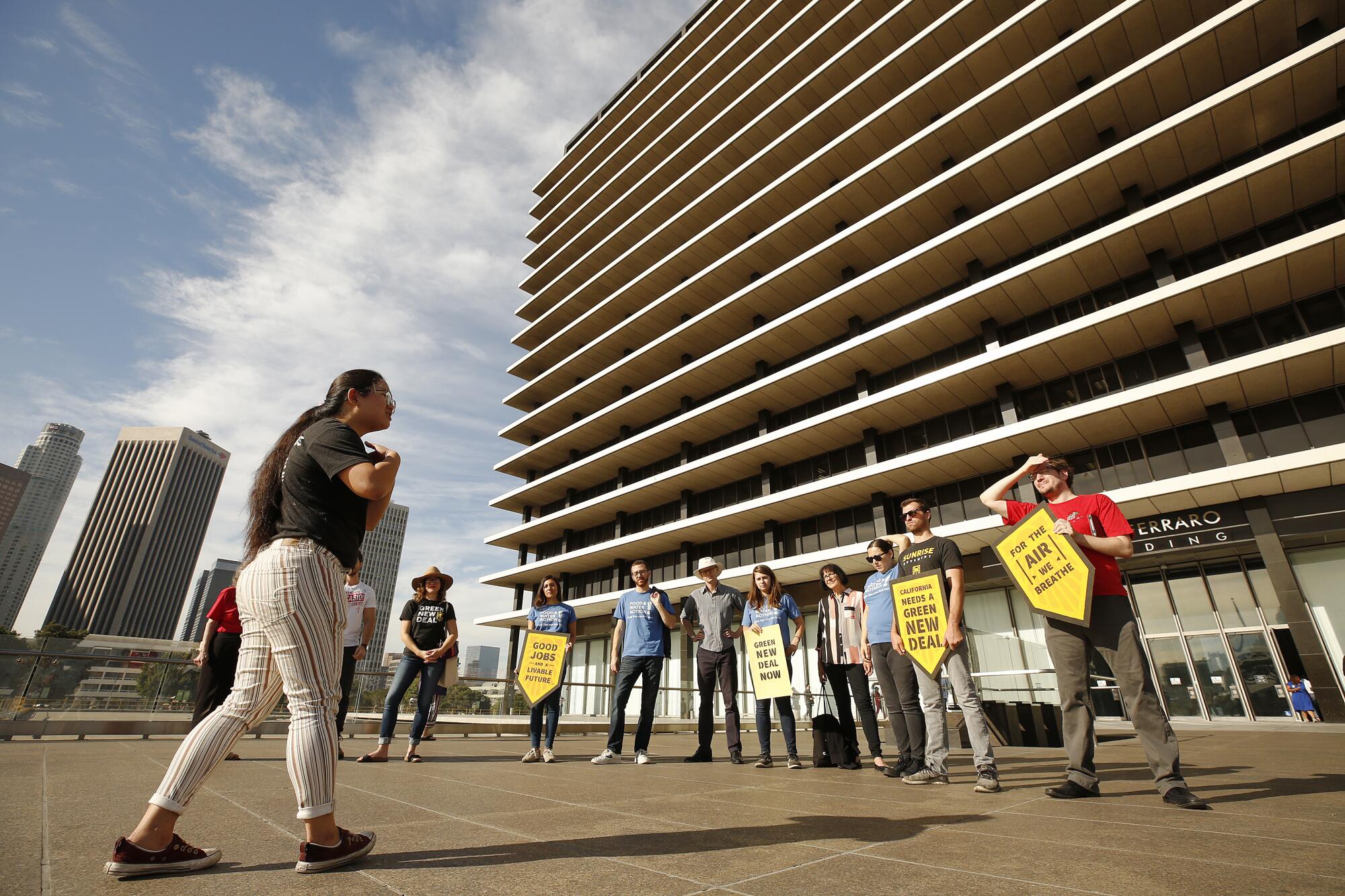
Lynn Wang with Sunrise Movement L.A., left, addresses a coalition of environmental groups as they stage a protest at LADWP headquarters downtown in November 2019.
(Al Seib / Los Angeles Times)
Those were really clear interventions that opened up a whole new arena of possibility.
What does Sunrise mean when you say you want a Green New Deal?
The easiest way is to think about the New Deal, which was not just one bill but a series of bills, executive actions and local rulings that happened over multiple years [during the Great Depression]. It changed the legislative landscape, and the economic and cultural landscape of society too.
That is what we need in order to stop the climate crisis. It’s legislation at every level of government, change in every sector of society. That’s what the Green New Deal is about.
What era is Sunrise in now? What are your priorities at this point?
After [Congress passed] the Inflation Reduction Act, we decided that it was time for us to take some of those wins and start racking them up locally. So that’s how we launched the Green New Deal for Schools and the Green New Deal for Communities.
It was a way for us to win things locally, but also to develop our leaders and build our base. We’ve been doing that for the last couple years.
No matter what happens with the election this year, we’re really shoring ourselves up to take the fight back to the federal level. We’re starting to do that this year with the Climate Emergency Campaign.
What’s that?
It’s a campaign to get President Biden to declare a climate emergency, which basically unlocks a lot of different executive action powers. We are facing record-breaking temperatures, floods, fires, hurricanes. This is a state of emergency, and we need to use the full might of the federal government to do everything we can to stop it.
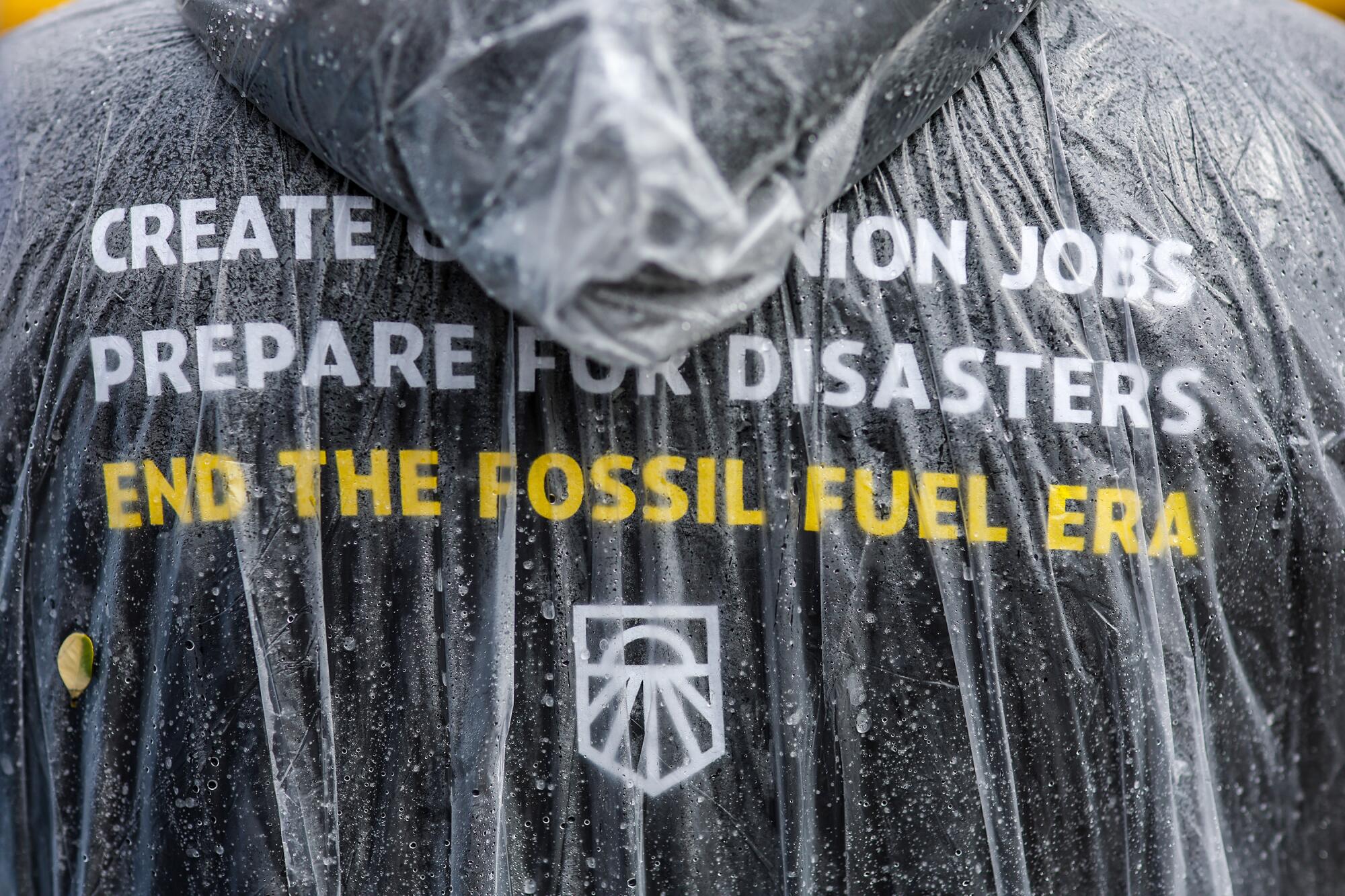
A Sunrise Movement protester outside Kamala Harris’ Brentwood home in April.
(Robert Gauthier / Los Angeles Times)
What do people misunderstand about your organization and the people it represents?
What we are asking for is not unreasonable. It’s not impractical. It’s actually the thing that is most in line with the physical realities of the world. As you get older, I think you start to think within the limitations of the political imagination, rather than the limitations of what literally must be done to keep millions of people alive.
People sometimes think of the Green New Deal as idealistic or impractical. Actually, I think it is the politicians who are being impractical about the reality of our situation.
Sunrise is explicitly for young people. Do members have to pack up and leave once they hit 35?
As long as young people are leading, then we welcome all the hands we can get. There’s been a lot of over-35 people in hubs who help us run logistics for training or give us their wisdom on how to plan actions or pass legislation in their city.
What does this generation understand that previous ones do not?
This generation grew up with the effects of the climate crisis being told to us since we were in elementary school, and so we know that this is an existential threat.
I also think this generation is just really oriented to justice and equality. And we’re not quite single-issue voters in the way that people maybe thought about voters 15 or 20 years ago.
When we spoke earlier this year, before President Biden withdrew from the race, you said your membership was deeply discouraged by the prospect of a Biden-Trump rematch. What’s your position on the election now?
Donald Trump is an existential threat to democracy and to our climate. Losing four more years to a president who actively promises to drill more fossil fuels would be planetary suicide. That’s why Sunrise will be doing everything we can to stop him from getting elected.
Vice President Harris’ record on climate is much more promising. As attorney general in California, she prosecuted oil and gas companies for pollution and sued the Obama administration for fracking. As vice president, she cast the tiebreaking vote on the Inflation Reduction Act, the country’s most significant climate legislation to date. With her in office, we actually have a chance at winning bold legislation that can tackle the climate crisis.
What is your message to young voters?
Our generation can turn the tide of politics. When we protested, voted and walked out in mass numbers, we won the climate legislation, an office of gun violence prevention, student debt relief, and a cap on prescription drug prices. If we vote for Harris this November, and then rally, protest and call for the scale of legislation we need, we will win the world we deserve.
Why has Gaza become an important part of Sunrise’s messaging?
We are a movement of young people, and the reality is that huge amounts of young people right now are speaking out against the war on Gaza. We think that it’s important to understand this as an election issue, alongside climate. The scale of death and destruction has been huge, and that has propelled it to a major issue for a lot of young people.
What are some of the harder decisions you see yourself having to make as a leader?
When legislation passes, there’s always a decision of how much to say, “That is not enough,” and how much to say, “I’m glad you did that.” It’s a strategic calculation every time.
One of the strengths of young people is that we are able to demand the biggest, boldest thing. But if you only ever demand the biggest, boldest thing, then it’s sometimes hard to ever feel like you’re winning, and people end up leaving because they feel like you haven’t won anything ever.
How have you evolved as an activist? Would anything about 2024 Aru surprise 2017 Aru?
I think I’ve gotten a lot better at being really disciplined about hope. It’s easy to feel like everything is falling apart when you look at the world. Something that Sunrise has taught me, and that I’ve learned from the world around me, is that hope comes through collective action but is also something that you need to practice. You don’t even know what spark will set something aflame. Just holding that hope within yourself can ignite that in other people.


new video loaded: NASA Announces Artemis III Crew
transcript
transcript
NASA Announces Artemis III Crew
NASA announced the crew of Artemis III mission, which will fly to low-Earth orbit to test rendezvous and docking maneuvers with one or two lunar landers.
-
“I am excited to welcome you as the next crew in the Artemis journey to successfully return to the moon — this time to stay.” “I’m honored by the role that I’ve been given. I’m also very humbled by the task in front of us. But first and foremost, I’m grateful.” “So with that, the Artemis II crew, comrade, hands you the baton. You got the controls.” “As you know, we had a significant anomaly at our Launch Complex 36A on May 28. We’ve redoubled our efforts and are moving forward.”
By Alisa Shodiyev Kaff
June 9, 2026
Science
Santa Monica Mountains’ last steelhead trout survived the Palisades fire — and even had babies

Scientists feared the Santa Monica Mountains’ last remaining steelhead trout were dead, smothered by debris flows unleashed by the Palisades fire.
But the endangered fish surprised them: A team of biologists recently spotted 30 of the rare trout — and 21 babies — in Topanga Creek.
“There was a lot of happy dancing in the creek,” said Rosi Dagit, principal conservation biologist for the Resource Conservation District of the Santa Monica Mountains, which works with public and private landowners to conserve natural resources.
That’s because the steelhead here are endangered, at both the state and federal levels. Once, they swam in most streams of the Santa Monicas, but their numbers plummeted amid overfishing and coastal development. Increasingly frequent wildfire has further stressed their habitat. Topanga Creek, a biodiversity hot spot, is home to their last known population in the mountains that stretch from the Hollywood Hills to Point Mugu in Ventura County.
The trout that were spotted, including this one, are part of a distinct Southern California population that’s listed as endangered at the state and federal levels.
(RCDSMM Stream Team)
The California Department of Fish and Wildlife spearheaded a complex mission to rescue trout threatened by the Palisades fire that sparked in January 2025.
Time was of the essence. The fire hadn’t yet been fully contained. But rain was on the way, which would sweep massive amounts of sediment from the denuded hillsides into the water. Fish are often killed this way.
Crews stunned the fish with electricity, scooped them up in buckets, trucked them to a hatchery and ultimately moved them to Arroyo Hondo Creek in Santa Barbara County.
Within days, Topanga Creek was choked with mud. Some assumed the fish left behind were goners.
But in March, the conservation district’s team found four. The following month, when water conditions were clearer, they saw more.
“These fish continue to amaze me,” said Kyle Evans, environmental program manager for the state Department of Fish and Wildlife, who had seen the damage to the creek. “I had seen populations get wiped out in similar situations. So when I heard, I was thrilled.”
Evans surmises the fish that survived were in an area of the creek where less charred material and sediment were swept in.
“These fish likely hunkered down, were hiding under some rocks or places to try to get away from the main concentration of flow,” he said. “And luckily they weren’t buried.”
The ones that were spotted were fairly small, around 6 to 14 inches. Rainbow trout and steelhead trout are the same species, but with different lifestyles. If the fish remain in freshwater, they’ll be considered rainbows. However, they can migrate to the ocean and become steelhead, where they typically grow larger before returning to their natal waters to spawn.
Topanga Creek hasn’t fully recovered from the damage it sustained, but scientists say it’s looking better. Surveys last year were “so depressing,” Dagit said, with very few animals, and stretches that were essentially transformed into flat roads from all the sediment buildup. Some of the riparian canopy burned right down to the creek.
Then came 32 inches of rain over the last nine months, scouring out and moving sediment, creating deeper pools. Dagit said they recently found newt egg masses for the first time in years, as well as a few adult newts and many frogs. Plants that provide cover are starting to recover.
She provided photos comparing certain pools last year and this year, some dramatically transformed. In September 2025, the Shrine Pool could have been an overgrown hiking trail. This April, it was filled with shallow water.

The Shrine Pool in September 2025, left, and the same location in April 2026, right, with RCDSMM’s Isaac Yelchin donning a wetsuit.
(RCDSMM Stream Team)
Topanga Creek is home to another endangered fish, the small but hardy northern tidewater goby, often described as cute. Not long before the trout operation, Dagit led a rescue of hundreds of these fish too. Many were repatriated to the lagoon at the mouth of the creek in a moving ceremony last June.
There’s still the matter of what to do with the trout that were moved to Santa Barbara County last year. Evans would like to bring them home to the Santa Monicas at some point, but isn’t sure if it will happen. On one hand, they could bolster the small, genetically isolated surviving population. On the other, they might inadvertently bring in a disease or bacteria. There is some time to decide. Evans estimates the creek still needs to recover for two to three more years.
For now, the fish are functioning fine in their adopted creek. Experts worried the trauma wrought by the move would disrupt their spawning process, but they had babies that spring. This year, they spawned again.

The Pacifica Municipal Pier was shut down and taped off Thursday after city workers noticed cracks running through the landmark structure and concrete chunks falling into the ocean.
It’s just one of many coastal California structures that have recently crumbled under pressure from a rising and relentless ocean.
Officials from the small, beach city south of San Francisco said the pier was closed due to “cracking, separation, and displacement of the concrete walkway and structural elements.”
It will stay closed while structural engineers asses its safety.
Photos taken by city employees show a wide crack that runs from top to bottom and across the structure as well. Other photos show a large horizontal crack under the foundation of a small restaurant on the pier, the Chit Chat Cafe.
The cafe was also shut down.
This is not the first time the 53-year-old pier has shown signs of stress. In 2021, part of it was shut down after handrails along the edge collapsed. And in 2023, after a series of storms pummeled the Central California coast, damaging parts of the pier, the structure was partially closed for more than year.
Those same storms caused extensive damage in Aptos and Capitola, 70 miles south, where piers and waterfront infrastructure were swept away or damaged.
In 2024, a 150- to 180- foot section of the Santa Cruz wharf was ripped off by powerful waves.
At least 10 of the state’s dozens of coastal public piers were closed for part or all of 2024 due to structural damage sustained in winter storms since 2022. At least five others have longer-term upgrades planned to address structural issues.
“These things are costly to maintain,” said Zach Plopper, senior environmental director at Surfrider. “They are a part of our California coastal culture in many ways, but we’re going to need to reckon with, one, the state that they’re in, and two, the continuous and worsening threats they’re going to experience,”
He said most of the piers were constructed in the early 1900s, and they weren’t built to withstand decades of rough seas, storms and rising sea level.
“With this incoming El Niño, which is forecasted to be significant, and this marine heat wave we’re in the midst of, we’re kind of in uncharted waters as far as what this winter could bring in terms of storms and swells to the California coast, and we’re likely going to see a lot more damage,” he said. “Not just piers, but roads and other coastal infrastructure up and down the state.”
There was no storm in Pacifica earlier this week, so no single event could be blamed for the destruction.
However, a 2025 report from an outside engineering firm, GHD, found that several sections of the pier were in “poor” or “serious” condition, and they recommended closure before anticipated storms or events that could “subject the piles to high winds, swells and large waves.”
The firm found several areas of the pier where concrete was missing and rebar was exposed and corroding.
“The pier has continued to experience high winds and large waves in a harsh marine environment,” the engineers wrote in the report, noting that continuous exposure to seawater or marine spray was “detrimental” to the structure.
A 2023 city report estimated it would cost $19 million to repair.
That same year, a state law was enacted to require local governments along the California coast to plan for sea level rise in the coming decades.
Sea level has risen some 8 inches, on average, along the coast in the past 150 years, Plopper said, and researchers anticipate another foot in the next 25 years.
“We’re going to see profound shifts on our coastline, none that we have ever experienced before, and building static structures on the coast just doesn’t work all that well,” he said. “We’re going to have to make some really hard decisions.”
-

 Arizona6 minutes ago
Texas-based Buc-ee’s reveals opening date for first Arizona store
-

 Arkansas9 minutes ago
Arkansas lands grant to battle deadly cattle tick disease
-

 California14 minutes ago
Operation Hands Down disrupts Central California gangs – Inside CDCR
-

 Colorado21 minutes ago
$25.7M Colorado private ski mountain property heads to auction
-

 Connecticut24 minutes ago
Connecticut driver spots snake in car while driving, police say
-

 Delaware29 minutes ago
Delaware Bay’s new oil spill response boat officially christened
-

 Florida36 minutes ago
Sheriff’s Office investigating fatal shooting of child in Florida City
-

 Georgia39 minutes ago
Northwest Georgia Congressman pushes for impeachment of federal judge for misconduct

