Science
7 Steps L.A. Could Take to Gird Against Future Wildfires


Fire and wind are certain to shape the future of Los Angeles as the world warms.
Los Angeles had started taking steps to prepare. But there are lessons it can learn from other cities adapting to extreme fire weather: managing yards; taking care of neighbors; making it easier to get out of harm’s way.
One big challenge, among many, is that plans like these need to be widely adopted. One home is only as safe as the home next door. “If your neighbor doesn’t do anything, and you do, if that home burns it will create so much radiant heat, yours will burn too,” said Kimiko Barrett of Headwaters Economics in Bozeman, Mont., a company that advises cities on reducing wildfire damage risk.
Neighbors matter. Building codes and zoning rules matter. But perhaps most of all, money matters. Building for an age of fire can be expensive, and often out of reach for many homeowners living in fire-prone communities.
Look hard at the landscape
Boulder County, Colo., has learned some big lessons from recent fires.
Pine needles and debris around a house quickly spread flames. Juniper bushes explode in fire. In fact, county officials call junipers “gasoline plants.” Firewood stuffed under a deck can ignite and destroy a house.
The county has spent several years persuading people to clear debris and rip out junipers. Voters have agreed to a sales tax hike to help pay for it.
Los Angeles has its own problem plant: palms. Many palm species, once they catch fire, are very hard to put out. In fire-prone areas, they should be avoided entirely, according to the Los Angeles County fire department.
San Diego county prohibits greenery — even shrubs — around a five foot perimeter of a building and requires that tree canopies be at least 10 feet away.,
Berkeley, Calif., sends fire inspectors into its most fire-prone neighborhoods to suss out signs of danger: dead brush less than five feet from a house; flammable vegetation that leans over the fence line and threatens a neighbor’s property; high shrubs that can send flames racing up a tree.
There are constraints. Live oaks are protected by law, which means they can’t be cut down. And local communities like Berkeley are still waiting for California state officials to issue regulations to implement a 2023 law designed to minimize fire damage by prescribing landscape-management standards. The city is due to tighten its regulations in the coming weeks, requiring homeowners to keep a five-foot fireproof perimeter around every house in the most fire-prone neighborhoods in the hills. That means no shrubs, no propane tanks, no wood mulch. Violations will be fined; the City Council has yet to determine how much.
“If I can hold a lighter to it and it can smoke and flame, it shouldn’t be there,” said Colin Arnold, the assistant fire chief responsible for the city’s most fire-prone areas on the edge of the wilderness, known as the wildland urban interface
Build safer houses
Houses are flammable, but it’s possible to make them less flammable.
Concrete, stucco, and engineered wood are better than old-fashioned wood frames. A few architects, including Abeer Sweis, in Santa Monica, work with compressed soil, also known as rammed earth, which offers both protection from fire and avoids the emissions of concrete. Roofs made of clay tiles, concrete or metal hold up well to flames. Laminated glass windows can reduce the radiant heat that presses up against a house during a fire.
Design matters, too. Eaves and overhangs can trap embers, which is why architects building in fire-prone areas like them to be sealed. At a time when insurance coverage is becoming increasingly hard to procure in fire-prone communities, Mitchell Rocheleau, an architect based in Irvine, Calif., says fortifying your home is a “physical insurance policy.”
Vents are frequent culprits. . Low-cost fixes, like fire-resistant vents with mesh screens, can keep big embers from flying in, but they’re not always effective, Ms. Sweis said, which is why she prefers vents that are coated with a material that melts in the heat and closes up.
Building codes increasingly mandate noncombustible roofs and siding. (California has among the strictest.) The problem, though, is that most homes in the United States were built before modern building codes. Upgrading an existing house for the age of fire means getting rid of flammable siding and roofs. That’s an expensive proposition.
Boast about improvements
Think of it as a fire-smart version of keeping up with the Joneses.
Boulder County has a way for homeowners to get certified by a nonprofit group, Wildfire Partners, for fireproofing practices like junking junipers, choosing less flammable shrubs, installing a fire-resistant roof or slathering fire-resistant sealant on a deck.
Certification comes with a yard sign to display. It’s a way to nudge others in the neighborhood to adopt similar practices.
There’s also a potential reward. Certification can be a way to not lose homeowner’s insurance, which is increasingly a risk in many communities in the American West. “The cost of retrofitting is very real,” Ashley Stolzmann, a county commissioner said. “The cost of losing insurance is also very real.”
Upgrade dangerous power lines
Power lines and utility poles have been responsible for some of California’s most destructive fires in recent years.
Much of that infrastructure was built in the 1960s and 1970s and is in urgent need of repair. Utilities have faced a barrage of lawsuits in the aftermath of some of those fires, including in recent days when residents of Altadena sued Southern California Edison claiming that the utility’s equipment set off the Eaton Fire that destroyed 5,000 buildings in the area. (Edison said it is investigating the cause of the fires.)
A range of fixes are possible, from fire-resistant poles to burying electricity lines (very expensive) to covering them in a protective layer (less expensive but less safe).
The Bipartisan Infrastructure Law set aside $3.5 billion for electricity grid upgrades. That’s a fraction of the $250 billion price tag of the latest Los Angeles fires.
Rethink roads
Cul-de-sacs and narrow, winding streets are a hallmark of many neighborhoods pressed up against wilderness, including the Berkeley Hills. That’s a problem when people need to get out, and first responders need to get in.
“There’s nowhere to put new roads,” Mr. Arnold said. “It’s a very densely packed community built without evacuation in mind.”
If you can’t widen roads, you can keep them clear for first responders to get in and out. The Los Angeles Fire Department prohibits street parking in some neighborhoods on windy days, when fire risk is high.
Rancho Santa Fe, a wealthy suburb of San Diego, has tried to solve the problem by keeping most of its residential roads clear at all times. No street parking is allowed if the street isn’t wide enough for fire trucks to get in and out.
Know when to leave
Bushfires have long been common in hot, dry southeastern Australia. But none scarred its people like the Black Saturday fires that broke out in Victoria state in February, 2009. The blazes killed more than 170 people and led to a rewriting of the state’s evacuation protocols.
On days of high fire risk, people who live in forested communities are encouraged to leave their homes before there are signs of smoke and flame. Warnings are broadcast on television.
Residents are encouraged to have the official state-government emergency-preparedness app, which highlights what areas should empty out when. A look at the app on a recent Thursday morning showed 10 notices across the state, from “leave immediately” warnings in some places to “monitor conditions” elsewhere.
Los Angeles residents, by contrast, received erroneous evacuation warnings by text message on the some of the worst fire days. More reliable was a private app built by a nonprofit group.
“We want people making good decisions before the fire rather than bad decisions during the fire,” said Luke Heagerty, a spokesman for the state control center.
A handful of schools and fire stations are designated as community fire refuge facilities. And for those people who stay behind until a fire reaches their homes, there is the ominously named Bushfire Place of Last Resort. Usually it’s an open field with no trees or structures to catch fire. But as the county fire authority starkly warns on its website, the Bushfire Place of Last Resort sites “do not guarantee safety.”
Build more homes
Los Angeles has long faced an acute need for more housing. For years, it’s met the demand by allowing development in fire-prone areas and allowing homeowners to rebuild after fires have swept through those areas.
The latest fires supersized the need. An estimated 10,000 homes were destroyed, leaving tens of thousands of people in need of shelter and driving up rents and home prices in one of the country’s most expensive real estate markets.
And so among the toughest choices facing Los Angeles now is where to build homes that won’t easily go up in flames.
“You have two options, both of which are politically very difficult, especially right after the fires,” said Michael Manville, a professor of urban planning at the University of California Los Angeles. One is to restrict development in fire-prone areas. The other is to allow more dense housing in less hazardous areas in the flatlands, in neighborhoods zoned for single-family homes. That’s been “a political non-starter,” Mr. Manville said.



Video released by Chinese state media shows a state-owned aerospace company launching a rocket and recovering part of it on Friday. The successful launch of a reusable rocket was a major step for China toward challenging SpaceX’s satellite internet dominance.
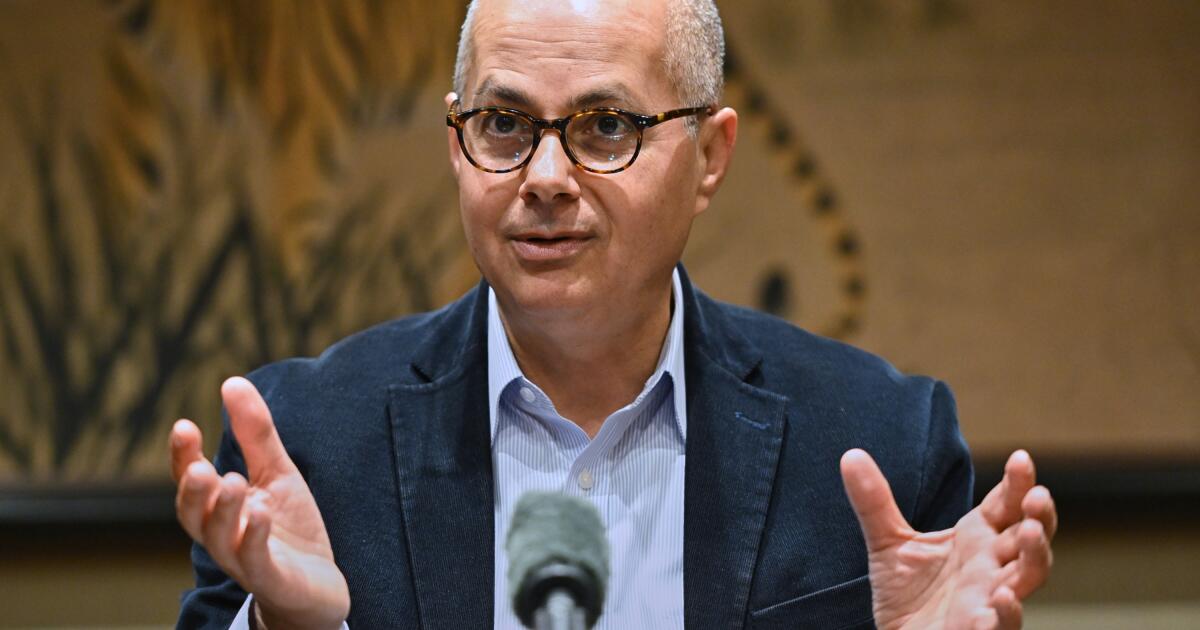
Nobel Prize recipient Omar Yaghi is leaving his role at UC Berkeley to lead the development of a new artificial intelligence institute at Tsinghua University in Beijing, the Chinese university announced.
Yaghi will head the AI Chemistry and Materials Research Institute at Tsinghua, where he was appointed an honorary professor in 2022. Known as AIMATRY (AI × Materials × Chemistry), the new center will focus on material design and synthesis through artificial intelligence, according to a statement from the university.
In 2025, Yaghi shared the Nobel Prize in chemistry with Susumu Kitagawa of Kyoto University and Richard Robson of the University of Melbourne for their development of metal-organic frameworks, a type of super-porous material in which metal ions and carbon-based molecules combine to form crystals with exceptionally large surface areas.
The material has the potential to combat climate change by capturing and storing carbon or other pollutants, and by extracting water from the atmosphere in water-scarce areas. Upon awarding the prize, a member of the Nobel committee likened the technology’s ability to store enormous amounts of stuff in seemingly compact spaces to Hermione Granger’s enchanted handbag in the Harry Potter series.
Yaghi’s Irvine-based company, Atoco, has said it will start taking orders later this year for its technology that harvests water from the air.
A representative for Yaghi said he was not yet available to respond to questions.
China is one of several countries that has been actively recruiting scientists from the U.S., where the Trump administration has slashed science funding, suspended research grants, fired science advisors and tightened immigration restrictions.
“For many, many years, our funding was very competitive; if you worked hard and you were doing good research, you would get funding,” Yaghi said of the U.S. in an interview with Scientific American earlier this year. “The current state is not so encouraging because of the cutting back on grants and support of science by the very agencies that many university researchers rely on.”
Yaghi was born in Jordan to Palestinian refugees, and immigrated to the U.S. when he was 15 to study.
“We’ve learned over and over in human civilization that scholars can move across borders,” Yaghi told the New York Times last year. “This is how knowledge spread and how vast regions of the world lifted themselves out of poverty.”
Science
Trump administration seeks to limit federal funding that doesn’t ‘advance’ presidential policies

A new rule proposed by the White House Office of Management and Budget would fundamentally overhaul the way federal grants are awarded and overseen — a sweeping change that one scientific society said “would all but end the use of scientific merit in the selection of grants and programs across the government.”
Proposed in late May, the rule would give political appointees unprecedented control over federal grants for research, education and infrastructure, and specifies that government funds can only be spent on projects “aligned with administration policies and priorities,” according to a copy of the proposed rule.
The rule would also restrict research topics, limit U.S. scientists’ ability to collaborate with colleagues in other countries and make it easier for the government to suspend or cancel grants at any time.
The changes are intended to improve “transparency, accountability, and oversight for Federal awards” while “ensuring that American tax dollars are not wasted or misused,” according to the White House office.
But critics say that if the rule is implemented, the final sign-off for grants will no longer be in the hands of subject-matter experts within individual agencies, but in those of political appointees.
“This touches all parts of American life,” said Dr. Eric Rafla-Yuan, a psychiatrist who practices at the Veterans Administration and San Diego County’s psychiatric hospital.
“Control of how all of the federal grants and programs are funded will fall under a small group of highly partisan individuals who would have very few limits on how they spend these billions of taxpayer dollars,” said Rafla-Yuan, who also chairs the Committee to Protect Public Mental Health advocacy group. “This touches everyone’s life, even if they don’t realize it.”
OMB published the proposed rule May 29, opening a 45-day comment period that closes July 13.
Opposition to the proposed rule has mobilized multiple sectors of society. Professional groups representing cancer researchers, civil engineers, county governments, medical schools, housing agencies, city and municipal governments, nonprofits and others have publicly expressed concerns about potential consequences.
By midday Thursday, the Federal Register logged nearly 100,000 comments about the proposal, many of them expressing concern.
“I understand the need for oversight, fiscal responsibility, and accountability. That is not the issue,” wrote Jack Feldman, a neuroscientist who holds the David Geffen School of Medicine Chair in Neuroscience at UCLA. “The issue is whether scientific research is to be judged by scientific merit, or whether it can be approved, denied, or terminated according to broad political criteria that may change from one administration to the next.”
Crucially, the rule converts policies governing federal grants from “guidance” into binding regulations that all agencies would be required to follow. It would give political appointees power to override federal agencies’ merit-based reviews and mandate that a political appointee review decisions to ensure that all awards “demonstrably advance the President’s policy priorities.”
The elevation of political appointees in what were previously merit-based decisions has alarmed many scientists.
“The proposed rule changes would all but end the use of scientific merit in the selection of grants and programs across the government,” read a statement from the Planetary Society, a nonprofit dedicated to space research.
Researchers and science groups have also expressed concern about a section of the rule prohibiting the promotion of “theories of disparate-impact liability” — a legal concept that refers to policies that appear neutral but cause disproportionate harm to certain groups.
The section’s vague language and many loopholes could have a chilling effect on any research that studies the effects of a disease, policy or public health intervention on any specific group of people, Rafla-Yuan said.
As an example, he said, “if there’s a specific age range that is at higher risk for suicide, and we want to figure out, well, what’s going on with people that are aged 14 to 19 … we can’t do that under the wording in this rule.”
New restrictions on collaborations with scientists in other countries would hinder opportunities for U.S. researchers and limit innovation, said Joanne Padrón Carney, chief government relations officer for the American Assn. for the Advancement of Science.
“Science is a global enterprise. Especially in biomedical and public health fields, diseases don’t care about borders or government policies,” she said.
California’s congressional delegation sent a letter Wednesday asking OMB to rescind the proposal, outlining concerns about its impact on scientific innovation, U.S. competitiveness and the fiscal stability of local governments, many of which rely on federal grants for local services.
The proposed rule grants the federal government broad powers to suspend or cancel grants for any reason, introducing “unprecedented unpredictability into local governance,” the lawmakers wrote, “leaving vital infrastructure projects unfinished and abandoning vulnerable populations who rely on these services.”
Republican Sen. Susan Collins has also asked the White House to withdraw certain parts of the letter and extend the public comment period, saying the proposed rule as written would “harm small and rural communities, undermine scientific and biomedical research, and conflict with Congress’ control over the federal funding process.”
-

 Milwaukee, WI11 minutes ago
Milwaukee cooling centers, heat advisory tips; what to know
-

 Atlanta, GA17 minutes ago
Warnock, Dickens talk about new housing legislation
-

 Indianapolis, IN29 minutes ago
Indiana heat index to hit 100 as hot, dry pattern holds | July 14, 2026
-

 Pittsburg, PA35 minutes ago
Another stretch of high temperatures in the 90s hitting the Pittsburgh area this week
-

 Augusta, GA41 minutes ago
Flash flooding impacts multiple areas across Columbia County
-

 Washington, D.C47 minutes ago
ARCO Design/Build Deepens Its Presence in Washington, D.C. Market
-

 Cleveland, OH53 minutes ago
LeBron James Could Give the Cavaliers the Mentality They’re Missing
-
 Austin, TX59 minutes ago
Documentary on the fight against a bat-killing plague flies into Austin

